Unions, Public Health Association, Environment Centre call on Alice Springs Council to oppose Muckaty nuclear waste dump plan
 Council implored to oppose Muckaty nuclear dump, ABC News, By Ruby Jones, August 02, 2012 The Public Health Association, the Council of Trade Unions, and the Arid Lands Environment Centre are calling on the Alice Springs town council to oppose the planned nuclear waste dump at Muckaty Station.
Muckaty Station, near Tennant Creek, has been put forward by the Federal Government as the best solution for the nation’s nuclear waste. The proposal has been strongly opposed by some traditional owners and environmentalists.
In a presentation to the council, Matthew Gardiner from the Council of Trade Unions said that the Northern Territory does not have the capacity to respond to a nuclear accident…… The groups want the Alice Springs Town Council to back calls for an independent inquiry into nuclear waste storage.
The Alice Springs Mayor Damien Ryan says he will not comment on the position the council might take….. Clive Rosewarne from the Public Health Association says the groups are happy to provide the council with further information.
http://www.abc.net.au/news/2012-08-02/muckaty-station-protest/4172982
Secret negotiations as Australia is drawn into USA’s war machine
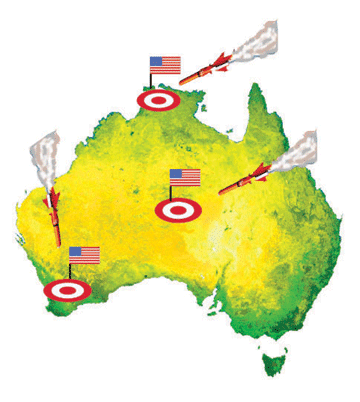 none of these negotiations have been shared with the Australian public
Nuclear drumbeat grows as US eyes Australia, Crikey, by Harley Dennett , 3 Aug 12,  Australian policymakers could not be getting a clearer picture of what our US ally expects of us. Nuclear weapons and joint military bases aimed at containing our largest trading partner will, sooner or later, be put in our backyard — and we’ll be expected to pay for the privilege.
The Center for Strategic and International Studies report making headlines over a proposal to establish a US base in Perth to host nuclear-powered aircraft carriers and manned and unmanned ISR (intelligence, surveillance and reconnaissance) drones is but the first report commissioned by this Congress. The second — as revealed by Crikey in May — will focus on positioning nuclear force in the Pacific.
Defence Minister Stephen Smith’s denials overnight were revealed as word trickery by the comments of the US Deputy Assistant Secretary of Defense for Plans Robert Scher in Congressional hearings early this morning, who pointed out that “no US bases” really means they expect Australia and other allies to share the costs of hosting large numbers of American troops at these so-called “shared facilities”: Continue reading
Radiation regulator to target miners http://www.governmentnews.com.au/2012/08/03/article/Radiation-regulator-to-target-miners/TODXIXSKLM.html , 03/08/2012, By Julian Bajkowski Radiation safety for workers in the mining and resources sector is set to be probed by the government after the Australian Radiation Protection and Nuclear Safety Agency (ARPANSA) revealed it is scouting for consultants to review the state of radiation exposure reporting. Continue reading
Physical and psychological harm to children from Fukushima radiation
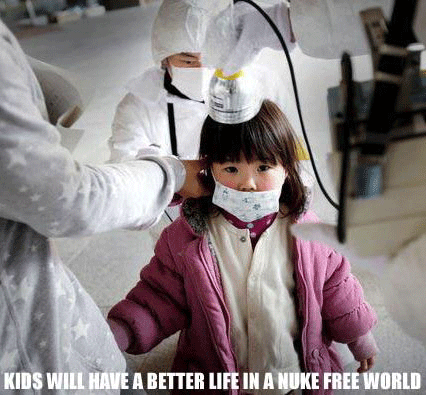 Kids’ safety key worry in Fukushima, Japan Times, Attendees of latest public hearing on energy fear low-level radiation, By NATSUKO FUKUE, 3 Aug 12, FUKUSHIMA — A year and half after the start of the nuclear crisis, many who attended the government’s latest public hearing on energy policy in Fukushima on Wednesday still expressed concern about the impact of radiation on their children……what concerns many parents in Fukushima is their children’s exposure to low levels of radiation…..
A 50-year-old woman living in Koriyama, Fukushima Prefecture, told The Japan Times after the public hearing that she fears young people will be harmed by the radiation, and that discrimination against Fukushima residents will continue.
“I’ve tried to prepare myself mentally for the discrimination my son may face when he looks for a job or when he gets married, just because he was in Fukushima last March,” said the woman, who withheld her name. Continue reading
Port Augusta, South Australia, encouraged by government interest in solar thermal energy
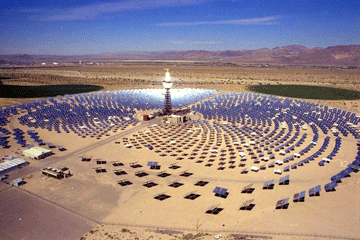 Minister on solar thermal fact-finding tour http://www.abc.net.au/news/2012-08-02/minister-on-solar-thermal-fact-finding-tour/4171960 August 02, 2012 South Australia’s Mineral Resources and Energy Minister, Tom Koutsantonis, will travel to Nevada to research the viability of solar thermal energy. The Minister met solar thermal lobbyists and local government representatives in Port Augusta yesterday. He was given documentation showing the community’s support for the local power stations to be converted to the renewable source.
Mr Koutsantonis says the trip to the United States is to explore and clarify details of solar thermal energy. “We understand gas power generation, we understand coal power generation, we understand wind – in terms of renewable energy we’re
basically the epicentre of Australia,” he said. “If South Australia was a country in its own right we would be number
two in the world for renewable energy.”
Mr Koutsantonis says he is willing to lobby the Federal Government and Alinta Energy to invest in solar thermal.
Port Augusta Mayor Joy Baluch says she is pleased the State Government is supporting a conversion to solar thermal energy for local power stations and is learning more about how the technology works.
“Our conversation has been extremely encouraging to the fact that the Minister is going to Nevada personally to check out the existing and operating solar thermal plant,” she said.
180,000 homes to be powered by Snowtown wind farm, (South Australia)
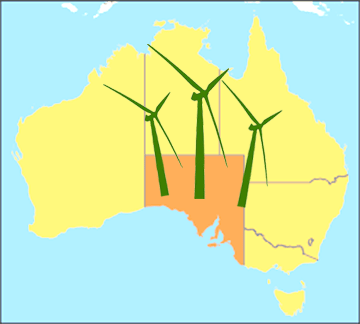 Siemens and TrustPower to build largest wind farm in South Australia, PACE, 3 August, 2012 Kevin Gomez, TrustPower has appointed Siemens as their turn-key supplier to construct South Australia’s largest wind farm at Snowtown using for the first time in Australia, gearless drive wind turbine technology.
With the project formally reaching financial close, the Snowtown II wind farm development will be capable of generating 270 megawatts of renewable energy and powering approximately 180,000 South Australian homes……. South Australia has now set a target of 33 per cent renewable energy by 2020. The new Snowtown II wind farm is set to help achieve this target.
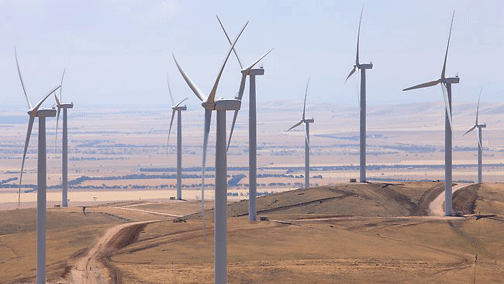
Snowtown II is co-located with the existing Snowtown wind farm, which will more than triple the renewable energy generation of the region. Early preparations have commenced at the site with construction commencing inAugust 2012 to ensure the project is fully operational by the end of 2014…. http://www.pacetoday.com.au/news/siemens-and-trustpower-to-build-largest-wind-farm
Poor rural Indians still had electricity, with decentralised solar power!
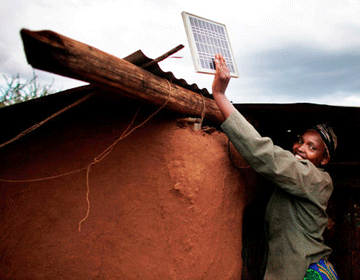
 Solar Power Helped Keep the Lights On in India By David Biello | August 1, 2012 | Every day, at least 400 million Indians lack access to electricity. Another nearly 700 million Indians joined their fellows inenergy poverty over the course of the last few days, or roughly 10 percent of the world’s population.
Oddly enough, some of the formerly energy poor—rural villagers throughout the subcontinent—found themselves better off than their middle-class compatriots during the recent blackouts, thanks to village homes outfitted with photovoltaic panels. In fact, solar power helped keep some electric pumps supplying water for fields parched by an erratic monsoon this year.
That monsoon is partly to blame for the blackouts as well. A lack of rain has meant a reduction in power from India’s hydroelectric dams. Pair that with problems with the supply of coal to burn and the northern half of India found itself with not enough electricity supply to meet demand. One ironic anecdote illustrates this conundrum nicely: coal miners in northern India were trapped when their electric lifts failed as a result of the blackout exacerbated by a lack of coal….. http://blogs.scientificamerican.com/observations/2012/08/01/solar-power-kept-the-lights-on-in-india/
Solar energy starred, in India’s massive electricity blackout
 India’s Massive Blackout Proves Solar Energy’s Mettle http://www.energymatters.com.au/index.php?main_page=news_article&article_id=3322 by Energy Matters, 3 Aug 12, In what has been described as the world’s largest blackout event, solar panels again proved their worth.
India is plagued by electricity shortages, due in part to massive demand on ageing and inadequate infrastructure. Some of the increased demand isn’t just attributable to a growing population, but how the population utilises power – for example, the popularity of energy hungry air-conditioners.
The country’s hydro-electric stations are also suffering due to a poor monsoon season and coal is in short supply in some areas. While regular blackouts are a part of life in many of the nation’s regions, an incident on Tuesday set a new and unenviable record when over 600 million people simultaneously found themselves without mains power – the equivalent to nearly 55 times the population of Australia.
The event occurred just after Monday’s failure of India’s northern grid, which left 370 million people without electricity.
The nation’s capital, New Delhi, was not spared. Some forms of public transport ground to a halt and the financial impact on businesses is said to be in the hundreds of millions of dollars. However, the New York Times points out some of India’s “energy poor” were winners during the events. Many households in affected rural areas had the lights stay on thanks to their small off grid solar power systems that incorporatedeep cycle battery storage.
With the possibility of another such event occurring, decentralized energy generation using renewable energy sources will likely gain even more attention in India.
The nation already has ambitious goals for solar power; having set a target of20,000MW of installed solar capacity by 2022. The nation’s grid-connected solar energy capacity had reached 1030.66 MW at the end of June and off-grid solar panel system capacity (1kW+) was estimated to be 85.21 MW.
Reports indicate that Australia is set for huge change to renewable energy
 Poised for energy game-changer http://www.theaustralian.com.au/business/companies/poised-for-energy-game-changer/story-fn91v9q3-1226441797585 BY: GILES PARKINSON The Australian August 03, 2012 The Bureau of Resources and Energy Economics has found that solar and wind will be less expensive than new coal or gas by 2020
A WEEK ago, the Climate Institute published the results of a survey that showed Australians, despite being largely undecided about climate change, much preferred solar and wind energy over coal power and nuclear.
It was a choice largely driven by the urge to be clean and green, and two key reports delivered in the past year affirm their choice: solar and wind are the cheapest options too. The reports — a study by AECOM and a more detailed, landmark analysis of 40 technology options by the government forecaster, the Bureau of Resources and Energy Economics — suggest we are on the verge of a profound change in sentiment in the debate about renewables.
The studies have effectively blown the argument that the nation’s 20 per cent renewable energy target should be canned or wound back on the basis that it is too expensive.
BREE found that wind and solar will be less expensive than new coal or gas by 2020 and will be the cheapest of all energy options by 2030. Its findings suggest that the RET, because it encourages deployment, simply accelerates the fall in the cost curve. AECOM’s report found that building more renewables generation such as wind and solar would
enable the nation to protect against rising gas prices, which are seen as inevitable as gas is funnelled through the massive liquefied natural gas plants to the export market.
1 This month

of the week – Australians for War Powers Reform (AWPR)
To see nuclear-related stories in greater depth and intensity
 Antinuclear