Radiation danger caused kindergarten to close, outside Fukushima evacuation zone
 NHK: Kindergarten outside evacuation zone closed because of Fukushima radiation threat — “No one can deny the reality” http://enenews.com/nhk-fukushima-kindergarten-evacuation-zone-closed-because-radiation-threat-one-deny-reality-contamination-away-
 video (VIDEO) October 24th, 2012 Watch the NHK report here http://www.youtube.com/watch?feature=player_detailpage&v=6scs7iE02Vg#t=145s
Source: NHK NewsWatch 9
Published by: Missingsky101
Date Aired: February 2012
[The head of a kindergarten in Minamisoma city, Fukushima Prefecture] decided to close the kindergarten indefinitely […] a history of 60 years […]
[He] says, “No one can deny the reality that the community is exposed to radiation” […]
The director was forthright about lingering concerns of radiation that never went away no matter how hard the school tried to decontaminate the premises […]
Queensland Premier’s risky choice to go for uranium, not for sunshine
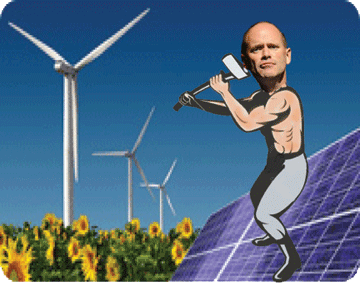 The Premier should remember that community trust is a finite resource.
The risks of uranium last far longer than a politician’s promise. Attempts to introduce uranium mining in Queensland will be actively contested.
Queensland, especially regional Queensland, is perfectly positioned to become a world leader in the globe’s fastest growing energy sector – renewable energy. Queensland has some of the world’s best solar and wind resources. There is no need to open the door to an industry like uranium which is unsafe, unwelcome and under-performing.
Uranium decision takes the cake http://www.theaustralian.com.au/news/uranium-decision-takes-the-cake/story-e6frg6n6-1226502563991 BY: DON HENRY From: The Courier-Mail October 25, 2012 WHEN Premier Campbell Newman wrote to me two weeks ago saying his Government had no plans to approve the development of uranium mining, I took the letter at face value.
So I was as surprised as other Queenslanders when Newman announced on Monday at noon that he would overturn the popular and long-standing state ban on mining the nuclear fuel
.
I realise the Premier has been under a lot of pressure to reverse the state’s prudent position on uranium. The Australian Uranium Association, the Queensland Resources Council and some of the multinational mining companies that hope to make big profits from digging up uranium and shipping it overseas have lobbied hard.
But there are some very strong reasons Queenslanders should keep our uranium in the ground. Uranium is not like other minerals. Continue reading
China cooling its fervour for nuclear power

 China to approve only a few new reactors by 2015 By David Stanway BEIJING Oct 24, 2012 (Reuters) – China will approve a small number of new nuclear reactors before 2015 to be built only in coastal regions, the government said on Wednesday, as it unveiled a raft of measures to spur private
investments in energy.
In its latest five-year plan for the energy sector, China said it would also promote price reforms for
electricity, coal, oil and natural gas and pledged to boost its hydro, solar and wind power generation in an effort to cut emissions….
China is preparing for a once-in-a-decade leadership transition in November, and its new leaders are widely expected to push for the sort of market-oriented reforms that will break up monopolies in sectors such as energy.
http://www.reuters.com/article/2012/10/24/us-china-nuclear-idUSBRE89N0IW20121024
Japan’s new nuclear regulator insists on wider evacuation zones for nuclear plants
The wide area of forecasted contamination means local governments will face a greater burden in compiling effective disaster management plans.
Shunichi Tanaka, chairman of the Nuclear Regulation Authority, has called such plans a minimum requirement before nuclear plants can be cleared for a restart.
If local governments cannot compile effective disaster management plans, it means the security of local residents is not assured. In such circumstances, not only would it be difficult to resume operations at such plants, but the very existence of those plants could be called into question.
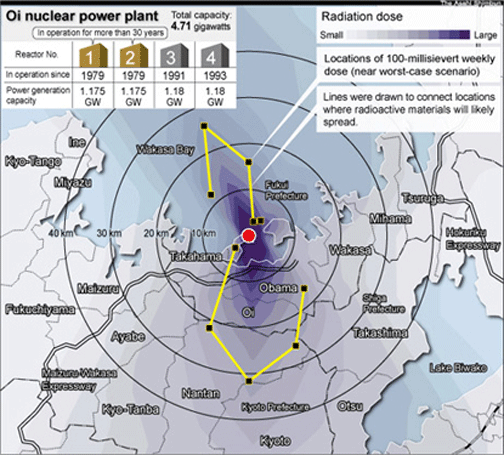
Forecast predicts wider evacuations needed if nuclear disaster repeated Nuclear watchdog may broaden definition of active fault lines October 24, 2012 THE ASAHI SHIMBUN A forecast of the radiation released in another nuclear accident shows that at four plants, a 30-kilometer evacuation zone would be insufficient for public safety, and that more distant residents would need to flee their homes too. Continue reading
Australia one of many nations taking action on Climate Change
 “Australia is not alone in acting on climate change … in fact Australia is a major player and an emerging leader.”
Australia a major greenhouse player: UN news.com.au LLOYD JONES AAP October 24, 2012 AUSTRALIA is not in “a lonely desert” as the only nation reducing greenhouse gas emissions, but is an emerging leader in
the field, a key United Nations climate change official says.
Christiana Figeures, the executive secretary of the UN Framework Convention on Climate Change, said there was a misconception among many Australians that their nation was acting alone in combating the problem. Continue reading
Australia’s uranium to India – part of a disgraceful saga
 Anxiety about uranium sales to India arises from the poor safety reputation of that country’s nuclear power industry and its development of nuclear weapons in violation of the Nuclear Non-proliferation Treaty
the visit looked for all the world like a sales pitch. The awarding of an Order of Australia to Indian batsman Sachin
Tandulkar was clearly intended to butter up customers for a big purchase.
The truth is that Australia, taking its cue from the US, is not worried about India having nuclear arms. In fact, it fits in nicely with long-term planning in the Pentagon.
The grubby saga of uranium sales to India, CPA 25 Oct 12 Prime Minister Gillard’s visit to India last week was pure pantomime. She met her counterpart, Mr Manmohan Singh, and took part in all manner of events and photo opportunities in an effort to repair Australia’s damaged reputation on the sub-continent –…– and to seal a deal that has made many observers nervous. Continue reading
Carbon tax cost Australia much less than expected
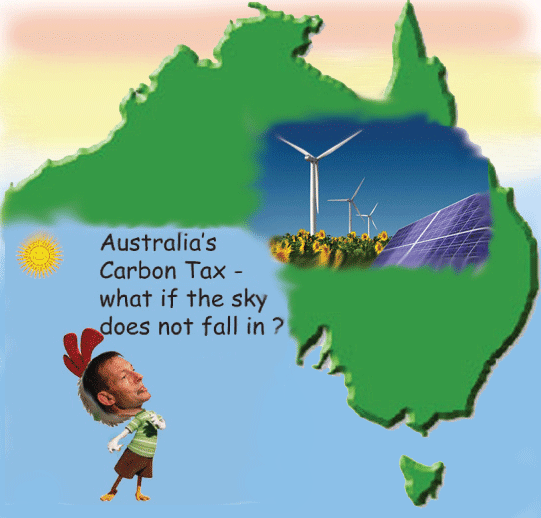
Cost of carbon tax less than estimated The Age, October 25, 2012 Peter Martin THE carbon tax has boosted the cost of living scarcely at all. Despite dire talk of an ”almost unimaginable” increase (Tony Abbott) and $100 for a Sunday roast (Barnaby Joyce) the first official consumer price figures show a far lower impact than predicted by the
Treasury….. http://www.theage.com.au/opinion/political-news/cost-of-carbon-tax-less-than-estimated-20121024-285se.html#ixzz2ALJJiJ5r
Australia’s $billions in investment, due to Renewable Energy Target
 Clean energy target drives billions in investment SMH, October 25, 2012 Tom Arup AUSTRALIA’s 20 per cent renewable energy target has helped spark $18.5 billion in new clean energy investment since its inception – and will drive another $8.8 billion to 2030 – an economic analysis commissioned by the industry’s peak body has found.
The modelling to be released today by the Clean Energy Council also says Australia would have failed to meet its greenhouse gas targets under the United Nations Kyoto Protocol without the target in place. Continue reading
Aw gee shucks when I say “No” to nuclear, I mean “Yes” – Martin Ferguson
 Ferguson says no to nuclear power THE AUSTRALIAN AAP October 24 The Australian government remains opposed to nuclear power, Resources Minister Martin Ferguson says. RESOURCES Minister Martin Ferguson has ruled out Australia pursuing nuclear energy as an increasing number of states open the door to uranium mining.
Queensland Premier Campbell Newman on Monday reneged on an election commitment to uphold a 30-year ban on uranium mining in his state, saying Mr Ferguson’s urging and the federal government’s moves to sell uranium to India prompted his decision.
Mr Ferguson told the National Carbon Capture Storage (CCS) Conference in Perth on Tuesday that a wide range of clean energy technologies including CCS would be part of the nation’s future, but not nuclear power, which was expected to fall in cost.
“The Australian government has basically said we are committed to all potential forms of clean energy from an innovative point of view, other than nuclear, which is a proven clean energy technology,” he told reporters…..
http://www.theaustralian.com.au/news/breaking-news/ferguson-says-no-to-nuclear-power/story-fn3dxiwe-1226501691026
Martin Ferguson’s great big lie about nuclear power getting cheaper!

It’s not just new investment that’s a problem: earlier this month, post-Fukushima stress tests on European reactors identified E25 billion in upgrades and fixes needed to bring existing plants up to acceptable safety levels. Japan isn’t the only country shutting down reactors
About the only cost for nuclear power that’s falling is the price of uranium,
Nuclear power costs are going up and up, Minister, not down http://www.crikey.com.au/2012/10/24/nuclear-power-costs-are-going-up-and-up-minister-not-down/ BERNARD KEANE | OCT 24, Contrary to what radioactive Minister Martin Ferguson might claim, the already high costs of nuclear power are growing higher amid delays and safety concerns.
While Martin Ferguson’s role as chief Labor spruiker of all things radioactive is well known, occasionally his enthusiasm for things that glow in the dark carries him away.
In particular, he appears to have yesterday made an outrageously misleading claim about nuclear power. “The only part of the energy mix not included in Australia at the moment is nuclear, and I must say that is going to reduce in costs over time as we go forward,” The Australian reported him telling a Perth conference. Continue reading
Nuclear economics – reactors too expensive to build, too expensive to run
 The industry’s renewed glimpse of its mortality comes as the Nuclear Regulatory Commission is working on the question of whether the existing plants can get a second 20-year extension, to age 80. But license extension may not be the problem. Wider economic circumstances may be instead.
Aging and Expensive, Reactors Face Mothballs NYT, Matthew Wald , 23 Oct 12 THE conventional wisdom about nuclear reactors is that they are expensive to build but cheap to run.
Queensland’s scandalous uranium history: a bad idea to start it again
 Queensland Forgets Its Uranium History http://newmatilda.com/2012/10/24/queensland-forgets-its-uranium-history Jim Green, New Matilda, 24 Oct 2012 The Queensland Government is unwise to reverse the ban against uranium mining and there is no stronger reason than the industry’s sordid track record in the state.
French company Minatome undertook trial mining at Ben Lomond, near Townsville, in the early 1980s. Federal MP Bob Katter spoke at length about Ben Lomond in Parliament on 1 November 2005. He noted that Minatome initially denied reports of a radioactive spill, but then changed its story and claimed that the spill posed no risk and did not reach the water system from which 210,000 people drank.
 Bob Katter’s version of the story is on Hansard: “For the next two or three weeks they held out with that story. Further evidence was produced in which they admitted that it had been a dangerous level. Yes, it was about 10,000 times higher than what the health agencies in Australia regarded as an acceptable level. After six weeks, we got rid of lie number two. I think it was at about week 8 or week 12 when, as a state member of parliament, I insisted upon going up to the site. Just before I went up to the site, the company admitted — remember, it was not just the company but also the agency set up by the government to protect us who were telling lies — that the spill had reached the creek which ran into the Burdekin River, which provided the drinking water for 210,000 people. We had been told three sets of lies over a period of three months.”
 Queensland’s other misadventure with uranium was the Mary Kathleen mine in western Queensland. In the mid-1970s, a whistleblower from Mary Kathleen Uranium Mining leaked documents which revealed the existence of a global uranium cartel leading to protracted international scandals and fines totalling hundreds of millions of dollars.
The leaked documents also revealed evidence of shoddy environmental practices at Mary Kathleen; close surveillance of environmental organisations; the close relationship between then-ACTU President Bob Hawke and the chairman of uranium miner Conzinc Riotinto Australia; and advice from government officials about how companies could circumvent non-proliferation treaties in order to sell uranium to countries that had not signed the Nuclear Non-Proliferation Treaty.
One million litres of radioactive liquid were released in February 1984 from Mary Kathleen’s evaporation ponds during a wet spell. Even now, 30 years after the mine’s closure, there is ongoing seepage of saline, metal and radionuclide-rich waters from tailings, as well as low-level uptake of heavy metals and radionuclides into vegetation.
Bob Katter’s son, state MP Rob Katter, claims that uranium mining represents a potential $20 billion export industry for Queensland which could generate 2600 jobs. The simple facts are that uranium accounts for just 0.2 per cent of Australia’s export revenue ($610 million in 2010-11) and less than 0.02 per cent of Australian jobs (1760 jobs including mining, exploration and regulation). Queensland is home to just 3 per cent of Australia’s uranium resources.
Rob Katter claims that Queenslanders support uranium mining but he provides no evidence. The latest poll reported in the Courier Mail in November 2008, found that 47 per cent of Queenslanders oppose uranium mining compared to 45 per cent in support. Two-thirds of Queenslanders oppose uranium sales to nuclear weapons states. A majority of Australians believe that the “safeguards” system, which aims to prevent nuclear weapons proliferation, is ineffective.
Before the last state election, the Queensland Liberal National Party said it had no intention of reversing the ban against uranium mining. Campbell Newman’s LNP Government ought to take its new position to the next state election. Better still, a referendum could be held on the question of uranium mining when Queenslanders next go to the polls.
The uranium industry has no capacity to deliver serious economic benefits to Queensland but, if given the chance, it will create more long-term environmental and public health hazards such as Ben Lomond and Mary Kathleen.
Queensland farmers not keen on uranium mines in their back yard
Uranium mining rethink sparks Qld farmland fears, ABC News, By Chrissy Arthur 24 Oct 12 Rural lobby group AgForce says it has concerns about the impact of uranium mining on Queensland farms. The State Government will lift a long-standing ban on uranium mining, saying it will generate investment and jobs.
However, some landholders and conservationists have expressed concern about the environmental impact and the possibility of toxic mine spills. AgForce president Brent Finlay says landholder concerns will need to be considered.
“All of those issues concern us and that is why it has to be done properly if it is done,” he said.
“We have to work with landholders, we understand that no landholder wants any mine in their backyard – it puts pressure on agriculture. “If these developments do go ahead, the impacts on the environment and the community are very important and they have to be managed and if there are spills, they need to be cleaned up.”
A Gulf of Carpentaria mayor says local government leaders will also pressure the Queensland Government to ensure environmental safeguards are in place for any uranium developments…
Online survey about Australia’s Renewable Energy Target
 The People’s Renewable Energy Target Review http://www.energymatters.com.au/index.php?main_page=news_article&article_id=3436 by Energy Matters, 24 Oct 12 While electricity related carbon pollution in Australia is dropping and 3,000 MW of coal-fired generation is being switched off as a result of the combined impact of the Renewable Energy Target (RET) and the carbon tax, some Big Energy players and industry lobby groups are attempting to slow the development of renewables in Australia the groups say.
“For months now big power companies like Origin Energy have been trying to undermine our Renewable Energy Target. Now it’s time for everyone who loves renewable energy to fight back!” says 100% Renewables; a non-profit group advocating renewable energy.
Together with the Australian Conservation Foundation, the group is asking people across Australia to express their views on how the RET should be working through an online survey that asks a number of related questions and only takes a couple of minutes to complete; with the option of providing additional commentary.
“We will bundle the results up and take them to RET Roundtable events to show the Climate Change Authority the depth of support for the RET in the wider community,” says Andrew Bray, 100% Renewables’ Communications Director.
Submissions to the People’s RET Review are open until October 31, 2012.
A renewable energy target of at least 20% by 2020 was established in 2009 with the support of all major political parties. The Climate Change Authority is currently reviewing the RET and will report its findings at the end of the year. Part of that process are the Roundtable events to be held in Sydney and Melbourne in early November.
Any changes to the Renewable Energy Target may erode investor confidence in clean energy in Australia. The fact a review is even being held is already contributing to uncertainty in the market according to industry sources; a situation exacerbated by some high profile and cashed up parties calling for cuts to the RET.
Japan might need to extend nuclear evacuation zone plans, says Nuclear Regulation Authority.
 30-km nuke safety zone may not be enough http://www.japantimes.co.jp/text/nn20121024a3.html KyodoRadiation doses beyond 30 km from four nuclear plants, including those in Niigata and Fukui prefectures, could reach 100 millisieverts in the first seven days amid a severe meltdown crisis like the one that started in March 2011 at the Fukushima No. 1 complex, according to estimates by the Nuclear Regulation Authority.
The NRA is crafting new guidelines on nuclear disaster mitigation measures based on the Fukushima disaster and has proposed a radius of 30 km from a nuclear plant as a rough standard for areas where special preparations against fallout exposure should be made.
The latest simulation results, however, could lead local governments to require preparations in areas beyond the 30-km zone.
The four nuclear power stations are Tokyo Electric Power Co.’s Kashiwazaki-Kariwa plant in Niigata Prefecture and Fukushima No. 2 plant in Fukushima Prefecture, Kansai Electric Power Co.’s Oi plant in Fukui Prefecture, and Chubu Electric Power Co.’s Hamaoka plant in Shizuoka Prefecture.
The NRA assumed two scenarios — one in which the amount of radioactive substances released is as high as in the Fukushima disaster and the other in which all reactors at each plant suffer meltdowns — to identify areas in which exposure could reach 100 millisieverts in the first seven days. The simulation did not take into account the geography around the plants. For Kashiwazaki-Kariwa, areas located within a 40-km radius of the plant would register 100 millisieverts.
1 This month

of the week – Australians for War Powers Reform (AWPR)
To see nuclear-related stories in greater depth and intensity
 Antinuclear