Film Review: Pandora’s Promise
Robert Stone and “Pandora’s Promise”, Noel Wauchope, 9 October 13, http://noelwauchope.wordpress.com/ The film’s Australian premiere was shown in Melbourne on October 8th, with director Robert Stone answering questions afterwards.
I found myself liking Robert Stone , for his enthusiasm, and sincere concern about climate change.
I found myself disliking the film, for its sins of omission, and manipulative way of discrediting anti nuclear people.
“Pandora’s Promise” presents as a documentary about climate change and nuclear power. It is very stylishly made and interesting, story on the theme that climate change is an urgent danger, and that nuclear power is the major solution to this. It is a very, very good soft sell for the nuclear industry
“Pandora’s Promise” uses the voices of people, mainly from the nuclear power lobby,The Breakthrough Institute, to present its argument. Mark Lynas, Michael Shellenberger, Gwyneth Craven, Stewart Brand, Richard Rhodes all portray themselves as former anti nuclear activists who have now seen the light, and are pro nuclear.
The film certainly highlights the reality of climate change, the health hazards of the coal industry, and the need for action on climate change. Indeed, that’s the background and stated reason for its main premise – that premise being – the world should now urgently adopt nuclear power.
Here’s where the subtle, and not always so subtle, manipulation comes in. A large part of the film goes over the bad things about nuclear power, the poor safety design of early reactors, the Three Mile Island, Chernobyl and Fukushima disasters. We are led to sympathise with the anti nuclear movement and its idealism.
But then – hey presto, we learn, almost magically, that our speakers, having talked with experts, now realise that new nuclear reactors are safe and good. Today’s environmental and anti nuclear movement , we are told, consists of well-meaning, but ignorant and uninformed people who are denying science.
They are shown to have an irrational fear of ionising radiation. In this they are shown as the same as climate change denialists, denying the scientific consensus. But the scientific consensus, including the World Health Organisation, is that ionising radiation is dangerous to health, even at low levels.
On the radiation question, the film is simply dishonest. It misrepresents the World Health Organisation’s position on low dose radiation, and on Fukushima. (WHO has in fact, predicted a later increase in cancer among women exposed to Fukushima radiation).
It trots out the absurd argument about bananas being more radioactively harmful than nuclear radiation. ( Bananas do contain radioactive potassium-40. However, our bodies have a constant amount of potassium-40, and it does not increase through eating bananas. Any excess is quickly eliminated. However, man made radioactive isotopes like cesium -137 accumulate in the body, and are very dangerous)
There is not one voice in this film to provide an opposing point of view – the assumption is made that no scientifically qualified person is against nuclear power.
Having demolished the anti nuclear movement, the film goes on to demolish the clean energy movement, though it does allow renewable energy to be “part of the energy mix”. Advocates of renewable energy are described as having a “hallucinatory delusion”. Nuclear power is safer than solar or wind energy, and, after the initial set up, cost is stated to be much more economical than solar or wind.
The film then goes on to the questions of safety and of nuclear waste. It explains the “generations” of nuclear reactors. Generation 111 (current reactors) are much safer, and Generation 1V , ‘recycling’ reactors , safer still. The Integral Fast Rector (IFR) uses nuclear waste as fuel, and leaves a smaller volume of nuclear waste. However, it’s still radioactive waste, so the IFRs still have that eventual problem.
But anyway, the glory of Generation 1V nuclear reactors (none actually built and operating yet) is that with them, the world’s existing nuclear waste becomes a valuable resource, as fuel.
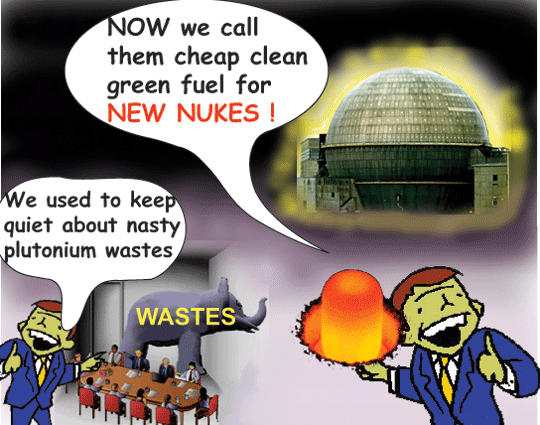
The film concludes on an optimistic note, enthusing about the “renaissance in reactor design”. Small Modular Reactors (SMRs), thorium reactors, Bill Gates’s Travelling Wave Reactor are especially praised. They would need to be mass produced (and ordered en masse) . Gen 1V reactors might take a while – 25 years to come on line, but in the meantime, Gen 111 can go ahead, as their nuclear waste can be safely stored in above ground cylinders, awaiting their new role as fuel.
This film was well received by the premiere audience. It is clear and understandable. It is quite amusing, (often at the expense of nuclear opponents, such as Amory Lovins, Ralph Nader, Jane Fonda, and of course, Australia’s own Dr Helen Caldicott.) The banana story got a good laugh.
The music is good – dramatic where needed, rather sweet and sentimental, where showing healthy people who still live near Chernobyl.
The sins of omission? No mention was made of the terrorism risk, of nuclear reactors, nuclear waste, nuclear transport as terrorist targets. The risk of nuclear weapons proliferation was glossed over. Discussion of renewable energy ignored recent developments in wind and solar technology, their increasing use globally, and falling costs. There was no mention of the high water requirements of the uranium and nuclear industries. Nor was mentioned the vulnerability of nuclear reactors to climate extremes.
The most glaring omission was in not discussing the economics of nuclear energy, which is currently the industry’s biggest stumbling block.
Still, for Australia, the film does carry an important message about the seriousness of climate change. One questioner did wonder whether all the nuclear reactors would be up and running in time to have any effect. Robert Stone thinks that they will.
Greens urge Abbott govt to come clean on Trans Pacific Partnership
Greens will move to review flawed and dangerous Trans Pacific Partnership (TPP) 08 Oct 2013 | Scott Ludlam Prime Minister Abbott should immediately stop the clock on negotiations over the secret text of the Trans Pacific Partnership (TPP), which threatens to further extend the power of foreign multinational companies.
In the event that Parliament ever resumes, the Australian Greens will move for the Joint Standing Treaties Committee to urgently review what the Abbott Government is proposing to sign us up to.
“Most Australians would be horrified if they knew what Tony Abbott might be about to sign away: Australia’s health, environmental and consumer protection laws are on the chopping block,” said Senator Scott Ludlam.
“The transnational tobacco, pharmaceutical and media corporations want to grant themselves the power to sue governments for passing laws they don’t like. Draft copies of the secret trade agreement have been provided to corporate lobbyists but not ordinary citizens. The TPP is an example of massive corporate overreach, and Australians would do well to join with people in other countries objecting to this agreement.

“We understand there are still significant areas of disagreement between governments on the TPP, but that it could be signed as early as the first week of December.
“Last year the Australian Greens secured a recommendation in a Treaties Report that: “prior to commencing negotiations for a new agreement, the Government table in Parliament a document setting out its priorities and objectives including independent analysis of the anticipated costs and benefits of the agreement”.
“Making a statement setting out the costs and benefits of such a dangerous treaty instrument is the very least the Government should do. In the meantime the Greens will work to force disclosure of what this secretive Government is actually up to,” said Senator Ludlam.
The JSCOT Report http://www.aph.gov.au/Parliamentary_Business/Committees/House_of_Represe…
Joint statement from Australian, New Zealand and Canadian Greens on TPPA issued August 2012 http://scott-ludlam.greensmps.org.au/content/news-stories/joint-statemen…
Radioactive cesium unknown in nature, now found in urine of Japanese children
 Cesium Found In Children’s Urine Shows Ongoing Widespread Problem In Japan http://www.fukuleaks.org/web/?p=11564 October 7th, 2013 The acceptable amount of radioactive cesium in human urine is zero. The substances (cesium 134 and 137) does not exist in nature and cause damage to the human body.
It was widely reported that a citizen group in the Tokyo region found cesium in children’s urine recently. While this is notable, it isn’t unique. Radioactive cesium has been found in the urine of children across a wide area of northern Japan since 2011. The levels do not seem to be going away. Levels seemed slightly higher earlier and higher closer to Fukushima but high levels were detected still now around Tokyo and in 2012 in places where it was not expected like Akita.
Also in 2013 a group in metropolitan Tokyo continued to find cesium in children’s urine. While they tested fewer children the amounts and instance percentage appears to be about the same as they found in 2011 and 2012. The Tokyo metro findings for 2013 were between .04 bq/kg to .43 bq/kg
Testing in Miyagi prefecture for 2013 by citizen group ACRO showed from .25 to 1.18 bq/liter contamination in children’s urine.
* A liter of water is equal to one kilogram of weight, urine should be about the same so the two measuring methods should be about the same.
Results from Iwate prefecture in early 2013 showed children with .50 to 1 bq/liter of cesium in their urine.
In 2012 cesium was found in the urine of children from Akita prefecture in western Japan. Levels of .075 to .1 bq/kg were found in their urine.
In mid 2012 141 children in Fukushima prefecture were found to have cesium in their urine. Most were below 10 bq/kg without the actual numbers being given and at least one at 17.5 bq/kg.
In early 2012 children from around Tohoku region and as far south as Chiba were found by citizen group ACRO to have between .30 bq/liter and 3.21 bq/liter of cesium in their urine.
Most of the testing groups have assumed contaminated food to be the cause of these ongoing contamination levels in children. Some had improvement by having parents change food consumption habits. We also reported recently that many municipal water supplies around Japan are still contaminated with cesium.
Fukushima water tank – holes found
 [Photo] 2 holes found in the bottom of 300m3 leakage tank / Entirely deteriorated http://fukushima-diary.com/2013/10/photo-2-holes-found-in-the-bottom-of-300m3-leakage-tank-entirely-deteriorated/ by Mochizuki on October 8th, 2013
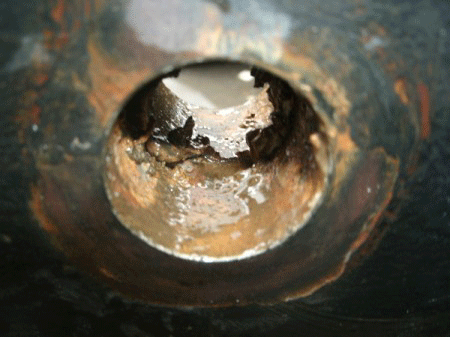
Tepco has been dismantling the tank since yesterday that experienced the 300m3 of leakage. The structural flaw may cause other tanks of the same type to leak commonly. Tepco is investigating the potential leaking points.
From their inspection, they found 2 holes around the bolt parts, which are 3mm × 11mm and 3mm × 22mm.
The flange parts were rusting inside and outside. The bottom parts of the tank were found severely deteriorated.
http://www.tepco.co.jp/nu/fukushima-np/handouts/2013/images/handouts_131008_03-j.pdf
http://photo.tepco.co.jp/date/2013/201310-j/131008-01j.html
News is not the truth. It’s a virtual reality that the sponsor wants us to live in.
Medical radiation can pose risk to those near the irradiated patient
Internal radiation is another matter..
The Johns Hopkins report said that if low-dose temporary pellets are used, patients require a hospital stay. During this time, they should have limited contact with family members. Friends should stay for only 10 to 30 minutes, and pregnant women should stay away.
But it’s still another story if doctors implant permanent brachytherapy implants. These gradually degrade over time and require greater precautions. Radiation experts say patients should not hug family members or others who want to wish them well for a few days following implantation. And for six months, they should keep 6 feet away from children and pregnant women.
Patients must remember that radiation is like an elephant: It never forgets. This means that radiation is cumulative, each radiation exposure adding to the last one.
 Can Radiated Patients Spread Radiation to Others? http://www.theepochtimes.com/n3/311788-can-radiated-patients-spread-radiation-to-others/ By W. Gifford-Jones M.D., DocGiff.com | October 9, 2013 How careful do patients have to be following nuclear diagnostic tests or after radiation for the treatment of cancer? How long do these nuclear materials remain in their bodies? And how long will this radiation remain detectable and transmissible to others?
A report from Johns Hopkins University several years ago said that patients who have been radiated must be made aware that they can pass radiation to others. The problem is that nuclear diagnostic tests are not going to go away. Unless we develop other means of diagnosis, these tests will increase in the years ahead.
During scans to detect thyroid disease, coronary troubles, and cancer, radioactive drugs are injected, taken orally, or inhaled. Gamma cameras or positron emission tomography (PET) scanners can then detect this energy and use it to produce images on a computer.
Because of this exposure to radiation, doctors advise patients to be certain to wash hands well after using the toilet. And they advise that it’s also important to flush the toilet twice to get rid of any radioactive material.
There are also varying degrees of radiation. For instance, radiation therapy delivers much higher amounts of radioactivity than nuclear scans. But patients having external radiation therapy should know that beams of radiation focused on a cancer will not spread radiation to other people.
Spreadable Radiation Continue reading
Cancer victims of Mururoa atomic testing get short shrift from France
Fritch Wants To Revisit Moruroa Nuclear Testing Issues http://pidp.eastwestcenter.org/pireport/2013/October/10-09-10.htm Pacific Islands Report Territorial assembly president: compensation laws don’t work WELLINGTON, New Zealand (Radio New Zealand International, Oct. 8, 2013) – The president of French Polynesia’s territorial assembly says the 2010 French nuclear test compensation law is not working, echoing the findings of a fresh French senate report on the issue.
Speaking on local television, Edouard Fritch says the issue needs to be revisited because too few people claiming to have suffered poor health and seeking compensation have their application recognised.
Mr. Fritch says the president, Gaston Flosse, turned to the French president, Francois Hollande, last week to point to the territory’s difficulties in dealing with cancer sufferers.
He says at the time of the weapons tests, the French Polynesian leaders like him and Mr. Flosse were assured by France that the tests were clean, but he says now they know that they were mistaken.
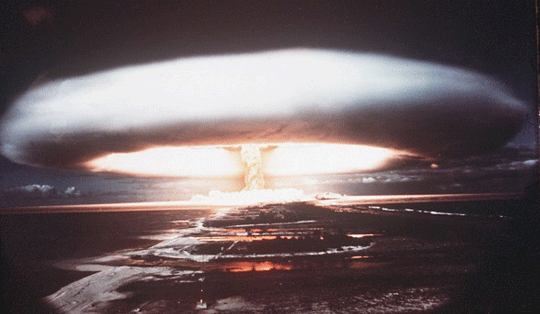
Last week, Mr. Flosse visited the Moruroa test site and said he was assured there was no problem with radioactivity nor any risk of the atoll collapsing.
Radio New Zealand International: www.rnzi.com
Report on the Australian premiere of nuclear promotional film ‘Pandora’s Promise’
 We gave out leaflets to those attending the film premiere last night. I was apparently the only anti nuclear person in the audience – a voice heckling n a pro nuclear wilderness.
- First part of the film: – established 4 or 5 speakers who all claim to have previously been anti nuclear, and shows the major nuclear accidents, faults etc. Sets up the bad things about nuclear power, and shows anti nuclear activists to be idealistc, but emotional and uninformed. Subtly denigrates and makes fun of anti nuclear activists, uses female speaker Gwyneth Craven a lot. Subtle put down of women – “brains hard wired to protect babies” Film’s protagonists changed their minds after learning from experts.
- Second part:Disillusion with environmental movement – rubbishing Kyoto Protocol, rubbishing renewable energy, rubbishing energy conservation. Stresses need for growing energy use. Harm from coal. (some good arguments here) Rubbishes fear of radiation – very poor information given here – inaccurate about radiation. repeats the “banana myth”. Misrepresents what WHO has said. Minimises Chernobyl, Fukushima’s health effects.
- Third part – safety and wastes History lesson on how USA nuclear power progress was stalled by politics, Democratic administrations. Integral Fast Reactors (Gen 1V) delayed by politics. IFRs so safe – they can use wastes as fuel, so in the meantime, Gen 3 reactors can go on, producing valuable fuel.
- Concluding part Present situation – nuclear France – hugely successful, Germany using more coal emitting more greenhouse gases. Nuclear is costly upfront, but will be much more economical than solar or wind. Nuclear wastes a valuable resource, nuclear warheads turned to fuel forreactors. especially exciting, Small Modular Reactors. Future energy needs for modern high energy resource rich lifestyle .
- inaccurate portrayal of anti nuclear people – all shown to be uninformed, anti science, pro coal, and non-expert.
- not at all up to date on renewable energy development – inaccurate picture of France today, and especially of Germany
- wrong information on ionising radiation – ?deliberate ignorance on this.
- no mention whatsoever of terrorism risks – to nuclear reactors, nuclear waste fuel pools, transport of “valuable” wastes to feed reactors
- glosses over weapons proliferation risks
- almost completely ignores economics – no mention of costs of security, eventual waste disposal from Gen 1V reactors.
- good presentation of climate change danger, and of health dangers of coal
- interesting presentation – at times amusing (though at times this is at the expense of anti nuclear people)
- music well used for emotional impact – dramatic at times, sentimental when showing happy Chernobyl residents.
—
Australian government planning to commercialise planned Northern Territory nuclear waste dump?
The Greens say that treating a nuclear waste dump as a growth business is unwise and unwanted. ‘It seems that behind the scenes, (the Abbott government) are developing a business case for the dump with private operators,’ Senator Scott Ludlam said in a statement.
‘As soon as you commercialise a nuclear waste dump, it is in the operators’ interest to look at taking other waste, including other countries’.’
He supports calls for an independent public commission to determine how to safely and responsibly handle Australia’s nuclear waste. This ‘would enable a more sophisticated management regime than the current plan to dump the waste containers in a shed on a cattle station’, he said.
 Nuclear tenders snub traditional owners http://www.skynews.com.au/national/article.aspx?id=913283 , Tuesday October 8, 2013 The federal government’s plan to manage Australia’s long-term nuclear waste has excluded the stakeholder voices of traditional Aboriginal land owners, an anti-nuclear activist says.
A Federal Court case is set for June to hear the objections of traditional owners at Muckaty Station, who do not want their lands to become a repository for nuclear waste.
But on September 23 the Abbott government called for applications for an initial business case to identify and analyse capability options for the long-term management of Australia’s radioactive waste to ensure it is safely and securely managed.
Applications close on Friday. Continue reading
Photos: broken support braces on 400 foot tower near Fukushima nuclear reactors
New report shows support braces completely severed on 400-foot tower near Fukushima reactors (PHOTOS) http://enenews.com/new-report-shows-support-braces-completely-severed-on-400-foot-tower-near-fukushima-reactors-photos
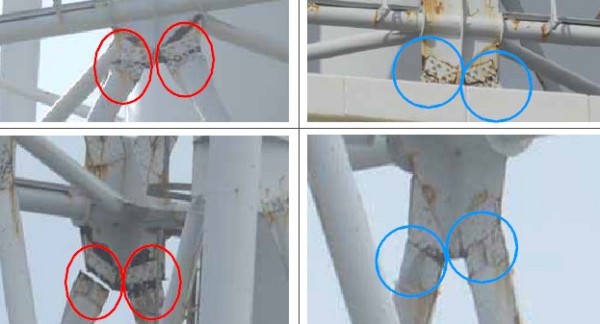
Title: (Systran Translation) Fukushima No. 1 nuclear power plant — Safety appraisal for the component damage of the machine chimney
Source: Tepco
Date: Oct. 7, 2013
h/t Fukushima Diary
Australian rare earths company Lynas still on the nose in Malaysia
Residents though remain highly sceptical and opposition candidates running on an anti-Lynas platform won a raft of seats around the plant, in the May general election.
Lynas lost more than $107 million last financial year, and has informed the market that it’s set to report another quarter of reduced output, as it continues to work on the plant’s operational issues.
Deutsche Bank’s Chris Terry says the company’s share price is now around 40 cents, compared with its peak value of $2.30 in early 2011
Australian rare earths miner Lynas Corporation sparks fresh anger in Malaysia ABC News, Kate Arnott for Newsline 9 Oct 13Australian rare earths miner Lynas Corporation is refusing to publicly disclose the location of a permanent waste storage facility for its processing plant in Malaysia.
Earlier this year, Lynas started commercial production of rare earths, which are used in a wide range of high tech equipment, but the plant on the east coast of peninsular Malaysia has been plagued by operational problems. Continue reading
USA government shutdown – how it is affecting nuclear power
 Nuclear Power and the Shutdown NYT, By PHILIP M. BOFFEY 9 Oct 13, Try as they may, Tea Party Republicans who triggered the shutdown cannot disguise the fact that it is disrupting important government activities.
Fortunately, the heads of federal agencies are not as reckless as Tea Partiers and have generally found ways to continue activities to protect public safety and health. But if this shutdown grinds on much longer it could cause significant harm.
Here is how two science-based agencies are faring.
Nuclear Regulatory Commission
The agency is expected to run out of previously appropriated money at the close of business on Thursday. At that point, the work force of 3,900 will drop to about 300. Some 150 inspectors at the nation’s 100 nuclear power plants will remain on the job as will an equal number of personnel in emergency response and support functions. That is an essential move to make sure reactors continue to operate safely. Work that is extremely important for future nuclear operations, however, will stop in its tracks. There will be no work on licensing new reactors or certifying new reactor designs, no work on adjudicating technical disputes, and no travel to or participation in meetings on such important issues as nuclear waste disposal. The Atomic Safety and Licensing Board, an expert group that second-guesses agency decisions, has started canceling hearings into next week….. http://takingnote.blogs.nytimes.com/2013/10/08/nuclear-power-and-the-shutdown/?_r=0
European Union rules against subsidies for nuclear projects – a blow to UK
 Blow to nuclear projects as Brussels drops plan for subsidy rules, Ft.com By Alex Barker and Joshua Chaffin in Brussels 9 Oct 13

Nuclear power projects in Europe face a legally uncertain future after Brussels heeded German concerns and ditched plans to issue specific guidelines on permitted state subsidies.
In a blow to the UK, France and countries in central and eastern Europe eyeing new nuclear programmes, the European Commission decided informally on Tuesday to carry on investigating programmes on a case-by-case basis
This puts Britain in the uneasy position of acting as a test case for EU public subsidy rules on the next generation of nuclear plants when it seeks clearance from Brussels in the coming months.
The UK is offering various support mechanisms, including a guaranteed price for nuclear power and a financing “guarantee”, to entice the private sector into building a series of nuclear reactors. The UK Treasury is locked in talks with EDF, the French energy group, over a price mechanism for energy from its proposed reactor at Hinkley Point in southwest England.
Brussels issued separate state-aid guidelines governing renewable forms of energy, as well as energy efficiency projects, in 2008. Joaquín Almunia, the EU competition commissioner, considered extending these to the nuclear sector under a broader review of the regime for policing state subsidies.
No new renewable energy for Western Australia – says State government
 WA government says no to new renewable energy REneweconomy, By Giles Parkinson on 8 October 2013 Western Australia has some of the best solar and wind resources in the world. But for the foreseeable future they are likely to go largely undeveloped because the state government has indicated that it will not support any new large scale renewable energy developments on its main grid. It will prefer instead to subsidise the construction of wind farms and solar farms in the eastern states.
The admission came in a series of speeches delivered recently by WA Energy Minister Mike Nahan which highlighted what a dog’s breakfast – and a very expensive dog’s breakfast at that – the state’s electricity grid had become. Continue reading
1 This month

of the week – Australians for War Powers Reform (AWPR)
To see nuclear-related stories in greater depth and intensity
 Antinuclear