Australia’s top newspaper deplores Abbott’s repeal of the carbon tax
Repeal of carbon tax shames our nation
In Australia rooftop solar is starving profits from coal power
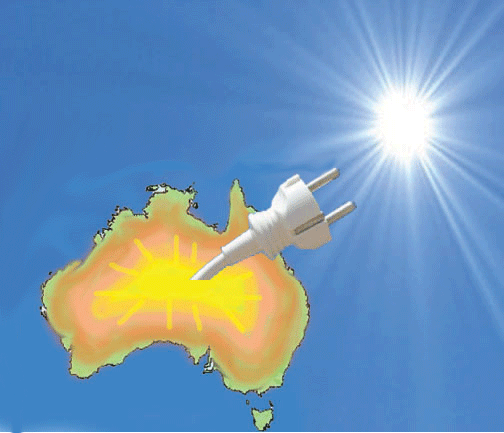 Game-changing rooftop solar boom is squeezing the profits out of coal power in Australia http://www.treehugger.com/renewable-energy/rooftop-solar-boom-squeezing-profits-coal-power-autralia.html Michael Graham Richard (@Michael_GR) 14 July 14
Solar power briefly turned electricity prices negative in Queensland Australia is known for its coal, which provides over 80% of its electricity and is a big export, but someday soon it might be known for its solar power. Thanks to rapidly falling solar PV prices, there’s been a rooftop solar boom in Australia. It’s now reaching a point where few coal generators made money last year, and even fewer will make profits this year… Wholesale energy pricing even briefly went negative in the middle of the day (see graph below) recently in the middle of the day in Queensland where there is 1.1 gigawatt of solar spread over more than 350,000 buildings.
Australia as a whole has about 3.4GW on 1.2 million buildings! Eventually, coal won’t be able to compete with solar at any price:
let’s imagine that the wholesale price of electricity fell to zero and stayed there, and that the benefits were passed on to consumers. In effect, that coal-fired energy suddenly became free. Could it then compete with rooftop solar?
The answer is no. Just the network charges and the retailer charges alone add up to more than 19c/kWh, according to estimates by the Australian energy market commissioner. According to industry estimates, solar ranges from 12c/kWh to 18c/kWh, depending on solar resources of the area, Those costs are forecast to come down even further, to around 10c/kWh and lower. (source)
The next step will be for people to get some storage and go off the grid to avoid having to pay these network charges. Australian solar installers are already reporting that “between 15 and 20 per cent of solar customers are asking about storage, and that rate is increasing each month.”
With companies like Tesla having ambitious goals to cut battery prices down over the next few years with gigafactories, the combo of cheap solar PV + cheap battery storage will be hard to beat. Dirty power sources will simply stop being competitive. Australia has lots of sun and high network costs, so it’s at the forefront of this movement. But most other countries will follow at their own pace. The best things we can do to accelerate the switch over to clean energy is to stop subsidizing fossil fuels, create regulation that is more friendly to rooftop solar (net-metering, for example), and put a price on carbon emissions.
Nuclear power nations are ‘naked’ when it comes to insurance
Earth Focus Episode 55 – Nuclear Insurance: America Goes Naked
Fukushima Crisis Total Cost $1 To $10 TRILLION Dollars; via A Green Road
http://agreenroad.blogspot.com/2012/06/fukushima-crisis-total-cost-up-to-10.html
Solar battery hybrid storage system for Muswellbrook, New South Wales
 Photon to build solar plus storage unit for NSW broadcast tower REneweconmy, By Giles Parkinson on 15 July 2014 German-based solar group Photon Energy is to install a large scale solar plus battery storage hybrid power system at a telecommunications tower in New South Wales that it says could be the fore-runner of thousands of such installations across the country.
The system, to be installed at a broadcast tower operated by BAI near Muswellbrook, will provide 24/7 power through a 39kW solar array and a 215kWh battery storage installation. An 8kW diesel generator will provide standby in emergencies.
Photon Energy says once successfully tested the concept could be implemented on thousands of sites across Australia.
Michael Gartner, the head of Photon Energy‘s Australian operations, said the project was a great step forward“ for solar power to provide clean and economically viable power supply for remote sites.
“The potential for solar PV in the replacement of conventional energy sources is substantial and will bring cost benefits and emissions savings for Australia in the coming years and decades.“
“… We can show how to incorporate solar PV into any given energy system and prove that using abundant sunlight for your own power consumption is the way forward.”……..http://reneweconomy.com.au/2014/photon-build-solar-plus-storage-nsw-broadcast-tower-37262
American billionaires wanting action to stop global warming (Koch brothers not happy)

 The Billionaire War Heats Up Slate.com 17 July 14 The richest people in America are turning on one another—over climate change.By Eric Holthaus Move over, Al Gore. There’s a new wealthy environmentalist whom conservatives love to hate. If you haven’t heard of him yet, meet Tom Steyer…….In a biographical post on his super PAC’s website labeled “accountability,” Steyer says “climate change has not always been on my radar.” In 2012, after founding Farallon Capital Management and running it for more than 25 years (amassing a billion-dollar fortune in the process), he left his post to work on global warming full time.
As the Washington Post reported last year, to reduce his footprint (which is probably still pretty big), Steyer chooses to take the red eye. He doesn’t shy away from the occasional environmental campaign rally, but he’s not about to guilt trip you for not switching out your light bulbs, either. His target is much bigger: the American political process itself.
In response to his efforts to make global warming a major political issue in the runup to the 2014 midterm elections,  Steyer is fast drawing the ire of the political landscape’s resident oil-money billionaires, the Koch brothers. Their talking point is simple: Tom Steyer is one of us, so lefties should demonize him, too. As Slate’s David Weigel wrote, “Republicans are trying to Koch-ify Tom Steyer in just five or six months.”
Ever since February, when Steyer announced a $100 million campaign to fight climate change, critics have been eager to pick at anything that may tarnish his green label. Steyer’s campaign—$50 million of his own, and $50 million from his super PAC, NextGen Climate—is primarily meant to encourage action on global warming……….
teyer doesn’t dispute that he “was for coal before he was against it.” In an op-ed in Politico on Monday, Steyer explained his about-face from hedge fund capitalist to environmental crusader, in an attempt to set the record straight:
[I]t’s true—Farallon did make fossil fuel investments under my watch. But the more I learned about the energy and climate problems we currently face, the more I realized I had to change my life. I concluded that the best way to align my work with my beliefs was to make a real change—leaving my role managing a firm with investments across the industrial spectrum, and instead joining in the global effort to find a solution to climate change once and for all.
Steyer says that he’s completely divested his personal holdings from the fossil fuel industry as of June 30 though certainly that won’t stop the right from claiming that he’s being hypocritical. But that’s missing the point. It’s not Steyer’s dollars (or even the source of those dollars) that will make the biggest difference but his example of putting his money where his mouth is. In his Politico piece, he offers an incredibly personal description of his epiphany and his decision to dedicate himself to tackling global warming on behalf of his children’s generation. Steyer has done something that’s still far too unusual: He’s admitting he was wrong on climate change and that he wants to rectify it. It’s that kind of honesty that we’ll all need to embrace if we’re to face the steep climb of remaking the global economy into one that isn’t tied to carbon with a full head of steam (or, electrons, as the case may be).
Meanwhile, in a world where money defines political clout, most billionaires aren’t as eager to ruffle the status quo. The few who are stand out. Last month, Steyer joined billionaire former New York City Mayor Michael Bloomberg and near-billionaire former Goldman Sachs CEO and Treasury Secretary Henry Paulson to release a high-profile report on the economic effects of climate change in the United States. That report called for the leaders of the business community to address the growing specter of climate change out of their own self-interest: to avoid economic risk. With their billions in annual revenue as part of the fossil fuel industry, the Koch brothers may want to take note……….http://www.slate.com/articles/technology/future_tense/2014/07/tom_steyer_koch_brothers_billionaires_are_battling_over_climate_change.html
Axing of carbon tax will not really help your power bills
The Carbon Tax Is Dead, Long Live the ..? http://www.energymatters.com.au/index.php?main_page=news_article&article_id=4399 18 July 14 The carbon tax is dead; but don’t expect to see a major difference in power bills – or for too long.
It doesn’t matter that many households were compensated for any impact of the scheme under the Household Assistance Package, or that the carbon tax prevented 11 to 17 million tonnes of carbon emissions.
Nor does it matter higher it resulted in some filthy brown-coal fired power stations being mothballed.
Like it or loathe it, it’s kaput. Spin bettered substance and Thursday’s passing of the repeal turned Australia from a leader to laggard.
“The repeal of Australia’s carbon price is a tragedy, not a triumph” said Michael Raupach Director, Climate Change Institute, Australian National University.
“It flies in the face of three giant realities: human-induced climate change, the proper role of government as a defender of the common good, and the emerging quiet energy-carbon revolution”.
According to the ABC, , consumers can expect to save between 20 and 50 cents each day on their electricity bills now the carbon tax has been repealed.
However, any financial benefit relating to power bills could quickly be eaten up by increases in other charges.For example, in New South Wales, Ausgrid wants increases of around 2 per cent a year over the next five years and TransGrid wants to raise prices by almost 4 per cent – this is just in relation to network charges.
Other states including South Australia have just implemented more electricity price rises. The average South Australian household will pay around $85 a year more.
In Queensland, households were recently hit with a 13.6 per cent increase, expected to cost the average household an extra $190 a year.
Depending what end of the scale of carbon tax savings are to be had, any relief may have already been gobbled up before many will receive their post-carbon tax bill. Anyone planning to do something other than pay power bills with the perceived windfall may need to re-evaluate those plans.
Huge Aboriginal death toll when Europeans invaded – should be recognised
Australian War Memorial should recognise revised Aboriginal death toll: researcher, Brisbane Times July 17, 2014 Cameron Atfield Brisbane Times and Sun-Herald journalist New research that has calculated an Aboriginal death toll of more than 65,000 in Queensland alone during the so-called frontier wars has renewed calls for formal recognition at the Australian War Memorial.
But the AWM in Canberra has dismissed the idea, saying recognition should instead be in the National Museum.
The research, presented to the Australian Historical Association’s Conflict in History conference last week at the University of Queensland, estimated 66,680 deaths between 1788 and 1930.
Of those deaths, 65,180 were indigenous, which is more than six times what was previously thought. The report’s co-author, historian Professor Raymond Evans, said the calculations were based on official records, witnesses’ reports and the number of patrols undertaken by the colonial Queensland government’s Native Police.
Professor Evans said the 65,180 figure was “conservative” and could be as high as 115,000.
“This is just Queensland – imagine what the nation-wide figure could be,” he said.
“If you say it’s a war, you at least allow the fact that Aboriginal people fought hard to defend their lands, so you can say they were warriors and they were fighting for their country. “They were fighting for Australia, for their land.”
Professor Evans said the estimated death toll was at least on a par with Australian casualties during World War I.
“The Australian War Memorial should recognise this as a war. It’s got such a high death rate, it was fought over a long period of time and it was fought between different communities, different nations, for territory,” he said.
“It’s a fight for land and territorial possession and it has many features of warfare and, of course, a huge death rate.” http://www.brisbanetimes.com.au/queensland/australian-war-memorial-should-recognise-revised-aboriginal-death-toll-researcher-20140716-ztqr6.html#ixzz388vSgyg2
1 This month

of the week – Australians for War Powers Reform (AWPR)
To see nuclear-related stories in greater depth and intensity
 Antinuclear