Reasons for hope in the climate movement
 In a few short centuries, the carbon-based fuels of the industrial breakthrough have come to threaten the entirety of a civilization they made possible. In the People’s Climate March is the suggestion that civilization might rise to the challenge, perhaps in time to avert total catastrophe. After the march, the four-letter word I heard most was: hope.
Why you should be hopeful about the climate movement Grist, By Todd Gitlin Cross-posted from Tom Dispatch 3 Oct 14, Less than two weeks have passed and yet it isn’t too early to say it: The People’s Climate March changed the social map — many maps, in fact, since hundreds of smaller marches took place in 162 countries. That march in New York City, spectacular as it may have been with its 400,000 participants, joyous as it was, moving as it was (slow-moving, actually, since it filled more than a mile’s worth of wide avenues and countless side streets), was no simple spectacle for a day. It represented the upwelling of something that matters so much more: a genuine global climate movement………
There is today a climate movement as there was a civil rights movement and an anti-war movement and a women’s liberation movement and a gay rights movement — each of them much more than its component actions, moments, slogans, proposals, names, projects, issues, demands (or, as we say today, having grown more polite, “asks”); each of them a culture, or an intertwined set of cultures; each of them a political force in the broadest as well as the narrowest sense; each generating the wildest hopes and deepest disappointments. Climate change is now one of them: a burgeoning social fact. Continue reading
John Carlson calls for full parliamentary scrutiny on Australia-India nuclear deal
 Australia-India nuclear deal: The need for full parliamentary scrutiny, The Interpreter, John Carlson, 1 Oct 14 In a previous post, I pointed out how the Australia-India nuclear cooperation agreement departs from Australia’s longstanding safeguards requirements. In particular, there is a risk that the follow-on ‘administrative arrangement’ could deprive Australia of the ability to track and account for Australian uranium supplied to India.
It is not too late to address this problem in a way that ensures the agreement is meaningful and can command bipartisan support in Australia. There will be a crucial role here for the Australian Parliament’s Joint Standing Committee on Treaties (JSCOT), which will have the opportunity to scrutinise the agreement and to ask the necessary and difficult questions about the administrative arrangement.
Here there are two practical issues: the administrative arrangement has not yet, as far as we know, been negotiated, so it will not be available when JSCOT commences its review of the agreement; and in any case it is the usual practice to treat administrative arrangements as being confidential.
The Abbott Government should proceed no further with the agreement unless it can give an assurance that all of Australia’s longstanding safeguards requirements will be met. Continue reading
Community rights disappearing under Campbell Newman’s uranium mining push
 To many Traditional Owners, these places are known as sickness country, or poison country, and are often considered sacred. Upsetting the poison and letting out into the landscape would be a disaster, particularly in the life giving and food providing Mitchel River basin.
The Bill, passed in parliament in early September, gives the Coordinator General the power to exclude community objection rights over some of the largest mining projects
Mining companies now have more rights than the community in Newman’s Queensland http://www.sbs.com.au/news/article/2014/10/01/comment-mining-companies-now-have-more-rights-community-newmans-queensland 1 Oct 14 Queenslanders have more reason than ever to be concerned about uranium mining in the sunshine state. By Andrew Picone Back in 2012 Queensland Premier Campbell Newman made a series of ‘crystal clear’ commitments to keep the door closed to uranium mining in Queensland. In a letter to former ACF CEO Don Henry, Newman wrote “I take this opportunity to reaffirm my statements, made before the last election, that the State Government has no plans to approve the development of uranium in Queensland”.
It proved to be one of his first broken promises. Just a fortnight later this commitment was dumped, without any independent assessment or community consultation. Uranium mining would not just be permitted in Queensland, the Premier started actively encouraging uranium mining companies to set up shop in the sunshine state.
Fast forward to 2014 and Queenslanders have more reason than ever to be concerned. In an echo of the heavy handed police state politics that so characterized former Queensland Premier Joh Bjelke Petersen, the Queensland government’s hand-picked co-ordinator general will now have sole authority over major new mining projects.
Proposed legislative changes introduced in the Mineral and Energy Resources (Common Provisions) Bill 2014, literally rushed through the Parliament at five minutes to midnight on September 9th 2014, in particular provision 47D entitled ‘restriction in giving of objection notice under the Environmental Protection Act’ – should sound the community alarm. Continue reading
The ‘Alice in Wonderland’ propaganda for (non existent) new nuclear reactors
‘New’ reactor types are all nuclear pie in the sky Ecologist Dr Jim Green 2nd October 2014 There’s an Alice in Wonderland flavour to the nuclear power debate, writes Jim Green. Lobbyists are promoting all sorts of new reactor types – an implicit admission that existing reactors aren’t up to the job. But the designs they are promoting have two severe problems. They don’t exist. And they have no customers. Some nuclear enthusiasts and lobbyists favour non-existent Integral Fast Reactors, others favour non-existent Liquid Fluoride Thorium Reactors, others favour non-existent Pebble Bed Modular Reactors, others favour non-existent fusion reactors. And on it goes.
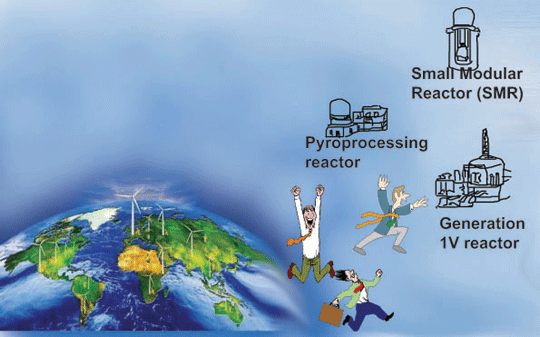
Two to three decades ago, the nuclear industry promised a new generation of gee-whiz ‘Generation IV’ reactors in two to three decades. That’s what they’re still saying now, and that’s what they’ll be saying two to three decades from now. The Generation IV International Forum website states:
“It will take at least two or three decades before the deployment of commercial Gen IV systems. In the meantime, a number of prototypes will need to be built and operated. The Gen IV concepts currently under investigation are not all on the same timeline and some might not even reach the stage of commercial exploitation.”
The World Nuclear Association notes that“progress is seen as slow, and several potential designs have been undergoing evaluation on paper for many years.”……..
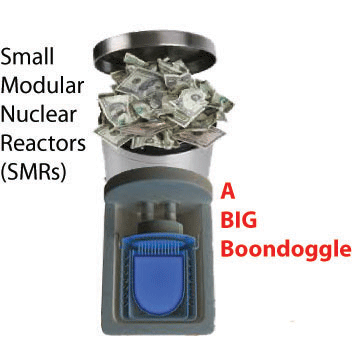 So work continues on Small Modular Nuclear Reactors (SMRs) but the writing’s on the wall and it’s time for the nuclear lobby to come up with another gee-whiz next-gen fail-safe reactor type to promote … perhaps a giant fusion reactor located out of harm’s way, 150 million kilometres from Earth.
And while the ‘small is beautiful’ approach is faltering, so too is the ‘bigger is better’ mantra. The 1,600 MW Olkiluoto-3 European Pressurized Reactor (EPR) under construction in Finland is nine years behind schedule (and counting) and US$6.9 billion over-budget (and counting).
The UK is embarking on a hotly-contested plan to build two 1,600 MW EPRs at Hinkley Point with a capital cost of US$26 billion and mind-boggling public subsidies.
Economic consulting firm Liberum Capital said Hinkley Point will be “both the most expensive power station in the world and also the plant with the longest construction period.”http://www.theecologist.org/News/news_analysis/2577637/new_reactor_types_are_all_nuclear_pie_in_the_sky.html
Northern Territory pastoral stations to get our radioactive trash returned from France?
 Pastoral stations may host nuclear waste dump site after Muckaty ruled out, Macfarlane says ABC News 3 Oct 14 Australia’s first nuclear waste dump could be built on a pastoral station, Federal Resources Minister Ian Macfarlane says.
Since the Northern Land Council withdrew a nomination to host the site at Muckaty Station, the Northern Territory’s two land councils have had exclusive rights to nominate other sites.
But neither put one forward and the deadline for submissions expired on Tuesday.
Mr Macfarlane told SBS a new round of submissions, which were to open November 10, would be open to pastoral lease holders.
The ABC understood at least one pastoral station in the NT had expressed interest.
“The reality is that we need to get this built,” Mr Macfarlane said. Our challenge is to ensure we can get the nuclear waste out of the basements of buildings in capital cities. “If I need a site – and I do need a site that is clear of dispute and clear of title – then obviously a freehold title, perhaps a grazing property, would be suitable”……..
Clock ticking to build permanent waste storage site More than 11 tonnes of nuclear waste were to return to Australia next year after being sent to France more than a decade ago. Under an agreement with France Australia was required to take back the reprocessed waste in 2015.
Earlier this week, NT Chief Minister Adam Giles said his government might consider offering up a site…….http://www.abc.net.au/news/2014-10-02/nuclear-waste-dump-muckaty-station-pastoral-ian-macfarlane/5786338
Judge rules against uranium mining at Grand Canyon
 Ban on uranium mining at Grand Canyon upheld by Arizona court . http://www.theguardian.com/environment/2014/oct/02/ban-uranium-mining-grand-canyon-arizona-court Ruling protects national treasure against the possibility of opening it to 26 new mines and 700 exploration projects Leslie Macmillan theguardian.com, Friday 3 October 2014
 In January 2012, then-US interior secretary Ken Salazar issued the ban that prohibits new mining claims and mine development on existing claims without valid permits. A subsequent mining industry lawsuit asserted that the interior department’s 700-page study of environmental impacts was inadequate and the ban was unconstitutional.
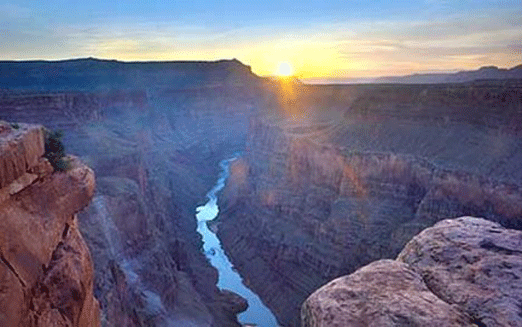
A coalition of groups including native American tribes and the Sierra Club intervened in that lawsuit, and on Tuesday the court ruled in their favour.
Judge David G Campbell of the US district court for Arizona summarised his ruling dismissing all uranium mining industry claims by stating that the secretary of the interior had the authority to “err on the side of caution in protecting a national treasure – Grand Canyon national park.”
Critics of uranium mining say that it would threaten the aquifers and streams that feed the Colorado river and Grand Canyon by releasing toxic waste.
Martha Hahn, chief of science and resource management for the Grand Canyon, says that mines would leach contaminants into watersheds, seeps and springs in the canyon, mar the landscape and impact wildlife. The seeps that make rocks slick might not look life-sustaining, but one might “feed a critter that feeds another critter, so you see the effect pretty exponentially,” said Hahn.
- According to the government’s study, removing the ban would mean that 26 new uranium mines and 700 uranium exploration projects could be developed.
The Grand Canyon attracts about 4m tourists a year. Uranium mining companies have 60 days to appeal the decision
The International atomic Energy Agency warns on the uncertain future of the uranium industry
 OECD/IAEA Red Book The latest edition of the ‘Red Book’ − ‘Uranium 2014: Resources, Production and Demand’ − has been released by the OECD Nuclear Energy Agency and the International Atomic Energy Agency.8………
“Uranium miners have been hit harder by the Fukushima Daiichi accident than any other segment of the nuclear fuel cycle,” the Red Book states, and Fukushima “has eroded public confidence in nuclear power in some countries and prospects for growth in nuclear generating capacity are in turn being reduced and subject to even greater uncertainty than usual.”
Uranium’s dead cat bounce as miners play chicken Dr Jim Green − Nuclear Monitor 2 Oct 2014 “…..the price increase has been driven by supply-side concerns and speculation instead of increased demand or even speculation regarding increased demand. UBS commodities analyst Daniel Morgan said in early September: “There’s been a few supply-side issues which has been enough for a very modest price rise. What the market really needs is a demand-side driver to get the price going and in my view we don’t have one at the moment.”2
Macquarie Group’s Stefan Ljubisavljevic predicts a uranium supply surplus for the next five years unless some unprofitable mines close.1 Raymond James analyst David Sadowski said in May that many utilities around the world “are sitting on near-record piles” of uranium.11 For example China has stockpiled about eight years’ supply (at its current rate of consumption) while it may take Japanese utilities a decade or more before they exhaust existing stockpiles.12
The long term price, where most uranium business is conducted, was still languishing at US$44 / lb in late August, a six-year low.3
A number of mines have been put into care-and-maintenance over the past year, including Paladin Energy’s Kayelekera mine in Malawi, and the Honeymoon mine in South Australia, owned by a Rosatom subsidiary. Many other planned mining projects have been cancelled or deferred or scaled down, and some uranium mining companies are being downgraded. Recent examples include: Continue reading
Tony Abbot’s ‘suicide strategy’ on coal is not winning friends for Australia
 Merkel adviser lashes Abbott’s ‘suicide strategy’ on coal, SMH, October 2, 2014 – Lisa Cox National political reporter A lead adviser to German Chancellor Angela Merkel on climate policy has attacked Australia’s complacency on global warming and described the Abbott government’s championing of the coal industry as an economic “suicide strategy”.
Hans Joachim Schellnhuber said most countries had given up on Australia setting tougher targets to reduce greenhouse gas emissions and the country was now viewed alongside Canada as not contributing its fair share to global efforts to reduce climate change.
Professor Schellnhuber, a former personal adviser to Chancellor Merkel, co-chairs the German Advisory Council on Global Change, which advises the Merkel government on environment policy – the equivalent of Australia’s Climate Change Authority.
Professor Schellnhuber was dismissive of the Abbott government’s direct action policy, which is still in limbo after the axing of the former Labor government’s carbon tax, describing it as “weak” and he criticised a “ridiculous” energy green paper published the day before the UN summit that advocated greater coal use in decades to come.
He said calling for continued coal use was not only poor climate policy, it made little sense economically when the rest of the world was turning to renewable energy.
“China will soon come up to peak coal consumption,” he said.
“Other Asian economies might peak even sooner.
“It’s almost a suicide strategy for the Australian economy.”
His comments come after countries savaged Australia’s performance at a special climate summit of world leaders in New York last week, where US President Barack Obama said combatting global warming was a joint effort by all nations and “nobody gets a pass”…….
Professor Schellnhuber said instead of backing away from policies such as Australia’s renewable energy target, the Abbott government should be exploiting Australia’s enviable position as the country with the “biggest potential” to produce renewable energy.
He said this was especially important when Australia was one of the continents most vulnerable to the effects of climate change, which would hit the country in the form of unprecedented heatwaves, fires and coral bleaching.
“If Australia just sits there and says we offer our cheap coal but we have no manufacturing industry, we have slipped from renewables, these are dire prospects for the economy of your country,” he said.
“It’s bad for Australia because you might miss the innovation train. http://www.smh.com.au/federal-politics/political-news/merkel-adviser-lashes-abbotts-suicide-strategy-on-coal-20141002-10ouu6.html#ixzz3F8CbEDko
Tony Abbott doesn’t like renewable energy, but many Coalition voters do!
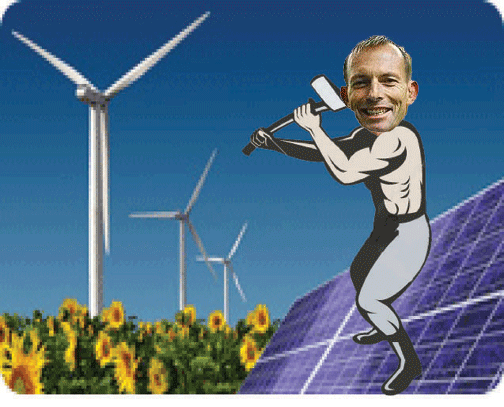 Abbott changing the rules at half time on Renewable Energy Target http://www.onlineopinion.com.au/view.asp?article=16732 By Guy Ragen – posted Thursday, 2 October 2014 “……..The renewable energy target is now being targeted by the Government precisely because it is working so well to reduce pollution. Clean energy makes sense to Australians because of our natural advantages. As a policy, the Renewable Energy Target aims for Australia to generate 41,000GWh of our electricity through renewable sources – sun, wind, hydro-electricity – by 2020.
It’s been so successful that solar panels are now on more than one million roofs across the country, and Australia is on track to actually generate more than 27% of our electricity from renewable sources by 2020 – equivalent to the entire electricity use of Queensland. This is a good thing.
It shouldn’t surprise anyone, therefore, that new polling this week from Essential Research confirms Australians are overwhelmingly in favour boosting renewable energy as their preferred policy to tackle climate change – more than half the country thinks renewable energy is the way to go.
And in troubling news for the Government, the Essential research revealed that four times as many Coalition voters prefer incentives for renewable energy over their own party’s centrepiece climate change policy – Direct Action. Continue reading
Northern Region takes first step to community renewable energy
 First step to first community renewable energy retailer http://www.northernstar.com.au/news/nre-awarded-54000-to-work-on-business-plan/2407390/ Rodney Stevens | 3rd Oct 2014 THE first step towards the Rainbow Region becoming Australia’s first community energy retailer has been taken with Northern Rivers Energy (NRE) being awarded $54,000 to develop a business plan.
Formed by a consortium of environmentally conscious citizens, Northern Rivers Energy NRE was awarded the grant from the Office of Environment and Heritage and the Total Environment Centre.
NRE spokeswoman Alison Crook said the company would encompass energy retailing, generation and asset management, and an educational energy literacy arm.
She said NRE would service the entire Northern Rivers Region, covering the Tweed, Kyogle, Byron, Lismore, Ballina, Richmond Valley and Clarence Valley council areas.
“Here on the Northern Rivers we have all the ingredients necessary to demonstrate that communities can meet their energy needs without relying on fossil fuels and can live in greater harmony with the environment, and still flourish,” she said.
“The Northern Rivers already has a high level of take-up of solar PV. We have a community that really understands what it means to be a community and to support each other.
“If any region can show how the renewable industry can both create employment and reduce our impact on the environment, this region can.
“Once the NRE business plan and feasibility study are complete, community consultation will begin.”
Northern Rivers Energy aims
- Provide renewable energy and purchase solar and other renewable energy from residential, commercial and government system owners at fair prices.
- Facilitate community investment in medium scale renewable energy projects.
- Provide and maintain renewable energy equipment.
- Enable purchase of equipment by consumers through lease or finance arrangements.
- Partner with social housing providers, caravan parks and retirement villages to facilitate access to renewable energy and efficient solutions for people on low incomes.
Small Modular Nuclear Reactors … no-one actually wants to buy one
‘New’ reactor types are all nuclear pie in the sky Ecologist Dr Jim Green 2nd October 2014 “……….In any case, IFRs are yesterday’s news.
Now it’s all about Small Modular Reactors (SMRs). The Energy Green Paper recently released by the Australian government is typical of the small-is-beautiful rhetoric:In any case, Integral Fast Nuclear Reactors (IFRs) are yesterday’s news. Now it’s all about Small Modular Reactors (SMRs). The Energy Green Paper recently released by the Australian government is typical of the small-is-beautiful rhetoric:
“The main development in technology since 2006 has been further work on Small Modular Reactors (SMRs). SMRs have the potential to be flexibly deployed, as they are a simpler ‘plug-in’ technology that does not require the same level of operating skills and access to water as traditional, large reactors.”
The rhetoric doesn’t match reality. Interest in SMRs is on the wane. Thus Thomas W. Overton, associate editor of POWER magazine, wrote in a recent article:
“At the graveyard wherein resides the “nuclear renaissance” of the 2000s, a new occupant appears to be moving in: the small modular reactor (SMR). … Over the past year, the SMR industry has been bumping up against an uncomfortable and not-entirely-unpredictable problem: It appears that no one actually wants to buy one.”
Overton notes that in 2013, MidAmerican Energy scuttled plans to build an SMR-based plant in Iowa. This year, Babcock & Wilcox scaled back much of its SMR program and sacked 100 workers in its SMR division. Westinghouse has abandoned its SMR program. As he explains:
“The problem has really been lurking in the idea behind SMRs all along. The reason conventional nuclear plants are built so large is the economies of scale: Big plants can produce power less expensively per kilowatt-hour than smaller ones.
“The SMR concept disdains those economies of scale in favor of others: large-scale standardized manufacturing that will churn out dozens, if not hundreds, of identical plants, each of which would ultimately produce cheaper kilowatt-hours than large one-off designs.
“It’s an attractive idea. But it’s also one that depends on someone building that massive supply chain, since none of it currently exists. … That money would presumably come from customer orders – if there were any. Unfortunately, the SMR “market” doesn’t exist in a vacuum.
“SMRs must compete with cheap natural gas, renewables that continue to decline in cost, and storage options that are rapidly becoming competitive. Worse, those options are available for delivery now, not at the end of a long, uncertain process that still lacks [US Nuclear Regulatory Commission] approval.”
Can’t find customers, can’t find investors
Dr Mark Cooper, Senior Fellow for Economic Analysis at the Institute for Energy and the Environment, Vermont Law School, notes that two US corporations are pulling out of SMR development because they cannot find customers (Westinghouse) or major investors (Babcock and Wilcox). Cooper points to some economic constraints:
“SMR technology will suffer disproportionately from material cost increases because they use more material per MW of capacity. Higher costs will result from: lost economies of scale; higher operating costs; and higher decommissioning costs. Cost estimates that assume quick design approval and deployment are certain to prove to be wildly optimistic.”
Academics M.V. Ramana and Zia Mian state in their detailed analysis of SMRs:“Proponents of the development and large scale deployment of small modular reactors suggest that this approach to nuclear power technology and fuel cycles can resolve the four key problems facing nuclear power today: costs, safety, waste, and proliferation.
“Nuclear developers and vendors seek to encode as many if not all of these priorities into the designs of their specific nuclear reactor. The technical reality, however, is that each of these priorities can drive the requirements on the reactor design in different, sometimes opposing, directions.
“Of the different major SMR designs under development, it seems none meets all four of these challenges simultaneously. In most, if not all designs, it is likely that addressing one of the four problems will involve choices that make one or more of the other problems worse.”
The future is in … decommissioning
Likewise, Kennette Benedict, Executive Director of the Bulletin of the Atomic Scientists,states: “Without a clear-cut case for their advantages, it seems that small nuclear modular reactors are a solution looking for a problem.
“Of course in the world of digital innovation, this kind of upside-down relationship between solution and problem is pretty normal. Smart phones, Twitter, and high-definition television all began as solutions looking for problems.
“In the realm of nuclear technology, however, the enormous expense required to launch a new model as well as the built-in dangers of nuclear fission require a more straightforward relationship between problem and solution.
“Small modular nuclear reactors may be attractive, but they will not, in themselves, offer satisfactory solutions to the most pressing problems of nuclear energy: high cost, safety, and weapons proliferation.”
And as Westinghouse CEO Danny Roderick said in January: “The problem I have with SMRs is not the technology, it’s not the deployment – it’s that there’s no customers.”
Instead of going for SMRs, IFRs, Pebble Bed Reactors or thorium technologies, Westinghouse is looking to triple the one area where it really does have customers: its decommissioning business. “We see this as a $1 billion-per-year business for us”, Roderick said.
With the world’s fleet of mostly middle-aged reactors inexorably becoming a fleet of mostly ageing, decrepit reactors, Westinghouse is getting ahead of the game.
The writing is on the wall
Some SMR R&D work continues but it all seems to be leading to the conclusions mentioned above. Argentina is ahead of the rest, with construction underway on a 27 MWe reactor – but the cost equates to an astronomical US$15.2 billion per 1,000 MWe. Argentina’s expertise with reactor technology stems from its covert weapons program from the 1960s to the early 1980s…………. http://www.theecologist.org/News/news_analysis/2577637/new_reactor_types_are_all_nuclear_pie_in_the_sky.html
USA now doesn’t want Australia to get nuclear submarines
US cools on nuclear subs for AustraliaThe United States has gone cold on its close ally Australia acquiring or leasing Virginia class nuclear submarines to replace the ageing Australian-built, diesel-electric Collins class. (subscribers only) http://www.afr.com/p/national/us_cools_on_nuclear_subs_for_australia_pFZuUHylgfi2w6aPkJZnwO
1 This month

of the week – Australians for War Powers Reform (AWPR)
To see nuclear-related stories in greater depth and intensity
 Antinuclear