Australia’s role in the global nuclear industry crisis – – theme for May 2015
The global nuclear industry may pretend otherwise, but it is in crisis. The commercial nuclear industry is an economic disaster. The first and greatest nuclear nation, USA, has learned this. So has France. Britain now undergoes this painful realisation.
As these “old” nuclear countries realise the collapse of their nuclear industry, they turn to marketing nuclear technology overseas, in a desperate effort to make the industry viable. This gets complicated, because the desire for nuclear weapons is a strong motive for buyers – India, Pakistan, Saudi Arabia? – countries that really do not need nuclear power, but like the option of nuclear weapons..
Within the nuclear industry there’s been a division between the interests of the big “conventional” uranium fired nuclear reactors, and the supporters of small nuclear reactors and thorium fuelled reactors.
Here’s where Australia comes in. Somewhat culturally isolated, Australia is a sitting duck for a clumsy plan to put all these technologies together, and for the global nuclear salesmen to present a united face, and try to sell the whole lot to Australia.
These nuclear marketers (Canada’s Lavalin, France’s AREVA, USA’s Westinghouse, GE Hitachi) are desperate for Australia to accept this scheme. Afflicted at home by public anxiety about radioactive trash, they really do need to be able to tell their citizens – “Don’t worry – Australia will take the trash – we can keep on making it.”

Nuclear Non Proliferation Treaty meeting ignored in media hype about ANZAC Day
 While Australia went into somewhat of a frenzy about ANZAC Day, over 100 nations were sending official delegations, and Japan, Mexico, Norway, Canada and other nations sending representatives of their non-governmental peace movements to the Nuclear Non Proliferation Review Conference in New York City, beginning April 27
On April 24 and 25, 800 of these representatives gathered at a Peace and Planet Conference at Cooper Union in Lower Manhattan to explore how to press their governments more effectively for nuclear disarmament. On the 26th there will a march and rally at the UN to encourage the official delegations to work diligently for true nuclear disarmament.
Is Australia sending any official delegation to the conference? If so, it’s a well kept secret.
I wonder what the old ANZAC soldiers would think about all this. They might be pleased to be remembered – but perhaps a bit cynical about Australia apparently ignoring the global effort to prevent nuclear war.
Karipbek Kuyukov born without arms works for nuclear disarmament

I am asking you to wave goodbye to these weapons, though I cannot do so myself. But I can raise my voice, and my paintbrush, and I will do that until the day I die, to ensure that the world sees what has happened in my country and my community, and more importantly, to make sure that this never happens again, in rich countries or in poor countries or in any other hidden place on earth. Children like me were hidden for long enough. I want to use my voice to tell you about us, now, and use my brush to show you the beauty and heartbreak of my landscape
Eliminating the World’s Nuclear Weapons by Bicycle Silk Road Reporters, by Karipbek Kuyukov 23 Apr 15 On April 21, another push – many miles worth, in fact – was added to the growing worldwide drive to rid the planet of nuclear weapons as the Bike Away the Atomic Bomb riders begin their journey from Washington, D.C. to New York to call for real action to be taken at the UN Nonproliferation Treaty Review Conference in New York on April 27. I won’t be riding with them. I couldn’t hold the handlebars, or anything else, for that matter: when I was born, outside the now-closed Semipalatinsk Nuclear Test Site in eastern Kazakhstan, it was without arms.

I’m not unusual, where I come from. Forty years of nuclear testing and hundreds of nuclear explosions have blighted swathes of the beautiful steppe there and shattered the surrounding communities, as their effects began to be seen in birth defects and diseases, which continue to this day. The UN estimates that 1.5 million people in Kazakhstan have been affected by the Soviet Union’s nuclear test programme. There are many people like me.
I am determined to be the last. Continue reading
Catholic Church to press for nuclear weapons ban at the UN Treaty review
 Catholics to press nuclear weapons ban at UN treaty review conference, Dennis Sadowski Catholic News Service | Apr. 24, 2015 It was April 11, 1963, as the Catholic church was in the midst of the Second Vatican Council, that St. John XXIII issued his landmark social encyclical Pacem in Terris (“Peace on Earth”) that included a call for a verifiable ban on nuclear weapons.
More than 50 years later, the Holy See continues to make the moral case for nuclear disarmament.
The Vatican’s most recent public comment came in December at the Vienna Conference on the Humanitarian Impact of Nuclear Weapons.
“The time has come to embrace the abolition of nuclear weapons as an essential foundation of collective security,” the Vatican said in a paper titled “Nuclear Disarmament: Time for Abolition” delivered to the conference.
In it, the church held firm to its stance that any use of nuclear weapons was immoral and argued that the time has come to abandon nuclear deterrence — the principle that such weapons might be used and that they exist to deter another country from using them. Previously, the Vatican conditionally accepted deterrence as “a step on the way toward progressive disarmament.”
But that has not happened, and Archbishop Bernardito Auza, the Vatican’s permanent observer to the United Nations, is likely to reiterate its call for total nuclear disarmament during the monthlong Non-Proliferation Treaty Review Conference opening April 27 at the United Nations…. Continue reading
Demonstrations, and a”global wave” for abolition of nuclear weapons
 Demonstrators to rally for nuclear abolition The Wisconsin Gazette
Monday, 20 April 2015 Thousands of protesters are set to gather in New York City this week to demand a nuclear-free world in advance of the five-year Nuclear Nonproliferation Treaty Review Conference.
Activists, scholars and students with anti-nuclear, peace and environmental justice movements will call on the NPT Review Conference meeting at the United Nations to mandate the commencement of “good faith negotiations” for the complete elimination of the world’s nuclear arsenals, as required by the treaty.
Activist events include an international conference April 24-25 at the Cooper Union featuring speakers from more than a dozen countries.
On April 26, a mass rally will take place in Union Square, followed by a march to Dag Hammarskjold Plaza, where millions of petition signatures will be presented to UN and NPT officials.
The rally will launch a “Global Wave,” with participants symbolically waving goodbye to nuclear weapons. The Global Wave will travel west, by time zone, with public events scheduled in Papeete, Manila, Amman, Bethlehem, Stockholm, Paris, London, Sao Paulo and points in-between. Continue reading
Australian company Paladin discharges uranium sludge into rivers in Malawi
Malawi: Paladin Starts Discharging Uranium Wastes Into Public Rivers, AllAfrica, By Bishop Witmos Karonga April 23: Few months after Paladin Africa Limited differed with civil society organizations (CSOs) and some chiefs in Karonga over the disposition of uranium wastes into public water, the company has started discharging the effluent into Sere River.
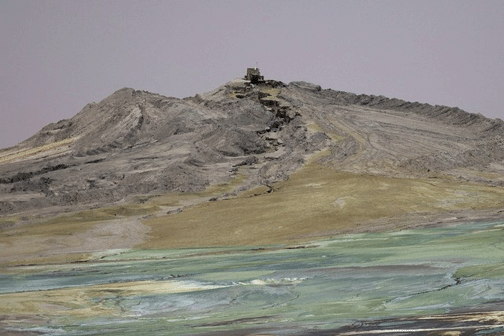
Paladin Africa Limited, a member of the Paladin Energy group of companies, suspended its operations at Kayelekera Mine in the district in May, 2014, due to unstable uranium prices at an international market. The project is now on care and maintenance.
Malawi News Agency (Mana) has established Paladin invited Paramount Chief Kyungu and the District Commissioner (DC) for Karonga, Rosemary Moyo, to a meeting in Lilongwe early April this year (2015),to brief them about the company’s recent decision.
Paladin Africa Acting General Manager in Malawi, Greg Walker, confirmed in a telephone interview that the company, indeed, started releasing the uranium wastes into the public rivers………
Sere River flows into North Rukuru River, then into Lake Malawi.
When asked why the company decided to brief Paramount Chief Kyungu and the Karonga DC about their action in Lilongwe instead of explaining it to the general populace of Karonga, Walker said the company conducted enough meetings with relevant authorities in the district……..
Despite the decision by Paladin to start discharging its effluent into the public water, some people in the district feet it would have been safer if the company had constructed another dam where the wastes would be transferred into.
Chairperson for Karonga District Council, Patrick Kishombe, said in an interview the plan to release the waste water from the storage dam into Sere River is raising fears amongst communities who feel the water is not fully treated and could be a health hazard.
“This, I believe, will lead into many hazards, like killing of fish in Lake Malawi and may also cause skin cancer to some people,” said Kishombe.
Uranium contains gamma rays, particles that cause skin cancer to human kind, according to experts.
In developed nations, mining companies construct a stable tank that stores all the wastes, ready for transportation to recommended disposal sites. ……http://allafrica.com/stories/201504231621.html
Slump in uranium production by Australian company Paladin
 Paladin uranium output slumps THE AUSTRALIAN, 24 Apr 15 Paladin said today production at the group’s Langer Heinrich mine during the March quarter had slumped 10 per cent from the December quarter to 1.23 million pounds of uranium oxide.
Abbott’s funding of Bjorn Lomborg – a travesty of climate science and economics
 Lomborg’s influence over key ministers in the Abbott government is quite well-known. He is seen to be at the centre of much of federal cabinet’s climate groupthink………
The real travesty of funding Lomborg’s newest franchise is that it comes from the same government that defunded the Climate Commission. This was composed of Australia’s best climate scientists, economists and energy experts, with an operating cost of A$1.5 million per year. This, more than even the most horrendous of storms, really exposes the parlous state of the Abbott government’s desertion of future generations
As such, one has to have some sympathy for Lomborg, who is a strange kind of “climate change refugee”. In 2012, the Danish government pulled all funding from his centre. Since, he has only set up shop in countries that have strong climate change-denying lobbies – both in the private sector and within mainstream media. He has enjoyed this in the US.
Lomborg operates by attaching himself to these centres as an adjunct professor, which will be his title at UWA, rather than a staff member. This offers the freedom to command remuneration well above a professorial salary – such as the US$775,000 he was paid in 2012 by the CCC and the US$200,484 paid for his work in 2013……… Continue reading
France’s government suppressed its own study that showed 100% renewable energy to be feasible
 the presentation of the study has been taken off the agenda because the subject is “very sensitive.”
the study found that a 100 percent supply of renewable electricity would be possible and affordable but not trivial.

 Suppressed French report says 100% renewables is possible, Energy Transition, 23 Apr 2015 by Craig Morris Over the Easter break, French daily Le Monde reported that an official study for a conference to be held last week was being held back. The energy experts investigated a 100 percent renewable supply of electricity by 2050. Craig Morris got hold of a copy, which still lacks an executive summary. So he wrote one.
Last week, a conference was held in France to investigate, as the title puts it (website in French), whether France is ready for 40 percent renewable electricity by 2030. But as Le Monde pointed out at the beginning of the month (report in French), French energy agency Ademe announced at the beginning of the year (press release, PDF in French) that the centerpiece was to be “the presentation of an unpublished study showing the path towards 100 percent renewable electricity.” Ademe itself commissioned the study, which was conducted under conditions that French think tank negaWatt calls “extraordinary” (in French). Continue reading
Australian govt fast tracks approval for Cameco uranium mine, despite environmental concerns
Environment Minister Greg Hunt has granted conditional approval to Canadian uranium miner Cameco to develop the Kintyre mine in WA’s north.
But Dave Sweeney from the Australian Conservation Foundation said the East Pilbara mine, adjacent to the Karlamilyi National Park, will harm the environment and people.
“On Anzac eve the government has backed the wrong diggers,” he said. “This mine plan does not enjoy broad support and the mining company has said it has no immediate plans to develop the project because of the low commodity price.
“The federal government had time to genuinely examine this plan. “Instead, it has chosen to fast-track an approval before a national holiday”.
Mia Pepper, from the Conservation Council of WA, said the mine, of which Cameco owns 70 per cent and Mitsubishi holds the remainder, also threatens water quality in the region.
“It is irresponsible for Minister Hunt to have given approval for this project at this time”, she said.
“A unique part of our country faces an unnecessary threat because of this approval.
“We will continue our work with the local Parnngurr community and many wider community members and organisations to stop a poor political decision becoming a polluting Pilbara mine”.
West Australian Environment Minister Albert Jacob granted conditional approval for the mine to go ahead last month. Environment Minister Greg Hunt was contacted for comment.
Extremely high levels of radiation closes Tokyo plaground

 Tokyo park closed over dangerous radiation Sky News, , 24 April 2015 Extremely high levels of radiation have been discovered in a playground in Tokyo, officials said Friday, fanning fears for the health of children in the area.
Soil underneath a slide at the park in the northwest of the Japanese capital showed radiation readings of up to 480 microsieverts per hour, the local administrative office said.
Anyone directly exposed to this level would absorb in two hours the maximum dose of radiation Japan recommends in a year. “Many children play in the park daily, so the ward office should explain the situation,” Kyodo News quoted a 62-year-old local woman as saying.
The radiation level is over 2000 times that at which the national government requires soil cleaning in areas around the Fukushima Daiichi nuclear plant, where reactors melted down after the March 2011 tsunami…….
The park has been sealed.: http://www.skynews.com.au/news/world/asiapacific/2015/04/24/tokyo-park-closed-over-dangerous-radiation.html#sthash.1X8diUzn.dpuf–
Kintyre uranium project approved, for when and if uranium price improves
Federal approval granted for Cameco to develop Kintyre uranium mine in Pilbara, ABC News 24 Apr 15 By Tyne McConnon and Ebonnie Spriggs A proposed uranium mine in Western Australia’s Pilbara region has been granted conditional Federal environmental approval.
One of the world’s largest uranium producers, Cameco Australia, wants to build the Kintyre open-cut uranium mine 270 kilometres north-east of the town of Newman.
The project received conditional approval from Western Australia’s Environment Minister Albert Jacob last month……..
In a statement, Cameco said the approval by the Federal Environment Minister Greg Hunt included conditions covering radiation, ground and surface water, terrestrial fauna and mine closure……..
Environmentalists fear long-term impact of uranium waste
Environmentalists have previously condemned the proposal, citing concerns over the level of radiation monitoring required of the company throughout the Karlamilyi National Park, where the mine would be located.
Campaigner Mia Pepper said current regulations for safely managing uranium in Australia were deficient. “The thing with uranium is that it’s different to other minerals. It’s radioactive, and that radiation is very hard to manage in our environment that [has] very, very dry periods and very, very wet periods,” she said.
“That radiation is so mobile in our environment when we start mining it, you know, it becomes hugely dangerous, and I don’t know of anywhere where they can safely mine uranium.
“What’s left behind after mining is radioactive mine waste, and that stays in our environment forever, really, or for at least 10,000 years. “It’s a very long period of time, and it will be there long after this company has stopped existing and long after this Government has changed.”
Traditional owners, the Martu people, signed a land-use deal with Cameco in 2012.
The company said a development decision would be made when market conditions were favourable to new uranium production…http://www.abc.net.au/news/2015-04-24/uranium-mine-kintyre-given-federal-approval-cameco-says/6418974
Russia’s control of uranium mines in Canada and Australia
 How Putin’s Russia Gained Control of a U.S. Uranium Mine, Bloomberg, 24 Apr 15 by William KennedyAndy Hoffman Since 2013, the nuclear energy arm of the Russian state has controlled 20 percent of America’s uranium production capacity.
Rosatom’s acquisition of Toronto-based miner Uranium One Inc. made the Russian agency, which also builds nuclear weapons, one the world’s top five producers of the radioactive metal and gave it ownership of a mine in Wyoming.
The deal, approved by a committee that included then Secretary of State Hillary Clinton, also followed donations from Uranium One’s Canadian chairman to the Clinton Global Foundation, the New York Times reported on Thursday.
Rosatom gained full control of Uranium One in early 2013.
Rosatom styles itself as Russia’s national nuclear corporation and today Uranium One is its international mining arm. As well as Willow Creek and the Kazakhstan assets, it owns mines in Australia and has exploration assets in Africa and the U.S…….http://www.bloomberg.com/news/articles/2015-04-23/how-putin-s-russia-gained-control-of-a-u-s-uranium-mine
South Asia security at risk with Canada’s (and Australia’s) uranium deals with India
Nuclear non-proliferation selectivism Nation.com Senator Sehar Kamran April 22, 2015 Canada recently signed a 280 million dollar deal for the supply of 3,000 metric tonnes of uranium over the next five years to India, a nuclear weapon state outside the NPT. This deal comes against the backdrop of experts’ warnings that the agreement will spur proliferation in the region, and if the Indian test of Agni III, mere hours after the signing of the deal, is any indication of things to come, the warnings are not without cause. The deal, if put in perspective of the recent efforts by the West to bring outlier states to abide by the rules of the Nuclear Nonproliferation Treaty (NPT), undermines the efforts for the universalisation of a rules-based nuclear non-proliferation regime.
It is staggering to think that the very same country that forsook all nuclear cooperation some 45 years earlier with India after the latter diverted nuclear fuel from Canadian reactors, supplied for ‘peaceful, civilian’ use, to conduct a nuclear weapons test would now actively sign a 5-year deal that can only further exacerbate the South Asian security dilemma. The deal brushes aside the entire controversy of the Indian episode of proliferation of nuclear fuel for conducting a nuclear test. At the very least, it is not a story any of the major powers are ready to lend an ear to anymore, busy as they are cashing in on the growing market economy of India. Paul Meyer, Canada’s former permanent representative to the Geneva Disarmament Conference expressed his fears in this regard saying that, “All of this flows from decisions where we essentially sold the shop some years back, sacrificing our nuclear non-proliferation principles and objectives for some other considerations, and I think it’s been a very poor deal for us in terms of the risks of nuclear proliferation.”………
Nuclear Non-Proliferation Treaty (NPT) parties meet
NPT parties meet to review nuclear progress and challenges, The Interpreter, 23 April 2015 Every five years, Nuclear Non-Proliferation Treaty (NPT) parties meet to review progress in limiting nuclear weapons proliferation, reducing the threat of nuclear arms and facilitating the peaceful uses of nuclear energy. The current review cycle culminates in the ninth NPT Review Conference in New York starting next Monday, 27 April, to 22 May. Only five countries will not be involved: India, Israel, Pakistan, North Kore and South Sudan. The first three are ‘hold-out’ states which have never joined the NPT, North Korea purports to have left it and South Sudan is yet to join.
What should be an opportunity for further strengthening the Treaty is likely again to be dominated by recriminations. The Iranian nuclear deal helps, but the failure to convene the promised conference on a WMD-Free Zone in the Middle East will feed resentments. And the five NPT nuclear weapon states will face growing unhappiness over their disarmament efforts.
But recriminations should give way to renewed efforts to address mounting challenges: Continue reading
1 This month
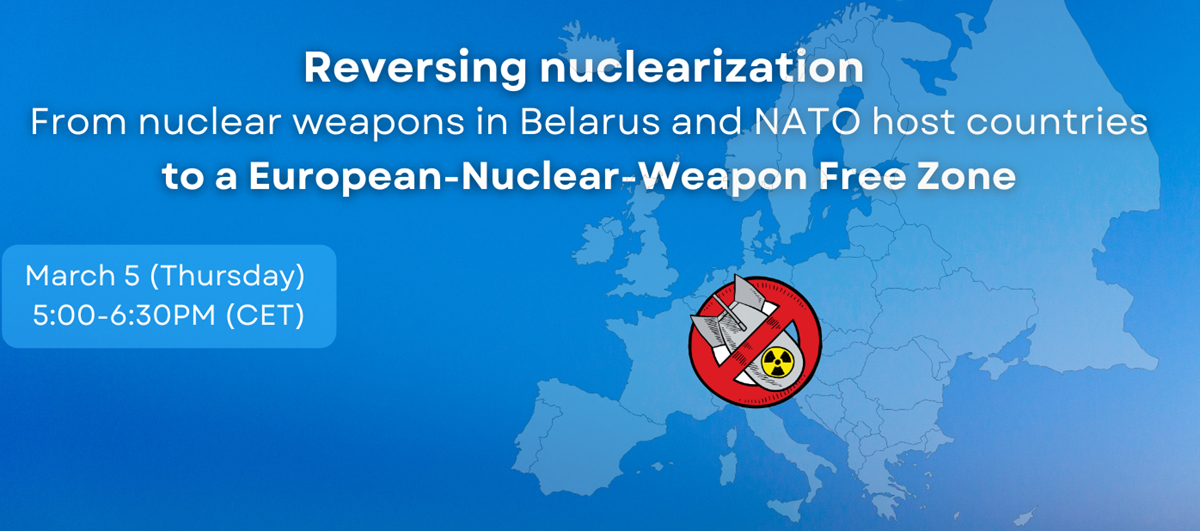
6 March -Online – Reversing nuclearization:
From nuclear weapons in Belarus and NATO host countries to a European-Nuclear-Weapon Free Zone
Mar 6, 2026 03:00 AM in Canberra, Melbourne, Sydney

of the week – Australians for War Powers Reform (AWPR)
To see nuclear-related stories in greater depth and intensity
 Antinuclear