This week’s Nuclear Notes, from Mia Pepper
 Mia Pepper , Beyond Nuclear 30 April 15 Last week the Federal Government gave conditional approval to the Kintyre uranium mine proposal on the edge of Karlamilyi National park. You can still send a message to the minister even though he’s made the decision here online action supporting Parnngurr’s. You can read the minister conditions here – which basically says they need to resubmit everything before they can start mining – reaffirming our frustration that everything we looked at through public review was a draft and could change as it goes through the DMP assessment. An article about this in the NW Telegraph is attached.
Also this week we saw the Mineral Council of Australia push for the Government to reconsider nuclear power as they also celebrated the $4 million gift to Climate denialist Bjorn Lomborg (*sigh). The South Australian Royal Commission has released papers for comment please have a look and make comment – if anyone is keen we’d love volunteer help to look through a make comment on behalf of CCWA, ANAWA or WANFA. Can pick your choice of org. We have computers, internet, photocopiers and phones to assist you in doing this.
Last week the Nuclear Non Proliferation Treaty Conference was opened in NYC – some strong statements have been made about the humanitarian cost of war and nuclear weapons, and calls to ban nuclear weapons. Unfortunately Australia is not one of those countries. Can see statements from Austria and
Mexico. Reaching Critical Will have put together this great little briefing book on the NPT, for a short read on background and demands for this conference. Yesterday there was a great action against US warships in Fremantle with Dr Death, the doomsday clock, Baloney Abbott and the CWA *concerned womyn anarchists – thanks to all involve for a very fun, engaging and peaceful protest.
The World Uranium Symposium in Quebec has now been and gone – check out the very inspiring declaration from the Symposium.
And remember to tune in to Understorey – and the Radioactive Show this week for all the latest nuclear and peace news.
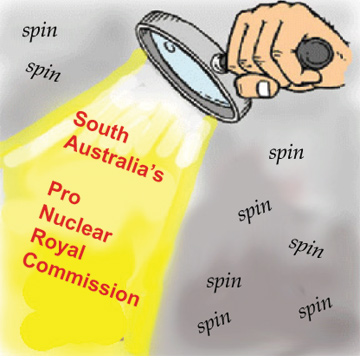
Even the pro Nuclear Royal Commission admits the threat of the nuclear industry to precious groundwater
 Groundwater a significant issue: nuclear royal commission, IN Daily,
 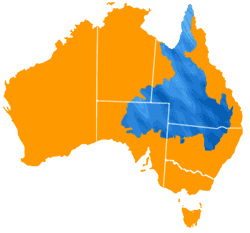 Adelaide Indpendent News, 30 April PETER GILL | 30 APRIL 2015 The potential impact of a nuclear waste storage facility on South Australia’s groundwater systems is one of the “significant issues” that need to be addressed in any consideration of expanding the nuclear fuel cycle, according to the royal commission.The second issues paper published by the royal commission says the siting and operation of a waste storage or disposal facility must take potential environmental impacts into account.
“In addition to the management of radiative exposure, a significant issue is the potential for the contamination of groundwater sources.
“Addressing that issue requires an understanding of the current frequency, flow and volume of surface and ground waters. “Management of water resources from sourcing and storage will be required if such a facility were to be sited in South Australia.
“Also significant is the potential risk of land contamination at handling, storage and disposal sites.
“Aside from its ecological impact upon animals and plants, contamination of the environment has implications for the health and safety of humans who use those resources.”
The issues paper, entitled Management, Storage and Disposal of Nuclear and Radioactive Waste,was released last week and followed the royal commission’s first public forum in Mt Gambier. Similar forums will be held in Port Augusta today (Thursday 30 April), Port Pirie tomorrow, and Berri on 5 May………http://indaily.com.au/business-insight/2015/04/30/groundwater-a-significant-issue-nuclear-royal-commission/
Minerals Council pushes for overturning of Australia’s environmental laws
When Oscar Archer spruiked on ABC Radio National for then entire nuclear chain to be set up, he left the first and most important step as a little addition near the end of his spruik. That was the necessity of overturning Australia’s Federal and State environmental laws. The Nuclear Lobby now takes this up
 Review emissions target, nuclear ban: Minerals Council The Minerals Council of Australia has called for a review of the ban on nuclear power and warned that Australia’s post-2020 emission-reduction target cannot be properly formulated without extensive economic modelling……
Western Australia ready to gamble with the radioactive uranium industry
The uranium lobby is one of the nation’s most powerful.
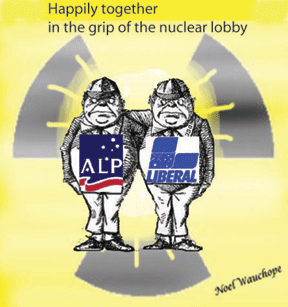 The State Labor Opposition carries on that it supports a uranium ban however this is hogwash. It was former Prime Minister Julia Gillard’s Government, helped along by Gary Gray and Martin Ferguson, who talked up uranium mining no less than Bob Hawke did, and who negotiated with India. State Labor despite its promises at its annual conferences will never reinstate the ban on uranium.
Western Australia ready to dice with uranium & radiation, The Stringer by Gerry Georgatos April 26th, 2015 “…….Yesterday, the Federal Government ‘green  light’ welcomed in a uranium mine in the Pilbara. There are now four uranium projects in advanced development stages. The Government will sell the underwriting of revenue and jobs but it is their mining chums who will get rich not the Australian nation – but the burden of any radiation leaks will be borne by the Australian people.
Mining companies are investing huge fortunes in research, exploration and development projects for the mining of uranium. Nuclear energy is not just touted but will be the energy fuel of the future. Previous and incumbent Australian Governments have signed off uranium export deals and not just with India.
Western Australia has four uranium mining projects in the advanced stages leading to their establishment – Kintyre, Mulga Rock, Wiluna and Yeelirrie.
For now, they are mostly by the communities – Homelands – of First Peoples. The communities are being told that jobs will be waiting for them at the uranium sites. The uranium sites are being sold as world’s best practice – Continue reading
Wide area in radiation danger as forests burn near Chernobyl
 Smoke from Chernobyl fire could spread radiation far and wide – experts Rt.com April 29, 2015 Smoke from burning forests in the Chernobyl exclusion zone is capable of spreading contaminants across great distances, even after the fire has been stopped, ecology experts told RT.
The forest fire near the crippled Chernobyl nuclear power plant started on Tuesday and triggered an emergency alert, with police and National Guard mobilized to bring the flames under control……
Although the sarcophagus remains untouched by the fire, decades-old contaminants could still be released and travel far and wide, borne aloft by the smoke, nuclear safety expert John H. Large told RT:
“Brush fires and forest fires were the greatest concern in terms of the means by which you can disperse a secondary radiological impact from the original dissipation that occurred in 1986,” he said. John went to Chernobyl in 2006 to assess the situation there and spoke to dozens of scientists working on containing the contamination.
“In the exclusion zone and further away you have an area that has been abandoned for farming, abandoned for man management,” John says. “That means you’ve got lots of brush and young wood growing out of control, and that means there’s a big fuel load to have a fire.”
He says the high temperatures and volumes of smoke produced in a forest fire can take contaminants hundreds of kilometers away from the exclusion zone: “Radiation really doesn’t respect any international boundaries.”
Forest fires have happened in the area before, but have never been so serious, Timothy Mousseau, biology professor at the University of South Carolina, told RT:
“Previous forest fires had re-released about eight percent of the radiation from the original catastrophe. The fire that we’re seeing today seems to be on a much larger scale, and so we could see a re-dispersion of a very significant component of the original radiation.”
Another problem is that as the trees that have absorbed contaminants burn up and release smoke, this turns radioactive particles into a much more dangerous form than if they simply lie in the ground….http://rt.com/news/254193-chernobyl-fire-radiation-spread/
In Japan clean renewable energy is on track to beat nuclear
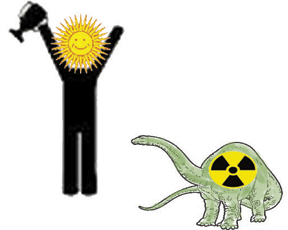
 Japan Sees Clean Energy Edging Out Nuclear Power in 2030, Bloomberg, Chisaki Watanabe and Emi Urabe 28 Apr 15 Clean energy sources will supply as much as 24 percent of Japan’s electricity in 15 years, while atomic power will account for as much as 22 percent, according to a draft report from the Ministry of Economy, Trade and Industry on what Japan’s electricity mix should look like by 2030……
If all 24 nuclear reactors currently under review for a restart by the country’s nuclear watchdog are allowed to switch back on, they would still not be able to generate more than 16 percent of Japan’s power, Greenpeace estimates. At least 10 more reactor units need to resume operations to reach the government’s target for nuclear, the group said.
Such a mass-scale restart is unlikely, according to Shaun Burnie, a nuclear specialist at Greenpeace Germany.
“The scale of the challenges facing the nuclear industry are such that generation from reactors is likely to collapse during the coming decade,” Burnie said in the statement. “Many reactors will never restart, and most reactors over the coming years will be too old to operate.”…..http://www.bloomberg.com/news/articles/2015-04-28/japan-expects-renewable-energy-to-edge-out-nuclear-power-by-2030
Julie Bishop downplays the biggest threat – nuclear war
But I think she goes too far when claiming Islamic State is the most significant threat to the global rules-based order to emerge in the past 70 years, including the rise of communism and the Cold War.
The Cold War was not a period of comforting stability and mutual understanding of avoiding Armageddon. To the contrary, it was a time of deep strategic uncertainty and extraordinary danger. There were numerous near misses from the Cuban missile crisis in 1962 to the events of 1983, when the Soviet leadership believed the US was about to embark on a disarming first nuclear strike.
When US president Ronald Reagan saw the film The Day After it had an enormous impact on him. Pentagon briefings advised him that an all-out nuclear exchange between the Soviet Union and the US would see about 100 million casualties on both sides in the first 24 hours and that America, the Soviet Union, most of Europe and Japan would cease to exist as modern functioning societies.
Much of the rest of the world, if not all of it, would have been subject to a nuclear winter involving massive radiation and catastrophic climate change.
Civilisation as we knew it would have ceased to exist. Continue reading
Middle East chaos is a boon for the weapons industry
 The Middle East accounts for approximately 32 percent of the United States’ weapons export market. From 2010 to 2014, the United States exported $43 billion in arms worldwide, according to the Stockholm International Peace Research Institute.
Russia has a thriving weapons export market as well. In 2012-2013, it sold $58.8 million in weapons to Iran and $1.2 billion in weapons to Syria
Weapons Manufacturers Are Making a Fortune Off Mid-East Chaos, Reader Supported News By Tim Mak, The Daily Beast 29 April 15
The Middle East is on a knife’s edge, thanks to a lunatic ISIS and a rising Iran. For American arms-makers, that means only one thing: opportunity.
 ar in Yemen. The continued threat of ISIS. Ongoing conflict in Iraq and Syria. Increasing Iranian influence. As America’s Middle Eastern allies watch their neighborhood burn, the U.S. defense industry is viewing increased instability as a money-making opportunity.
An unintended consequence of growing Iranian clout in the Middle East—punctuated most recently by a framework nuclear deal—has been the Obama administration’s decision to ease Gulf ally concerns by approving more sales of U.S.-made weaponry.
According to defense industry sources, inquiries for their product are way up. So while the region is a disaster for the Gulf states, the recent chaos is a timely godsend for the American defense industrial base—which due to congressional spending cuts is badly in need of customers. Continue reading
United Nations forum supports Kimberley Land Council’s plea to save Aboriginal communities from closure

Australian Capital Territory helps Victoria’s wind energy industry to get going
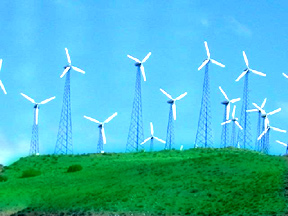 Coonooer Bridge Wind Farm a renewable win for Victoria in dire environment, SMH April 28, 2015 Tom Arup Environment editor, The Age It’s been a torrid few years for renewable energy in Australia, with jobs being shed and investment drying up. The Victoria landscape has been no exception.
So it is perhaps to some state shame that one of the few recent Victorian projects to get the financial go-ahead has been backed by the Australian Capital Territory.
On Tuesday renewable energy firm Windlab announced it has signed a deal with a Japanese company for the final financing for a $50 million wind farm north-west of Bendigo, meaning construction will now begin mid-year.
The Coonooer Bridge Wind Farm will have a modest six turbines and generate up to 19.4 megawatts of power, enough for 14,000 homes It is one of three wind projects supported by the ACT government via feed-in-tariffs, with winning projects selected earlier this year through an auction. Company RES Australia was also backed to build a 80.5 megawatt wind farm near Ararat.
The auctions are part of the ACT’s goal to have 90 per cent of its electricity needs come from renewable power by 2020. Continue reading
Forced evictions: Australian govts make way for uranium miners
50 City of Perth armed police raided an Indigenous homeless camp at Matagarup, and drove off mostly elderly women and young mothers with children. The people in the camp described themselves as “refugees … seeking safety in our own country”. They called for the help of the United Nations High Commissioner on Refugees.
Australian politicians are nervous of the United Nations. Abbott’s response has been abuse. When Professor James Anaya, the UN Special Rapporteur on Indigenous People, described the racism of the “intervention” , Abbott told him to, “get a life” and “not listen to the old victim brigade.”
The planned closure of Indigenous homelands breaches Article 5 of the International Convention for the Elimination of Racial Discrimination (ICERD) and the Declaration on the Rights of Indigenous People (UNDRIP).
Forced evictions are Australia’s latest racist assault on Aboriginal  People, Ecologist 28 Apr 15 28th April 2015 Australia’s deliberate and calculated attacks on its indigenous population carry many of the hallmarks of genocide, writes John Pilger. And things are getting worse, not better, as states that have grown rich by exploiting Aboriginal land evict and demolish remote Aboriginal communities. Australia has again declared war on its Indigenous people, reminiscent of the brutality that brought universal condemnation on apartheid South Africa.
Aboriginal people are to be driven from homelands where their communities have lived for thousands of years.
In Western Australia, where mining companies make billion dollar profits exploiting Aboriginal land, the state government says it can no longer afford to“support” the homelands.
Vulnerable populations, already denied the basic services most Australians take for granted, are on notice of dispossession without consultation, and eviction at gunpoint. Yet again, Aboriginal leaders have warned of “a new generation of displaced people” and“cultural genocide”.
Genocide is a word Australians hate to hear. Genocide happens in other countries, not the ‘lucky’ society that per capita is the second richest on earth. Continue reading
An American example of how the nuclear industry subverts democracy

 LePage Plan to Change Nuclear Power Rules Meets Resistance MPBN News, By Alanna Durkin, The Associated Press, 29 Apr 15
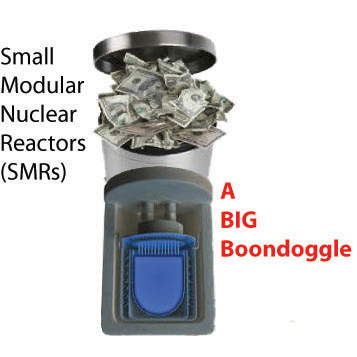
AUGUSTA, Maine – Republican Gov. Paul LePage’s proposal aimed at making it easier to bring small nuclear power plants to Maine is meeting fierce resistance because it would strip voters of their power to sign off on new plants.
Currently, Maine voters must approve the construction of any nuclear power plant. But LePage wants to remove that requirement for plants that generate 500 or fewer megawatts…….anti-nuclear activists said that removing voters’ right to decide whether Maine should build more potentially dangerous plants is wrong.
The state’s only nuclear power plant, Maine Yankee, closed in 1997.http://news.mpbn.net/post/lepage-plan-change-nuclear-power-rules-meets-resistance
 The Real State Of Australia’s Energy Resources Highlights Need For Significant Renewable Energy Investments, IBT, By Reissa Su on April 28 2015 “…………………Outlook For Australia’s Renewable Energy
The need for significant change to the Australian energy market is highlighted by the international effort to shift to renewable energy sources to reduce greenhouse gas emissions. The journey to a lower emissions economy has already begun for Australia with the introduction of the renewable energy target and other government policies.
In 2012, the Australian government had established the Australian Renewable Energy Agency, or ARENA, to provide funding for research, development and demonstration of renewable energy technologies. ARENA initiatives include helping renewable energy technologies move closer to commercialisation and providing system-wide solutions to renewable energy output variability. According to a press release on April 13, ARENA has announced a $20 million research and development round dedicated to industry-partnered projects that seek to commercialise renewable energy.
Opposition Leader Bill Shorten released his own statement in response to the government’s white paper. The Australian Labor Party has fully expressed its support for efforts to boost renewable energy investments and retain jobs in the sector. Continue reading
Japn on the way to becoming the world leader in solar power
 The U.S. media rarely reports on the huge marches by this pro-solar, anti-nuke movement in Japan. Now, four years later, all the nukes are still shut down …. and the lights are still on.
Why? Because the people’s solar movement has worked every day to install millions of solar panels everywhere in Japan. It is working
Four years after Fukushima, Japan is solar-powered Bay View by Theresa Coleman and Paul Kangas, 29 Apr 15
In the week before the March 11, 2011, earthquake at Fukushima, one person, Prime Minister Naoto Kan, did an extraordinary act that set Japan’s energy course in history for the next 100 years. He was able to convince the Japanese Parliament to pass a solar payment policy (SPP), that required big utilities in Japan to pay solar home owners $0.53 kwh for 20 years.
This is amazing. One, because the rate is very attractive to solar home owners and two, because he even made the effort. This one policy shift is now making Japan one of the leading solar powered nations on earth – far ahead of California or the U.S.
Number one in solar generation in 2014 was Germany. The same year they won the World Cup in soccer. They are on a roll. It is going to be interesting to see if China becomes No. 2 in 2015. It is a tight three-way race between Japan, Germany and China. Who will win?
The really big question is: “What inspired Prime Minister Naoto Kan to introduce this solar payment policy to the Japanese Parliament the day before Fukushima? Was it Chernobyl? Continue reading
Dismantle Nuclear Bombs and Reactors – read “Plutopia”
Enough of this century of dread. Nuclear waste is here to stay, but the bombs and reactors can be dismantled. Shut it all down before the centennial of the Trinity Nuclear Bomb Test at Alomogordo, July 16, 1945
Plutopia: Interview with Kate Brown on Talking Stick TV (transcript), Nuclear Free by 2045 29 Apr 15
 Plutopia: Nuclear Families, Atomic Cities, and the Great Soviet and American Plutonium Disasters
Mike McCormick interviews author Kate Brown on Talking Stick TV
January 18, 2014
Do we all live in Plutopia? This is the disturbing question implied by Kate Brown’s book. By describing the towns where Americans and Soviets made plutonium for their nuclear weapons, she raises troubling questions about how the project influenced all urban design and social structures of the post-nuclear world. We are all participants in the plutonium economy. She says toward the end of this interview, “… this epitomizes a lot of shifts we find in American society in the post-war years… making these kinds of exchange, of body rights, rights over one’s body, and civil rights and freedoms for consumer rights and financial security, and national security made sense to a lot of Americans, not just people in Richland.”
If you can’t find the time to read the whole book, this interview serves as the next best thing. It was so good that I realized a transcript of it could serve as a comprehensive journal article that summarizes all the research that went into the book. I found a way to download the terribly inaccurate automated subtitles that Youtube produces, then transformed them into an proper transcript……..http://nf2045.blogspot.jp/2015/04/plutopia-interview-with-kate-brown-on.html
1 This month
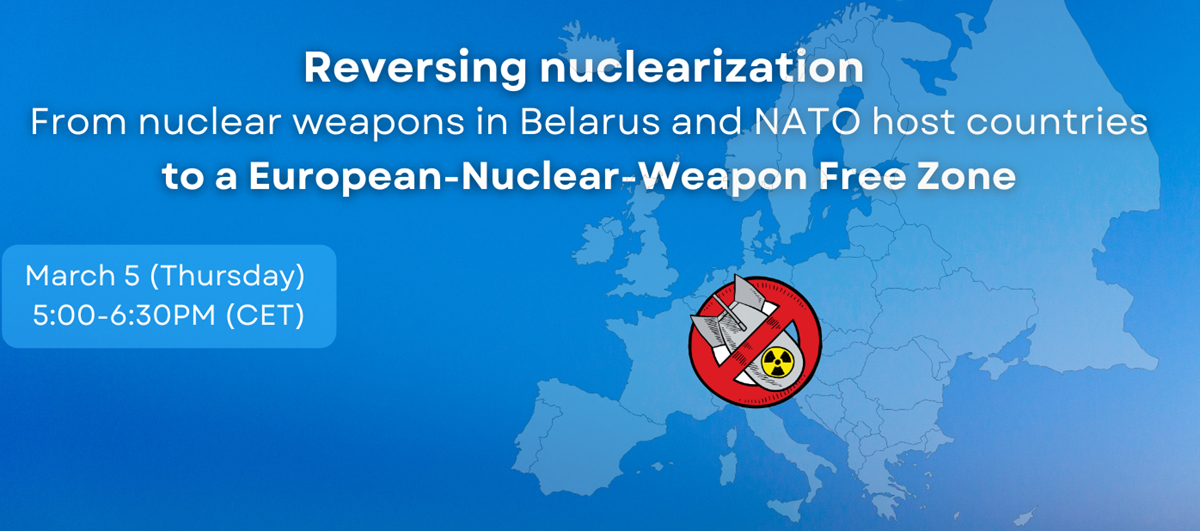
6 March -Online – Reversing nuclearization:
From nuclear weapons in Belarus and NATO host countries to a European-Nuclear-Weapon Free Zone
Mar 6, 2026 03:00 AM in Canberra, Melbourne, Sydney

of the week – Australians for War Powers Reform (AWPR)
To see nuclear-related stories in greater depth and intensity
 Antinuclear