Nuclear reprocessing threatened by cheap, efficient, deep bore wastes disposal
successfully developing deep-hole disposal techniques would be a great development for society
 it could be devastating for next-generation nuclear developers attempting to utilize existing used nuclear fuel stockpiles
Why Sending Nuclear Waste to the Center of the Earth is Bad News for General Electric, Motley Fool By Maxx Chatsko April 30, 2015 “………the U.S. Department of Energy is set to experiment with a technique to dispose of nuclear wastes by drilling 3-mile boreholes into the Earth’s crust and then, well, dropping radioactive materials into their geological tombs. For good
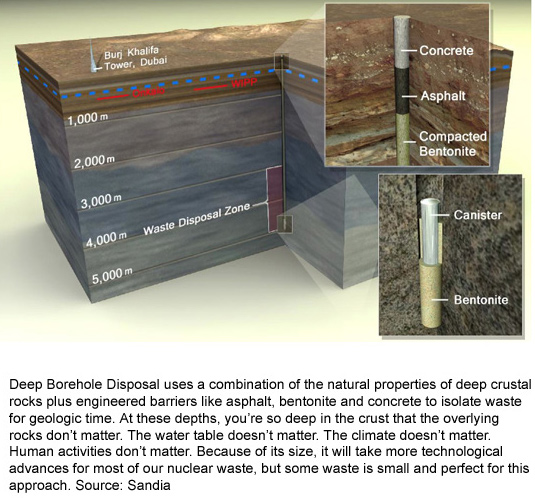
………Fergus Gibb, the technique’s pioneer, told The Engineer that each bore hole, measuring roughly 3 miles deep and 2 feet wide, would cost just a few tens of millions of dollars to drill. …
Although there is no long-term plan for disposing of nuclear waste, the Nuclear Regulatory Commission has always been preparing for the inevitable decommissioning of nuclear power plants. Thus, every nuclear power plant in the United States has been required to pay into the Nuclear Decommissioning Trust, or NDT, at a rate of $0.001 per kilowatt hour of electricity to fund future closure and waste disposal expenses.
At the end of 2013, the Trust had a balance of $58 billion. It’s no Apple war chest, but it’s impressive nonetheless.
Of course, when regulators set the massive balance requirement decades ago, it wasn’t based on any expected expense, just with the expectation that decommissioning would be expensive. If something as simple and low-cost as deep-hole disposal becomes a suitable option, the NDT will have more than enough funds to cover it — and the excess will be redistributed to companies that have been paying their fair share over the decades…..
It’s not all good news. General Electric has been hard at work resurrecting designs for a Generation IV small modular reactor, or SMR, called PRISM. Engineering and design work is still being completed, but the sodium-cooled reactor will be capable of consuming traditional nuclear fuels, plutonium fuels, and used nuclear wastes — the same materials the DOE wants to bury deep underground.
One of the major value propositions for PRISM, aside from its low-cost footprint and supercharged power capacity, was its ability to consume spent nuclear wastes. General Electric has been pursuing the United Kingdom’s plutonium stockpile for the flagship deployment of the technology, but the opportunity to build SMRs at existing or decommissioned nuclear power plants was tremendous. If deep-hole disposal proves successful and emerges as the method of choice, General Electric could miss out a critical market for its latest atomic thrust.
What does it mean for investors?
From a completely neutral standpoint, successfully developing deep-hole disposal techniques would be a great development for society. We’ve invested hundreds of billions of dollars in nuclear energy technologies — a monumental achievement in itself — without developing adequate solutions to store the unfortunate byproducts……..
it could be devastating for next-generation nuclear developers attempting to utilize existing used nuclear fuel stockpiles…….. PRISM does have the potential to emerge as a leading revenue source for the company and investors should its use become heavily adopted. That being said, in the long run investors in GE may have to take one for the team……..http://www.fool.com/investing/general/2015/04/30/sorry-general-electric-the-doe-may-send-nuclear-wa.aspx
No comments yet.
1 This month

of the week – Australians for War Powers Reform (AWPR)
To see nuclear-related stories in greater depth and intensity
 Antinuclear
Leave a comment