Kevin Scarce, Nuclear Royal Commission chief, shows up in his true pro nuclear colours
 Dennis Matthews, 26 June 15 It does no credit to the Advertiser, or Kevin Scarce, or the SA inquiry into the nuclear industry when Scarce cites misleading statements like no one was killed by exposure to ionising radiation from the Fukushima disaster (The Advertiser, 25/6/15).
This sort of ignorance was promulgated generations ago by the asbestos industry. Gullible, greedy politicians and newspaper editors became part of the problem and it took many decades before action was taken.
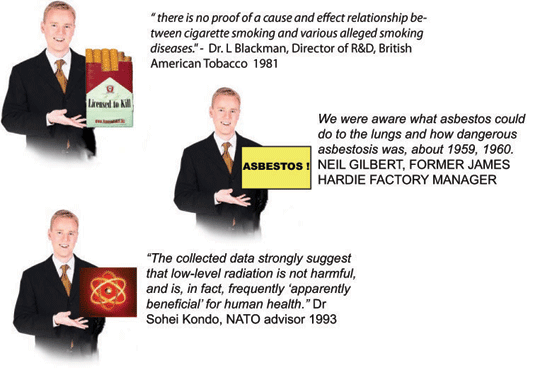
Sure, nobody was killed outright by asbestos, and lots of jobs and wealth were produced, but do we really want to lumber the next generation of South Australians with another expensive medical disaster?
It’s time that editors, politicians, and ex-Governors learnt from the past. Learnt that some medical disasters don’t happen overnight and can take decades to be diagnosed.
As with asbestos, the nuclear industry and its supporters will undoubtedly be condemned by history. It’s a pity that the Scarce’s and Koutsantonis’s of this world won’t be around to try to defend themselves.
Nuclear Royal Commission chief Scarce says “Don’t worry about Fukushima”
Fukushima scarcely a worry Adelaide Advertiser, Adelaide, Paul Starick 25 Jun 2015 FORMER governor Kevin Scarce says the Fukushima disaster doesn’t pose a major barrier to the nuclear industry’s development in SA.
The Nuclear Fuel Cycle Royal Commissioner, who toured the Fukushima exclusion zone during a global study tour, says the 2011 nuclear power plant meltdown was a result of poor design and management. In an exclusive interview with The Advertiser, Rear Admiral (retired) Scarce said the six-country study tour had demonstrated SA was technically capable, with help, of developing a nuclear industry, from the enrichment to spent fuel rod reprocessing, if this was financially viable.
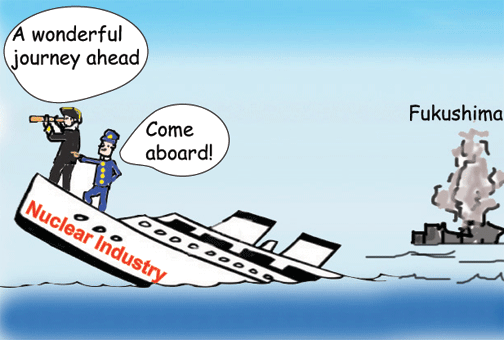
……. Rear Admiral Scarce said the disaster had prompted safety rethinks at other sites the three-person delegation visited during the Asian and European tour, completed this month…..it doesn’t indicate to me that we shouldn’t be looking at this technology. “It means we’ve got to be very careful. We’ve got to be aware of what the consequences are.
“As devastating as Fukushima was, the subsequent improvements made since then enable us to go and look at this technology for our future.”….
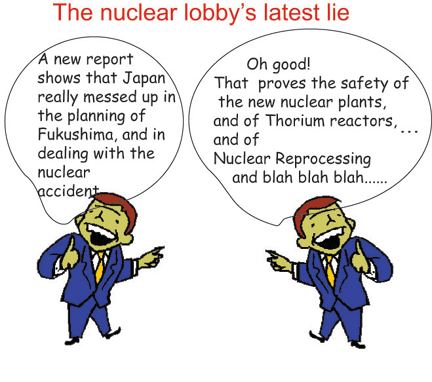
Stricken Fukushima nuclear station faces new problems
New Problems & Challenges Plague Fukushima, Simply Info June 23rd, 2015 As June wanes we find more delays, more problems and new admissions about the extent of the disaster.
TEPCO introduced a new roadmap plan. In this they declared they would now focus on safety over speed. At the same time they announced that spent fuel removal work for units 1-3 would be delayed again. Currently they are attempting to remove the cover on unit 1 but this process has not actually begun based on visual evidence at the plant. TEPCO has not been forthcoming what is delaying this work again. Work at unit 3 had been underway in early spring to remove parts of the crane that fell into the fuel pool. An oil leak was found as they attempted to remove a portion of the crane. This stopped the removal work as they cleaned the oil out of the pool water and investigated a cause. Around the same time they discovered damage to the metal gate that connects the spent fuel pool to the reactor well. After this discovery, removal work at unit 3 appeared to cease.
Newer reports also showed that the earlier concept of flooding the reactor containments to remove damaged fuel debris is being phased out. ……..http://www.fukuleaks.org/web/?p=14818
South Australia’s pro nuclear lobby upset about the State’s embrace of rooftop solar
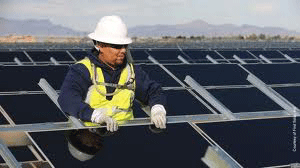 Dennis Matthews, 26 June 15, There is little doubt that South Australians have embraced rooftop solar electricity, with gusto. This is undoubtedly a worry to the pro-nuclear lobby ( a long time opponent of renewable energy) and to companies who stand to lose income from such independent electricity producers.
Thanks to the breakup and privatisation of the former publicly owned ETSA, what one part of the electricity industry gives, another part can just as easily take away. Or as the monopoly electricity network company SAPN has so coyly put (The Advertiser, 25/6/15) “it was ultimately up to the energy retailers as to how much of the reduction in SAPN charges were passed on to householders.”
Given that SAPN and the retailers do not compete for the electricity dollar, what’s the bet that prices will continue to go up, maybe not this year but almost certainly by the end of 2016, and that each segment of the privatised electricity industry will blame the other.
South Australia’s Renewable Energy Future
 Renewable energy future for South Australia http://indaily.com.au/opinion/2015/06/25/renewable-energy-future-for-south-australia/ MARK DIESENDORF | 25 JUNE 2015 The closure of Alinta Energy’s Leigh Creek Coal mine and two Port Augusta power stations will cost 438 jobs in South Australia, but over several years this could be transformed into an opportunity to create many new jobs in renewable energy.
South Australia’s wind and solar resources are huge, and SA is already the leading Australian state in non-hydro renewable energy utilisation, with about 40 per cent of its annual electricity consumption coming from wind and sunshine.
State electricity supply has operated reliably and stably for hours when the contribution of variable renewable energy reached two-thirds of demand, and wind power and gas coped admirably recently when the coal-fired Northern power station went unexpectedly offline.
The SA electricity system could be operated entirely on scaled-up, commercially available, renewable energy sources. This is the conclusion of the studies underlying my report to the Conservation Council of South Australia, now available online.
Our hourly simulation modelling at University of New South Wales shows the South Australian system could be supplied by a combination of variable renewable energy sources (wind and solar PV), and flexible, dispatchable sources (biofuelled gas turbines and concentrated solar thermal power with thermal storage).
It is the combination of variable and flexible sources that is the basis for reliability. Continue reading
Antony Hegarty speaks out on Q and A against the nuclear industry
 Q & A ABC TV Monday 22 June, 2015 “………….CURTIS TAYLOR: Thanks, Tony. I travelled here with my family from the western desert and my question to the panel is: There has been huge momentum around the Recognise campaign and changing the Constitution. What we want to know is when are we going to talk about changing the Native Title Act because for us the problem is native title is not land rights? We have native title over our country and we have been forced to negotiate with mining companies like Cameco over the Kintyre uranium project and Reward Minerals over the Lake Disappointment, Kumpupirntily. Both mining projects we don’t want on our country but we have no rights to say no to mining under native title. When will Australia start talking about changing the Native Title Act and getting real land rights for Indigenous people? …….
ANTONY HEGARTY: Well, I would just add to that from the side of corporations and business interests in general, it is the oldest – it’s the story as old as the hills. It is the story of – it’s the story of the, like, you know, the virulent consumption of North America, you know, is to manipulate, to divide and conquer Indigenous people, create a cloud of confusion and then rush in and steal the spoils during that window of opportunity and then it’s too late to go back. You know, these kinds of damages that you are proposing, that the companies your party represents are proposing, you know, are irreversible. You know, and they affect the most pristine lands on this continent, in some of the most beautiful places in the world and affect some of the most plugged in, spiritually aware and forward thinking communities in this country. You know, the Indigenous people of Australia are one of our most precious resources in terms of being a people that have an almost unbroken, you know, story that goes back 60,000 years of maintaining a sustainable relationship with nature and with treading lightly on the ground and leaving no trace and collaborating with nature in a sustainable way……….
TONY JONES: Okay, I’m going to quickly go to Grahame because you were doing quite a good impersonation of steam power there. It was coming out of your ears.
GRAHAME MORRIS: Oh, God. Look, you know, not everyone wants a bloody big windmill in their back yard. Look, nuclear power is clean. It is the clean energy.
ANTONY HEGARTY: We’d be happy to dig – we’d be happy to dig a uranium mine in your garden. ……..http://www.abc.net.au/tv/qanda/txt/s4242255.htm
British musician Antony Hegarty joins the Martu people in their struggle against uranium mining
 UK musician joins Indigenous campaign against uranium mine The elders of the Martu people in Western Australia’s Pilbara region are campaigning against a proposed uranium mine and they’ve received support from an unlikely ally – an avant-garde British musician.
SBS News, By Sally Block 23 JUN 2015 THEY’RE FIGHTING AN UPHILL BATTLE.
Senior Martu artists in Parnngurr in the east Pilbara region of Western Australia are taking on the mining giants.
They painted ‘Kalyu’ to help raise funds for their campaign. It depicts the waterways or Kalyu over the proposed Kintyre uranium mine.
“Kalyu tells the story about water that’s on the surface, which can be waterholes, springs, rockholes soaks that you can dig up and drink but also see it visibly,” says one artist’s grandson, Curtis Taylor.
“Forever that uranium belongs to that place, underground.” “But it’s poison, when you dig it up – when it gets exposed.” “We are carrying the land, we are that close,” his grandfather Wokka Taylor said.
And the campaign has caught worldwide attention.
Avante-guard British musician Antony Hegarty is joining the campaign, moved by the Martu people’s connection to nature.”They have an almost unbroken connection to 60,000 years of land stewardship and stepping gently and leaving no trace.
“They’re environmental experts and they’re spiritual experts and they have a lot to teach us,” he said. Backing a push to stop Canadian Mining giant Cameco, along with Japanese owned Mitsubishi from going ahead with the uranium mine.
Concerned environmentalists are also joining the fight……..http://www.sbs.com.au/news/article/2015/06/22/uk-musician-joins-indigenous-campaign-against-uranium-mine
$ 3.7 trillion to be invested globally in solar by 2040
 Report: The world will invest $ 3.7 trillion in solar by 2040, WP, By Chris Mooney June 23 The world’s energy portfolio will get vastly cleaner by the year 2040, says a new long-term energy outlook from Bloomberg New Energy Finance — but not clean enough.
Out to 2040, the world will see a jaw-dropping growth of solar energy, especially on rooftops. BNEF projects $ 3.7 trillion of solar investment in the next 25 years — 35 percent of new electricity-generating capacity. And $2.2 trillion of that investment will be for individual rooftops or other “local” installations, rather than large utility-scale arrays…….http://www.washingtonpost.com/news/energy-environment/wp/2015/06/23/our-solar-future-still-has-a-lot-of-coal-plants-in-the-background/?postshare=3131435158010724
Australian Liberal Party is urged, by farmers, to defeat climate denialism
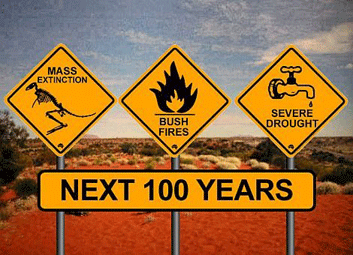 Farmers call on Liberals to snuff out internal push by climate sceptic conservatives, SMH, June 25, 2015 Heath Aston Political reporter Farmers are circulating an open letter calling on the Liberal Party to kill off an internal push to derail Australia making meaningful commitments at the upcoming Paris climate talks.
The letter, which describes farmers as being “on the front line of rising temperatures and more extreme weather”, urges the Liberals to resoundingly defeat a climate sceptic motion to be debated at its federal council meeting on Saturday……http://www.smh.com.au/federal-politics/political-news/farmers-call-on-liberals-to-snuff-out-internal-push-by-climate-sceptic-conservatives-20150625-ghxp5s.html
Better prospects now for action on climate change
The prospects for action on climate have never been better, Canberra Times, John Quiggan June 24, 2015 Climate change has been called the greatest challenge facing the world, and it has certainly been one of the most intractable. So much so, in fact, that many observers have concluded that we are past the point of no return and that dangerous climate change is now inevitable. Others have concluded that only a drastic fix will solve the problem. Their various, and incompatible, suggestions include large-scale geo-engineering, a crash program of building nuclear power plants, and the abandonment of industrial civilisation.
Positions of this kind, once taken, are hard to shift. So it’s not surprising that hardly anyone has recalibrated their views in response to recent developments that have greatly improved our prospects of avoiding dangerous climate change. But such a recalibration is certainly necessary if we’re to make progress.
The first of these developments is the effective end of the debate over climate science. The debate hasn’t been resolved, but it has been clarified, with the positions of the two sides now established and unlikely to shift. On one side is a vast body of scientific analysis summarised in the reports of the Intergovernmental Panel on Climate Change, or IPCC. There is no longer any scientific debate on the key issues, or any serious perception of one…….
1 This month

of the week – Australians for War Powers Reform (AWPR)
To see nuclear-related stories in greater depth and intensity
 Antinuclear