Once again, Chernobyl’s radioactive zone threatened by forest fires
 Chernobyl exclusion zone on fire again http://www.rt.com/news/311976-chernobyl-exclusion-
 zone-fire/ 9 Aug, 2015 As many as 32 hectares of new wildfires have been registered in the exclusion zone close to the Chernobyl nuclear power plant, report Ukraine’s emergency services report. Firefighters are battling new fires that have flared up in the Kiev region. Continue reading
Australian electricity companies offer solar, battery technology for lease
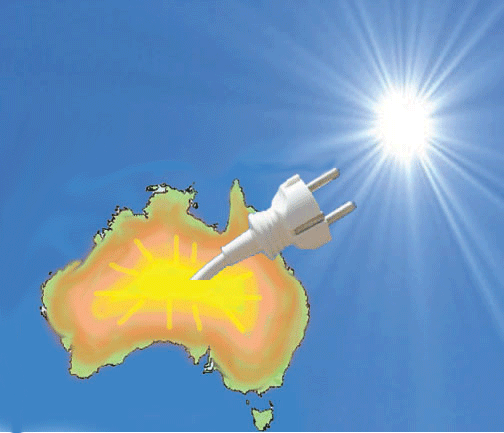 Solar power for rent: Electricity companies offer solar, battery technology for lease http://www.abc.net.au/news/2015-08-07/solar-power-for-rent-batteries-electricity/6679494 AM By Eric Tlozek Electricity companies have offered solar and battery systems for lease in a bid to keep customers and lower their own costs. Continue reading
How to make sense of ‘alarming’ sea level forecasts #Auspol #ClimateChange

You may have read recent reports about huge changes in sea level, inspired by new research from James Hansen, NASA’s former Chief Climate Scientist, at Columbia University. Sea level rise represents one of the most worrying aspects of global warming, potentially displacing millions of people along coasts, low river valleys, deltas and islands.
The Intergovernmental Panel on Climate Change, the UN’s scientific climate body, forecasts rises of approximately 40 to 60 cm by 2100. But other studies have found much greater rises are likely.
Hansen and 16 co-authors found that with warming of 2C sea levels could rise by several metres. Hansen’s study was published in the open-access journal Atmospheric Chemistry and Physics Discussion, and has not as yet been peer-reviewed. It received much media coverage for its “alarmist” findings.
So how should we make sense of these dire forecasts?
What we’re pretty sure about
According the to the IPCC…
View original post 178 more words
Japan’s Nuclear History and the Power of Peace


“Paper cranes prayers for peace. Peace Memorial Park, Hiroshima Japan” See: https://miningawareness.wordpress.com/2014/08/06/1000-japanese-cranes-sadako-sasaki/
From Greenpeace:
“Japan’s nuclear history and the power of peace
Blogpost by Junichi Sato – 6 August, 2015
Protest on the anniversary of the Hiroshima bombing in 1990, in Hiroshima, Japan.
The fight against nuclear is steeped in Greenpeace history. On the 70th anniversary of the Hiroshima and Nagasaki bombings we’re reminded of the consequences of nuclear energy and the people’s movement to campaign for nuclear disarmament to create a safer and sustainable future for the people of Japan and the world.
Seventy years ago, the world’s first atomic bombs were dropped on the Japanese cities of Hiroshima and Nagasaki, creating a “mushroom cloud” and killing more than 450,000 people. The horror of these bombings has been an eternal memory for survivors, imprinted on the consciousness of people around the world, and a reminder of…
View original post 499 more words
The reality of global warming: We’re all frogs in a pot of slowly boiling water. #Auspol
In 2009, global leaders agreed to try not to let the world warm more than 2 degrees Celsius above pre-industrial times. This is sometimes seen as a rule of thumb for keeping on the right side of climate change, within “safe” territory.
But that’s not at all how scientists meant it, Professor Camille Parmesan, an expert in biodiversity at the University of Plymouth in the United Kingdom said. Climate risks don’t begin at 2C, she said; it’s more like where they go from high to intolerably high.
The planet has already warmed by about 0.8C (1.7 Fahrenheit) since the late-19th century.
Some of the world’s most iconic places are also the most vulnerable, and they are already feeling the effects.
“We’re already seeing contraction of species in the most sensitive ecosystems, such as those dependent on sea ice or those living on mountain tops,” she said. “We’re also seeing declines…
View original post 707 more words
How much will irreversible damage to the oceans’ ecosystems cost? #Auspol #ClimateChange
It’s no surprise that climate change is raising summer temperatures in many parts of the globe, but what you might not know is where most of that extra heat is going.
Scientists estimate that as much as 90% of it is heading straight into our oceans, and that has major consequences not only for marine wildlife but for the world’s economy.
The average surface temperature around the world has increased by roughly 1.08 degrees Fahrenheit over the last 40 years, but that number would be a lot larger if it weren’t for the oceans.
“To date, the oceans have essentially been the planet’s refrigerator and carbon dioxide storage locker,” Hans-Otto Pörtner, who is a researcher at the Alref Wegener Institute, Helmholtz Centra for Polar and Marine Research, told ScienceDaily. “For instance, since the 1970s they’ve absorbed roughly 93% of the additional heat produced by the greenhouse effect, greatly helping to…
View original post 375 more words
1 This month
15 April – Zoom –Nuclear Power is Not the Solution
Apr 15, 2026 01:00 AM in Canberra, Melbourne, Sydney

Join the International Physicians for the Prevention of Nuclear War (IPPNW) on Tuesday, April 14th for a timely webinar exploring the risks associated with nuclear power and challenging the myth that it offers a simple, safe, carbon-free solution to the climate crisis

of the week – Australians for War Powers Reform (AWPR)
To see nuclear-related stories in greater depth and intensity
 Antinuclear