Coal giant Adani in a financial pickle
 Adani’s finances go from bad to worse, Independent Australia Lachlan Barker 3 January 2016, Federal and State Governments continue to approve it but the Adani Carmichael project will never eventuate unless an investor with “a financial death wish” can be found, writes Lachlan Barker.
IN OCTOBER 2015, the new Minister for Resources, Energy and Northern Australia,Josh Frydenberg, made a death knellpronouncement on Adani’s Carmichael Coal Mine and Rail Project, indicating that the rail line to the Galilee Basin to serve the mine:
“… wouldn’t be a priority project.”
He added that Adani’s project was:
“… a commercial operation and it needs to stand on its own two feet.”
This makes it pretty clear that the federal government have, at last, recognised that this Adani coal mine has not a chance in hell of making a red cent and federal funding through the Northern Australia Infrastructure Facility (named by opponents as the ”Dirty Energy Finance Corporation”) will not be provided.
Additionally, the banks have indicated that they will not touch this project and the one bank that Adani has constantly pointed to as a source of finance, the State Bank of India (SBI), has not actually said “yes” to the project. The SBI has simply received an application from Adani for financing.
Currently, the SBI are reviewing Adani’s application – as they do with any application – and will, presumably, announce their decision soon.
So, with no banks and now without the Australian Government, Adani were left with the solitary hope that the Queensland Government might come to the “white elephant” party.
If that was indeed their main source of hope, they must have been chagrined when, over the Christmas break, a tiny story appeared on the SBS website, headlined, ‘Adani must fund mine: Qld premier’.
The link takes us to a brief story reprinted here:
Queensland’s government has warned Indian mining giant Adani it must finance the controversial Carmichael coal mine on its own.
The federal government on Tuesday approved the expansion of Abbot Point port, which is intended to service the proposed Carmichael mine, prompting Premier Annastacia Palaszczuk to sternly tell Adani not to expect any financial assistance from the state.
“There will be no taxpayers’ money going towards this project,” she said.
At the time of writing, the only entity on the planet prepared to fund the Carmichael mine project – rated as a A$16 billion project (US$11 billion) – is Adani itself.
IEEFA tells us that Adani has already borrowed A$3 billion for the initial investment in the mine and now need to raise the remaining A$13-14 billion (US$9-10 billion). That being the case, the mine looks as likely to be built as environment minister Greg Hunt’s chances of getting an invitation to the Greenpeace Christmas party — for Adani’s financial situation has got worse………https://independentaustralia.net/article-display/adanis-finances-go-from-bad-to-worse,8539
“Nuclear Armageddon” – a past idea (but it could happen today)
Memories of Whistling Past Nuclear Armageddon, NYT By FRANCIS X. CLINESJAN. 2, 2016 No one called it terrorism back then, but the angst of day-to-day existence during the Cold War was chillingly recalled with the release last month of the government’s top-secret nuclear target list for 1959. “Population” was the obscenely brief title of target category No. 275 — population, as in the citizens of major cities who war planners estimated would necessarily die by the millions……..
“Duck and cover” jokes and tight-lipped laughter became the real civil defense in the Cold War. It felt smarter to seek survival in satire like Stanley Kubrick’s “Dr. Strangelove.” Or in Mort Sahl’s stand-up skewering of Dr. Wernher von Braun, the captured German rocket scientist, who metamorphosed into an American space-age hero. Mr. von Braun said in his best-selling autobiography that “I aim at the stars.” “But,” Mr. Sahl amended, “sometimes hit London,”……..
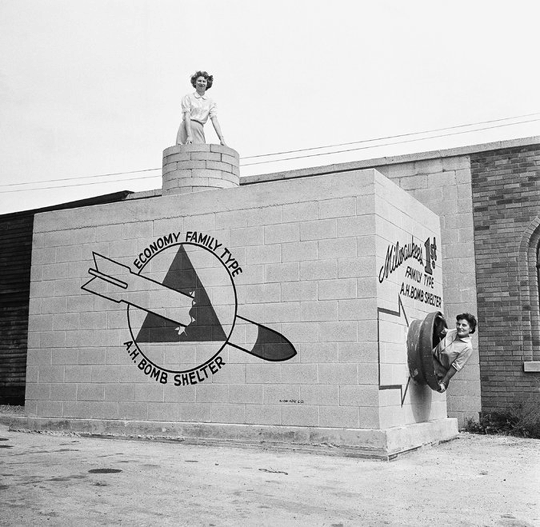
the notion of nuclear Armageddon reappeared with the discovery by the New York State Assembly during a routine session that the state, in 1963, had actually constructed a bomb shelter with 4½-foot-thick walls and drawn up a list of 700 or so people who would be privileged to survive in it.
The long-forgotten shelter was a quiet, pet project of Gov. Nelson Rockefeller, who was also one of the era’s chief promoters of bunkers. Immediately, questions arose among the lawmakers: Why didn’t I know about this until now? More urgently: How do I get on the list?…….http://www.nytimes.com/2016/01/03/opinion/sunday/memories-of-whistling-past-nuclear-armageddon.html?_r=0
Mahatma Ghandi -his message is relevant today
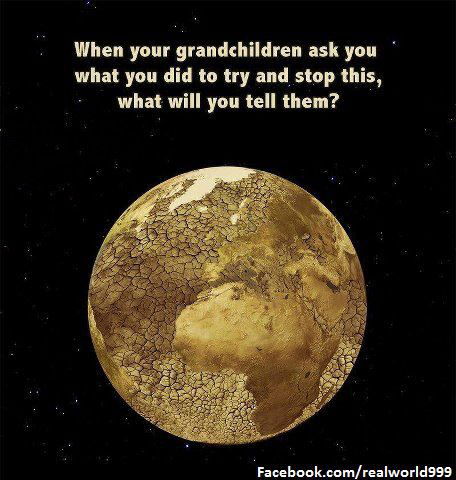 Ecological Meltdown And Nuclear Conflict: The Relevance Of Gandhi In The Modern World By Colin Todhunter Global Research, January 03, 2016 ………. Gandhi was ahead of his time. Although he might not have used today’s terms, ideas pertaining to environmentalism, agroecology, sustainable living, fair trade, local self-sufficiency, food sovereignty and so on were all present in his writings. He was committed to inflicting minimal damage on the environment and was concerned that humans should use only those resources they require and not amass wealth beyond their requirements. People have the right to attain certain comforts but a perceived right to unbridled luxuries would result in damaging the environment and impinge on the species that we share the planet with. His own lifestyle was a highly sustainable one, focusing on simplicity, austerity and need rather than want…………. government after government aggravates the problems by creating an impression that the villagers are a backward, inefficient and unproductive lot who can survive only on relief. With proper investment and appropriate policies, India’s rural economy could once again thrive.
T N Khoshoo argued that Gandhi’s advocacy of an ‘non-interventionist lifestyle’ provides the answer to the present day problems. The phrase ‘health of the environment’ is not just a literary coinage, he argues. It makes real biological sense because, as Gandhi argued, our planet is like a living organism. Without the innumerable and varied forms of life that the earth inhabits, without respecting the species we share this place with, our world will become lifeless.
Alternatively, before that happens, humans will become extinct and the planet will shake us off like a bad case of fleas. But, in the meantime, how much damage will have done by then and how much suffering will we have caused by a system that thrives on turning people into slaves to their desires and allowing imperialism to reign free?
Gandhi was “an apostle of applied human ecology,” according to T N Khoshoo. He offered a vision for a world without meaningless consumption which depleted its finite resources and destroyed habitats and the environment. Given the problems facing humanity, his ideas should serve as an inspiration to us all, whether we live in India or elsewhere.
Unfortunately, his message seems to have been lost on many of today’s leaders who have capitulated to an out-of-control ‘capitalism’ that is driving the world towards resource-driven conflicts with the ultimate spectre of nuclear war hanging over humanity’s head. http://www.globalresearch.ca/ecological-meltdown-and-nuclear-conflict-the-relevance-of-gandhi-in-the-modern-world/5499007
1 This month

of the week – Australians for War Powers Reform (AWPR)
To see nuclear-related stories in greater depth and intensity
 Antinuclear