Fossil Fuel and Nuclear Industries in lockstep in Australia – theme for April 16
 Despite the global imperative and a strong public movement to reduce greenhouse gas emissions, Australia’s coal, gas and oil industries predict a prosperous future for decades to come.
The nuclear industry proudly touts itself as the solution to climate change. But nothing could be further from the truth. The full nuclear fuel chain emits large amounts of Co2 and other greenhouse emissions. In the coming decades, indirect carbon dioxide emissions from nuclear power plants will increase considerably, because high-grade resources of uranium are exhausted and much more fossil energy will have to be used to mine uranium. In view of this trend, nuclear power plants will no longer have an emissions advantage over modern gas-fired power plants, let alone in comparison to the advantages offered by increased energy efficiency or greater use of renewable energies.
Even when they pretend that nuclear power would cut emissions, the industry itself is well aware that the thousands of reactors needed to have any real impact could not be up and running for many decades – way too late for combatting the global warming process.
That situation suits the fossil fuel industries perfectly. Coal can keep on being mined – “in the meantime”, and nuclear power can take over many decades later, when the coal runs out.
Fossil fuel and nuclear industries are large centralised operations. The much touted Small Modular Nuclear Reactors are supposed to be “decentralised”, but in fact are produced in, and totally dependent on, the same centralised grandiose way as the “conventional” big reactors.
The nuclear industry is very comfortable indeed, with the continuance of dirty fossil fuel industries, aiming for a smooth transition later on, when it can get its dirty industry up and running – meanwhile posing as the world’s saviour from climate chnage.
Unlike Britain,Australia is, at present, easily able to avoid a very bad nuclear deal
Secret deals: Australia’s nuclear waste plan and the UK’s Hinkley project, Independent Australia 21 March 2016, The South Australian Government scheme to import international nuclear waste has a major flaw in common with the UK’s Hinkley Point C project — secret contracts with foreign organisations, writes Noel Wauchope.
THESE TWO PLANS have something in common. Both the UK’s Hinkley Point C plan and South Australia’s nuclear waste plan are grandiose and very expensive to set up.
But, more than that, they both require the involvement of foreign governments and companies, in secret arrangements.
 The South Australian Nuclear Royal Commission‘s plan for importing international wastes already involves confidential communications from foreign companies. Put into operation, the plan will mean secret contracts — South Australia being beholden to the provisions of foreign laws regarding disclosure, shipping and transport security, insurance and other matters relating to a client nation’s high level nuclear wastes (HLNW).
Plans have been suggested for foreign companies paying up front towards the setting up of the waste facility, in exchange for “ironclad contracts”to later set up “Generation IV” nuclear reactors. With foreign governments and companies involved, South Australia is very likely to become locked in to a deal from which it cannot escape. A later decision to pull out of the scheme would certainly entail heavy compensation payments to foreign companies.
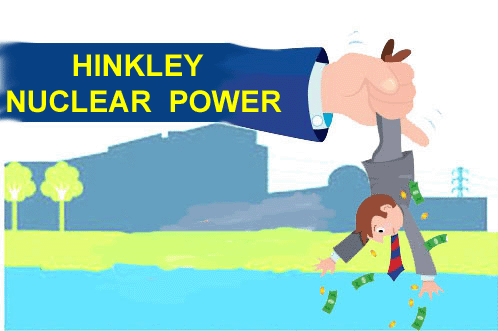 Britain’s Hinkley Point C nuclear project is thoroughly embroiled in complicated negotiations with the government-owned companies of China and France. The major backer, Electricite De France(EDF) is in grave financial trouble and its financial director Thomas Piquemal has resigned, over this Hinkley project. EDF is being bailed out by the French government, so that the £18bn plan can go ahead. UK has had to agree to a contract with EDF, amounting to about £40bn in real terms, and providing State guarantees on insurance, among other matters. The plan locks the UK in, with compensation costs in the event of it being shut down, as shown in an unpublicised departmental “minute“:…….
Professor Catherine Mitchell, an energy policy expert at the University of Exeter, comments in The Guardian:
The £22bn “poison pill” effectively reduces the risk to zero for EDF and its backers, which is great for them. But from an outside perspective, it smacks of desperation.
There could be so many reasons over 35 years that you would want to close the plant, including rising costs, changes to the UK’s energy system or loss of public confidence……..
However, in two important ways, the Australian situation is very different from that of the UK.
Firstly, although the UK Hinkley project is big, the South Australian nuclear waste plan is ginormous. Potentially sourcing high level nuclear wastes (HLNW) from around the world – USA, Canada, Europe, Asia – would be a massive operation, many decades in the setting up, many thousands of years in carrying it out. The money involved would be not dozens of billions of dollars in costs but hundreds of billions.
Secondly, for all the millions in dollars now being spent on the Royal Commission project – the trips abroad, forums, research, public relations and so on – the plan is nowhere near the point of agreement, whereas the UK plan is well advanced…….
It is vitally important for Australia to pay attention to the Royal Commission plan and to the scrutiny of South Australian radiation expert Paul Langley. and others. Unlike Britain, Australia has the opportunity to prevent this plan, while it’s still only a gleam in the eyes of Royal Commissioner Kevin Scarce and the nuclear lobby. https://independentaustralia.net/politics/politics-display/secret-deals-australias-nuclear-waste-plan-and-the-uks-hinkley-project,8797


Nuclear waste importation – an election issue?
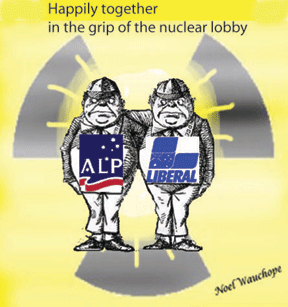
 Probably not. Both Liberal and Labor prefer to keep nuclear topics off the agenda.
  Australia’s subservient mainstream media toes the parties’ line. They can talk about gay marriage until the cows come home. Which always puzzles me. I strongly believe that gays and lesbians should be free to make the same choices that the straights have, however miserable it might turn out. When a couple makes such a choice, it does not impact upon their neighbours, or on the rest of the Australian public.
But choices made that DO impact on others – such as in threatening their health, safety and environment, these surely are the choices that should be discussed and explored fully by the media.
 However, as the debacle of the pro nuclear South Australian Nuclear Fuel Chain Royal Commission shows – the issue of making Australia the toilet for the world’s radioactive trash, can go on for a year, virtually unnoticed by the mainstream Australian media.
Sue, it’s fine and necessary to discuss gay rights. But it’s imperative to get this radioactive waste issue – of importance to us all, and to our grandchildren – out in the open. What’s the matter with Australian media and politicians – are nuclear issues just too bad taste to mention?
Election July 2nd?

Bernie Sanders opposes nuclear power, Hillary Clinton supports it: they do agree on climate change
 Clinton, Sanders united on global warming, divided on nuclear energy,Idaho Statesman. BY ROCKY BARKER rbarker@idahostatesman.com 20 Mar 16
Both Bernie Sanders and Hillary Clinton have ambitious plans to shift the nation’s economy away from fossil fuels to clean energy to combat the global warming caused by their burning.
But as the two Democratic presidential candidates campaign and compete in Idaho in the days before the Tuesday caucus, the largest contrast is their views of the role nuclear power will play in the clean-energy future.
Little polling has been done in the state, but the last poll in February by Dan Jones and Associates for Idaho Politics Weekly showed Sanders with a tiny 47-45 percent lead, within the margin of error. That was a rise of 12 points for the Vermont senator from a poll earlier this year.
“It was very close,” said Dan Jones, the Salt Lake City pollster. “My guess is it is still close.”……….
CLIMATE CHANGE, INL AND CLEAN ENERGY
Sanders has made climate change action one of the central platforms of his campaign, helping to energize many of his youthful supporters. He has called for ending leases for coal, oil and gas on public lands and in the Arctic, which could affect leasing for gas drilling in Southwest Idaho.
Sanders also has called for a tax on carbon and an end to subsidies for the oil and gas industry. But his biggest contrast with Clinton is on nuclear energy, the central mission at the Idaho National Laboratory headquartered in Idaho Falls, which employs thousands of Idahoans.
“Transitioning toward a completely nuclear-free clean-energy system for electricity, heating and transportation is not only possible and affordable, it will create millions of good jobs, clean up our air and water, and decrease our dependence on foreign oil,” Sanders said on his website.
Clinton Policy Director Jake Sullivan said the former secretary of state sees it differently.
She believes nuclear energy has an important role to play in our clean-energy future,” Sullivan said. “With that in mind, the Idaho National Laboratory would be an important institution to promote our clean-energy policy.”
Sanders introduced a bill to spend $41 million on clean energy and transition workers out of the fossil fuel and nuclear industries, said spokesman Karthik Ganapathy.
“He believes we can run an economy entirely on clean, safe energy,” Ganapathy said. “He’s aware of the risks of nuclear energy.”
Clinton shifted early in the campaign to agree with Sanders on an eventual ban on oil, gas and coal leasing on public lands, an issue important in many western states, although less so here………http://www.idahostatesman.com/news/local/news-columns-blogs/letters-from-the-west/article67181847.html
1 This month

of the week – Australians for War Powers Reform (AWPR)
To see nuclear-related stories in greater depth and intensity
 Antinuclear