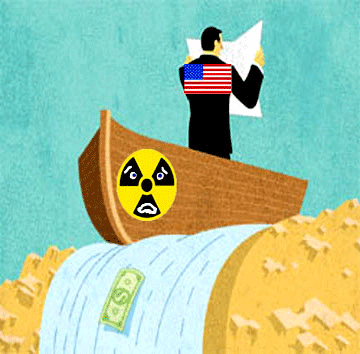
As a U.S. Business, Nuclear Power Stinks http://www.powermag.com/blog/as-a-u-s-business-nuclear-power-stinks/ 01/01/2017 | Kennedy Maize Regardless of one’s views of the social values of nuclear power — compelling cases can be made all around — as a business proposition nuclear stinks.
The latest evidence comes from the giant Japanese conglomerate Toshiba, which saw a third of its market value vanish in two days of trading (20% in one day, a free-fall stopped only by a limit to trading losses imposed by the Japanese stock market). Credit rating agencies promptly downgraded the company’s debt.
Toshiba’s stock crash was a result of billions in reported losses from its Westinghouse Electric subsidiary and Westinghouse’s ruinous investment last year in nuclear engineering and construction behemoth CB&I Stone & Webster, itself the product of an ill-fated merger. Toshiba’s nuclear business has been hemorrhaging money at its U.S. construction projects in Georgia and South Carolina. Westinghouse is years behind schedule and billions of dollars over budget at its two construction projects: Southern’s Vogtle and Scana Corp.’s Summer units, a total of four Westinghouse AP1000 reactors under construction. Toshiba faces the possibility that its nuclear troubles will lead the company to a negative net worth.
My colleague Aaron Larson describes the gory business details well. The bottom line is that Westinghouse threatens to bring Toshiba to its financial knees, although the firm is too large to fail entirely. It may well require a Japanese government bailout.
Then there is France’s Areva, which has been bleeding red ink for more than a decade and would have expired but for its French government owners, and a recent bailout. Continue reading →
Israel to build world’s tallest solar tower in symbol of renewable energy ambition, Independent, 5 Jan 17 With Israel traditionally running its economy on fossil fuels, renewable energy has long been hobbled by bureaucracy and a lack of incentives. In sunny Israel, solar energy supplies only a small percentage of the nation’s power needs, leaving it far behind countries with cloudier and colder climates.
Now the fledgling solar industry is trying to make a leap forward with a large-scale project boasting the world’s tallest solar tower, as a symbol of Israel’s renewal energy ambitions.
The country is starting to make an effort, setting a goal of generating 10 percent of its energy from renewable sources by 2020, up from the current 2.5 percent. Continue reading →
The project team will be hosting a webinar which will consider the suitability of Australia’s use of nuclear medicine production facilities and cyclotrons and the case around importing and exporting nuclear medicine products. Some topics for discussion may include:
• Productive capacity of cyclotrons and nuclear reactors
• Importing and exporting nuclear medicine
• Waste generation from Australian production
The webinar will be live online from our Sydney office and accessible from any computer. You will be able to send questions to the panel members at any point throughout the discussions. The webinar will run from 9am to 1pm on 23 February 2016.
Please signal your interest in attending this event in person in your area to radioactivewaste@industry.gov.au as this will assist us in our planning. If there is enough interest, we may look at hiring a hall.
Tesla Flips the Switch on the Gigafactory Musk meets a deadline: Battery-cell production begins at what will soon be the world’s biggest factory—with thousands of additional jobs. Bloomberg, by Tom Randall January 5, 2017 The Gigafactory has been activated.
Tesla’s solar roofs could revolutionize the industry
Hidden in the scrubland east of Reno, Nev., where cowboys gamble and wild horses still roam—a diamond-shaped factory of outlandish proportions is emerging from the sweat and promises of Tesla CEO Elon Musk. It’s known as the Gigafactory, and today its first battery cells are rolling off production lines to power the company’s energy storage products and, before long, the Model 3 electric car. 1Continue reading →
Bureau of Meteorology’s annual climate statement cites unprecedented bushfires in regions that don’t usually burn and worst coral bleaching on record, Guardian Michael Slezak, 5 Jan 16 Australia’s weather was extreme in 2016, driven by humankind’s burning of fossil fuels as well as a strong El Niño, according to the Bureau of Meteorology’s annual climate statement.
That extreme weather led to devastated ecosystems both on land and in the sea, with unprecedented bushfires in regions that don’t usually burn, the worst coral bleaching on record, and has been attributed as the cause of damage to vast tracts of crucial kelp forests, oyster farms and salmon stocks across southern Australia.
The statement, released on Thursday, said the country as a whole had its fourth-warmest year on record, but locally, Sydney and Darwin broke records for both their hottest maximum temperatures and hottest minimum temperatures.
Hobart had its warmest night on record in 2016 and both Hobart and Brisbane had records for their hottest annual mean temperature fall as well. The hot and dry start to the year sparked bushfires in Victoria, Tasmania and Western Australia.
The fires that swept through the Tasmanian world heritage forests were described as the worst crisis those forests faced in decades. The usually damp alpine forests there had been dried out by earlier dry weather and then a huge number of lightning strikes – which are expected to become more common as temperatures rise – burned through forests, killing trees that were hundreds of years old.
While land burned, the sea around Australia broiled. The bureau’s statement said despite the surface temperature of the seas around Australia being consistently high in recent years, 2016 reached a new record temperature, being 0.73C above the 1961-90 average.
Off the coast of Queensland, those record temperatures led to the worst coral bleaching on record, where an estimated 22% of the coral on the entire 2,300km length of the Great Barrier Reef was lost.
In the northern, most remote and most pristine part of the reef, coral was devastated by the unusually warm water, which scientists say will become the norm in fewer than 20 years.
The bureau’s statement also notes that ocean temperatures were at record highs around Tasmania in 2016. The freakishly hot waters there have been attributed as the cause of damage to oyster, salmon and abalone industries, as well as increased stress to kelp forests, already devastated by warmer waters in recent years.
The record hot waters in Tasmania were caused by a strengthened east Australian current, which drags warm waters from the tropics, along the coast of Australia. “This was associated with the longest and most intense marine heatwave on record for the south-east Australian region,” the statement said.
It added: “The pattern of above average temperatures over land and in the oceans reflects the background warming trend. The Australian climate in 2016 was influenced by a combination of natural drivers and anthropogenic climate change.”
The hot temperatures around the country were followed up by unusually wet conditions for much of Australia too.
The bureau said Adelaide had its second-wettest year on record and its wettest since 1992. Sydney, Canberra and Hobart had above average rainfall. But the pattern wasn’t uniform, as Perth and Melbourne were close to average and Darwin and Brisbane were significantly drier than average in 2016.
“Widespread, drought-breaking rains led to flooding in multiple states,” said Neil Plummer from the Bureau of Meteorology. “Even northern Australia saw widespread rainfall, during what is usually the dry season, greening regions that had been in drought for several years.”
” … But at a time when global warming is a significant threat to humanity, the Carmichael mine is generating substantial opposition. Since the project was announced in 2010, there have been more than ten appeals and judicial processes against the mine.
“Shani Tager, a campaigner at Greenpeace Australia Pacific, is adamant that the coal that Adani wants to dig up must remain in the ground. “It’s a massive amount of coal that they’re talking about exporting, which will be burnt and used and make the problem of global warming even worse,” she says. …
““The Carmichael coal mine will have a domino effect of bad impacts on the reef, from driving the need for port expansion and more dredging and dumping to increasing the risk of shipping accidents on the reef,” saysCherry Muddle from the Australian Marine Conservation Society. …
““If they can’t get the money, they can’t build the mine,” says Murrawah Johnson. … “
“One of the most inspiring speakers I’ve heard recently is Murrawah Maroochy Johnson,
a 20-year-old from the Wangan and Jagalingou people (WJP) of central Queensland.
She spoke passionately about the battle to stop the Carmichael mine on her ancestral lands.
Adani, an India-based multinational, plans to build one of the world’s biggest coal mines in the Galilee Basin, causing environmental devastation and reaping billions of dollars in profit. …
“The groundswell of opposition to the project is growing, and the issues at stake —the sovereign rights of the Traditional Owners, – the health of the Great Barrier Reef – and the future of our only planet
—are just too great. …
“We need to stop the Carmichael mine, leave the Galilee Basin coal in the ground and create a sustainable energy future based on planning. This means challenging the underpinning logic of the capitalist system. People and environment need to triumph over profit and corruption.”
Greenland Ice Melt Could Push Atlantic Circulation to Collapse,New research gives a glimpse of the potential long-term consequences of anthropogenic warming, Hakai Magazine, byRebecca Boyle January 3, 2017
In the North Atlantic, east of North America and south of Greenland, the ocean’s upper layers are much warmer than one might presume given the extreme latitude. This unexpected warmth is a product of the Atlantic Meridional Overturning Circulation (AMOC), a vitally important system of ocean currents that moves warm salty water northward from the tropics and cold fresher water south. The AMOC looms large in the Earth’s climate: it is responsible for redistributing nutrients throughout the Atlantic Ocean and is a major driving force controlling the climate on both sides of the pond.
Ocean currents all experience fluctuations, which can dramatically change the distribution of nutrients, heat, and fish. The best known example is probably the El Niño-Southern Oscillation, in which unusually warm water occasionally disrupts the Pacific Ocean’s Humboldt Current that flows north from Chile toward Peru. El Niño events can shift the jet stream south, cause excessive rainfall and devastating floods, and temporarily collapse fish stocks.
The governor of Japan’s Niigata prefecture reiterated his opposition to the restart of Tokyo Electric Power’s (Tepco) Kashiwazaki-Kariwa nuclear plant, adding it may take a few years to review the pre-conditions for restart.
During a meeting on Thursday with Tepco Chairman Fumio Sudo and President Naomi Hirose, Governor Ryuichi Yoneyama, who was elected in October on his anti-nuclear platform, repeated his pledge to keep the plant shut unless a fuller explanation of the 2011 Fukushima nuclear disaster was provided.
He also said that evacuation plans for people in Niigata in case of a nuclear accident and the health impacts that the Fukushima accident have had would need to be reviewed before discussing the nuclear plant’s restart……..http://www.reuters.com/article/us-japan-tepco-idUSKBN14P0IK




 Antinuclear