

Antinuclear

Australian news, and some related international items

In America, State renewable energy policies are working.

text-cat-questionWhy can’t Australia’s States succeed in renewable energy, by-passing our climate denying federal government?

Report: Benefits of state renewable energy policies far outweigh text-relevantantnuke-relevantFlag-USAcosts http://midwestenergynews.com/2017/01/09/report-benefits-of-state-renewable-energy-policies-far-outweigh-costs/   EnergyWire By David Ferris

A new report from the national laboratories examined states’ renewable energy goals and found that, while renewables add costs, they more than make up for it in avoiding pollution and saving water.

For the first time, researchers from the National Renewable Energy Laboratory and Lawrence Berkeley National Laboratory took a look at state renewable energy portfolios and projected their costs and benefits decades into the future, as far as 2050.

Today, 29 states and Washington, D.C., have a renewable portfolio standard. They have been an important engine for the spread of renewable energy sources like solar panels and wind farms. More than half of all renewable energy installations since 2000 have been created to satisfy an RPS, according to the paper.

The study analyzed two scenarios: one where RPSs remain unchanged from where they stand today, and another where they expand to every state and have higher targets.

It’s unknown how realistic the scenarios are, since RPSs find themselves in powerful crosscurrents, with some states on a path to strengthen their standards while others face movements to weaken them.

Just since the paper’s research was completed last July, Michigan has strengthened its renewable portfolio standard, while a watering-down of Ohio’s standard was prevented only by a veto from the governor (Energywire, Dec. 16, 2016; Greenwire, Dec. 27, 2016).

Under existing RPSs, the country will count on renewables for 26 percent of electricity generation by 2030 and 40 percent by 2050. Under the high-RPS scenario, renewables would reach 35 percent by 2030 and 49 percent by 2050, the report found.

Satisfying existing portfolio standards will cost about $31 billion, or about three-quarters of a cent per kilowatt-hour of renewable energy in terms of levelized costs. If renewable standards multiply and strengthen, the study said, costs could range widely, from $23 billion to $194 billion, or from about one-quarter of a cent to 1.5 cents more per kWh.

Meanwhile, emissions of common pollutants — sulfur dioxide, nitrogen oxides and small particles — would drop by between 4 and 5 percent under existing standards, prompting $97 billion in health and environmental benefits. A stronger RPS regime would trigger these pollutants to drop much more, 29 percent, with benefits of $558 billion, the study said.

Greenhouse gas emissions will drop by 6 percent under the existing portfolio standards, with $161 billion in benefits. In the high-RPS scenario, they would decrease by 23 percent and provide a value of $599 billion in avoided costs.

Water, which is used in copious quantities to cool fossil fuel power plants, would see a drop in use as more renewables come online. One megawatt-hour of renewable energy avoids the withdrawal of 3,400 gallons from waterways and the consumption of 290 gallons, the report said. The United States would save the water consumption equivalent of 420,000 homes under the existing portfolio standards and 1.9 million homes under a high-RPS scenario.

In terms of employment, the existing state RPSs would cause the creation of 4.7 million hours of job time, while the more optimistic scenario would spur 11.5 million job-hours. But the overall number of jobs would remain the same, as a gain in renewable-related employment would be offset by the loss of jobs in other parts of the energy industry, the study said.

January 11, 2017 Posted by | Uncategorized | Leave a comment

As New York nuclear station closes, the renewables industry is more than ready to take over

text-relevantStatue-of-Liberty-solarRenewables Industry ‘More Than Ready’ For N.Y. Nuclear Plant Closure http://solarindustrymag.com/renewables-industry-more-than-ready-for-n-y-nuclear-plant-closure by Joseph Bebon on January 09, 2017 Gov. Andrew M. Cuomo, D-N.Y., has announced the closure of a 2 GW nuclear power plant in New York by April 2021. Renewable energy advocates have applauded the decision and say it provides an opportunity to further bolster solar and wind energy, including offshore wind power, in the state.

According to Cuomo’s announcement, the aging Indian Point Energy Center, located 25 miles north of New York City, has been plagued by numerous safety and operational problems, including faulty bolts and various leaks and fires. After extensive litigation and negotiation, plant operator Entergy Corp. has agreed to end all operations at the facility, with plans to shut down Indian Point Unit 2 as early as April 2020 and Unit 3 in April 2021 – 13 and 14 years earlier than required under the anticipated federal re-licensing terms, respectively.

“For 15 years, I have been deeply concerned by the continuing safety violations at Indian Point, especially given its location in the largest and most densely populated metropolitan region in the country,” says Cuomo in the press release. “I am proud to have secured this agreement with Entergy to responsibly close the facility 14 years ahead of schedule to protect the safety of all New Yorkers. This administration has been aggressively pursuing and incentivizing the development of clean, reliable energy, and the state is fully prepared to replace the power generated by the plant at a negligible cost to ratepayers.”

The release says there will be continued employment at the plant throughout the closure process through 2021, and Entergy has committed to offer plant employees new jobs at other facilities. Furthermore, the state will work with employees to gain access to other job opportunities and worker retraining in the power and utility sectors within New York. Through the New York State Energy Research and Development Authority, the release notes, the state will also offer workers retraining and new skills in renewable technologies, such as solar and wind.

The release says a combination of current and planned resources, including 1 GW of hydropower, will be able to generate more than enough electricity to replace Indian Point’s 2 GW of capacity by 2021. Nonetheless, Anne Reynolds, executive director of the Alliance for Clean Energy New York (ACE NY), emphasizes that the state should avoid relying on more natural gas and instead focus on additional solar and wind power. In a press release, she says the renewables industry is “more than ready” to help fill in the energy gap.

“Governor Cuomo’s 50 percent renewable energy by 2030 mandate has created fertile ground for renewables developers, and they have responded by proposing dozens of projects,” says Reynolds. “There are now 34 wind projects totaling 4,544 MW in the interconnection queue. There are also 27 proposed utility-scale solar projects totaling 583 MW of capacity. This totals to more than twice the current capacity of the two Indian Point reactors.”

“Meanwhile, continuing adoption of rooftop and community solar will also help push New York toward 50 percent, as will development of small hydro and fuel cells,” she says. “These smaller projects add up, providing New Yorkers the opportunity to generate their own power and modernize the grid.”

Reynolds adds, “Offshore wind development is also moving forward. Offshore areas for wind energy development have already been leased by the federal government off Montauk and the Rockaways and off the shores of neighboring states. Development in these areas alone could provide 1,500 to 2,000 MW of capacity to New York. And more offshore areas should be leased in the coming years.”

Liz Gordon, director of the New York Offshore Wind Alliance, comments, “With the Atlantic Ocean off New York featuring some of the best wind resources in the world, offshore wind power is uniquely situated to help meet that downstate demand.”

January 11, 2017 Posted by | Uncategorized | Leave a comment

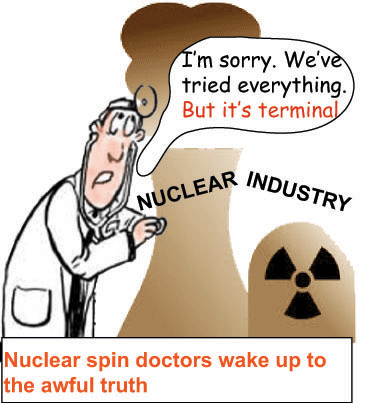
Nuclear – a dying industry

terminal-nuclear-industryPaul Waldon, Fight To Stop Nuclear Waste Dump In Flinders Ranges SA, 10 Jan 17 There are over 20 companies trying to produce the best solar paint, they say the product is a reality. I received a email asking if I would like to invest, but poverty stops me.

But I have to ask has anybody ever received requests if they would like to invest in a nuclear waste machine that has a byproduct called electricity.

Nuclear can NOT get investors, it relies on government handouts and other support. Wall Street won’t invest in the game, the Chemical Bank of New York went belly up investing in nuclear, and if you remove the liability cap from nuclear power generation the utilities that operate the reactors won’t want to have anything to do with the businesses, if there was a accident in a NPP IN America the utility will only have to pay about $75 million which is about 1% of what the government will spend.

‘Nuclear is death and it’s a dying industry that can’t be buried and from past history of any offers of compensation by the government is usually gone after the recipients have passed.https://www.facebook.com/groups/344452605899556/

January 11, 2017 Posted by | General News | Leave a comment

W.A. govt approves Toro Energy’s Wiluna uranium mine, as uranium prices continue to decrease

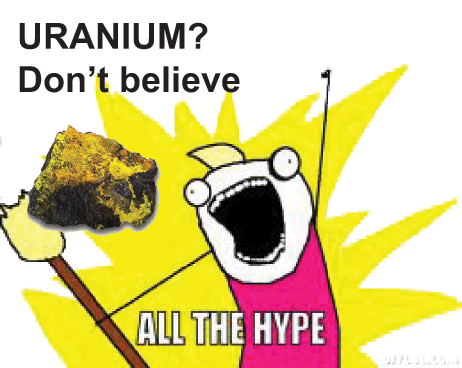
text-uranium-hypeToro Energy’s Wiluna uranium mine in Goldfields gets green light from WA Government, ABC News, By Jarrod Lucas, 9 Jan 17, Western Australia’s first uranium mine is a step closer after the state’s Environment Minister Albert Jacob granted approval for a project at Wiluna in the northern Goldfields.

The owners of the proposed mine, Toro Energy, still need the green light from Federal Environment Minister Josh Frydenberg.

Toro told the stock market on Monday afternoon it hoped federal approval would be granted by March…..

, uranium miners rushing to get approvals in place before March’s state election were thwarted in their bid for a hat-trick when Canadian giant Cameco’s proposed Yeelirrie mine was knocked back on environmental grounds last year……

Drop in Australian uranium production predicted

Uranium prices remain near historic lows, depressed since the 2011 Japanese tsunami sent the Fukushima plant into multiple meltdowns.

The Department of Industry, Innovation and Science today released its Resources and Energy Quarterly which forecast Australian uranium production to decrease by 6.8 per cent this financial year to 7,141 tonnes……http://www.abc.net.au/news/2017-01-09/toro-energy-wiluna-uranium-mine-approved-by-wa-government/8171398

January 11, 2017 Posted by | business, politics, uranium, Western Australia | 1 Comment

Nuclear watchdog questions Environment Ministry’s plan to reuse radioactive soil

dunrenard's avatarFukushima 311 Watchdogs

tomioka.jpg

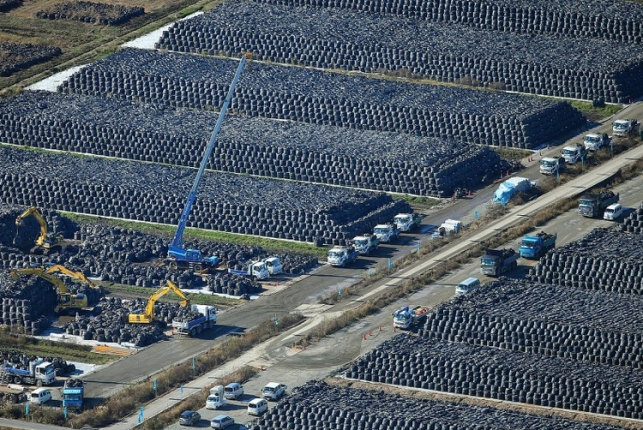
Bags containing contaminated soil and other materials produced through decontamination work are seen at a provisional storage site in Tomioka, Fukushima Prefecture.

The Nuclear Regulation Authority (NRA) has raised questions about the Environment Ministry’s proposal to reuse radioactive soil resulting from decontamination work around the crippled Fukushima No. 1 Nuclear Power Plant due to the insufficiency of information on how such material would be managed, it has been learned.
As the ministry has not provided a sufficient amount of information, the nuclear watchdog has not allowed the ministry to seek advice from its Radiation Council — a necessary step in determining standards for radiation exposure associated with the reuse of contaminated materials.

The Ministry of the Environment discussed the reuse of contaminated soil in closed-door meetings with radiation experts between January and May last year. The standard for the reuse of such materials as metal produced in the process of…

View original post 296 more words

January 11, 2017 Posted by | Uncategorized | Leave a comment

Antarctica is About to Lose a 2,000 Square Mile Chunk of Ice — And it Could Mean the End of the Larsen C Ice Shelf

robertscribbler's avatarrobertscribbler

It’s happened before. Ice shelves on the northern Antarctic Peninsula released large chunks of ice into the Southern Ocean as the world warmed up. They developed a concave shape which became unstable. Then they collapsed.

The ultimate collapse of Larsen A occurred in 1995. In 2002, further up the Antarctic Peninsula, the larger Larsen B Ice Shelf succumbed to the same fate. And it is thought that such losses haven’t happened to this section of Antarctica in at least 11,000 years and possibly as long ago as 100,000 years.

(NASA’s Jet Propulsion Laboratory provides this narrative describing the collapse of the Larsen B Ice Shelf in 2002. Video source: JPL.)

But in the present world, one where human fossil fuel emissions have forced global temperatures above 1 C hotter than 1880s averages, the stability of many of the great great ice shelves is now endangered.

Larsen C Ice Shelf…

View original post 579 more words

January 11, 2017 Posted by | Uncategorized | Leave a comment

The Small Plutonium Dust in the Lung

dunrenard's avatarFukushima 311 Watchdogs

https://blogs.mediapart.fr/ano/blog/221216/la-petite-poussiere-de-plutonium-melox-astrid

Translation from french by Hervé Courtois (Dun Renard)

1, What does a small grain of invisible dust of plutonium arrived in a lung?

2) Why are the lungs of French people at risk?

3) and their wallets?

The small grain of plutonium in a lung

The following text * was written by Maurice Eugène ANDRÉ, commandant, honorary instructor in NBCR, Nuclear, Biological, Chemical and Radiological, of the Royal Air Force of Belgium.

He made a great effort of pedagogy:

“The technical aspect developed below shows that a plutonium dust with a diameter of the order of a micron (millionth of a meter) kills by simply lodging in a lung: this dust in fact delivers more than 100 000 rad [see at the end the notes about units] in one year to a lung area surrounding the dust, a very small area delimited by a sphere with a…

View original post 2,228 more words

January 11, 2017 Posted by | Uncategorized | Leave a comment

What Was Dumped in and Cemented West of Reactor #1?

dunrenard's avatarFukushima 311 Watchdogs

1479135_10202845215594748_1791438227_n.jpgCitizen scientists at work! This is what we can all do to ensure the truth remains clear, in spite of the barrage of corporate propaganda. Thanks Ray Masalas

Ray Masalas found this early picture in his files {May 8th 2011 still a road west of reactor #1} and of course the later {Late July 2011} below picture showing the huge concrete pour west of reactor #1.

You can guess what got dumped in there and cemented over? No wonder the aquifer is hot. Anyway, at least we have a timeline on the mysterious boat shaped, concrete pour. By Aug. 2011 it became covered with sand and they pretended they were just regrading the road.

Ray Masalas guesses the blob from the north wall of reactor #4 and a pile of blown out fuel rod chunks went in there. He really wishes he had a picture of how deep they dug…

View original post 143 more words

January 11, 2017 Posted by | Uncategorized | Leave a comment