The fossil fuel industry and who really runs Australia

The age of entitlement is over in Australia — except for the dominant fossil fuel industry and those rich enough to be able to buy political patronage. Deputy editor Sandi Keane reports.
Treasurer Joe Hockey urges all of us to “share the pain” for his confected “budget emergency”, but, sadly, ‘sharing’ isn’t in the fossil fuel industry’s playbook.
Big Carbon has always balked at sharing profits from Australia’s mineral wealth.
In stark contrast to Norway, where a miningtax of 78% has resulted in a sovereign wealth fund twice the size of its GDP, Australia’s effective tax rate for foreign multinational miners is a mere 13%.
Instead, whilst crying poor, the mining industry managed to stump up $22 million for an anti-tax campaign and, in 2010, bring down a prime minister — Kevin Rudd.
This week, Australia’s dominant fossil fuel industry threw down the gauntlet to Hockey’s razor gang after…
View original post 1,417 more words
TEPCO cancels robotic probe of reactor 1


The operator of the Fukushima Daiichi nuclear power plant has cancelled Tuesday’s operation to send a remote-controlled probe into the crippled No.1 reactor.
Tokyo Electric Power Company began preparations in the morning to send the robot into the containment vessel of the reactor to monitor melted nuclear fuel.
But the company called off the attempt after images on a camera placed outside of the containment vessel to monitor the robot could not be seen on screens in the control room.
The company plans to investigate the cause of the problem and try again on Wednesday or later.
No Return to Normal in Fukushima
Just 6 years ago Fukushima was struck by a deadly earthquake, and then a nuclear disaster. For the survivors, there’s been no return to normal.
A Fukushima Survivor’s Story – Setsuko Kida
Japanese activist Setsuko Kida – who lost her home, her land, and her former life to radioactive pollution from the Fukushima triple meltdown – tells how she overcame personal tragedy and trauma to become an outspoken international advocate for radiation refugee rights.
Fukushima Pref. Governor Irked at Abe’s Omission During 3/11 Memorial Speech
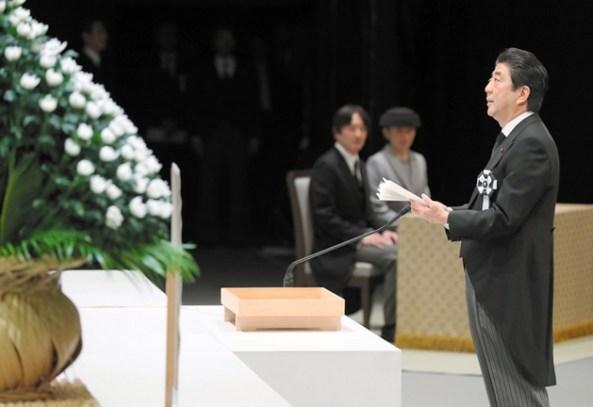
Prime Minister Shinzo Abe delivers a speech at a government-sponsored memorial event on March 11 for the victims of the Great East Japan Earthquake and tsunami six years ago.
Fukushima Pref. governor criticizes Abe’s 3/11 memorial speech
FUKUSHIMA — Prime Minister Shinzo Abe has been criticized by the governor of Fukushima Prefecture for not using the term “nuclear accident” during his speech at a Great East Japan Earthquake memorial service in Tokyo, on March 11.
Masao Uchibori, who has been governor of Fukushima Prefecture since 2014, expressed his criticism of Abe during a news conference on March 13. Specifically, Uchibori stated, “To Fukushima residents, it felt strange that Abe left the phrase ‘nuclear accident’ out of his speech. One must not ignore important terms such as ‘nuclear plant accident’ or ‘nuclear disaster'” when referring to what has happened in Fukushima.
The government-sponsored memorial service for the Great East Japan Earthquake…
View original post 341 more words
Press conference at FCCJ on The Dangers of Low-Dose Radiation in Fukushima
Six years after the Fukushima nuclear accident, concerns about low-dose radiation and the decision to reopen much of the evacuation zone to returning evacuees have not been settled. Representatives from the Citizen-Scientist International Symposium on Radiation Protection (CSRP), a non-profit organization based in Tokyo, will explain their concerns and outline their recommendations, which have been signed by experts belonging to scientific organizations from all over the world.
The recommendations are addressed to Japanese authorities in charge of risk communication and radiation protection measures in the area affected by radiation from the Fukushima Daiichi Nuclear Power Plant.
The scientists take a critical look at risk communication currently conducted by the Japanese authorities and list urgent action that is required on behalf of the victims of the nuclear accident. They recommend using the “linear non-threshold model” based on the latest scientific findings and challenge the present return policy for the evacuees to…
View original post 41 more words
1 This month

of the week – Australians for War Powers Reform (AWPR)
To see nuclear-related stories in greater depth and intensity
 Antinuclear