Urgency of USA’s nuclear waste problem – Diablo Canyon Power Plant as an example
 Are Australia’s radioactive waste experts paying attention to the issues raised here? The so-called “Intermediate” Level Wastes (ILL) from Australia’s Lucas Heights nuclear reactor will face the same problems, albeit on a smaller scale, as Diablo’s.
What about the type and strength of canisters transporting highly radioacyive wastes from spent nuclear fuel rods?
What about the risks of transport accidents, over a 2000 km trail, past towns?
What about setting up “interim”nuclear waste dumps -, without any final deep repository existing – to become stranded nuclear waste dumps?

A pact with the devil, https://www.newtimesslo.com/sanluisobispo/a-pact-with-the-devil/Content?oid=4329619, BY AMY HEWES , 22 Feb 18
Diablo Canyon Power Plant is due to shut down in 2025, maybe earlier, but the radioactive waste it has generated will threaten our lives for another 200,000 years.
Society owns this Pandora’s box—but we haven’t owned up to the responsibility.
“For 30 years, the Nuclear Regulatory Commission has kept its head in the sands,” U.S. Rep. Salud Carbajal (D-Santa Barbara) said.
To his credit, Carbajal understands the urgency of the nuclear waste problem and has co-signed a bipartisan bill, HR 3035, that he hopes will provide a temporary solution.
Unfortunately, that legislation is seriously flawed. Without amendments or follow-up legislation, the bill threatens huge population centers in the event of likely unavoidable transportation accidents. It also establishes unsafe consolidated waste dumps without mandating a permanent, geological repository.
Having lived in the shadow of Diablo Canyon since 1985, most of us on the Central Coast have become inured to the dangers that lurk there. But even after decades of decay, it takes just a few minutes of exposure for spent fuel rods to deliver a killing dose of radioactivity. According to the Nuclear Information and Resource Service (NIRS), “Certain radioactive elements (such as plutonium-239) in ‘spent’ fuel will remain hazardous to humans and other living beings for hundreds of thousands of years. Other radioisotopes will remain hazardous for millions of years. Thus, these wastes must be shielded for centuries and isolated from the living environment for hundreds of millenia.”
“Today, there are 100 reactors operating at 59 sites in the U.S., and 35 permanently shut-down reactors at 25 additional sites,” noted Tim Judson, NIRS executive director.
How many tons of highly dangerous waste has accumulated at these sites? “The last reliable estimate was 74,000 tons in 2015—more than the 70,000-ton mandated capacity limit for Yucca Mountain [the stalled U.S. geologic repository located in Nevada],” said Judson.
On average, the industry generates about 2,000 tons of additional irradiated fuel each year, bringing the total tonnage to 80,000 tons.
Just over the hill from San Luis Obispo, approximately 2,200 metric tons of toxic waste is stored onsite at Diablo Canyon. By the time the plant closes, we’ll face a 2,690-metric-ton, 200,000-year-long local problem.
No wonder Carbajal has embraced HR 3035, which would authorize mass transportation of waste to parking lot dumps, supposedly “interim” consolidated storage sites—now proposed in Texas and New Mexico. Under the bill, our mountain of waste would become someone else’s problem.
Or would it? Why does NIRS, the Union of Concerned Scientists, San Onofre Saftey, Beyond Nuclear, and SLO-based Mothers for Peace, among others, oppose the bill?
First, consider transportation of the world’s deadliest waste. Shipments would travel through 45 states, exposing millions of people to murderous radiation in an accident.
And accidents do happen. Amtrak’s latest derailment in December sent train cars plummeting onto the interstate in DuPont, Washington. Meanwhile, in 1999, the American Petroleum Institute reported that heavy truck accidents occur approximately six times per million miles. According to the Federal Motor Carrier Safety Administration, in 2015 alone there were 57,313 fatal and injury crashes involving large trucks on our highways. Of those accidents, at least 154 resulted in the release of hazardous material.
Imagine if that hazardous material was radioactive.
OK, but aren’t the shipment casks built to withstand accidents?
Nope. The Nuclear Regulatory Commission (NRC) allows U.S. nuclear plants to store or transport spent fuel waste in thin walled welded stainless steel canisters designed to withstand a crash at 30 miles per hour. Do you want to bet lives that they would hold up in a calamity at 80 miles per hour?
Before HR 3053 is approved—and before any more thin-walled canisters are stored at earthquake-prone Diablo Canyon—there needs to be legislation mandating upgraded, thick-walled casks such as those used in Europe and Japan. We should also demand continuous, long-term monitoring and inspection of all transportation containers and/or dry storage casks, whether they’re stacked at Diablo Canyon or at consolidated the “interim” sites envisioned in HR 3053.
And let’s be honest: The Nuclear Waste Policy Act currently disallows “interim” nuclear waste storage at consolidated sites unless a permanent U.S. geologic repository is built. HR 3053, however, does away with that mandate. Without that leverage—and in light of the enormous political and scientific challenges to establishing a permanent repository—in all likelihood, “interim” will de facto become “permanent.”
What to do? Carbajal and his congressional colleagues should listen to the Union of Concerned Scientists (UCS), which has testified that “spent fuel can be managed safely at reactor sites for decades, but only if … the security of dry cask storage is enhanced.” UCS told a House committeee last year that interim facilities should not be allowed unless a permanent repository is established. And, finally, the science-based group has called for Congress to fully support the technical work needed to build a safe and secure permanent repository.
Carbajal agrees that HR 3053 is only a temporary fix and that Mothers for Peace and other opponents have legitimate concerns. But we cannot let what he terms a “Sophie’s choice” bill to become a pact with the devil.
Carbajal and Congress must address the problems before this legislation goes forward. Because, as Mothers for Peace spokesperson Linda Seeley said, “Diablo Canyon is our baby—a horrible, poisonous monster—but we have to take care of it. It’s morally wrong to do otherwise.” Δ
Amy Hewes is actively involved in grassroots political action. Send comments through the editor at clanham@newtimesslo.com.
Arctic temperatures soar 45 degrees above normal, flooded by extremely mild air on all sides
This latest temperature spike is another striking indicator of the Arctic’s rapidly changing climate…. (registered readers only)
https://www.washingtonpost.com/news/capital-weather-gang/wp/2018/02/21/arctic-temperatures-soar-45-degrees-above-normal-flooded-by-extremely-mild-air-on-all-sides/?utm_term=.52bc34406fde
MILITARY PLUTONIUM To be manufactured at Hinkley
“MILITARY PLUTONIUM To be manufactured at Hinkley”

 The charade of Atoms for Peace, Dr David Lowry , 23 Feb 18, “……Atoms for Peace ( in reality a cynical project promoting US global nuclear technology dominance launched by President Eisenhower at the UN in New York in December 1953) using a special atomic train taking nuclear scientists around the country promoting nuclear power.
But it was a charade. The first public hint came with a public announcement on 17 June 1958 by the Ministry of Defence, on: “the production of plutonium suitable for weapons in the new [nuclear ] power stations programme as an insurance against future defence needs…” in the UK’s first generation Magnox (after the fuel type, magnesium oxide) reactor.
A week later in the UK Parliament, Labour Roy Mason, who incidentally later became Defence Secretary, asked (HC Deb 24 June 1958 vol 590 cc246-8246) why Her Majesty’s Government had
“decided to modify atomic power stations, primarily planned for peaceful purposes, to produce high-grade plutonium for war weapons; to what extent this will interfere with the atomic power programme; and if he will make a statement.?” to be informed by the Paymaster General, Reginald Maudling
“At the request of the Government, the Central Electricity Generating Board has agreed to a small modification in the design of Hinkley Point and of the next two stations in its programme so as to enable plutonium suitable for military purposes to be extracted should the need arise.
The modifications will not in any way impair the efficiency of the stations. As the initial capital cost and any additional operating costs that may be incurred will be borne by the Government, the price of electricity will not be affected. Continue reading
Lawsuits against USA agencies and companies, over Widespread radioactive contamination in St Louis, Missouri
HBO documentary, “Atomic Homefront” at St. Louis Filmmakers Showcase
Lawsuits: Widespread radioactive contamination in north county
 The lawsuits seek relocation and financial awards for thousands of people.
Tesla big battery results suggest local storage better than “monster” projects — RenewEconomy

New analysis says performance of Tesla big battery shows advantages of distributed storage rather than a single “monster” project like Snowy 2.0.
via Tesla big battery results suggest local storage better than “monster” projects — RenewEconomy
Battery storage: Are Australian households about to charge into market? — RenewEconomy
Further rises in Australia’s already ridiculously high grid prices, South Australian incentives, and the first battery storage manufacturing plant in the country suggest the battery storage market is about to take off.
via Battery storage: Are Australian households about to charge into market? — RenewEconomy
Electric vehicles: SA Labor proposes no stamp duty, free rego for zero emissions cars — RenewEconomy

SA Labor promises to waive stamp duty, five years of registration costs, on purchase of zero emissions cars, if it wins election.
via Electric vehicles: SA Labor proposes no stamp duty, free rego for zero emissions cars — RenewEconomy
REGARDING THE NATIONAL RADIOACTIVE WASTE MANAGEMENT FACILITY – summary of letter to Industry Minister Matt Canavan
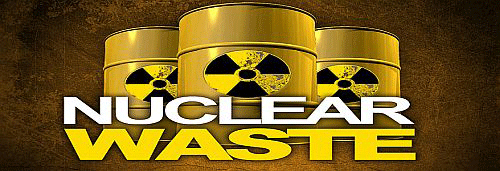 Medical Association for the Prevention of War (MAPW), 23 Feb 18 REGARDING THE NATIONAL RADIOACTIVE WASTE MANAGEMENT FACILITY (NRWMF )
1) The process is very divisive. Repeated, highly damaging processes imposed on previously cohesive communities are causing significant harms.
2) Considerable amounts of persistently misleading information have been and continue to be presented to communities. Incorrect and incomplete information does not result in genuine consent.
3) There is a failure to observe international best practice standards for the highly radioactive long lived intermediate level waste (ILW) management. There is no disposal plan whatsoever for ILW, leaving the problem for many future generations.
REGARDING THE EXPANSION OF NUCLEAR MEDICINE PRODUCTION FOR EXPORT
1) There is a lack of demonstrable “Net benefit”. The proposed 40 year-long expansion of medical isotope production needs genuine cost/benefit analysis to make sure this is not a heavily subsidised product being sold into the global market at the expense of the Australian community both now and in the future. Independent NEA/OECD economic modelling finds only 10-15% cost recovery of isotope manufacture when there is genuine inclusion of all costs.
2) The expansion will create 40 years of significantly increased production of ILW.
3) ANSTO has a narrative of global shortages, yet given falling demand and increasing global supply there is no shortage of Mo99. The NEA/OECD predict a significant oversupply.
4) Again, there is no plan whatsoever for disposal of the additional ILW generated.
Both processes are unacceptably flawed.
Medical Association for the Prevention of War (MAPW) urges
* A halt to the current NRWMF process until such time as world’s best practice is followed. There is sufficient capacity at the Lucas Heights facility, once regulatory approvals are met, to store Low Level Waste (LLW) and Intermediate Level Waste (ILW) well into the next decade.
* Cessation of expansion of nuclear medicine for export, and a phase out of exports, until there is demonstrated, publicly available, clear analysis of cost/benefit and plans for appropriate disposal of the substantial amount of ILW this process will generate.
* Transparent evaluation of “net benefit” to the Australian community. This as a whole must underpin the process, and be based on cradle to grave impacts of production.
* Recognition that currently the information provided to communities is riddled with so much misinformation it calls into question the underlying validity of any community consent process.
In closing, it is clear there is an urgent need for an independent inquiry into the production and management of Australia’s nuclear waste.
Longterm slump in uranium industry looks like being permanent
Very few mines could operate at a profit at current prices. Some mines are profitable because earlier contracts stipulated higher prices, while many mines are operating at a loss.
And with the cost of a single power reactor climbing to as much as $20 billion, proposals to introduce nuclear power to Australia seem more and more quixotic and are now largely limited to the far right ‒ in particular, Australians Conservatives’ luminary Senator Cory Bernardi and the Minerals Council of Australia.
BHP marketing vice-president Vicky Binns said in December 2017 that uranium markets would remain oversupplied for close to a decade, with downward pressure remaining on uranium prices
 Uranium industry slumps, nuclear power dead in the water Jim Green, Online Opinion, 23 F
……….These days, the market exhibits multiple levels of weirdness, all stemming from the growing acknowledgment that nuclear power and the uranium industry face a bleak future.
The uranium market has a “subdued outlook” and Cameco’s uranium is now “more valuable in the ground” according to Warwick Grigor from Far East Capital, because the cost of production is higher than the prices currently being offered. Cameco CEO Tim Gitzel agrees, saying in January 2018 that at current prices “our supply is better left in the ground.” So uranium industry executives and market analysts are finally coming around to rallying cry of the anti-uranium movement: Leave it in the ground!
We’ve also had the odd situation over the past year of nuclear lobbyists arguing repeatedly that the nuclear power industry is in “crisis” and wondering what if anything can be salvaged from “the ashes of today’s dying industry“. Usually such claims come from the anti-nuclear movement ‒ sometimes more in hope that expectation.
And we’ve had the odd situation of industry bodies (such as the US Nuclear Energy Institute) and supporters (such as former US energy secretary Ernest Moniz) openly acknowledging the connections between nuclear power and weapons ‒ connections they have strenuously denied for decades.
Such arguments are now being used in an effort to secure preferential treatment for uranium mining companies in the US. Ur-Energy and Energy Fuels have lodged a petition with the Department of Commerce seeking a mandated requirement for US power utilities purchase a minimum 25% of their requirements from US mines. Uranium is “the backbone of the U.S. nuclear deterrent and fuels ships and submarines in the U.S. Navy”, the companies state………
Another miserable year for the uranium industry Nuclear power has been stagnant for the past 20 years. Although power reactors account for an overwhelming majority of uranium demand, uranium production ‒ and prices ‒ have been up and down and all over the place.
Uranium mine production increased by 50% from 2007 to 2016. The increase was driven, initially at least, by expectations of the nuclear renaissance that didn’t eventuate. Mine production plus secondary sources (e.g. stockpiles and ex-military material) have consistently exceeded demand ‒ 2017 was the eleventh consecutive year of surplus according to the CEO of uranium company Bannerman Resources.
Stockpiles (inventories) have grown steadily over the past decade to reach enormous levels ‒ enough to keep the entire global reactor fleet operating for around eight years. Supply from mines and secondary sources in recent years has exceeded demand by about 18%.
Those dynamics have put downward pressure on prices. After six years of steady decline, uranium prices were flat in 2017. The spot price as of 1 December 2017 was less than one-third of the pre-Fukushima price and the long-term contract price less than half the pre-Fukushima price.
Countless would-be uranium mining companies have given up, some trying their luck in other areas such as property development or growing dope. Some mines have closed, others have been put into care-and-maintenance, and others have reduced output. But supply has continued to exceed demand ‒ and to exert downward pressure on prices.
Very few mines could operate at a profit at current prices. Some mines are profitable because earlier contracts stipulated higher prices, while many mines are operating at a loss. Many companies have been loathe to close operating mines, or to put them into care-and-maintenance, even if the only other option is operating at a loss. They have been playing chicken, hoping that other companies and mines will fold first and that the resultant loss of production will drive up prices. “We have to recognise that we over-produce, and we are responsible for this fall in the price,” said Areva executive Jacques Peythieu in April 2017.
Current prices would need to more than double to encourage new mines ‒ a long-term contract price of about US$70–$80 is typically cited as being required to encourage the development of new mines.
The patterns outlined above were repeated in 2017. It was another miserable year for the uranium industry. A great year for those of us living in uranium producing countries who don’t want to see new mines open and who look forward to the closure of existing mines. And a great year for the nuclear power industry ‒ in the narrow sense that the plentiful availability of cheap uranium allows the industry to focus on other problems.
Cut-backs announced
The patterns that have prevailed over the past five years or so might be changed by decisions taken by Cameco and Kazatomprom (Kazakhstan) in late 2017 to significantly reduce production. Continue reading
1 This month
7 April – WEBINAR – Australia and the Doomsday Clock – Preventing nuclear war through NoFirstUse and other policies
Online | Tuesday April 7, 4:00-5:30pm, Australian Eastern Time / 8:00-9:30am Central Europe Time
– Access the registration link
15 April – Zoom –Nuclear Power is Not the Solution
Apr 15, 2026 01:00 AM in Canberra, Melbourne, Sydney

Join the International Physicians for the Prevention of Nuclear War (IPPNW) on Tuesday, April 14th for a timely webinar exploring the risks associated with nuclear power and challenging the myth that it offers a simple, safe, carbon-free solution to the climate crisis

21 April Webinar: No Nuclear Weapons in Australia
Start: 2026-04-21 18:00:00 UTC Canberra, Melbourne, Sydney (GMT+10:00)
End: 2026-04-21 19:30:00 UTC Canberra, Melbourne, Sydney (GMT+10:00)
Event Type: Virtual
A virtual link will be communicated before the event.
Host Contact Info: australia@icanw.org

of the week – Australians for War Powers Reform (AWPR)
To see nuclear-related stories in greater depth and intensity
 Antinuclear