When Ray Whitby and a handful of Australian Navy colleagues stepped onto an island off the WA coast after Britain had just wrapped-up its nuclear weapons testing, they had no idea their lives would be changed forever.
“We were in shorts, sandals and short-sleeved shirts,” Mr Whitby said.
A scientist who was with them that day on the Montebello Islands off the Pilbara coast — and who was decked-out in full protective clothing — delivered a grim message.
“He told us ‘you guys shouldn’t be here, this is deadly’,” Mr Whitby said.
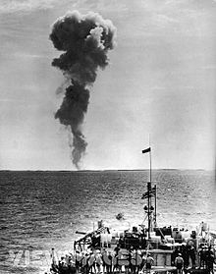
Later investigations found the weapons tested on those islands — believed to be around four times more powerful than those dropped on Hiroshima and Nagasaki in World War II — had left behind a level of radiation that was “definitely unacceptable to personnel”.
When Mr Whitby and his colleagues returned to their ship they attempted to decontaminate themselves, but were later told the water they used to do this, also contained high radiation levels.
So too, did the kitchen items they were using to prepare meals.
There’s no excuse whatsoever’
Mr Whitby said the effect was devastating, with many of his fellow servicemen on that HMAS Fremantle mission dying as early as their 30s, or suffering lasting health issues.
He has fought cancer and saw his wife miscarry five times.
“We were used as live guinea pigs,” Mr Whitby said.
“There’s no excuse whatsoever, we all joined the service to help our country and do our part.”
Many in similar circumstances to Mr Whitby had a big win last year, when the Federal Government announced a $133 million program to give nuclear veterans access to the gold card, which provides veterans with lifelong no-gap medical insurance.
But this would only apply to veterans exposed to radiation between October 3, 1952 and June 19, 1958.
Mr Whitby and his colleagues were exposed 85 days after the cut-off date.
One of those colleagues, ex-serviceman Jim Marlow, describes the situation as infuriating.
“Why it differentiates between one and the other I have no idea,” he said.
“We are not recognised, we simply get ignored.”
A small cost for a big benefit: veterans
Mr Marlow, Mr Whitby and others have spent years campaigning for access to the gold card, believing it to be a fair request given the challenges they have faced in their later lives.
“I paid hundreds of thousands of dollars out over the years on cancers and various medical situations that I had,” Mr Whitby said.
“It has been dreadful.”
The exact number of people in the same situation is unknown, but the Australian Ex-Services Atomic Survivors Association believes it to be relatively small and one that would not require a big financial outlay from the Federal Government.
Veterans affairs benefits are a federal issue, but the State Government has vowed to lobby the Commonwealth to extend medical benefits to Mr Whitby and others in the same circumstance.
Mr Whitby’s son, Reece, is a first-term Labor MP in WA and used his platform in State Parliament to urge the Commonwealth to act.
“If we can’t treat veterans from the 50s fairly, how can current members of our armed services have confidence they will be treated fairly in years to come?” Reece Whitby said.
A spokeswoman for Federal Veterans Affairs Minister Darren Chester said the eligibility dates were determined on the basis of scientific evidence.
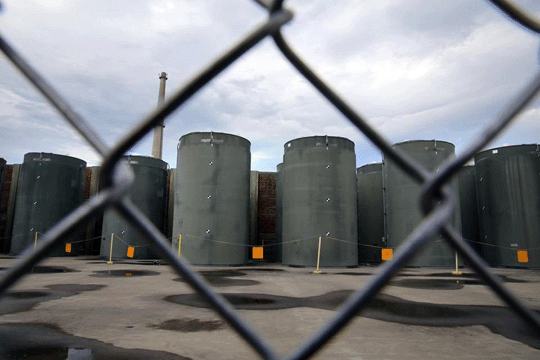
Paul Waldon Fight To Stop Nuclear Waste Dump In Flinders Ranges SA, 16 Mar 18A successful safety test is one that shows the limitations or structural integrity of a product, just like car crash tests. Dry-casks have only had one successful safety test, where a cask was compromised with a less than 10 meter drop. However this had approximately 6 tonne of water which is a shortfall of the weight of nuclear fuel, plutonium being 1.8x heavier than lead, which shows heavy manipulated data can NOT always fuel the nuclear industries factoids.
Despite one newspaper’s effort, Japan can’t make its radioactive waste “disappear.”From information provided by Kurumi Sugita, Jon Goman, and Fukushima 311 Voices.
After the disastrous events of the March 2011 Fukushima-Daiichi nuclear meltdown in Japan, France-based Kurumi Sugita, a retired Japanese social anthropologist, and her American partner, Jon Goman, started a website for the French citizens group, Nos Voisins Lontains, 311(Our Far Away Neighbors 311.) At first published only in French, it is now also published in English and Japanese at Fukushima 311 Voices.
In a particularly revelatory article last October, the pair highlighted the extent to which efforts to “normalize” the devastating consequences of the nuclear disaster are pervasive in Japan.
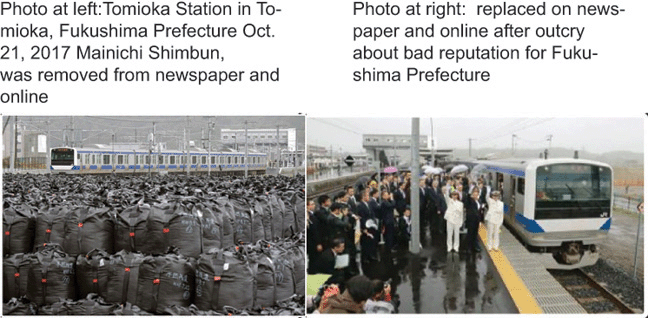
They detailed how the Mainichi Shimbun ran a story about the reopening of a stretch of railway line that had been closed since the Fukushima accident. The photo that accompanied the piece showed a train in the background. But the foreground of the picture was dominated by row after row of black trash bags filled with radioactive waste. (Shown in headline photo at the top of the article.)
Apparently, the radioactive trash bags photo at the train station caused some public (or possibly corporate) protest. The photo abruptly vanished from the Japanese online version of the paper (but not the English language one), to be replaced by a picture showing cheerfully smiling train personnel and passengers on the station platform.
Rows of such radioactive waste-filled bags now litter that region of Japan, sometimes stretching as far as the eye can see. Watch RT’s extraordinary drone footage of waste bags.
They are a reminder of the impossibility of effective “cleanup” after a radioactive accident. In a desperate attempt to restore confidence among exiled residents, top soil and other debris was scooped up intro trash bags in the name of “cleanup”. However, all this achieves, if the bags are ever “disposed of,” is to move the radiation somewhere else.
The story is one small example — but nevertheless a poignant one — of the extent to which the Japanese public are being subjugated, silenced and even threatened into an acceptance of the widespread radioactive contamination of their country.
Here is the original October 30, 2017 blog post from Fukushima 311 Voices, published in English and Japanese.
Newspaper changes an “annoying” photo
When we are outside of Fukushima, or of Japan, it is difficult for us to realize to what extent it has become difficult to speak of radio-contamination and the risk of exposure.
To illustrate this, we are reporting on the case of a photo replacement in the Mainichi Shimbun. This took place only in the Japanese edition. The original photo seems to have remained in the English edition. Continue reading →
The global nuclear lobby has smartened itself up a bit – especially in Australia. When it comes to “new nukes’ Generation IV -( those elusive super-expensive new gimmicks for which there is no market at all) the goal of propaganda is to give the industry a makeover – a young, female-friendly, image.
ANSTO – ever ready to spend our tax dollars on pro nuclear spin, is backing this new publicity tack in a big way.
TOKYO (AFP) – A Japanese court on Thursday (March 15) ordered the government to pay one million dollars in new damages over the 2011 Fukushima nuclear disaster, ruling it should have predicted and avoided the meltdown.
The Kyoto district court ordered the government and power plant operator Tokyo Electric Power Co (TEPCO) to pay 110 million yen (S$1.3 million) in damages to 110 local residents who had to leave the Fukushima region, a court official and local media said.
Thursday’s verdict was the third time the government has been ruled liable for the meltdown in eastern Japan, the world’s most serious nuclear accident since Chernobyl in 1986.
In October, a court in Fukushima city ruled that both the government and TEPCO were responsible, following a similar ruling in March in the eastern city of Maebashi.
However, another court, in Chiba near Tokyo, ruled in September that only the operator was liable.
On Thursday, presiding judge Nobuyoshi Asami ordered that 110 plaintiffs who saw their lives ruined and their property destroyed by the disaster be awarded compensation, Jiji Press and other media reported.
Contacted by AFP, a court spokesman confirmed the reports, adding that the ruling denied damages to several dozen additional plaintiffs.
“That damages for 64 people were not recognised was unexpected and regrettable,” a lawyer for the plaintiffs said, adding that they would appeal, according to public broadcaster NHK.
Around 12,000 people who fled after the disaster due to radiation fears have filed various lawsuits against the government and TEPCO.
Cases have revolved around whether the government and TEPCO, both of whom are responsible for disaster prevention measures, could have foreseen the scale of the tsunami and subsequent meltdown.
Dozens of class-action lawsuits have been filed seeking compensation from the government.
In June, former TEPCO executives went on trial in the only criminal case in connection with the disaster.
The hearing is continuing.
Triggered by a 9.1-magnitude earthquake, the tsunami overwhelmed reactor cooling systems, sending three into meltdown and sending radiation over a large area.
Japan faces questions from abroad about its handling of the lingering aftereffects of the triple disaster.
March 11 marked the seventh anniversary of the earthquake and tsunami disaster that devastated Japan’s northeast coastal regions in 2011. While the resulting accident at the Fukushima Daiichi nuclear power plant continues to cause a great deal of disruption within the country, it also poses ongoing challenges for Japan’s diplomacy.
The Japanese government recently came under pressure in a United Nations human rights forum over the adequacy of its support for people who fled the disaster zone – and faced scrutiny about radiation levels in places where evacuees have returned. At the same time, Japanese diplomats have been waging a long battle to persuade other countries to ease import restrictions on food from the surrounding areas.
The Fukushima prefectural government says that the number of evacuees peaked at…
An event in Thailand promoting flounder from Fukushima has been cancelled amid concerns from consumers.
The event was being held at a Japanese restaurant and scheduled to run through the end of the month. The export of flounder caught in waters off Fukushima was resumed on March 1st for the first time since the 2011 nuclear accident.
The Fukushima prefectural government says a consumer group raised concerns about the safety of the fish. The group said the fish were caught in contaminated waters and dangerous to eat.
The group also reportedly demanded the Thai government announce the name of a local restaurant that sold the fish.
Consumers took to social media to voice their concerns.
Organizers say they cancelled the event to avoid confusion.
Nearly 130 kilograms of flounder have been exported from Fukushima to Thailand but close to half remains untouched…
University of New Hampshire researchers recently concluded there’s at least 30 percent more dangerous radiation in our solar system than previously thought, which could pose a significant risk to both humans and satellites who venture there.
In their study, published Feb. 22 in the journal Space Weather, the researchers found that astronauts could experience radiation sickness or possibly more serious long-term health effects, including cancer and damage to the heart, brain, and central nervous system, said Nathan Schwadron, a space plasma physics professor at UNH and lead author of the study.
“Both concerns are very serious, but what we’re seeing in deep space is that over time, radiation seems to be getting worse,” Schwadron said.
Why is it getting worse? The sun’s activity has been low, the lowest it’s ever been during the Space Age, which began in 1957 with the launching of Sputnik, the world’s first satellite.
That’s bad because an active sun intensifies the sun’s magnetic field, which shields our solar system from cosmic rays, the university said in a statement.
“When we started sending human beings to the moon in the late 50s, the solar activity cycles were fairly strong, so the number of cosmic rays were lower,” Schwadron said. “But now the cosmic rays number is going up.”
Scientists expect the solar activity levels to vary, but they don’t know why the current activity is so weak, he said.
Electric vehicles can now travel across WA’s Kimberley region, thanks to three new charging stations servicing the 900km stretch of Northern Highway between Kununurra and Derby.
If the NEG could get one thing right, you might think it would be a signal for new investment in “dispatchable” capacity. But Tesla and Genex, the leading developers of battery storage and pumped hydro projects, say it could do the opposite.








 Antinuclear