With power prices skyrocketing, the mining sector has called for the nuclear option with hopes a high-level review could end a ban on the prohibited energy source.
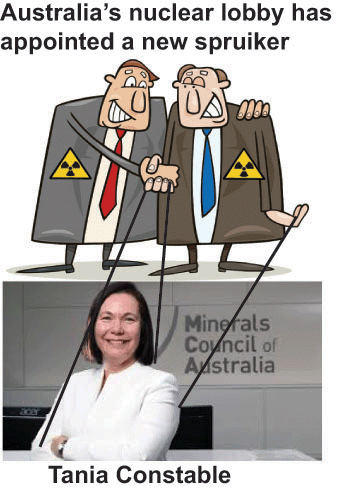
The Minerals Council of Australia has seized on the upcoming review of environmental protection laws under which nuclear power is banned.
Chief executive Tania Constable said removing the four words — “a nuclear power plant” — in one section of the law would allow the industry to be considered for development.
Federal Environment Minister Melissa Price said while the extent of the review had not yet been determined it must examine the full operation of the laws.
“The review will involve extensive consultation and will consider all ideas put forward by industry, environment and community groups to improve and strengthen national environmental law,” she said.
Ms Price said under law the review of the Environment Protection and Biodiversity Conservation Act had to be completed by October.
But Opposition leader Bill Shorten ruled out any changes under a Labor government.
“Labor has no plans to build nuclear power plants, full stop. We will deliver more renewables and cheaper power for Australians, and we will do it without building nuclear power plants in our cities and towns,” he said.
Ms Constable said that along with upgrades to existing coal-fired generators, nuclear power was a “commonsense approach” to lowering power prices and also reducing emissions.
In December, Labor signed off on its new national platform which states “Labor will … prohibit the establishment of nuclear power plants and all other stages of the nuclear fuel cycle”.
About 30 countries rely on nuclear power, with France generating nearly 75 per cent of its electricity that way.
The World Nuclear Association lists Hungary, Slovakia and Ukraine as generating more than half from nuclear, while Belgium, Sweden, Slovenia, Bulgaria, Switzerland, Finland and the Czech Republic use it for more than one-third of their power.
Prime Minister Scott Morrison said he was open to changing the law but wanted to be sure of the economic case.
“I’m not too much into an ideological debate about from what source it comes, I just want to make sure it turns up and that it brings power prices down,” he said. “The only work I have seen on that … is that (lower prices) is only achieved with very significant government subsidies.”
There was a time – not so long ago – that government ministers talked enthusiastically about a new nuclear age. A fleet of brand new reactors producing reliable, low carbon electricity for decades to come. Not only that, but the government wouldn’t be taking any of the risks associated with financing and building them.
Hinkley, Moorside, Wylfa, Oldbury, Bradwell and Sizewell were identified as the sites for the most significant national wave of new nuclear power construction anywhere in the world.
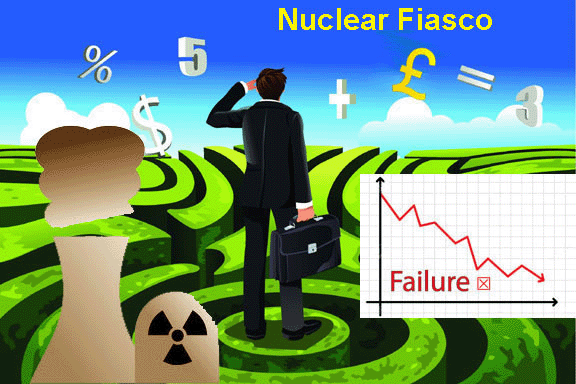
Of those six, only one is under construction, three have been abandoned, and two face an uphill battle to get the green light.
Under those circumstances, you might think the government would be embarrassed that its energy policy was in disarray. But it’s not.
The collapse of the Wylfa and Oldbury projects today (following the abandonment of Moorside) is evidence of some new economic realities that have seen government enthusiasm for new nuclear fade.
High price
The first and most obvious is the cost of building the darn things.
At £20bn Hinkley Point is the most expensive UK construction project to date – HS2 will beat it.
The good news is that the UK government isn’t paying a penny of it.
The bad news is that the electricity it will one day produce will be expensive.
EDF, the French contractor that’s paying for its construction, could only raise the money to do it by extracting a guarantee from the UK government that it would receive more than double the current going rate – for 35 years.
That’s one way to finance it. Let EDF raise the money and take the risk but ultimately foist the cost onto future generations of energy customers.
Who pays?
One of the reasons Hinkley is so expensive is that EDF needed to go out and borrow huge sums for a risky project at interest rates of over 9%. In fact, of the total £20bn bill for Hinkley, well over half of it was the cost of raising the money over the lifetime of the project.
The government can borrow money much more cheaply than anyone else. Right now it could get a £20bn 10-year loan at 1.3% and use that money to build the thing itself. There are financial and political problems with that.
First, it adds to the public debt – which successive recent governments have been keen to reduce.
Second, if there are massive cost overruns (and that is almost a rule with nuclear projects), the government foots the spiralling bill, taking commensurate political flak.
Third, if the government is suddenly in the business of building nuclear power stations, why not other things – in fact why not nationalise the infrastructure we have already got? That is not comfortable territory for a Conservative government.
Doing the sums
There is a another way. Pay-as-you-go. Rather than lumber future generations with more expensive energy, get current consumers to pay a little extra on their bills (amount decided by the regulator) during the construction. This removes the need for massive borrowing and means you don’t have to offer a juicy price guarantee to the contractor at the end as a reward for taking the operational and financial risk.
This is the model the government now prefers and is testing on the Thames Tideway project. If Sizewell and Bradwell are ever built – this is how they will be financed.
I say “if” because the truth is, the sums for new nuclear have been made very tough by the sharp falls in the cost of renewables. In 2015, the cost of offshore wind was over £140 per megawatt hour. That makes Hinkley Point look cheap at £92.50. The price of offshore wind is now £57.50……. https://www.bbc.com/news/business-46906245
Sir David Attenborough calls for ‘urgent’ climate change action
David Attenborough tells Davos: ‘The Garden of Eden is no more’Human activity has created a new era yet climate change can be stopped, says naturalist, Guardian, Graeme Wearden in Davos, Tue 22 Jan 2019 Last modified on Tue 22 Jan 2019 Sir David Attenborough has warned that “the Garden of Eden is no more”, as he urged political and business leaders from around the world to make a renewed push to tackle climate change before the damage is irreparable.Speaking at the start of the World Economic Forum (WEF) in Davos, Switzerland, the 92-year-old naturalist and broadcaster warned that human activity has taken the world into a new era, threatening to undermine civilisation.
“I am quite literally from another age,” Attenborough told an audience of business leaders, politicians and other delegates. “I was born during the Holocene – the 12,000 [year] period of climatic stability that allowed humans to settle, farm, and create civilisations.” …..
“The Holocene has ended. The Garden of Eden is no more. We have changed the world so much that scientists say we are in a new geological age: the Anthropocene, the age of humans,” he declared.
In a stark warning to the world leaders and business chiefs flocking to the WEF this week, Attenborough warned that the only conditions that humans have known are changing fast.
“We need to move beyond guilt or blame, and get on with the practical tasks at hand.”…..
Get it right, he argued, and humans can create a world with clean air and water, unlimited energy and sustainable fish stocks, but only if decisive action is taken now.
“Over the next two years there will be United Nations decisions on climate change, sustainable development and a new deal for nature. Together these will form our species’ plan for a route through the Anthropocene.
“What we do now, and in the next few years, will profoundly affect the next few thousand years,” he added.
Australia’s solar, wind boom to power past grid woes in 2019,Sonali Paul, MELBOURNE (Reuters) 21 Jan 19 – Australia’s wind and solar boom looks set to power through 2019 following a record year, despite grid constraints and extra scrutiny from network operators to make sure new projects don’t spark blackouts like ones that hit two years ago.
Abundant wind and sun, falling turbine and panel costs, and corporate demand for contracts to hedge against rising power tariffs have attracted dozens of international developers looking to build wind and solar farms Down Under.
Even though the developers have met with flip-flops on energy policy, a strained grid that has trouble integrating intermittent renewable power, and unexpected hook-up costs, they still see Australia as a growth market.
“We believe that we have a great future in Australia, because we have the right answers,” said Xavier Barbaro, Chief Executive of France’s Neoen (NEOEN.PA), whose biggest market is Australia.
Companies like Neoen, its compatriot Total-Eren (TOTF.PA), India’s Adani (ADEL.NS), U.S. utility AES Corp (AES.N) and Germany’s Sonnen are expanding in Australia, looking to fill a gap as ageing coal-fired plants are retired over the next two decades.
“Confidence is high as the industry enters 2019, with unprecedented levels of construction activity under way,” said Anna Freeman, a director at the Clean Energy Council, an industry group.
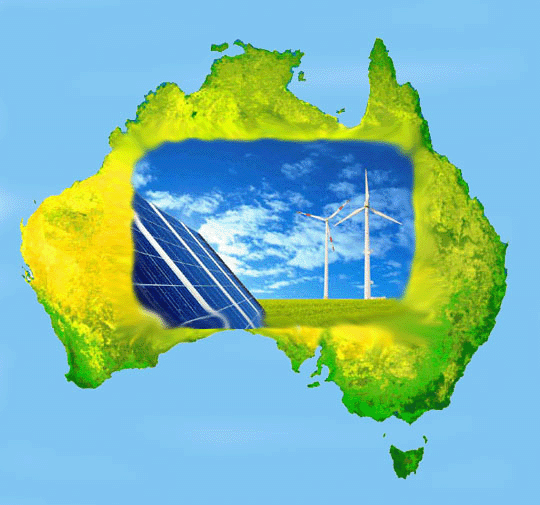
Australia generates nearly 20 percent of its electricity from renewables. This is forecast to jump to 75 percent over the next 20 years.
A total of 14.7 gigawatts (GW) of large-scale solar and wind projects worth A$20 billion ($14 billion) were under construction or reached financial close last year, more than double 2017’s record, according to the Clean Energy Council.
……….HOOK-UP HICCUPS
A Clean Energy Council survey of senior executives in December found grid connection is the biggest industry concern heading into 2019, Freeman said.
UK-based solar investor Octopus Investments said grid issues were what took it two years to choose its first investment in Australia. The Darlington Point solar farm is about to begin construction and will be the country’s largest.
My Turn: Martin Luther King’s quest to stop the nuclear arms race https://www.concordmonitor.com/KIngs-quest-to-stop-the-nuclear-arms-race-22786447By WILLIAM LAMBERS For the Monitor January 21, 2019, Civil rights champion Martin Luther King Jr. was also an activist for nuclear disarmament. Dr. King used his voice for peace during the Cold War nuclear arms race.
He can inspire us today to finish the journey of eliminating all nuclear weapons.
The year was 1958. The Soviet Union and the United States were developing and testing nukes at an alarming rate. In March, Dr. King received a letter from Norman Cousins and Clarence Pickett of the National Committee for a Sane Nuclear Policy. King was asked to support a statement urging an end to nuclear testing.
He joined the SANE movement right away. In April, Dr. King also signed an appeal by Protestant clergyman on halting nuke tests.
The public outcry against nuclear tests helped encourage President Dwight Eisenhower to start negotiations with the Soviets on a test ban treaty in 1958. In October, King joined a statement to the U.S. and Soviet negotiators in Geneva.
It read “an important beginning has to be made on one vital part of the problem of world peace, the permanent internationally inspected ending of nuclear weapons tests.”
Eisenhower proposed a suspension of nuclear tests during the talks. There were no nuclear tests by the U.S. or the Soviets from late 1958 into 1961. His successor President John F. Kennedy was able to produce a limited treaty with the Soviets in 1963 banning nuclear tests in the atmosphere, underwater and outer space. Underground tests did continue.
The 1996 Comprehensive Nuclear Test Ban Treaty, banning all tests including underground, has yet to be ratified by the U.S. Senate. President Donald Trump could ask the Senate to ratify this treaty and fulfill one of Dr. King’s goals of ending nuke tests forever.
Ending nuclear testing was seen as a critical step toward stopping the arms race. Dr. King understood the threat of nukes.
In 1957, in Ebony Magazine, King wrote “I definitely feel that the development and use of nuclear weapons of war should be banned. It cannot be disputed that a full-scale nuclear war would be utterly catastrophic. Hundreds and millions of people would be killed outright by the blast and heat, and by the ionizing radiation produced at the instant of the explosion.”
Dr. King recognized that spending on nuclear armaments robbed from society. King said, “A nation that continues year after year to spend more money on military defense than on programs of social uplift is approaching spiritual doom.”
The goal of eliminating nuclear weapons has been shared by successive leaders including presidents Ronald Reagan and Barack Obama. President Trump has yet to take action on eliminating nuclear weapons. Instead Trump has sought to scrap the Iran nuclear deal and the INF Treaty with Russia.
We have lost any momentum in reducing the nuclear danger. There are still close to 15,000 nukes worldwide, according to the Arms Control Association. Dr. King’s words can inspire us to jumpstart nuclear disarmament.
In his sermon “Loving Your Enemies” Dr. King said, “It is an eternal reminder to a generation depending on nuclear and atomic energy, a generation depending on physical violence, that love is the only creative, redemptive, transforming power in the universe.”
King wanted all people, all nations, to come together to work out their differences. Through what Dr. King called “a great fellowship of love” the world can achieve peace and nuclear disarmament.
Instead of nation’s wasting dollars on nukes we could feed the hungry, end disease and save the environment. As we celebrate Martin Luther King Day listen to his words and be inspired to take action for world peace.
(William Lambers is the author of “The Road to Peace” and “Ending World Hunger.”)
REneweconomy, Giles Parkinson21 December 2018Australia’s leading scientific research group and the country’s energy market operator have released a benchmark study that shows the cost of new wind and solar – even with hours of storage – is “unequivocally” lower than the cost of new coal generation.
Is there a message in here, for Tasmania, Kangaroo Island, French Island ……?
Observer 20th Jan 2019 A tech revolution – and an abundance of wind and waves – mean that the people of Orkney now produce more electricity than they can use. It seems the stuff of fantasy. Giant ships sail the seas burning fuel that has been extracted from water using energy provided by the winds, waves and tides. A dramatic but implausible notion, surely.
Yet this grand green vision could soon be realised thanks to a remarkable technological transformation that is now under way in Orkney. Perched 10 miles beyond the northern edge of
the British mainland, this archipelago of around 20 populated islands – as well as a smattering of uninhabited reefs and islets – has become the centre of a revolution in the way electricity is generated.
Orkney was once utterly dependent on power that was produced by burning coal and gas on the Scottish mainland and then transmitted through an undersea cable. Today the islands are so festooned with wind turbines, they cannot find enough uses for the emission-free power they create on their own. Community-owned wind turbines generate power for local villages; islanders drive non-polluting cars that run on electricity; devices that can turn the energy of the waves and the tides into electricity are being tested in the islands’ waters and seabed; and – in the near future – car and passenger ferries here will be fuelled not by diesel but by hydrogen, created from water that has been electrolysed using power from Orkney’s wind, wave and
tide generators. https://www.theguardian.com/environment/2019/jan/20/orkney-northern-powerhouse-electricity-wind-waves-surplus-power-hydrogen-fuel-cell
The work – based on a two-year project between the University of Technology Sydney, the University of Melbourne and German Aerospace Centre – found a combination of renewables and energy efficiency can achieve the net-zero emissions outcome needed by 2050.
“The main barrier is neither technical nor economic – it’s political,” Sven Teske, research director at the UTS’s Sydney’s Institute for Sustainable Futures, said, adding “it’s not too late” to restrict global warming to 1.5 degrees, the lower end of the Paris climate target.
The research, released on Monday at the World Economic Forum in Davos, modelled 72 regional energy grids at hourly increments through 2050, including the Australian states on the National Electricity Market and other regions.
Costs would be moderated in Australia because the average age of coal-fired power plants was about 40 years, and would soon have to be replaced anyway. Solar and wind-generated electricity was also already cheaper than new coal, he said.
Fossil-fuel use in other sectors, such as transport and agriculture, could also be phased out and replaced by synthetic fuels, particularly hydrogen. Australia’s abundant sun and wind resources gave the nation an advantage only matched by north Africa and the Middle East as a renewable powerhouse, Dr Teske said.
Australia would benefit from the transition from the export of hydrogen-based or other synthetic fuels, and from shipments of cobalt and silver used for storage and solar panels, respectively.
While biofuels offered potential to supplement renewables, the sector would be constrained by the need to maintain farm land to feed growing populations. Reforestation would also be needed to provide a carbon sink to help reduce carbon-dioxide levels, he added.
“Citing a growing body of research, we show that using land restoration efforts to meet negative emissions requirements, along with a transition to 100 per cent renewable energy by 2050, gives the world a good chance of staying below the 1.5-degree target,” Malte Meinshausen, founding director of the Climate and Energy College at the University of Melbourne, said.
The research, understood to cost in the range of $1 million, was the first in Australia by the foundation set up by prominent actor and environmentalist Leonardo DiCaprio.
Given the scant carbon budget left to keep warming from reaching dangerous levels, “every year of delay is a huge problem”, Dr Teske said.
New data shows for the first time Australia’s distributed rooftop solar PV responding to help keep the power system secure. The post How solar PV contributes to the maintenance of power system security appeared first on RenewEconomy.
Opinion: ¶ “How Orkney Leads The Way For Sustainable Energy” • Orkney’s community-owned wind turbines generate their power. Islanders drive nonpolluting EVs. It is a test site for devices that can turn the energy of the waves and the tides into electricity, and in the near future, Orkney’s ferries will be fuelled by hydrogen. The […]
From record investment to policy chaos – a guide to last year’s biggest renewable trends and milestones that have set the pace for the energy market transformation. The post 10 hot trends shaping Australian clean energy appeared first on RenewEconomy.
Despite a bumper year for renewables on Australia’s grid, electricity prices remain stubbornly high. So what’s going on? The post Know your NEM: Pool prices higher than last year, despite new supply appeared first on RenewEconomy.
Canavan says Australia’s “fragile electricity system” needs more “reliable” “baseload” power. TAI report shows booming renewables displacing black coal generation for first time ever, and rooftop solar pulling weight in summer heat. The post Wind, solar eat further into coal supply on NEM, as Coalition pushes for more coal supply on NEM appeared first on…





 Antinuclear