Morrison government not recognising the climate impacts already hitting Australia
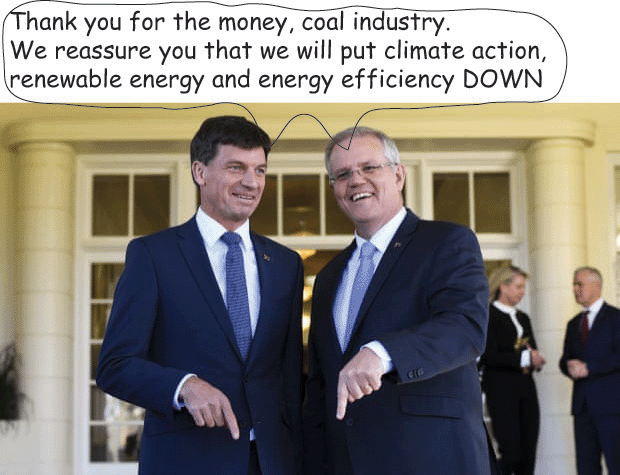 Governments not keeping pace with climate change impacts: scientist, Brisbane Times, By Tony Moore, February 5, 2019 — One of Australia’s leading scientists has warned the Queensland and federal governments that they are not keeping pace with the impacts of climate change. Governments not keeping pace with climate change impacts: scientist, Brisbane Times, By Tony Moore, February 5, 2019 — One of Australia’s leading scientists has warned the Queensland and federal governments that they are not keeping pace with the impacts of climate change.
Queensland’s recent extreme weather – bushfires, heatwaves, coral bleaching, drought, Cyclone Penny, Townsville’s floods – showed the state was clearly experiencing climate change, Professor Ian Lowe said. “What I think is a reason for concern is that the science in the 1980s was saying that – if the [1980] climate models were right – by about 2030 there would be observable changes in climate that would be impossible to ignore,” Professor Lowe said. “Now I think you could say that, if anything, the science of the time was being unreasonably cautious,” he said. I think you would have to be in deep denial not to accept that there are unmistakeable signs of climate change.” Professor Lowe is a member of the Queensland government’s senior climate change body, the Queensland Climate Advisory Council. It is chaired by Queensland Environment Minister Leeanne Enoch, while Queensland Premier Annastacia Palaszczuk, Deputy Premier Jackie Trad, Natural Resources and Mines Minister Anthony Lynham and Queensland’s chief scientist are members. It has met only three times since 2017. ……. Professor Lowe listed coral bleaching, Townsville’s flooding, the Australia-wide heatwaves in January 2019, the unseasonal Queensland bushfires from October to December and the recent fires in Tasmania as examples of extreme weather, triggered by the changing climate. Professor Lowe said the Queensland government was not “keeping pace” with measures to adapt to a changing climate, despite a string of reports since 2015. “As I said before, there isn’t yet the sense of urgency that there should be, either in adaptation, or in mitigation,” he said. He said the federal government was “in complete denial” over the impacts of climate change. Prime Minister Scott Morrison, in Townsville on Tuesday, declined to say whether the torrential rain, described as a one-in-100-year event, was a demonstration of climate change……. https://www.brisbanetimes.com.au/environment/climate-change/governments-not-keeping-pace-with-climate-change-impacts-scientist-20190205-p50vun.html |
The Department of Industry an Innovation now spending much time and resources in Hawker.Why?

Katrina Bohr Face book page: No Nuclear Waste Dump Anywhere in South Australia, 7 Feb 19, WHY IS DIIS SPENDING MORE TIME AND RESOURCES IN HAWKER? THE FLINDERS RANGES COUNCIL COVERS 4,198 SQUARE KMS. WHICH DOESN’T INCLUDE ALL TRADITIONAL OWNERS. IS THIS A FAIR AND CONSULTATIVE PROCESS?
Cost of insurance becoming unmanageable in Australia, due to climate change?
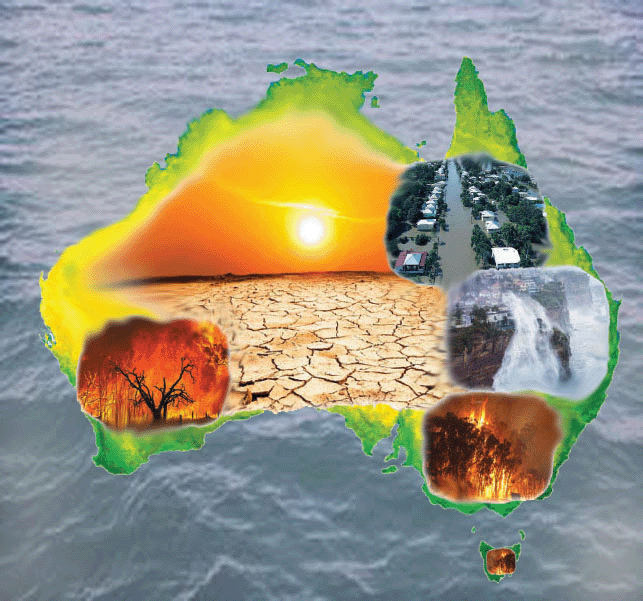 Could climate change make it harder to get insurance in Australia? ABC News The Signal , By Ange Lavoipierre and Stephen Smiley for The Signal, 6 Feb 19, At the moment, Townsville is more or less underwater and large parts of Tasmania are on fire.
Key points:
- There were anecdotal reports of premiums reaching $30,000 after the 2017 Lismore floods
- There is a serious risk some places could become too disaster-prone to insure, according to an expert
- Taxpayers could end up footing the bill
Summer in Australia has always been extreme, but some corners of the country are experiencing climate-driven disasters that are worse than ever — and more of them every year.
Those stories are told in extraordinary detail as they unfold, but once the world looks away, there’s the question of who’ll pay the bill.
So with fires, floods and crazy weather becoming more frequent and severe, is Australia on its way to being uninsurable?
The clean-up can take years and cost millions…….
Could we become too disaster-prone to insure?
The director of the Climate and Energy Program at the Australia Institute, Richie Merzian, says it’s a very real risk.
“We will get to a certain point, somewhere between say 3 degrees or 4 degrees above pre-industrial levels, and a world like that will see situations where cities, entire coastlines, do become uninsurable,” he said.
Mr Merzian said in that case “the basic safety net that’s provided by the private sector just becomes too prohibitively expensive”.
He said in that instance, the burden will fall back on the taxpayer.
“The Government is always the insurer of last resort and then you see these odd situations where everyone will have to pay to keep these towns operating,” Mr Merzian said.
“And we saw that with the Queensland flood levy, where the damages were so big the insurance industry couldn’t possibly cover it.”.
So can it be avoided?
Mr Merzian said it was possible, in the immediate future, to manage the risks to insurers in flood and fire-prone areas.
“Some insurers have basically decided to leave certain markets,” he said.
“Ideally the insurance [companies] that do want to stay in there need to work with the governments to make that happen.
“And that’s where you see more money and effort put into mapping the risks, improving zoning, building better codes and better safety measures.”
Mr Merzian warned that the difficult discussion about whether or not it was even appropriate to rebuild in some disaster-prone areas was not happening in enough places.
“There’s $88 billion at risk in terms of damage from coastal erosion in Australia … but no local council wants to go and tell people who have million-dollar beach houses, ‘you shouldn’t have built here’,” he said. https://www.abc.net.au/news/2019-02-06/could-climate-change-make-australia-uninsurable/10783490
|
|
Trump Uranium Quota Could Shutter Nuclear Plants, Trade Group Warns
 The Nuclear Energy Institute warns that a 25 percent quota on domestic uranium would send prices soaring and force nuclear plants offline. US News, By Alan Neuhauser, Staff Writer, Feb. 4, 2019, A TRUMP ADMINISTRATION proposal to institute quotas on domestic uranium could put the country’s nuclear power sector in a nuclear winter.
The administration is reportedly considering an import quota that would require U.S. uranium mining firms to provide a quarter of the domestic market. The Commerce Department began exploring the idea last year, citing national security concerns. However, critics of the proposal point out that much of the country’s uranium is supplied by close U.S. allies: Canada and Australia.
$500 billion to modernise USA’s nuclear weapons – great for investors in Northrop,Boeing etc
Across this nuclear triad, the takeaway for investors is, there’s a lot of money on the table up for grabs………Definitely going to be a bullish sign for these defense contractors going forward.

|
The $500 Billion Push to Modernize the Nuclear Triad, Cold War-era technology is due for replacement, but the cost is out of this world., Motley Fool Staff, (the_motley_fool), Feb 5, 2019 . Continue reading |
Keeping South Australia nuclear-dump-free – a priority for Candace Champion, Greens candidate for Grey electorate
Greens announce new candidate for Grey electorate, Transcontinental, Amy Green 6 Feb 19 Port Augusta woman Candace Champion has joined the race for the seat of Grey at the next federal election.
Running as a candidate for The Greens, Candace is described as a passionate and driven young Aboriginal woman who can bring diversity to Australian parliament.
Brought up in a close-knit family, Candace has many fond memories of her childhood growing up on the Eyre Peninsula – especially participating in local sports. ……
While her family has been a large source of inspiration throughout her life, her faith is also something that has had a big influence on who she is today.
Candace’s father was a minister and later on her mother followed suit.
“The church is and has always been a second home for me. Friday night Youth Group and Sunday Church hold special memories,” she said.
She is now an active member of the Uniting Church in Australia and the Uniting Aboriginal and Islanders Christian Congress.
Candace said she was inspired to run for government after witnessing the many issues her family, friends, country, communities and church continue to face. ……
She is deeply committed to child safety and keeping families together, a treaty with First Australians, and the protection of Australia’s beautiful country and waters.
“By running for the seat of Grey I hope to achieve real advocacy, I will advocate for equality, justice and change. I hope to create positive change in all areas of government and society,” Candace said……
Candace is also passionate about cleaning up politics – where corporate donations should be banned and making SA a no nuclear waste dump. …… https://www.transcontinental.com.au/story/5886273/candace-throws-her-hat-to-contest-the-seat-of-grey/?fbclid=IwAR0TR2ZpvxAPD1T647q1lPdqF30cV6h6aE38D
Canavan takes cheap shots at the UN for Adani
“Canavan and Adani keep saying that Adrian Burragubba and the W&J Council don’t speak for the Traditional Owners. One thing is absolutely certain… Canavan and Adani don’t.
Neither Canavan nor Adani would know land rights if they fell over them. We will persist with our petitioning of various UN bodies because the legislation and processes in Australia fall well short of international laws and standards to which Australia is a signatory.
The Coalition Government has an appalling record on Aboriginal rights, and we operate under a worse native title regime today than when the UN CERD, more than 20 years ago, found the Howard government’s “10 point plan” changes to the Native Title Act were racially discriminatory.
The mining industry’s Resources Minister, Adani and the Coalition Government: fighters for Aboriginal Land Rights? Canavan must think we’re fools if we believe that. He is not going to run W&J business.” wanganjagalingou.com.au/canavan-takes-cheap-shots-at-the-un-for-adani/
Anger in Ireland, about UK plans to dump nuclear waste close to Louth border
| . |
Bill Shorten’s climate change policy isn’t ‘ambitious enough’ – Zali Steggall
Independent challenging Tony Abbott says Shorten’s climate change policy isn’t ‘ambitious enough’ The high-profile independent taking on Tony Abbott in Warringah at the coming federal election says Labor’s climate change policy needs to be more ambitious and include an explicit commitment to block the Adani coalmine.In an interview with Guardian Australia’s political podcast, Zali Steggall said the current policy outlined by Bill Shorten was on the right track, but she challenged the opposition to go further. “I don’t think it’s ambitious enough.”
Steggall said Labor, given the potential for a change of government later in the year, needed to include a commitment to block the controversial Queensland coal project. “Our financial institutions aren’t prepared to lend or invest in coal projects, why should the Australia people’s money be invested?”
She said Labor, if it wins this year’s federal contest, needed to use whatever regulatory powers it had available to it to stop the project. “We need an orderly retirement of coal, I don’t think we should be entering new projects,” Steggall said.
“The attention should be with renewables, technology, clean transport, clean energy – not projects like Adani.”
Steggall, a barrister, and former Olympic ski champion, is one of a group of small l liberal independents taking on government frontbenchersin the federal election contest expected in May, and has put Abbott and the Coalition’s record on climate change front and centre of her campaign in the Sydney seat.
The environment movement, and activist groups like GetUp, also want Labor to strengthen its position on the Adani project, an idea Shorten countenanced seriously last year, before stepping back.
Private polling conducted for the environment movement and for the major parties suggests community concern about climate change is currently sitting at levels not seen since the federal election cycle in 2007……. https://www.theguardian.com/australia-news/2019/feb/06/zali-steggall-says-labor-needs-to-commit-to-stopping-adani-coalmine
|
|
Climate disruption is driving the migration of people from Central America
|
Climate change is the overlooked driver of Central American migration, https://www.pri.org/stories/2019-02-06/climate-change-overlooked-driver-central-american-migration, Living on Earth. February 06, 2019 Adam Wernick As people from Guatemala and Honduras continue to seek sanctuary in the US for a variety of reasons, including violence and poverty, another factor driving their migration has gotten much less attention: climate disruption. Continue reading
|
How Australia has lost the plot on adapting to climate change
|
Ten years ago, climate adaptation research was gaining steam. Today, it’s gutted, The Conversation, Professor, University of Melbourne February 7, 2019 “……..Between 1997 and 2009 the state [of Victoria] suffered its worst drought on record, and major bushfires in 2003 and 2006-07 burned more than 2 million hectares of forest. Then came Black Saturday, and the year after that saw the start of Australia’s wettest two-year period on record, bringing major floods to the state’s north, as well as to vast swathes of the rest of the country.
In Victoria alone, hundreds of millions of dollars a year were being spent on response and recovery from climate-related events. In government, the view was that things couldn’t go on that way. As climate change accelerated, these costs would only rise. We had to get better at preparing for, and avoiding, the future impacts of rapid climate change. This is what is what we mean by the term “climate adaptation”. Facing up to disastersA decade after Black Saturday, with record floods in Queensland, severe bushfires in Tasmania and Victoria, widespread heatwaves and drought, and a crisis in the Murray-Darling Basin, it is timely to reflect on the state of adaptation policy and practice in Australia. In 2009 the Rudd Labor government had taken up the challenge of reducing greenhouse gas emissions. With Malcolm Turnbull as opposition leader, we seemed headed for a bipartisan national solution ahead of the Copenhagen climate summit in December. Governments, meanwhile, agreed that adaptation was more a state and local responsibility. Different parts of Australia faced different climate risks. Communities and industries in those regions had different vulnerabilities and adaptive capacities and needed locally driven initiatives. Led by the Brumby government in Victoria, state governments developed an adaptation policy framework and sought federal financial support to implement it. This included research on climate adaptation. The federal government put A$50 million into a new National Climate Change Adaptation Research Facility, based in Queensland, alongside the CSIRO Adaptation Flagship which was set up in 2007. The Victorian Government invested A$5 million in VCCCAR. The state faced local risks: more heatwaves, floods, storms, bushfires and rising sea levels, and my colleagues and I found there was plenty of information on climate impacts. The question was: what can policy-makers, communities, businesses and individuals do in practical terms to plan and prepare? Getting to workFrom 2009 until June 2014, researchers from across disciplines in four universities collaborated with state and local governments, industry and the community to lay the groundwork for better decisions in a changing climate. We held 20 regional and metropolitan consultation events and hosted visiting international experts on urban design, flood, drought, and community planning. Annual forums brought together researchers, practitioners, consultants and industry to share knowledge and engage in collective discussion on adaptation options. We worked with eight government departments, driving the message that adapting to climate change wasn’t just an “environmental” problem and needed responses across government. All involved considered the VCCCAR a success. It improved knowledge about climate adaptation options and confidence in making climate decisions. The results fed into Victoria’s 2013 Climate Change Adaptation Plan, as well as policies for urban design and natural resource management, and practices in the local government and community sectors. I hoped the centre would continue to provide a foundation for future adaptation policy and practice. Funding cutsIn the 2014 state budget the Napthine government chose not to continue funding the VCCCAR. Soon after, the Abbott federal government reduced the funding and scope of its national counterpart, and funding ended last year. Meanwhile, CSIRO chief executive Larry Marshall argued that climate science was less important than the need for innovation and turning inventions into benefits for society. Along with other areas of climate science, the Adaptation Flagship was cut, its staff let go or redirected. From a strong presence in 2014, climate adaptation has become almost invisible in the national research landscape. In the current chaos of climate policy, adaptation has been downgraded. There is a national strategy but little high-level policy attention. State governments have shifted their focus to energy, investing in renewables and energy security. Climate change was largely ignored in developing the Murray-Darling Basin Plan. Despite this lack of policy leadership, many organisations are adapting. Local governments with the resources are addressing their particular challenges, and building resilience. Our public transport now functions better in heatwaves, and climate change is being considered in new transport infrastructure. The public is more aware of heatwave risks, and there is investment in emergency management research, but this is primarily focused on disaster response. Large companies making long-term investments, such as Brisbane Airport, have improved their capacity to consider future climate risks. There are better planning tools and systems for business, and the financeand insurance sectors are seriously considering these risks in investment decisions. Smart rural producers are diversifying, using their resources differently, or shifting to different growing environments. Struggling to copeBut much more is needed. Old buildings and cooling systems are not built to cope with our current temperatures. Small businesses are suffering, but few have capacity to analyse their vulnerabilities or assess responses. The power generation system is under increasing pressure. Warning systems have improved but there is still much to do to design warnings in a way that ensures an appropriate public reaction. Too many people still adopt a “she’ll be right” attitude and ignore warnings, or leave it until the last minute to evacuate. In an internal submission to government in 2014 we proposed a Victorian Climate Resilience Program to provide information and tools for small businesses. Other parts of the program included frameworks for managing risks for local governments, urban greening, building community leadership for resilience, and new conservation approaches in landscapes undergoing rapid change. Investment in climate adaptation pays off. Small investments now can generate payoffs of 3-5:1 in reduced future impacts. A recent business round table report indicates that carefully targeted research and information provision could save state and federal governments A$12.2 billion and reduce the overall economic costs of natural disasters (which are projected to rise to A$23 billion a year by 2050) by more than 50%. Ten years on from Black Saturday, climate change is accelerating. The 2030 climate forecasts made in 2009 have come true in half the time. Today we are living through more and hotter heatwaves, longer droughts, uncontrollable fires, intense downpours and significant shifts in seasonal rainfall patterns. Yes, policy-makers need to focus on reducing greenhouse emissions, but we also need a similar focus on adaptation to maintain functioning and prosperous communities, economies and ecosystems under this rapid change. It is vital that we rebuild our research capacity and learn from our past experiences, to support the partnerships needed to make https://theconversation.com/ten-years-ago-climate-adaptation-research-was-gaining-steam-today-its-gutted-111180 |
|
NSW under pressure to move quickly on renewables, as coal clunkers fail — RenewEconomy

Major parties under pressure to produce a plan for energy transition as new data highlights growing failures of ageing fossil fuel generators. The post NSW under pressure to move quickly on renewables, as coal clunkers fail appeared first on RenewEconomy.
via NSW under pressure to move quickly on renewables, as coal clunkers fail — RenewEconomy
Gupta’s Simec pushes into Victoria, says “baseload” renewables to “change the game” — RenewEconomy

Simec Energy obtains licence to retail in Victoria, extending its reach to offer its “baseload renewable energy” product to businesses and large energy users. The post Gupta’s Simec pushes into Victoria, says “baseload” renewables to “change the game” appeared first on RenewEconomy.
via Gupta’s Simec pushes into Victoria, says “baseload” renewables to “change the game” — RenewEconomy
February 6 Energy News — geoharvey

Opinion: ¶ “Why Oil Companies Have Suddenly Gone Missing In The Bond Market” • The US shale oil revolution was built on cheap capital from the bond markets. Frackers used tons of borrowed money to make enormous technological advances in drilling, and that sent oil output skyrocketing. But that trend has broken down in recent […]
2018: The year fossil fuels began their inexorable decline — RenewEconomy

Renewable energy broke through the 20% market share threshold in 2018, for the first time since the 1970s. Meanwhile, coal and gas generation continued to fall. The post 2018: The year fossil fuels began their inexorable decline appeared first on RenewEconomy.
via 2018: The year fossil fuels began their inexorable decline — RenewEconomy
1 This month

of the week – Australians for War Powers Reform (AWPR)
To see nuclear-related stories in greater depth and intensity
 Antinuclear