Australia is still finding out what it doesn’t know about its secretive AUKUS deal
7.30 / By Laura Tingle, Sat 10 Aug 2024
When US President Joe Biden announced he would not be standing for another term, Australia’s political leaders expressed their gratitude for his contribution to public life. But this week, Australian voters had something else for which to be grateful to Biden.
For it was only as a result of a letter the US president wrote to the US Congress, that we found that there had been an update to the AUKUS agreement which will allow naval nuclear propulsion plants, rather than just nuclear propulsion “information”, to be transferred to Australia.
But it is not this part of the letter that has raised eyebrows and hackles even if, as usual, we find out about such deals from the Americans before we find out about them from our own government. The formal part of the deal will be exposed when it is submitted to the Treaties committee of our own parliament.
It is a side agreement, between the US, the UK and Australia that is of considerable concern: a non-legally binding “understanding” that includes “additional related political commitments”.
What are these? Well, they are secret.
The AUKUS saga moves on without much scrutiny
Critics argue that the “understanding” and “additional related political commitments” could include how and where these vessels are used. That is, what conflicts Australia would be expected to show up for, and how.
Some speculate on the possibility that it involves Australia agreeing to accept nuclear waste from the US and the UK, something the government has denied.
The idea that any of these such undertakings may have been made, but we aren’t allowed to know, is simply outrageous.
A quick recap of the AUKUS deal reveals that we are still expecting to receive two second-hand US Virginia class submarines, before embarking on building an entirely new, and so far unseen, British submarine in Adelaide.
Of course, we get a bit of a say in the design and plans for that new sub, don’t we?
Well the UK announced in October 2023 that it had selected BAE Systems for the SSN-AUKUS submarine. That month, Greens senator David Shoebridge asked officials about what involvement Australia had in the selection of the company that would build both the UK and Australian submarines.
The Australian Submarine Agency’s Alexandra Kelton told the Senate that “we had, through our high commission, some notification that an announcement would be made and some context around that but not of the content in great detail”.
The AUKUS submarine saga moves on with not much scrutiny in Australia, let alone apparently much input from Australia, given its cost and its huge strategic investment in one particular idea.
The second-hand Virginia class subs and later the AUKUS-class subs to be built in Adelaide are supposedly “sovereign Australian assets operating under the complete control of the Australian government”.
The Greens’ Shoebridge is one critic who warns the secret undertakings could include commitments on how the subs are used.
And this is a position which seems to be backed in by the authoritative papers written for the US Congressional Research Service.
Voters likely to be the last to know
In its latest update on the Virginia-class submarines, dated August 5, the Service’s analysts once again outline the relative benefits costs and risks of an “alternative division-of-labor approach”.
That’s technical talk for an alternative plan in which “up to eight additional Virginia-class SSNs would be procured and retained in US Navy service and operated out of Australia along with the US and UK SSNs that are already planned to be operated out of Australia … while Australia invested in military capabilities (such as, for example, long-range anti-ship missiles, drones, loitering munitions, B-21 long-range bombers, or other long-range strike aircraft)”.
That is, we don’t get any submarines, the Americans (and Brits) just run theirs out of here. Along with an expansion of bomber visits, personnel and troop rotations.
The “deterrence and warfighting cost-effectiveness” arguments for doing this “include [the fact that] Australian Defence Minister Richard Marles in March 2023 reportedly confirmed that in exchange for the Virginia-class boats, Australia’s government made no promises to the United States that Australia would support the United States in a future conflict over Taiwan.”
“Selling three to five Virginia-class SSNs to Australia would thus convert those SSNs from boats that would be available for use in a US-China crisis or conflict into boats that might not be available for use in a US-China crisis or conflict. This could weaken rather than strengthen deterrence and warfighting capability in connection with a US-China crisis or conflict.”
There’s a lot more like that.
Riled on Friday by the prime minister’s dismissal of his observations on AUKUS, Albanese’s predecessor Paul Keating warned that “the strength and scale of the United States’s basing in Australia will eclipse Australia’s own military capability such that Australia will be viewed in the United States as a continental extension of American power akin to that which it enjoys in Hawaii, Alaska and more limitedly in places like Guam”.
“Such an outcome is likely to turn the Australian government, in defence and security terms, into simply the national administrator of what would be broadly viewed in Asia as a US protectorate,” he said.
If that happens, voters are likely to be the last to know about it.
Laura Tingle is 7.30’s chief political correspondent
Buck-passing inside the murky arms trade
Australia bears responsibility for how Australian-made weapons are used in conflict zones around the world
Undue Influence, Michelle Fahy, Aug 10, 2024
‘It is almost literally true that Australia cannot go to war without the consent and support of the US.’
This statement, made in 2001, is key to understanding the deceit and denials by the Albanese government regarding weapons exports bound for Israel.
In his 2019 book Secret: The making of Australia’s security state, veteran journalist Brian Toohey quoted the 2001 research paper by the Australian parliamentary library.
Toohey explained that:
The US requires almost all countries that buy its weapons systems, including Australia, to send sensitive components back to the US for repairs, maintenance and replacements without the owners being allowed access to critical information, including source codes, needed to keep these systems operating.
To rephrase Toohey: Australia cannot use its advanced weapons platforms for any length of time without US support.
Two decades later, the F-35 fighter jet is one such advanced weapons platform.
Australia reliant on the US
Australia is now more embedded in and reliant on the US military than it was in 2001.
After nine months of denials, Defence Minister Richard Marles and Foreign Minister Penny Wong finally admitted in June that Australia is still exporting parts into the global F-35 supply chain, a point of contention because Israel is using its F-35s in its war in Gaza. Both senior ministers also noted at the same time that Australia’s F-35 fleet forms the heart of our air force’s “fast jet capability”.
Is Australia’s continuing supply of parts to the US somehow linked to the need to maintain our own F-35 capability?
The UN has stated only that supply to Israel of weapons, parts, components, ammunition and munitions should cease. It has not said all exports into global weapons supply chains that include Israel as a recipient nation should cease. Australia could continue supplying the US-led global F-35 supply chain and be compliant with UN requests provided the US has agreed that none of the Australian exports will be sent to Israel.
I asked the Defence Department whether it had sought assurances from the US and Lockheed Martin, the manufacturer of the F-35 fighter jet, that they would cease transferring Australian-made parts and components to Israel. The Department had not responded by deadline.
I also asked whether it was correct that Australia does not have access to the necessary source codes, or other critical information, needed to repair, maintain, upgrade or replace the sensitive components in our fleet of F-35s. Again, no response had been received at deadline.
As Toohey concluded in his 2019 book:
Although the ability to operate our major weapons systems independently is crucial to defending Australia, our leaders prefer to ignore this fundamental flaw and become more tightly integrated with US forces.
This may explain why the Albanese government has been intent on obscuring the extent of Australia’s involvement in the F-35 supply chain and unwilling to take decisive action to ensure that no Australian parts and components could end up in Israel.
Hot denials
“I am saying we’re not sending parts.”
That was Richard Marles, Australia’s deputy prime minister and defence minister, on ABC Radio Melbourne in June talking about Australia’s arms exports to Israel.
Marles then admitted, however, that Australia was continuing to supply parts into the F-35 global supply chain. But that was “worlds away” from claims that “we are directly supplying weapons to Israel” which, he said, “is just a falsehood”.
Marles insisted that claims by the Greens that Australia was supplying weapons to Israel were “absolutely false”, “a total lie”, “completely wrong”, and “utterly, utterly false”.
He repeated the government’s line that “there have been no weapons exported to Israel…for the past five years” and stated this to be “the absolute truth”. I have reported previously on this highly misleading statement.
Should Australia be taking stronger action?……………………………………………………………………………………………………………………. more https://undueinfluence.substack.com/p/buck-passing-inside-the-murky-arms?utm_source=post-email-title&publication_id=297295&post_id=147548747&utm_campaign=email-post-title&isFreemail=true&r=1ise1&triedRedirect=true&utm_medium=email
AUKUS Revamped: The Complete Militarisation of Australia
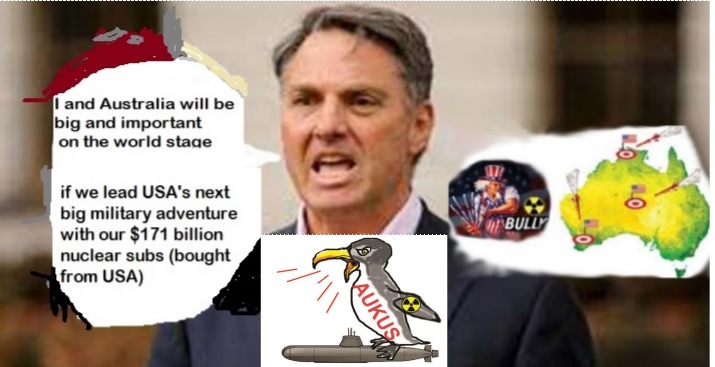
Marles, the persistently reliable spokesman for Australia’s wholesale capitulation to the US war machine, calls the document “the legal underpinning of our commitment to our international obligations so it’s a very significant step down the AUKUS path and again it’s another demonstration that we are making this happen.”
US military forces, in short, are to occupy every domain of Australia’s defence.
August 10, 2024, by: Dr Binoy Kampmark https://theaimn.com/aukus-revamped-the-complete-militarisation-of-australia/
There is much to loathe about the AUKUS security agreement between Canberra, Washington and London. Of the three conspirators against stability in the Indo and Asia Pacific, one stands out as the shouldering platform, the sustaining force, the political and military stuffing. But Australian propagandists and proselytisers of the US credo of power prefer to see it differently, repeatedly telling the good citizens down under that they are onto something truly special in being a military extension, the gargantuan annexe of another’s interests. Give them nuclear powered submarines, let them feel special, and a false sense of security will follow.
The August 2024 AUSMIN talks in Annapolis, Maryland, held between US Secretary of Defense Lloyd J. Austin III, US Secretary of State Antony Blinken, and their Australian counterparts, Richard Marles (Minister of Defence) and Penny Wong (Foreign Minister)provided yet another occasion for this grim pantomime. No one could be in doubt who the servitors were.
The factsheet from the US Department of Defense on the meeting is worth noting for Washington’s military capture – no other word describes it – and Australia’s sycophantic accommodation. As part of the “Enhanced Force Posture Cooperation,” the US and Australia are to advance “key priorities across an ambitious range of force posture cooperation efforts.” This is merely a clumsy way of describing the deeper incorporation of Australia’s own military requirements into the US military complex “across land, maritime, air, and space domains, as well as the Combined Logistics, Sustainment, and Maintenance Enterprise.” US military forces, in short, are to occupy every domain of Australia’s defence.
The greedy and speedy US garrisoning of Australia is evident through ongoing “infrastructure investments at key Australian bases in the norther, including RAAF Bases Darwin and Tindal” and “site surveys for potential upgrades at RAAF Bases Curtin, Learmonth, and Scherger.” Rotational deployments of US forces to Australia, “including frequent rotations of bombers, fighter aircraft, and Maritime Patrol and Reconnaissance Aircraft” are to increase in number. As any student of US-Australian relations knows, rotation is the disingenuous term used to mask the presence of a permanently stationed force – occupation by another name.
The public relations office has obviously been busy spiking the language with a sense of false equality: the finalising, for instance, by December 2024 of a Memorandum of Understanding on Co-Assembly for Guided Multiple Rocket Systems (GLMRS) – a “co-production”; finalising, by the same date, an MOU “on cooperative Production, Sustainment, and Follow-on Development of the Precision Strike Missile (PrSM)”; and institutionalising of “US cooperation with Australia’s Guided Weapons and Explosive Ordnance (GWEO) Enterprise.” Everywhere we look, a sense of artificial cooperation under the cover of Washington’s heavy-handed dominance, be it cooperative activities for Integrated Air and Missile Defence, or the hypersonic weapons program, can be found.
In this even more spectacular surrender of sovereignty and submission than previous undertakings, Canberra is promised second hand nuclear-powered toys in the form of Virginia Class submarines, something forever contingent on the wishes and whimsy of the US Congress. But even this contingent state of affairs is sufficient for Australia to bury itself deeper in what has been announced as a revised AUKUS agreement. More accurately, it constitutes a touch-up of the November 22, 2021 agreement between the three powers on the Exchange of Naval Nuclear Propulsion Information (ENNPIA).
The ENNPIA allows the AUKUS parties the means to communicate and exchange relevant Naval Nuclear Propulsion Information (NNPI), including officially Restricted Data (RD) as part of what is described as the “Optimal Pathway” for Australia’s needless acquisition of nuclear powered vessels.
In his letter to the US House Speaker and President of the Senate, President Joe Biden explains the nature of the revision. Less cumbersomely named than its predecessor, the new arrangements feature an Agreement between the three powers for Cooperation Related to Naval Nuclear Propulsion. In superseding the ENNPIA, it “would permit the continued communication and exchange of NNPI, including certain RD, and would also expand the cooperation between the governments by enabling the transfer of naval nuclear propulsion plants of conventionally armed, nuclear-powered submarines, including component parts and spare parts thereof, and other related equipment.”
The Agreement further permits the sale of special nuclear material in the welded power units, and other relevant “material as needed for such naval propulsion plants.” Transferrable equipment would include that necessary for research, development, or design of naval propulsion plants. The logistics of manufacture, development, design, manufacture, operation, maintenance, regulation and disposal of the plants is also covered.
Tokenistic remarks about non-proliferation are then made in Biden’s letter. The powers, for instance, commit themselves to “setting the highest nonproliferation standard” while protecting US classified information and intellectual property. This standard is actually pitifully low: Australia has committed itself to proliferation not only by seeking to acquire submarine nuclear propulsion, but by subsidising the building of such submarines in US and UK shipyards.
Marles, the persistently reliable spokesman for Australia’s wholesale capitulation to the US war machine, calls the document “the legal underpinning of our commitment to our international obligations so it’s a very significant step down the AUKUS path and again it’s another demonstration that we are making this happen.”
Obligations is the operative word here, given that Australia is burdened by any number of undertakings, be it as a US military asset placed in harm’s way or becoming a radioactive storage dump for all the AUKUS submarine fleets. Marles insists that the only nuclear waste that will end up on Australian soil will be that generated by Australia. “That is the agreement that we reached with the UK and the US back in March of last year, and so all this is doing is providing for the legal underpinning of that.”
Given that Australia has no standalone, permanent site to store high-level nuclear waste, even that undertaking is spurious. Nor does the understanding prevent Australia from accepting the waste accruing from the fleets of all the navies. Given the cringing servitude of Canberra, and the admission by the Australian government that they have made undisclosed “political commitments”, such an outcome cannot be ruled out.
Always reliably waspish, former Australian Labor Prime Minister Paul Keating gavehis assessment about the latest revelations of the AUSMIN talks. “There’ll be an American force posture now in Australia, involving every domain.” The Albanese government had “fallen for the dinner on the White House lawn.” That, and much more besides.
Australia being turned into ’51st US state’ – ex-PM

https://www.sott.net/article/493814-Australia-being-turned-into-51st-US-state-ex-PM 10 Aug 24
Canberra is losing its strategic autonomy due to its security pact with the US and UK, former Prime Minister Paul Keating has said.
The US is surrounding Australia with military bases under the AUKUS pact, which undermines the country’s sovereignty and makes it a legitimate target for China.
In an interview with ABC on Thursday, Keating, who served as prime minister between 1991 and 1996, voiced strong skepticism about whether his country benefits from being a member of AUKUS – a landmark security partnership between Australia, UK, and the US, which was announced in 2021. The pact, which has been condemned by China, focuses on helping Australia acquire nuclear-powered submarines.
Keating argued that by allowing the US to “displace our military” and surround the country with bases, Canberra is essentially giving up its right to determine its foreign and defense policy. Australia will “completely lose” its strategic autonomy as a result, he claimed.
“So AUKUS is really about, in American terms, the military control of Australia. The government of Prime Minister Anthony Albanese is “likely to turn Australia into the 51st state of the United States.”
The former prime minister added that the expanded military presence makes the country a target from China’s point of view.
“We’re now defending the fact that we’re in AUKUS… If we did not have an aggressive ally, like the United States, aggressive to others in the region, there would be nobody attacking Australia. We are better left alone.”
The US, he argued, is trying to “superintend” China, with tensions between the two being fueled by a power struggle over the self-ruled island of Taiwan, which Beijing views as part of its sovereign territory.
However, Keating argued that the Taiwan situation “is not a vital Australian interest” while China “has no strategic design” on Australia. The US attitude to Taiwan is comparable to China deciding that Tasmania needed help breaking away from Australia, he said.
The former prime minister’s remarks come after Australian Defense Minister Richard Marles and Foreign Minister Penny Wong traveled to Washington for talks about the AUKUS pact, and to discuss a new agreement on the transfer of nuclear material to Canberra as part of its push to acquire domestic-built atomic submarines from the 2030s.
China has warned that the AUKUS agreement raises nuclear proliferation risks, adding that it was conceived in the “Cold War mentality which will only motivate an arms race.” Russia has also sounded the alarm about the security situation in the Asia-Pacific, insisting that it “has no place for closed military and political alliances.”
Lawyers for Peace Open Letter to the Prime Minister
Aug 9, 2024 https://icanw.org.au/campaign-news/
Dear Prime Minister Albanese,
As Australian lawyers, we believe that international law can play a powerful role in nuclear disarmament and the creation of new norms, leading to increased peace and security for all.
Under your leadership, Australia has the opportunity now to uphold our long and proud commitment to championing international law by joining the Treaty on the Prohibition of Nuclear Weapons (TPNW). With two nuclear-armed powers involved in heated conflicts overseas, and the risk of nuclear escalation growing, now is a vital time to take necessary steps for nuclear disarmament.
Noting the growing international consensus on this matter, we urge your government to honour the ALP’s policy commitment to sign the TPNW, without further delay.
In the insightful words of former ALP Deputy Leader Tom Uren,“The struggle for nuclear disarmament is the most important struggle in the human race.”
The TPNW embodies Uren’s vision of a future where the international community embraces a total ban on nuclear weapons. The TPNW entered into force in 2021, and now has 93 signatories and 70 state parties. Australia’s signature would add heft to this global movement, and reflect the wishes of the overwhelming majority of Australians who support eliminating the scourge of nuclear weapons.
Joining the treaty also makes good on Australia’s obligation under Article VI of the Treaty on the Non-Proliferation of Nuclear Weapons (NPT) that binds parties to pursue good faith negotiations relating to a treaty on ‘general and complete disarmament and to negotiate effective measures relating to the cessation of the nuclear arms race and to nuclear disarmament.’ While progress has been made on effective measures concerning non-proliferation and peaceful uses of nuclear energy, little has been achieved in disarmament. The TPNW is the first multilateral effective measure under Article VI to enter into force since the NPT in 1968.
Moreover, the complementarity between the TPNW and NPT creates a robust legal framework for a nuclear-free world. The drafters of the TPNW designed it to reinforce and build on the NPT. It complements the NPT by adding prohibitions and obligations, akin to how the 1993 Chemical Weapons Convention complements the 1925 Geneva Protocol. The TPNW enhances the NPT through a comprehensive prohibition on nuclear weapons that applies to all parties. It also establishes frameworks for the verified, time-bound elimination of nuclear-weapon programmes and for addressing harms caused by nuclear weapons.
As legal professionals dedicated to creating a safer, more peaceful world for future generations, we call on your Government to stand up against the threat of nuclear devastation by joining the growing number of nations putting their signatures to the TPNW.
This treaty is not just a symbolic gesture but a tangible step towards global disarmament. By acting now, Australia can demonstrate its commitment to international peace and security and set a powerful example for other nations. Your Government’s potential to make history via the TPNW is substantial and ought not be squandered. We urge you to seize this opportunity to ensure a future free from the threat of nuclear warfare.
The time for action is now.
Signed,
Continue reading1 This month

of the week – Australians for War Powers Reform (AWPR)
To see nuclear-related stories in greater depth and intensity
 Antinuclear