The Moral Hazard of Being US Deputy-Sheriff
6 December 2025 David Tyler , https://theaimn.net/the-moral-hazard-of-being-us-deputy-sheriff/
In a secure room in Washington last week, Australian officials watched what the world would soon see.
A small Venezuelan fisherman’s tinnie drifts, already incinerated by a first missile. Two survivors cling to a piece of the wreckage. A pause. Then a second flash. A missile is aimed at the living, not the vessel. Eleven men die. US officials insist it was legal. Congress wants answers. The survivors are dead either way. It is an act of primitive, barbaric cruelty. The purpose is to erase witnesses and to send a message of terror as a deterrence.
That second strike; the notorious “double tap” has a long historical precedence. It is now under investigation as a potential war crime, authorised by the same US defence secretary Australia is binding itself to more tightly than at any time since 1945. This is what AUKUS really entangles us with: not an abstract “rules-based order,” but a command chain learning to live with killing those who survive.
Hannah Arendt warned that “most evil is done by those who never make up their minds to be good or evil.” Australia is drifting into that moral fog; without even pretending to know the difference.
Our Hands Are Not Clean
When the footage broke, six US lawmakers, all military veterans, reminded troops they must refuse illegal orders. President Trump’s response? Their comments were “seditious behaviour, punishable by death.” His team later softened his threat, but the FBI still moved to interview the six.
No strike operators are under investigation. The dead Venezuelans are not discussed. The controversy, incredibly, is whether Americans are allowed to warn other Americans not to commit war crimes.
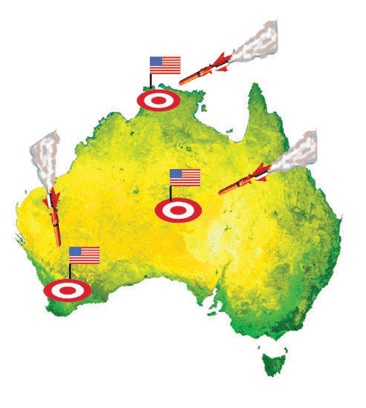
Australia, moreover, is not just an innocent onlooker to a Trump’s gung-ho vigilantism, a state which shoots first and asks questions after. We have ADF personnel embedded in US commands that carry out attacks of this kind. We host Pine Gap, described by senior intelligence analysts as a premier US targeting facility in the southern hemisphere, linking satellites to weapons systems across the Middle East and Asia. We tell ourselves we host it for “security.” In practice, we help aim weapons we never authorised, and cannot refuse.
It is not the brutality that shocks the alliance; it is the dissent.
Asymmetry on Steroids
AUKUS was sold as strategic maturity; an insurance policy against an uncertain Indo-Pacific. Instead, it could become a transfer of sovereignty disguised as procurement. Australia pays up to AUD 368 billion for nuclear submarines that may not arrive until the 2040s. Ships we can neither crew, service nor fuel.
Even then, we may service American boats before our own. The Parliamentary Library analysis makes clear the technology transfer remains subject to US export controls. We do not buy independence; we buy a permanent maintenance job.
Washington gains unfettered access to Australian ports, deeper control of our deterrence posture, and logistical reach into Asia. Canberra gets second-hand privileges wrapped in secrecy.
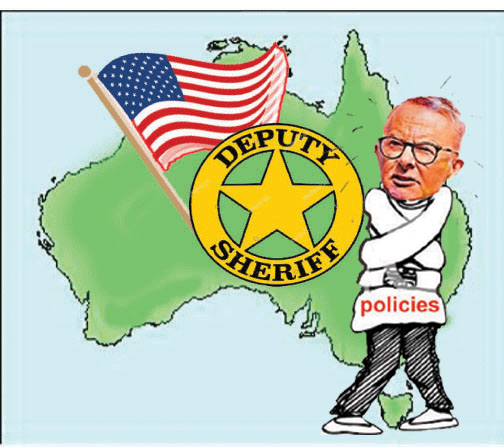
As Bernard Keane has observed, Labor governs as though office is something to occupy, not use. The result is an alliance that treats American commercial and military interests as interchangeable, while our interests and needs are politely deferred.
The Pattern Is Becoming Impossible to Ignore
In just two weeks:
- The administration signalled openness to watered-down Nvidia AI chip sales to China, over the objections of US China hawks who argued they could bolster Chinese military capacity.
- A leaked plan for Ukraine’s reconstruction envisaged turning frozen Russian assets into profit streams for US-led venture funds; Europeans were expected to accept territorial loss and pay a commission for the privilege.
- Trump stalled sanctions against a Chinese spy agency implicated in extensive hacking to protect an upcoming trade trip to Beijing.
In each episode, intelligence and human rights concerns are bent around the same question: What makes money now?
Imagine if Canberra behaved as crassly. When Australia signs quiet deals with Beijing, we call it “strategic naïveté‘. When Washington does it, we call it “the alliance.”
Australia Has Agency – or It Has Nothing
This is not an argument for abandoning the alliance, but for removing the leash. A self-respecting partner demands:
- Transparency: Parliamentary oversight of defence commitments, including rules of engagement affecting Australian personnel and facilities.
- Reciprocity: Partnerships beyond one power; ASEAN, India, Japan, South Korea, the EU, not an exclusive dependence.
- Sovereign capability: Shipbuilding and cyber defence that serve Australia first, not as a service station for US fleets.
- Moral Limits: If allies breach international law, we do not close our eyes; we close our ports.
Blind obedience is not strategy. It is outsourcing judgment. Surrendering autonomy.
The Choice Is Not Between America and China
Canberra’s defenders of AUKUS love a false dilemma: independence equals Beijing. They mistake sovereignty for treason. Malcolm Fraser warned of this decades ago, describing Australia as a “client state.” We have since upgraded ourselves; to a nuclear client state, paying interest on promises.
Independence is not abandonment. It is partnership without servility. It is the ability to say no. If a second strike on drowning men does not trigger such a boundary, nothing will.
The real danger is no longer foreign power. It is our refusal to imagine ourselves without permission.
Choose Leadership Before It’s Chosen For Us
The Caribbean footage will fade. The legal arguments will thicken. The bodies will be forgotten. What will remain is the alliance, tighter than ever, and a government too cautious to ask what we might be agreeing to on our behalf.
Gough Whitlam once feared Australia would become a nation of “toadies and bludgers” trading sovereignty for illusion. That future arrives quietly. It arrives not with invasion, but with permission slips. It arrives when the second flash on a foreign sea is someone else’s problem, and ours only if we ask.
Albanese must choose leadership while we still have a choice to make.
Labor backs ‘practical’ nuclear disarmament, Wong says
Anthony Albanese’s top diplomat has addressed a key question on Labor’s nuclear stance after a high-level defence official dropped a bombshell.
Joseph Olbrycht-Palmer, December 4, 2025 , https://www.news.com.au/technology/innovation/military/labor-backs-practical-nuclear-disarmament-wong-says/news-story/71ab3526def44ff9505452fb55bbc9f2
Labor backs “practical” efforts to reduce nuclear weapons stockpiles across the world, Anthony Albanese’s top diplomat has said after a senior defence official revealed a naval base in Western Australia could host nuclear-armed US submarines.
Greens senator David Shoebridge on Thursday peppered Foreign Minister Penny Wong with wide-ranging queries during Senate estimates.
Among them was why Defence Minister Richard Marles refused to “endorse” the Treaty on the Prohibition of Nuclear Weapons (TPNW) in an interview last month, as Senator Shoebridge characterised it.
He said it “caused deep despair” among nuclear weapons abolitionists “who have been pushing for this treaty for years”.
“Does the Albanese government support the Treaty to Prohibit Nuclear Weapons?” Senator Shoebridge asked.
Senator Wong said Labor was “engaging constructively on the evidence on the TPNW” but that existing frameworks were the best bet.
“Our party has a very proud history of championing practical – I emphasise that – practical non-proliferation and disarmament efforts internationally,” she said, adding that Labor is “steadfast in our support for the NPT”.
“The Treaty on Non-Proliferation of Nuclear Weapons is the cornerstone of global disarmament and non-proliferation.”
Recognising the “devastating consequences for humanity” bore by nuclear arms and concerns around the use of artificial intelligence in nuclear command systems, Senator Wong said the NPT offered the “best pathway to advance non-proliferation and disarmament”.
Signing the TPNW would block Australia from hosting any US military nuclear assets, counteracting the Prime Minister’s offer to Donald Trump in October of expanding port access for the US’ roaming Virginia-class submarines.
The submarines are the nuclear-armed vanguard of the US Navy.
During Senate estimates on Wednesday, Department of Defence Deputy Secretary Hugh Jeffrey was asked whether US submarines docking at Western Australia’s HMAS Stirling would be armed with nuclear capabilities.
Mr Jeffrey would not rule it out.
“The United States is very clear about the Australian government’s treaty obligations and our policy on those (nuclear) weapons,” he said.
“We respect the United States’ position of neither confirming nor denying.”
NewsWire has contacted Mr Marles’ office for comment.

US submarines carrying nuclear weapons could dock in Australia despite ban, Senate told.
Defence secretary appears to contradict previous assurances from Penny Wong that only conventionally armed submarines will visit Australian ports under Aukus deal.
Ben Doherty, 5 Dec 25, https://www.theguardian.com/australia-news/2025/dec/05/us-submarines-nuclear-weapons-australia-aukus
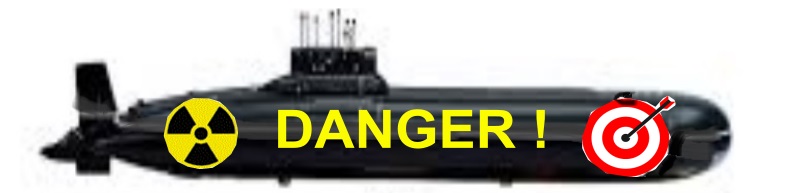
US submarines carrying nuclear weapons could dock at Australian bases, defence officials have told the Senate, and the Australian government and people would not know.
Senate estimates heard fierce debate over whether US Virginia-class submarines – set to “rotate” through Australian ports from 2027 as part of the contentious Aukus agreement – could carry nuclear weapons. Nuclear weapons are prohibited in Australia.
Defence department officials told senators there was “no impediment” to submarines armed with nuclear weapons visiting Australia, insisting that any such visit would not breach Australian or international law.
The US maintains a policy of “strategic ambiguity” around its nuclear deployment and it refuses to confirm or deny whether aircraft or seagoing vessels capable of carrying nuclear weapons are, in fact, carrying a nuclear warhead.
That ambiguity would apply to US submarines that might dock at Australian ports, as it now does to nuclear-capable B-52 bomber aircraft landing at RAAF Base Tindal in the Northern Territory, which is being upgraded to be able to accommodate more US bombers.
“We respect the United States position of neither confirming nor denying,” the Australian defence department secretary, Greg Moriarty, told the Senate.
But anti-nuclear campaigners and some senators argue that the evidence to the Senate undermines Australia’s non-proliferation commitments and risks making the country “a launchpad for nuclear war”.
They also say the acquiescence to US ambiguity over its nuclear weapons contradicts the foreign affairs minister’s assurance in a 2023 speech that only conventionally armed submarines would visit Australia.
“The US has confirmed that the nuclear-powered submarines visiting Australia on rotation will be conventionally armed,” Penny Wong told the National Press Club.
Sign up: AU Breaking News email
US Virginia-class submarines are to begin rotating through Australian ports – part of pillar one of the Aukus agreement – from 2027, before Australia buys then builds its own nuclear-powered, conventionally armed submarines.
The US Congress approved funding in 2024 for a new submarine- and ship-launched nuclear missile – the first new US nuclear weapon since the end of the cold war. The SLCM-N weapon is slated to be operational within a decade and Vice-Admiral Johnny Wolfe has told Congress that the weapons program is “focused on the integration of SLCM-N into the Virginia-class submarine”.
The South Pacific nuclear free zone treaty – known as the Treaty of Rarotonga and to which Australia is a party – prohibits the “stationing” of nuclear weapons in Australia (and the broader South Pacific zone). But Australia maintains that a US submarine, potentially armed with nuclear weapons, is not prohibited from visiting an Australian port.
Bernard Philip, assistant secretary of international policy at the Department of Defence told the Senate Australia would comply with its treaty obligations, which were also understood by the US.
“The United States does not station nuclear weapons in Australia,” he said. “Stationing nuclear weapons in Australia is prohibited by the South Pacific nuclear free zone treaty, to which Australia remains committed.
“There is no impediment under the Treaty of Rarotonga and the Treaty on the non-proliferation of nuclear weapons to the visit of dual-capable foreign platforms to Australia’s territory or transiting Australia’s airspace or waters.”
Dual-capable platforms are those able to carry both conventional and nuclear weapons. Defence officials said nuclear missiles deployable on Virginia-class submarines were still in development, labelling the scenario “hypothetical”.
The Australian director of the International Campaign to Abolish Nuclear Weapons, Gem Romuld, said the foreign minister’s commitment that nuclear weapons would not be rotating through Australia was now “dead in the water”.
“It’s taken just two years for expectations of an Aukus partner to shift, so what will come next?” she said.
“If Aukus is ‘not about nuclear weapons’, then Australia’s numerous assurances must be backed up with legal commitments. The best way to draw the line on nuclear weapons is to sign and ratify the UN Treaty on the Prohibition of Nuclear Weapons.”
Labor has formally committed in its party platform to signing and ratifying the weapons ban treaty “in government” but it has not yet signed done so. Seventy-four countries are now party to the treaty: none of the nine nuclear-armed states have signed it.
The Greens senator David Shoebridge asked in Senate estimates: “So we’re going to permit them to be sitting, floating off Fremantle in US-Virginia class submarines, and is it still the position that the Australian government won’t ask the US whether or not they’re nuclear-armed submarines, just like we don’t ask about the nuclear-armed B-52s?
“Is that still the position? Don’t ask, don’t tell?”
The secretary of the defence department said: “We respect the United States’ position of neither confirming nor denying.”
Earth’s Greatest Enemy, the second feature film project by Abby Martin, is a groundbreaking anti-imperialist environmental documentary.
Exempt from international climate agreements and rarely scrutinized in mainstream reporting, the Pentagon is the world’s single largest institutional polluter—spewing carbon, contaminating water, and scarring landscapes across the globe. Combining investigative journalism, striking visuals, and stories from impacted communities, this film challenges audiences to rethink the hidden costs of a global military empire and its planetary consequences. Provocative, urgent, and eye-opening, this is a documentary that will change how you see both the military and environmentalism. https://earthsgreatestenemy.com/
1 This month

of the week – Australians for War Powers Reform (AWPR)
To see nuclear-related stories in greater depth and intensity
 Antinuclear