Australia’s Photovoltaic Institute ahead of Google with software tool for estimating solar savings
 Google allows households to calculate solar system savings, but Australia beats them to it, Business Spectator TRISTAN EDIS , 18 Aug 15, Google has unveiled a software tool that assists home owners to estimate how much they could save on their energy bill from placing solar panels on their available roof space. Yet Australia’s Photovoltaic Institute had already developed a similar tool some time ago.
The Google tool, known as Project Sunroof, uses high resolution aerial maps to estimate the suitable roof space of a building that could host solar panels, and then calculates the amount of energy these panels would produce and associated power bill savings. It does this taking into account the amount of solar radiation for that geographic location and then adjusts for factors such as roof orientation and shade from nearby buildings and trees. At present the tool is only available for the US locations of the San Francisco Bay Area, Fresno in central California and the North-east coast city of Boston.
However the Australian Photovoltaic Institute has designed almost precisely the same tool, releasing it several months ago. Called the Live Solar Potential Tool, it is a free to use tool that operates in a similar manner to Google Earth, allowing anyone to zoom in on a specific household and then estimate how much energy a given area of the rooftop would be likely to generate with solar panels……..http://www.businessspectator.com.au/news/2015/8/18/solar-energy/google-allows-households-calculate-solar-system-savings-australia-beats
Huge solar panel array for Canberra Hospital’s roof
Canberra Hospital to get one of the nation’s largest solar rooftop arrays August 15, 2015 Matthew Raggatt Reporter at The Canberra Times The ACT government will spend up to $3.3 million, and install one of the nation’s largest rooftop solar arrays, to make Canberra Hospital more energy efficient.
The moves to add a 500-kilowatt solar system and install LED lights throughout all hospital buildings were aimed at slashing energy use at the site, which accounts for a quarter of the government’s electricity bill.
Overlapping two of his portfolios, Deputy Chief Minister Simon Corbell said the loan to ACT Health from the Carbon Neutral ACT Government Fund – by far the largest in the fund’s short history – would reap financial rewards.
“The Canberra Hospital delivers a critical 24-hour service to our community and is the ACT government’s largest user of energy,” he said.
“The announcement will see the hospital save a massive $490,000 a year in energy bills by 2017-18 and improve the government’s overall carbon footprint.”
The Sunday Canberra Times understands the hospital would become home to one of the top 10 largest roof-mounted arrays in Australia. A 500kW rooftop array [see below] at Toyota’s manufacturing plant in Melbourne, using 2000 panels, was Victoria’s largest when installed last year………http://www.canberratimes.com.au/act-news/canberra-hospital-to-get-one-of-the-nations-largest-solar-rooftop-arrays-20150814-giz7fh.html

Solar power is top choice for Australians, nuclear is last
Solar Power Still The Preferred Energy Choice Of Australians http://www.energymatters.com.au/renewable-news/climate-institute-solar-em4980/ August 10, 2015
The Climate Institute has released Climate of the Nation 2015, its annual review of public attitudes on climate change and its solutions.Even in the face of stinging attacks from the Coalition, renewable energy has become even more popular with the Australian public – and fossil fuels less so.
Among all energy sources, solar power leads in popularity at 84 per cent, up 2 points on last year. Women turned out to be the strongest supporters of solar energy; with 86% ranking it their most preferred choice, compared to 81% of men.
Solar power is followed by wind at 69% (up 5 points on last year).
The popularity of both gas and nuclear crashed 7 points to 21 and 13 per cent respectively; making nuclear and coal tied as least preferred energy sources. Continue reading
Australian electricity companies offer solar, battery technology for lease
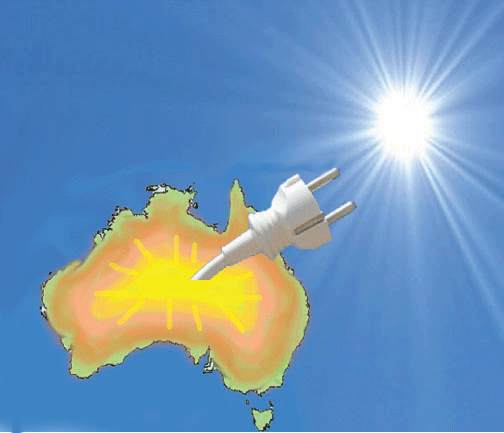 Solar power for rent: Electricity companies offer solar, battery technology for lease http://www.abc.net.au/news/2015-08-07/solar-power-for-rent-batteries-electricity/6679494 AM By Eric Tlozek Electricity companies have offered solar and battery systems for lease in a bid to keep customers and lower their own costs. Continue reading
Australian Renewable Energy Agency helps kick off Queensland’s ‘Virtual solar plant’
 ‘Virtual solar plant’ in home trial in Queensland http://www.theage.com.au/business/energy/sunverge-energy-links-with-ergon-energy-for-qld-home-power-storage-program-20150805-gisdx5 August 6, 2015 Angela Macdonald-Smith Californian electricity storage developer Sunverge Energy has forged an alliance with Ergon Energy for a limited commercial rollout of its power systems in Queensland homes, with at least two similar deals with other Australian partners expected to follow later this year.
The partnership with the Queensland utility, which also involves US-listed solar panel provider SunPower, will tap into keen interest in battery storage among households in Australia, partly thanks to the huge popularity of rooftop solar.
The deal announced on Thursday involves installing SunPower solar panels and Sunverge energy storage systems in 33 homes in Toowoomba, Townsville and Cannonvale in a program that will receive $400,000 of funding by the Australian Renewable Energy Agency.
The Sunverge systems include back-up power, a six-kilowatt inverter with 11.6 kilowatt-hours of energy and a sophisticated communications and control capability that allows the utility to control and collectively manage them to increase the efficiency of power supply on its grid. Continue reading
How federal govt changes to Clean Energy Finance Corporation will affect Australian househholds
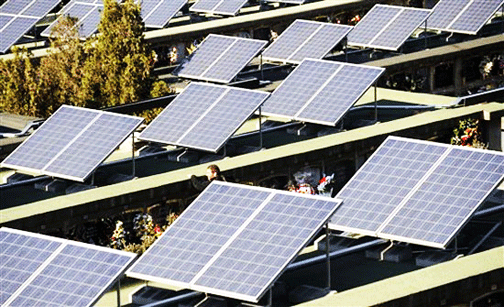 Solar panels: What do the federal government changes mean for households, SMH July 19, 2015 Peter Hannam
Environment Editor, The Sydney Morning Herald The Clean Energy Finance Corporation has been told not to invest in rooftop solar. What does that mean for me?
The CEFC is the “green investment bank” set up by the Gillard Labor government that the Abbott government wants to scrap. It has been blocked in the Senate so instead it wants to narrow the CEFC’s mandate by blocking investment in “mature” technologies such as wind farms and solar panels.
The fund, though, exists mainly to find ways to boost the competitiveness of all renewable technologies, from large-scale solar plants to wave and geothermal sources, and energy-efficiency measures.
Earlier this month, for instance, the CEFC joined in a 12-year, $100 million venture with Origin. The energy giant will own, install and maintain solar PV systems for households and businesses. Customers get a fixed energy price for a longer term than would typically have been offered by banks.
What is this large-scale solar we’re hearing about?……… http://www.smh.com.au/environment/climate-change/solar-panels-what-do-the-federal-government-changes-mean-for-households-20150718-giewy8.html#ixzz3gZupHfyv
Australia’s government not stopping Sydney IKEA’s renewable energy project
The world’s biggest furniture retailer, which has annual sales of €30 billion ($44 billion), is aiming to be energy neutral by 2020, with 100 per cent of its energy needs coming from renewable sources.
IKEA’s Australian business took the first steps last year, installing 16,000 solar panels on the roofs of six stores, including almost 4000 panels at its flagship store at Tempe, near Sydney Airport.
“It’s really cool,” says Wilson, who gave up his job running Randwick Council’s Sustaining Our City program almost three years ago to join the Swedish retailer, attracted to the company by its ambitious long-term environmental targets.
“When they do have bold ambitions it makes things happen,” says Wilson. “It was the 100 per cent renewable energy targets that got me excited about working for IKEA – I want to be on that journey.”
It’s a journey that may not have got off the ground if not for Labor’s now defunct carbon tax. When electricity was cheap and solar panels expensive, the business case simply did not stack up.
The company pressed ahead after the carbon tax was scrapped by the Abbott government last year and now expects to achieve payback in less than 10 years, in line with its parent’s relatively generous return on investment hurdles……….http://www.afr.com/business/energy/solar-energy/ikea-backs-renewable-energy-targets-despite-government-changes-20150717-gid4gu
South Australian government says wind and solar power are sources of jobs
 Wind and solar a source of jobs in SA http://www.heraldsun.com.au/news/breaking-news/wind-and-solar-a-source-of-jobs-in-sa/story-fni0xqi4-1227439666671
JULY 13, 2015 THE South Australian government says a commonwealth ban on supporting solar and wind energy scheme will make it harder to create jobs.
THE commonwealth has directed the Clean Energy Finance Corporation not to back any further wind energy projects as well as rooftop solar schemes.
But South Australian Treasurer Tom Koutsantonis says wind energy is a source of immediate and future jobs and putting barriers in the way of investment will make it more difficult to cut SA’s unemployment rate, which climbed to 8.2 per cent in June.
“South Australians are told by the commonwealth government that we are not allowed to build cars, we’re told we are not allowed to build submarines, now we are being told we shouldn’t build wind farms when we have investors ready to spend their money and create jobs now,” he said.

Climate Change Minister Ian Hunter will meet his interstate counterparts this week and says they will call on the federal government to end its ideological opposition to renewable energy.
“The message being sent to renewable energy investors by our federal government is `look elsewhere – don’t spend your money in Australia and don’t create jobs here’,” he said.
Concentrated Solar Power pre-feasibility study now being finalised at Port Augusta
The transition from fossil to renewable energy The Fifth Estate, Graham Davies, Engineers Australia | 13 July 2015“…………It is encouraging that Alinta, with financial support from ARENA and the SA Government, is currently finalising a pre-feasibility study into concentrated solar thermal power at Port Augusta – a project that has the full support of the community. At present the capex of CSP is too high for a company to meet what is required for shareholder returns, but costs will decrease as the technology develops further. If government were to contribute an amount equivalent to saved externalities (such as adverse health effects associated with continuing the coal power station) it is probable that the project would be economically viable now.
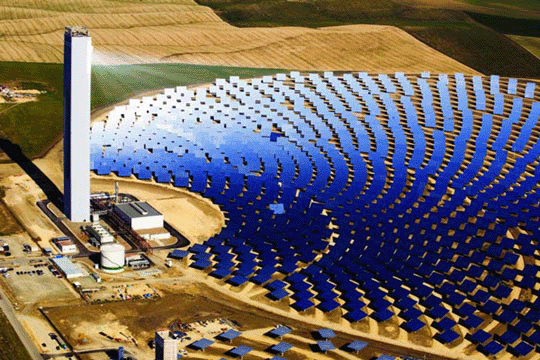
CSP is of particular value to a renewable grid, as it has the ability to efficiently store energy, be despatchable and provide synchronous generation and grid stability. These capabilities will circumvent the need for inflexible base load generators such as coal, CCGT and nuclear, with their many externalities. Port Augusta is an ideal location for CSP and presents a great opportunity for the future.
The closure of the Port Augusta Power Station may initially appear as bad news, but it may galvanise South Australia in becoming the iconic turning point for a new future – a future in which Australia again leads in solar development and export; where energy security is based on the sun and not the fossil reserves; where long-term thinking is built into economic analysis; and where prosperity is not measured by GDP but by net wealth and wellbeing.
Graham Davies is incoming chair of Engineers Australia’s Sustainable Engineering Society. http://www.thefifthestate.com.au/spinifex/the-transition-from-fossil-to-renewable-energy/75484
Poorer Western Australians will lose out from Abbott’s solar turnoff – Senator Scott Ludlam
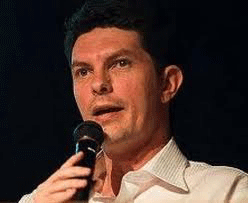
WA Greens senator says Abbott solar turn-off will hit battlers hardest, WA Today July 13, 2015 Ray Sparvell Reporter WA battlers will be hardest hit by the Abbott government’s decision to wind back investment into home solar, according to Greens Senator Scott Ludlam.
He said the state’s solar-driven homes were now producing as much electricity as two conventional coal-fueled power stations.
And he believes it is too soon for the Abbott Government to pull the plug on investments into the solar industry. “Retirees, people on lower incomes and people in outer metro and rural areas of the state will be hardest hit by this.
The federal government has recently directed the Clean Energy Finance Corporation to exclude household and small scale solar from further investment funding. Senator Ludlam said the government still needed to support the solar industry.
Some 180,000 WA households have installed rooftop solars and Senator Ludlam said they were now generating the equivalent of two typical coal fire power stations. “Solar powered WA homes have increased 19 per cent in just one year – overwhelmingly in outer suburbs and households with lower incomes,” he said.
WA now has four postcodes in Australia’s top 20 solar suburbs including Mandurah at number two, North east Wanneroo at eight, Canning Vale/Willeton at 12 and Cockburn at 19.
Home owners benefit from trading in small scale technology certificates at the time of installation and feed-in tariffs (selling power back into the grid). “Householders are streaking ahead of the state and federal government as they use rooftop solar to dramatically reduce their power bills, but Tony Abbott’s crusade against renewable energy is set to have a devastating effect. Continue reading
Government’s attack on Clean Energy Finance Corporation threatens commercial solar projects in ACT
Federal directive on solar threatens commercial rooftop projects in the ACT, says Simon Corbell July 13, 2015 Kirsten Lawson Chief Assembly reporter for The Canberra Times. The Abbott government’s directive against investment in small and medium-scale solar threatens commercial rooftop projects in Canberra, ACT Environment Minister Simon Corbell said on Monday.
Mr Corbell attacked Prime Minister Tony Abbott as “public enemy No 1” on renewable energy.
“He’s putting jobs at risk, he’s putting investment at risk and he’s putting the industry at risk, an industry that will need to grow considerably over the next decade if Australia is to meet its international greenhouse gas reduction commitments,” Mr Corbell said.
He was responding to news of a draft directive from the Abbott government to the Clean Energy Finance Corporation not to invest in small and medium-scale solar projects. The corporation was also ordered not to invest in new wind projects.
He was responding to news of a draft directive from the Abbott government to the Clean Energy Finance Corporation not to invest in small and medium-scale solar projects. The corporation was also ordered not to invest in new wind projects.
Mr Corbell said the ACT’s large-scale projects were not threatened by the decision, with the ACT government’s funding providing the certainty that companies and financiers needed.
Queensland, South Australia and Victoria were already looking at the ACT’s model, he said. http://www.canberratimes.com.au/act-news/federal-directive-on-solar-threatens-commercial-rooftop-projects-in-the-act-says-simon-corbell-20150713-gib2e8.html#ixzz3ful17Caa
Tony Abbott sabotages thousands of Australian jobs by ending wind and solar investment
 Renewable energy investment: Government ‘sabotages’ thousands of jobs as it ends wind, solar power investment, Australian Solar Council warns, ABC News By Katri Uibu 13 July 15 Thousands of Australians could lose their jobs because of the Federal Government’s latest “ideology-driven” decision not to invest in wind and small solar power projects, the head of the Australian Solar Council (ASC) says.
The Federal Government has ordered the Clean Energy Finance Corporation (CEFC) to stop financing wind and household solar energy and instead invest in “new and emerging technologies”.
But ASC chief executive John Grimes said small business owners would be most affected by the change, saying the “tragic” decision would compromise thousands of jobs.
“There are about 18,000 people in Australia directly employed in the solar industry,” he said.
“These are the jobs of rural and regional Australia and these are the jobs that we want to create. So, the Government is sabotaging the whole industry because of its ideology that we should burn more coal and we need to shut down the renewable sector.”
Mr Grimes said the Government was “completely out of touch with the people of Australia” on the issue and vowed to “campaign hard” for policy change.
Small-scale solar energy installers labelled the Government’s policy a “stupid” decision that was causing them to “move out of the solar industry”.
Installing solar panels has been Richard de Bruin’s livelihood for five years.
Because of the Government’s decision, Mr de Bruin — the owner of R&R Solar Installations — is facing an even “bigger drop” in his revenue. It is a predicament that has forced him to explore alternative business ideas and axe the job of his own son.
“The uncertainty that we’ve had for the last six to 12 months has just really hurt the business to the effect that now we’re moving to a new site, trying to find some more work,” he said……….
Policy change ‘stupidest thing’ Government could have done
Craig Balmanno, owner of Free Solar & Solar Farmers, said while his business was not exposed to solar energy funding cuts, the decision was destructive for the industry.
“Up till now the CEFC hasn’t provided any funding to our business,” he said.
“CEFC has funded larger organisations and now, before the CEFC has a chance to fund the smaller ones, the Government’s going to cut them off.
“It is a bad cut for the renewable energy industry as a whole, but for one particular company, in our circumstances, it’s not going to affect us in a huge way.”
He found the Government’s policy to stop investing in a system “that is making money” incomprehensible and named it “the stupidest thing they could have ever done”.
“They are worried about renewables removing revenue from the fossil fuel industry and tax receipts from the fossil fuel industry,” he said.
“As far as a finance corporation, it’s [the CEFC] an organisation that’s actually making money for them.
“Why would they want to cut back on how it’s investing and try and limit its investments only to emerging technologies?” http://www.abc.net.au/news/2015-07-13/government-sabotages-thousands-of-solar-energy-sector-jobs/6615778
Tony Abbott now attacking rooftop solar power industry

“By knocking off wind and solar, the only thing that you leave there is the high-risk stuff,” he said. “They’re trying to make it as difficult as possible for the CEFC.”
Abbott government extends renewable energy investment ban to solar power, Guardian, Shalailah Medhora 12 July 15 Clean Energy Finance Corporation banned from investing in small-scale solar projects in move industry claims is ‘revenge politics’ that will strangle the sector A directive banning the Clean Energy Finance Corporation (CEFC) from investing in existing wind technology will also apply to small-scale solar projects, a move that will effectively throttle the industry, the Australian Solar Council said.
The federal government on Sunday confirmed that the $10bn CEFC will no longer invest in wind power, instead focussing on “emerging technologies”.
“It is our policy to abolish the Clean Energy Finance Corporation because we think that if the projects stack up economically, there’s no reason why they can’t be supported in the usual way,” Abbott told reporters in Darwin. “But while the CEFC exists, what we believe it should be doing is investing in new and emerging technologies – certainly not existing windfarms…..
it has emerged the government’s investment directive also applies to small-scale solar technology like rooftop panels that generate up to 100 kilowatts of power. Continue reading
North Queensland’s Collinsville solar energy project going ahead
 Collinsville solar power plant to go ahead thanks to Renewable Energy Target decision says Ratch http://www.abc.net.au/news/2015-07-06/collinsville-solar-power-plant-a-goer/6597400 By Jonathan Hair
The company behind a proposed solar power project in north Queensland says it hopes to start construction next year. Ratch Australia is planning to build a $100 million solar plant in Collinsville. It will create up to 80 jobs in the construction phase and two to three once operational.
Ratch general manager of business management, Anil Nangia, said the recent Federal Government deadlock on the Renewable Energy Target put the project on hold. However, he said the recent agreement on a new target meant the project would go ahead.
“The other good thing about renewable energy is it produces jobs and investment in regional Australia,” he said.”The key aspect of this resolution is it was bipartisan support, with no additional reviews until 2020. “We believe there’s real certainty in this target and it will stay in place and we think it will be there for the long run, if not increased.”
He said it was disheartening when politicians expressed a lack of faith in renewables. It’s terrible when they talk like that, renewables are the way of the future,” he said. “They basically are going to produce the low cost power in the long-term and they produce power with no emissions, no side effects, it’s really sad when they talk … down the potential of renewable energy in Australia.”
GDF SUEZ Australian Energy, coal mine owner, investing big into solar energy
“Solar is becoming totally competitive,” “Solar is an energy of the future. It is the energy with the biggest potential for development. It’s no longer a subsidized niche.”
the shift by Engie from centralised fossil fuel and nuclear capacity to one based around decentralised renewable energy generation is typical of the transformation going on around the world – with Europe’s E.ON, RWE and Vattenfall, and in the US, with generators such as NRG, and network operators in California, New York and elsewhere.
 Hazelwood owner makes big push into solar energy, REneweconomy, By Giles Parkinson on 10 July 2015 The owner of the Hazelwood coal-fired power station, the dirtiest generator in Australia, has announced a major push into renewable energy, snapping up the international solar farm developer SolaireDirect for about $A300 million.
GDF Suez, now known as Engie under a massive re-branding campaign that signals its shift from fossil  fuels and nuclear to renewable energy, will become the largest solar and wind developer in France after the purchase.
But its big focus is on the international scene. Gerard Mestrallet, the CEO of Engie, one of the biggest operators of nuclear plants in Europe, says new solar now beats new nuclear on price, with new solar parks costing between $US60 and $US90/MWh. Continue reading
1 This month

of the week – Australians for War Powers Reform (AWPR)
To see nuclear-related stories in greater depth and intensity
 Antinuclear