Federal opposition plans to roll out nuclear energy have been dismissed as a thought bubble as the nation races to replace coal power.
Alternatives to the fossil fuel – which still powers much of the grid in NSW, Victoria and Queensland – are being rapidly rolled out with coal’s reign “swiftly ending,” according to electricity company bosses.
Proposals to increase natural gas supplies for the nation’s most populous state are being assessed and welcomed as renewable projects come online, NSW Energy Minister Penny Sharpe says.
“We don’t want to see price spikes and we don’t want to see uncertainty for industry,” she told a Committee for Economic Development of Australia event on Tuesday………………….
“More and more renewable energy is entering the system, but it’s always happening more slowly than we would like,” Ms Sharpe said.
The state Labor minister said she was “unimpressed” by a proposal from the federal coalition to roll out nuclear power stations.
The plan posed too many important but unanswered questions and threatened to smash a hole in the certainty provided by the state’s energy strategy, she said.
“NSW will not be risking our future economic prosperity for a policy thought bubble designed to play politics,” Ms Sharpe said……………………..
The chief executive of Australia’s largest energy generator and greenhouse-gas emitter reaffirmed nuclear power was not part of the company’s future.
AGL’s Damien Nicks told the same event the electricity supplier focused on renewable generation and storage.
“AGL’s generation portfolio will look completely different by 2035, when we’re no longer generating electricity from coal,” he said……………
The transmission network operator is building 2500km of new lines to carry an expected 17-gigawatt surge in renewable generation as more projects enter the grid.
Defence has little oversight. Whenever they turn up to Senate Estimates or the Joint Parliamentary Committee on Accounts and Auditing, and the subject matter strays into areas of embarrassment, Defence pleads “it’s classified, we can’t talk about it.”
On the last day of sitting before the winter parliamentary break, the Albanese Government, who’ve had bills delayed and amended, for the first time in the 47th Parliament had a piece of legislation voted down in the Senate. It’s an outcome that does not serve Australians well. Rex Patrick reports.
Comedy in the Senate
Last Thursday in the Senate, Greens’ Senator David Shoebridge rose from his seat and gave an impromptu speech on Defence. Anyone watching might reasonably have thought he was engaging in a moment of comedy, but he wasn’t; the topic was deadly serious.
“It’s hard to know where you end the list of defence procurement disasters which have happened because, whether it’s Labor in government or the Coalition in government, whether it’s Labor in opposition or Coalition in opposition, the usual practice is that the club doesn’t hold Defence to account.“
The club just signs off on whatever new funding fantasy Defence comes up with and pretends that Defence can achieve it.
Zero, zero,zero
Shoebridge then made some blunt observations on submarine procurement.
“Two decades of this nonsense on submarines has given us a $20 billion hole. I’m trying to think how many submarines we got in the last 20 years – oh, zero. We’ve given $5 billion to the French for no subs, $5 billion to the US for no subs, $5 billion to the UK for no subs and $5 billion trying to keep the Collins class going for another ten years under an experimental project. How many new subs have we got? Zero”
He moved on to frigates.
“I think we were meant to get nine frigates for $45 billion. Now it looks like we’re going to get six frigates, and guess what the price tag will be? It’s $45 billion and counting.”
“Let’s be clear: the $45 billion on the Hunter frigates is to date the single largest procurement contract ever signed by the Commonwealth, and it’s a disaster zone. How many Hunter frigates do we have? You’ll be pleased to know we have the same number of Hunter frigates in service as we have new submarines. Zero.”
He finally turned to the Navy’s Offshore Patrol Vessels……………………………
A mess that needs fixing
Defence, by far, has the most public money committed to projects. If you wanted only one agency of government to spend money wisely, it would be Defence.
But they don’t spend it wisely. Defence procurement is an absolute mess. [excellent chart here on original]
The starting point for that mess is Admirals, Air Marshalls and Generals with little project and risk management experience making purchasing recommendations to Cabinet ministers with no experience in project and risk management.
Senator Shoebridge rightly pinged the timidity of successive governments, cabinets and ministers when it comes to defence:
“They pretend they’re tough on Defence until somebody strides into the room with a little bit of gold braid on their shoulder, and then there’s this obscene subservience from both the Labor party and the coalition: ‘Oh, Sir! Oh, Madam! How much money can we give you? Does it go ‘whoosh’? Will it go ‘bang’ at some point? Oh, that’s great! You can have the money.”
Oversight vacuum
And that leads us to the failed Bill last Thursday.
.
Defence has little oversight. Whenever they turn up to Senate Estimates or the Joint Parliamentary Committee on Accounts and Auditing, and the subject matter strays into areas of embarrassment, Defence pleads “it’s classified, we can’t talk about it.”
In late May, the Government introduced a Defence Amendment (Parliamentary Joint Committee on Defence) Bill 2024 that would establish a parliamentary committee that would meet in secret (by default) and have the power to inquire into just about any aspect of Defence.
The Committee, as prescribed in the Government’s Bill, was to consist of 13 Senators and MPs: seven Government members and six non-government members. The Liberals and Nationals went into a cataclysmic spasm. This would allow the Prime Minister to appoint a cross-bencher or two. OMG!
We have 14 cross benchers in the House (out of 151 MPs – 9%) and 20 cross benchers in the Senate (out of 76 senators – 26%). Having their representation on the Committee is appropriate, particularly given that most Defence projects are so long they extend across parliamentary terms and indeed several changes of government. Both Labor and the Coalition are to blame for the many screw-ups and are hesitant to engage in vigorous scrutinise.
So, Senator Birmingham moved an amendment to restrict the membership to seven government members and six opposition members. That amendment went down, and the Government and cross-bench voted against his changes. This put a nail in the Bill’s coffin, ensuring the Coalition would eventually vote against it.
So, Senator Birmingham moved an amendment to restrict the membership to seven government members
Two-party squeeze
Senator Shoebridge, rightly suspicious of the wording of Labor’s Bill, sought to amend it from seven Government members and six non-government members (which could easily just mean opposition members) to seven government members, four opposition members and two cross-benchers, one from the House and one from the Senate. That option was not supported by Labor or Liberal and was voted down.
That left the original wording of the Bill without Liberal or cross-bench support. The Bill went then went down in flames. It was Labor’s first comprehensive legislative failure in this Parliament.
There were some happy winners though; Defence’s bloated and complacent bureaucratic leadership. For them it’s business as usual; billions of taxpayers’ dollars to splurge with little scrutiny and even less accountability. There were, no doubt, a few bottles of (contractor supplied) champagne popping at Defence central on Russell Hill. They had dodged a bullet.
Politics, as it so often does, got in the way of a good outcome for the Australia public.
Australia is the only G20 nation that doesn’t use nuclear power.
OUR VERDICT
Misleading. Five other G20 nations don’t generate nuclear power, and two of those don’t use it.
AAP FACTCHECK – Federal Opposition Leader Peter Dutton claims Australia is the only country not to use nuclear energy out of the world’s 20 largest economies.
This is misleading. Five other nations in the top 20 – Germany, Italy, Turkiye, Saudi Arabia and Indonesia – do not generate nuclear energy.
Germany, Italy and Turkiye import very small amounts of electricity generated from nuclear sources, but Indonesia and Saudi Arabia don’t consume any nuclear power.
Australia is the only top 20 economy that doesn’t generate, import or have a plan to do so.
Mr Dutton has made the claim at least four times in interviews about the coalition’s plan to build seven nuclear power stations in Australia without clarifying that he’s counting countries planning to use nuclear power among those that are actually using it.
Mr Dutton said nuclear power was “used by 19 of the 20 biggest economies in the world” at a June 18 press conference in NSW.
He again claimed that of the top 20 economies in the world, “Australia is the only one that doesn’t have nuclear” in a June 20 interview on Sky News.
That same day, the opposition leader spoke out about how Australia could benefit from nuclear power “as 19 of the world’s top 20 economies have done” in an ABC News Breakfast interview.
Mr Dutton again said Australia was the only one of the 20 biggest economies that “doesn’t operate” nuclear at a press conference on July 5.
When asked to clarify his claims, the opposition leader’s spokeswoman told AAP FactCheck that he’s counting countries that have nuclear power and those “taking steps towards embracing nuclear”.
He also said Australia was the only G20 member that didn’t use or plan to use nuclear power in an ABC TV interview on April 21.
The G20 is a global forum for countries with large economies. Despite its name, the G20 includes only 19 nations, plus the African Union and the European Union. Spain is invited to the G20 as a permanent guest.
It’s unclear if Mr Dutton is referring to the G20 countries plus Spain, or the 20 largest nations by gross domestic product, as he’s used both interchangeably.
However, AAP FactCheck has analysed the former because the nations that don’t generate nuclear power and the nations that only import small amounts of it are exactly the same for both groupings, as per World Bank 2023 GDP data.
When Robert Menzies was out of office in 1943, in between prime ministerships, he was thinking about the future of non-Labor politics in wartime Australia. He read Edmund Burke’s book Thought on the Present Discontents. In it, Burke included the now-famous definition of a political party as:
a body of men united in promoting by their joint endeavour the national interest upon some particular principle on which they are all agreed.
For Burke, political parties were legitimate when they were based on shared principles and were committed neither to personal nor sectional interest, but to the interest of the nation as a whole.
Recently, Opposition Leader Peter Dutton announced the Coalition would not have an emissions reduction target for 2030. Instead, it would build seven nuclear power plants to reach zero emissions by 2050.
I have spent much of my research life thinking and writing about the Liberal Party and its predecessors, as well its three most successful leaders: Alfred Deakin, Robert Menzies and John Howard. So I have been running Dutton’s nuclear policies against my understanding of the Liberal party’s core principles.
It’s left me puzzled. Setting aside the many technical questions about the cost and feasibility of the plan, the proposal seems to breach some of those core principles.
Public ownership?
Political parties change and evolve over time, so it’s worth assessing the Liberal Party’s current web page for a contemporary statement of beliefs.
As expected, there are clear statements about the party’s commitment to maximising private sector initiatives. This includes statements like “government should only do those things the private sector cannot”, and “wherever possible government should not compete with an efficient private sector”.
So why is the Liberal Party proposing to build and own nuclear power plants on sites the government doesn’t even own, like Liddell in New South Wales? Or Loy Yang in Victoria where the owner, AGL, has plans already in train to develop low-emission industrial energy hubs?
How would a resort to compulsory acquisition of privately owned sites be justified by a party committed to private enterprise? And what would be the cost of these acquisitions?
Section 51 of the Constitution allows the Commonwealth to acquire property “on just terms from any State or person for any purpose in respect of which the Parliament has power to make laws.” Just terms – that means the property so acquired has to be paid for, by us, the tax payer, and this has to be added to the considerable cost of building the plants.
What about the states?
The state premiers of Queensland, NSW and Victoria oppose the plan, as do some Liberal opposition leaders such as Victoria’s John Pesutto.
Speaking to the Liberal Party Federal Council in June, Dutton said that the Commonwealth can override state laws, so the state premiers won’t be able to stop the plan.
Well it can, but it requires legislation that has to get through a Senate unlikely to be controlled by any future Coalition government. It would also cost a mountain of political capital.
But in terms of principles, how does this sit with the Liberal Party’s long-standing support for the rights of the states within the federation? One of the Liberal Party’s beliefs is that “responsibility should be divided according to federal principles, without the Commonwealth taking advantage of powers it has acquired other than by referendum.”
National interest or political interest?
It seems the policy as announced breaches two of the Liberal party’s core principles:
government should not do what is better left to private enterprise
the Commonwealth should respect state rights
But what of the national interest? The Liberal Party has always claimed it is not a sectional party and so is best able to represent the national interest. This, it says, is in contrast to Labor, with its ties to the unionised working class, and the Country Party turned Nationals which represents farmers, the regions, and increasingly, the miners.
What was most shocking about the Coalition’s plan is that it blithely flirts with sovereign risk and hence with Australia’s national interest. This is completely out of character for the Liberal Party.
Energy infrastructure is a long-term investment. Local and foreign investors are spooked by the collapse of bipartisan commitment to a clean energy transition and reconsidering their investment plans. And if the investment goes, so will the jobs it would have created. How is this in the national interest?
Shadow Minister for Energy Ted O’Brien tried to settle investors down by claiming the Coalition was still committed to renewables as well, but with little detail about the planned mix.
The only one of the Liberal Party’s traditional principles visible in this policy is the one that gives the leader, rather than the party, authority over policy.
But where does this leave the Liberals in federal parliament when their leader’s policy is so fundamentally at odds with their party’s core beliefs? Loyalty to the leader can only go so far. Perhaps Liberal MPs should consult their party’s website to remind themselves of the principles on which they stood for election. It seems in the pursuit of winning political points, political principles are all too easy to forget.
The Conversation, Sven Teske, Research Director, Institute for Sustainable Futures, University of Technology Sydney July 2, 2024
The Coalition’s pledge to build seven nuclear reactors, if elected, would represent a huge shift in energy policy for Australia. It also poses serious questions about whether this nation can meet its international climate obligations.
If Australia is to honour the Paris Agreement to limit global average temperature rise to 1.5˚C by mid-century, it can emit about 3 billion tonnes, or gigatonnes, of carbon dioxide (CO₂) over the next 25 years. This remaining allowance is what’s known as our “carbon budget”.
My colleagues and I recently outlined the technological options for Australia to remain within its carbon budget. We did this using a tool we developed over many years, the “One Earth Climate Model”. It’s a detailed study of pathways for various countries to meet the 1.5˚C goal.
So what happens if we feed the Coalition’s nuclear strategy into the model? As I outline below, even if the reactors are built, the negative impact on Australia’s carbon emissions would be huge. Over the next decade, the renewables transition would stall and coal and gas emissions would rise – possibly leading to a 40% blowout in Australia’s carbon budget.
The CSIRO has investigated this carefully and has produced a detailed report saying that nuclear energy is not feasible. So, too, has Australia’s former chief scientist, Alan Finkel.
The L-NP has rejected both these reports and attacked the credibility of the scientists who prepared them, without offering any details themselves that counter the two reports.
OPPOSITION LEADER Peter Dutton still refuses to release any details about how he will introduce nuclear energy into Australia. Therefore let’s look at some details of why it won’t work.
The first clue should be that there are no private investors who have expressed an interest in building a nuclear power plant.
All the energy companies in Australia have rejected nuclear energy as not being feasible and have invested billions of dollars in transitioning to renewables.
Secondly, all nuclear reactors take a long time to build. We wouldn’t be able to have one online until 2040 at the earliest.
You can’t just build them anywhere. Dutton’s plan to build them on the sites of existing coal-fired power plants is ill-informed and reckless.
Existing plants are built near coal mines with underground tunnels prone to subsidence. The soil is also contaminated which has caused changes in the silt layer, increasing the chance of subsidence. The last thing we want is nuclear power plants sinking into the ground.
Nuclear power plants also need to be built near large freshwater supplies. The water supplies that exist near coal-fired plants are not large enough and are also contaminated.
The ideal place to build nuclear plants would be near large existing dams that supply water for our major cities. I don’t think anybody would be agreeable to the possibility of a nuclear power plant contaminating the water supply.
Also, take into account that nuclear power plants were first built in the USA in 1955. Since then, 255 plants have been built and today, only 60 continue to operate commercially, with the last one going online in 2018. There are no new plants under construction in the USA.
Of the 60 that are operating commercially, only 30 are operating at a profit. After 70 years of nuclear power plant construction, nuclear energy only provides 18.6 per cent of America’s electricity supply.
Compare this to renewable energy which first came online in the USA in 2008. Today, renewable energy is responsible for 21.4 per cent of electricity production in the United States.
Nuclear is on the way out in America and renewables are replacing it. Even the Americans have realised that nuclear energy production is far more expensive than renewables.
The CSIRO has investigated this carefully and has produced a detailed report saying that nuclear energy is not feasible. So, too, has Australia’s former chief scientist, Alan Finkel.
The L-NP has rejected both these reports and attacked the credibility of the scientists who prepared them, without offering any details themselves that counter the two reports.
An uncooperative Senate could block Dutton’s nuclear power plans, but could not stop him expanding and prolonging the use of fossil fuels and derailing the renewable energy transition.
Bullying your way to nuclear power might play out well in the Liberal-National Party room, but it’s unlikely to win favour with the states, or the punters, writes Dr Jim Green.
Former Liberal prime minister Malcolm Turnbull famously described Coalition leader Peter Dutton as a “thug”. That description appears particularly apt in Dutton’s nuclear power plans.
The Coalition’s nuclear project is opposed by state Labor governments in each of the five states being targeted. Victoria, NSW and Queensland have laws banning nuclear power. The Labor governments in SA and WA may follow suit if they think state legislation will give them some legal protection, or political advantage. Or both.
Could a Dutton Coalition government override state laws banning nuclear power? Anne Twomey, a Sydney University Professor Emerita with lengthy experience teaching and practising in constitutional law, argues that states probably could not prevent the Commonwealth establishing a nuclear power plant, nor could they prevent necessary associated operations such as transmission lines and nuclear waste transport.
Would a Dutton Coalition government attempt to override state opposition to nuclear power plants? Almost certainly it would. Nationals leader David Littleproud said in March that “if the Australian people vote for us that’s a fair indication to premiers that they should get out of the way”.
Coalition and Labor federal governments have pursued attempts to impose a national nuclear waste dump in SA and the NT despite state/territory laws banning such facilities. Those attempts have all failed, largely due to community opposition led by affected Traditional Owners.
Legal challenges helped stop three of the four proposed nuclear dump sites — Woomera (SA) under the Howard government; Muckaty (NT) under the Abbott government; and Kimba (SA) under the Morrison and Albanese governments. But the legal difficulties could have been overcome if the government of the day was ruthless enough and wasn’t suffering too much political pain because of its racist, undemocratic thuggery.
No doubt a Dutton Coalition government would ignore the wishes of Traditional Owners and Native Title holders opposed to the construction of a nuclear reactor on their country. They would be stripped of their land rights and heritage protections, as has been the case with nuclear waste dump proposals.
Compulsory acquisition
What about the companies who own the sites being targeted by the Coalition for nuclear power plants, and who have their own multi-billion dollar plans to develop their own clean energy industrial hubs based around renewables. According to energy minister Chris Bowen, six of the owners of the seven targeted sites have ruled out agreeing to nuclear power reactors on their land.
Dutton hasn’t bothered to consult these companies, but he has sought legal advice. This is what he said: “We will work with the companies, the owners of the sites. If we find a situation where we apply a national interest test and we require that site to be part of the national grid, then the legal advice that we have is that the Commonwealth has ample power to compulsorily acquire that with ample compensation.”
The Coalition also hasn’t bothered to consult communities around the sites targeted for nuclear reactors. And, like state governments and the owners of the targeted sites, opposition from local communities will be overridden.
Nationals deputy leader Perin Davey made the mistake of saying that the Coalition would not impose nuclear power plants on communities that were adamantly opposed. Davey was corrected by Littleproud, who said: “She is not correct and we made this very clear. Peter Dutton and David Littleproud as part of a Coalition government are prepared to make the tough decisions in the national interest.”
Likewise, Dutton said: “Perin I think made a mistake yesterday as everybody does from time to time…. We’ve identified the seven locations and we believe it’s in the community’s interests and the national interest to proceed.”
Democracy is for wimps, apparently, and for traitors who oppose the ‘national interest’ as Comrades Dutton and Littleproud see it.
All this stands in stark contrast to a 2019 parliamentary inquiry led by current shadow energy minister Ted O’Brien. The Committee’s report was titled ‘Not without your approval: a way forward for nuclear technology in Australia’.
Announcing the release of the parliamentary report, O’Brien said in 2019 that a future government should only proceed with nuclear power on the condition that it make “a commitment to community consent as a condition of approval for any nuclear power or nuclear waste disposal facility”. He also waffled on about “maintaining a social license based on trust and transparency” and putting the Australian people “at the centre of any approval process”.
That was then, this is now. The ‘national interest’ is at stake.
Prof. Anne Twomey notes that the Dutton government would need to get legislation through Parliament, including the Senate, both to repeal federal laws banning nuclear power and also “to provide any necessary legal support and protection for a nuclear power industry in Australia”.
An uncooperative Senate could block Dutton’s nuclear power plans, but could not stop him expanding and prolonging the use of fossil fuels and derailing the renewable energy transition. Only voters can do that.
South Australia
Here in SA, we’ll get one or more nuclear power reactors in SA whether we like it or not and whether or not we need the additional power supply. SA has gone from 1 percent renewable electricity supply to 74 percent over the past 16 years and the government aims to reach 100 percent net renewables by 2027.
While there’s doubt about the 2027 timeline, it’s a safe bet we’ll reach 100 percent net renewables by the time a nuclear reactor could possibly begin generating electricity 20-plus years from now.
The Northern Power Station near Port Augusta, one of the seven sites targeted by the Coalition, was shut down in 2016 and the region has since become a renewableshub. Are Dutton and O’Brien unaware of these developments? Are they planning a renewables-to-nuclear transition for SA? It’s difficult to see their non-negotiable plan for a nuclear power plant in SA as anything other than an ill-conceived, uncosted thought bubble.
The Coalition insists that nuclear power would reduce power bills. But there’s no evidence to support that claim, and plenty of evidence to suggest otherwise. The claim isn’t supported by CSIRO’s ‘GenCost’ report; or in a recent report prepared for the Clean Energy Council by Egis, a leading global consulting, construction and engineering firm; or in a recent report on small modular reactors by the Institute for Energy Economics and Financial Analysis; or in the latest economic analysis released by investment firm Lazard.
SA Premier Peter Malinauskas isn’t convinced about the Coalition’s economic claims either, saying: “Every single objective, independent analysis that has looked at this has said nuclear power would make power more expensive in Australia rather than cheaper. Why we would impose that burden on power consumers in our country is completely beyond me.”
The recent proposed nuclear power plan announcement by the federal Opposition prompted a Charles Sturt University climate change analyst and a colleague to model the necessary energy sources implied by the plan. They found that it doesn’t add up.
A Charles Sturt University analysis of the Opposition’s nuclear power proposal finds that relying on nuclear power to attain net zero by 2050 would require four times as many nuclear power plants to be built in the 2040s as the Coalition currently plans
The analysis indicates that the increasing reliance on gas generation implied under the Coalition’s plan would result in Australia having much higher carbon emissions through to 2050 than under the current renewables roll-out trajectory
The analysis indicates that slowing the pace of the renewables roll-out implied or stated by the Coalition would have a severe negative impact on the renewables industries but would be a major boost to the gas industry
The recent proposed nuclear power plan announcement by the federal Opposition prompted a Charles Sturt University climate change analyst and a colleague to model the necessary energy sources implied by the plan. They found that it doesn’t add up.
Charles Sturt University Vice-Chancellor’s Chair of Public Ethics Professor Clive Hamilton and colleague the highly respected energy expert Dr George Wilkenfeld have analysed the implications for Australia’s emissions path of the Coalition’s nuclear plan and how it might help to meet the commitment to net zero by 2050.
The Coalition announced that it plans to commission seven nuclear power stations by 2050 and said it would abandon the government’s 2030 target of reducing the nation’s emissions by 43 per cent (compared with 2005 levels).
Professor Hamilton said their analysis shows that the Coalition’s nuclear strategy, if it met its stated aims, would see nuclear plants account for approximately 12 per cent of total electricity generation by 2050.
“The slowed pace of the renewables roll-out implied or stated by the Coalition would result in renewables supplying 49 per cent of total supply, compared with 98 per cent under Labor’s plan, and gas generation supplying approximately 39 per cent, compared with two per cent under Labor’s plan,” he said.
“It would likely have a severe negative impact on the renewables industries but would be a boon to the gas industry.
“With high continued supply of electricity from gas under the Coalition’s plan, attaining net zero emissions by 2050 would be out of the question.”
Professor Hamilton said the modelling indicates that attaining net zero by 2050 would require four times as many nuclear power plants to be built in the 2040s as the Coalition currently plans.
“Under Labor’s renewables plan, Australia’s electricity emissions are expected to decline year on year until they reach almost zero on 2050,” he said.
“Under the Coalition’s plan for nuclear power, a declining emphasis on renewables and an unavoidably greater role for fossil fuels means emissions from the electricity sector in 2050 would be nearly 19 times higher than under Labor’s plan.”
The full analysis was published in Renew Economy on Thursday 27 June.
Election Analyst (Psephologist) at The Conversation; and Honorary Associate, School of Mathematics and Statistics, The University of Melbourne
A national Newspoll, conducted June 24–28 from a sample of 1,260 people, gave Labor a 51–49% lead over the Coalition, a one-point gain for Labor since the previous Newspoll, three weeks ago. Primary votes were 36% Coalition (down three), 32% Labor (down one), 13% Greens (up two), 7% One Nation (steady) and 12% for all others (up two).
…………………………………..Opposition Leader Peter Dutton’s net approval slumped six points to -16, his lowest since October 2023. Albanese led Dutton by an unchanged 46–38% as better PM.
By 45–42%, voters disapproved of the Coalition’s “plans to build nuclear reactors in Australia on seven sites of current and former coal-fired power stations before 2050”.
Controversy over the nuclear plans has probably boosted Labor in two-party terms, despite the continued cost of living pressures hurting Albanese’s ratings.
Resolve poll on nuclear power
A national Resolve poll for Nine newspapers, conducted after Dutton’s nuclear plan announcement (June 20–23) from a sample of 1,003 people, had voters supporting nuclear power by 41–37%. In a more open question, 32% (down four since February) said they supported nuclear power, 28% were opposed (up five) and 30% (up three) did not have a strong view, but were open to investigating it.
Renewables, in general, had a net likeability of +66, nuclear-powered electricity +8 and coal-powered electricity +2.
Asked to choose between “Labor’s plan to use 100% renewables (supported by gas for the next decade or two)” and “the Coalition’s plan to use nuclear power and some gas to support the renewables”, voters backed Labor’s plan by 43–33%.
Essential poll: Labor’s first lead since April
A national Essential poll, conducted June 12–16 from a sample of 1,181 people, gave Labor a 48–46% lead including undecided after a 48–48% tie in early June.
This is Labor’s first lead in an Essential poll since April, with weak respondent-allocated preference flows for Labor partly responsible.
ALP Government must be consistent on nuclear energy Grassroots anti-AUKUS campaign, Labor Against War, joins with the ALP Government in condemning Liberal leader Peter Dutton’s desperate attempt to reignite the climate wars by announcing plans for seven nuclear reactors on land sites in Australia.
Nuclear energy should play no part in Australia’s energy mix. Dutton’s distraction is about extending Australia’s reliance on, and production of, fossil fuels and delaying the urgently needed transition to renewals. It is not a serious attempt to reduce carbon emissions.
Prime Minister Anthony Albanese has said the policy is a “nuclear fantasy”. We agree. Energy Minister Chris Bowen has said the plans are “too slow, too expensive and too risky for Australia. It’s not a plan, it’s a scam.”
LAW National Convenor Marcus Strom said: “Chris Bowen is spot on, but this assessment equally applies to AUKUS: a dangerous and expensive scam introduced by Scott Morrison. “By continuing with the Morrison nuclear submarine plan, the Albanese Government has unfortunately opened the door to Dutton’s nuclear energy fantasy.
“If nuclear energy is too risky on terra firma, it can’t be safe for our oceans. And AUKUS brings with it the added risk of weapons-grade nuclear waste, nuclear proliferation and a US war with China that is against the interests of the Australian people. “The Government must be consistent: we need to reject nuclear energy on land and at sea.”
Dutton’s reactors will produce nuclear waste for which there is no safe plan for storage. This is the same for the weapons-grade waste that the AUKUS submarines will produce. “And like Dutton’s reactor fantasy, it is still very much up in the air if the AUKUS nuclear submarines will ever arrive,” Mr Strom said.
“The US is way behind its own nuclear submarine manufacturing timetable and by January Donald Trump, a convicted felon, could be back in the White House calling the shots. “In criticising Dutton’s fantasy, the Prime Minister needs to cast out the nuclear beam in his own eye.” Marcus Strom
Paul Keating has launched a broadside at Peter Dutton’s nuclear policy, accusing him of “seeking to camouflage” the Coalition’s “long held denialism in an industrial fantasy”.
The former Labor prime minister said in a statement the plan for seven nuclear power plants amounted to “resort to the most dangerous and expensive energy source on the face of the earth”.
The Coalition argues that nuclear power will help it achieve net zero by 2050, but abandoning the interim 2030 target has prompted warnings the policy will reduce investment in renewables that bring prices down.
“Dutton, like [Tony] Abbott, will do everything he can to de-legitimise renewables and stand in the way of their use as the remedy nature has given us to underwrite our life on earth,” Keating said.
“Dutton, in his low rent opportunism, mocks the decency and earnestness which recognises that carbon must be abated and with all urgency.”
On Tuesday, Dutton said the federal Coalition wants “to have renewables in the system but we want to do it in a responsible way”, with nuclear energy providing baseload power.
Australia “can’t be reliant on the weather for the ability to turn on the lights. A modern economy just doesn’t work like that”, the opposition leader told reporters.
“I want to make sure we’ve got renewables in the system. We’re happy for batteries, but we can’t pretend that batteries can provide the storage,” he said.
Keating argued the Coalition policy attacks Labor’s efforts to create a “reliable and dependable framework for investment in renewables – the one thing, however late in the piece, the country needs to rely upon to lift the carbon menace off its back”.
Earlier, the shadow energy minister, Ted O’Brien, revealed an independent authority would determine how much nuclear power is produced at each of its seven proposed sites, despite the Coalition claiming it would set the proportion of nuclear in the national energy mix.
On Sunday, O’Brien urged Labor to respect that if the Coalition wins the next election, it arguably has a mandate for nuclear power, but then refused to commit to the opposition dropping the policy if it loses the poll, due by 2025.
In a cagey interview with the ABC’s Insiders, O’Brien repeatedly refused to reveal or even say if he knew how much of Australia’s power could be supplied by nuclear, nor to say if the Coalition would push ahead if local communities rejected the plan.
Asked if electricity prices would go up as coal power plants shut down and nuclear is unavailable for at least 10 years, O’Brien said: “You’re right in that if you have limited supply then prices go up.”
O’Brien said the Coalition’s proposal was to bring in more gas supply and that it supports “the continuation of rolling out renewables”.
Last Monday the Nationals leader, David Littleproud, had suggested the Coalition wanted to cap or limit the rollout of large-scale renewables, but was immediately contradicted by Simon Birmingham, a leading moderate who said they are an “important part of the mix”.
O’Brien confirmed there is “no discussion about capping investment” and Littleproud had since acknowledged this is not Coalition policy.
The Smart Energy Council has estimated the Coalition’s pledge to build seven nuclear reactors could cost taxpayers as much as $600bn while supplying just 3.7% of Australia’s energy mix by 2050.
But O’Brien noted although the Coalition had nominated seven sites there was potential for “multi-unit sites” such as multiple 300 megawatt small modular reactors on the same site.
“In terms of exactly how many on any plant, we’ll be leaving that to the independent nuclear energy coordinating authority,” he said. “It is right we want multi-unit sites. That’s how to get costs down.”
O’Brien said the Coalition would release details of the energy mix “in due course”, after further announcements on gas, renewable energy and market reforms.
“The real question is not – on nuclear, for example – how much it costs. But: is it value for money?”
O’Brien said it would be “crystal clear” how much nuclear the Coalition is planning to implement but up to the independent authority “to work out at each site what’s the feasibility of certain technologies and only from there, can you come down to a specific number of gigawatts”.
This week the deputy Nationals leader, Perin Davey, suggested if communities are “absolutely adamant” they didn’t want nuclear power plants then the Coalition “will not proceed”, but was contradicted by Littleproud.
O’Brien said the Coalition would undertake a two-and-a-half-year consultation with communities, claiming he didn’t think they would reject nuclear power.
“Ultimately the decision … will be a matter for the minister.”
O’Brien said he would base any decision on the “independent coordinating authority’s feasibility report, what is in our national interest, and what’s in the community interest” including “economic, social, and environmental issues”.
O’Brien said that the prime minister, Anthony Albanese, must answer “if we actually get a mandate, will they respect and will he facilitate the uplifting of the moratorium?”
O’Brien then refused to say if the Coalition would ditch the nuclear plan if it lost the election, arguing that it is also advocating for renewables and gas but would not be expected to jettison those.
“We’re doing this because it’s in our national interest,” he said.
On Sunday the environment minister, Tanya Plibersek, told Sky News that the Coalition plan could cost $387bn, and that the CSIRO had estimated that each reactor would cost $8 to 9bn.
Plibersek has approved 54 renewables projects since Labor was elected in May 2022, with a total of 8.6 gigawatts of capacity, comparable to 8.6 large-scale nuclear reactors.
Littleproud said the Coalition would be “upfront and honest” and acknowledged when asked about the $387bn figure that “there is an upfront capital cost”.
“There is an upfront cost but you get to amortise that over 80 or 100 years,” he said.
The next chair of the Climate Change Authority, former NSW Liberal treasurer Matt Kean, has already voiced his scepticism at a push towards nuclear energy.
news.com.au Jessica Wang and Jack Quail, 24 June 24
Incoming Climate Change Authority chair and former NSW Liberal treasurer Matt Kean has poured cold water on the Coalition’s nuclear plans, arguing that a turn to atomic energy would take “far too long” and be “far too expensive”.
Appointed to the position by the Albanese government on Monday, Mr Kean, who announced he was quitting politics just last week, also served as energy and climate change minister under former NSW premier Gladys Berejiklian.
Speaking alongside Prime Minister Anthony Albanese and Energy and Climate Change Minister Chris Bowen, Mr Kean said he would take a “pragmatic approach” to energy policy, and would not be driven by ideology in his role.
“If we get the transition right, we cannot only put downward pressure on electricity bills for families and businesses right across the country but protect our environment and make our economy even stronger and more prosperous for everyone,” he told reporters in Canberra.
“I will be making decisions and providing advice of the government based on facts.”
While not directly commenting on the Coalition’s proposal to build seven Commonwealth-owned nuclear power plants by 2050, Mr Kean said advice he had received as NSW energy minister showed the cost and time frame of nuclear energy ruled it out as a viable option.
…………………………………… Asked if there were other Liberals that were sceptical with the Coalition’s proposed rollout of nuclear power, Mr Kean pointed to analysis conducted by the Australian Energy Market Operator and the CSIRO.
…………………….Announcing Mr Kean’s appointment, Mr Albanese also took a swipe at the Coalition’s plans and the Opposition Leader Peter Dutton.
“This is about delaying the investment that is required,” he said.
“Mr Dutton is on the fringe of Australian politics. He is nowhere near the centre, he is out there on the hard right of Australian politics, being driven by ideology, not common sense.”……………….
Lambie blast Dutton over nuclear switch
Tasmanian senator Jacqui Lambie has unleashed on Peter Dutton’s nuclear ambitions, blasting it as a poorly thought-out plan he pulled “out of his clacker”.
The firebrand politician took aim over a lack of detail over nuclear waste, with Senator Lambie also questioning whether Australia has the experts to execute the project, saying that Australian specialists were “miles behind”.
While Senator Lambie flagged she was open to considering a removal of a federal prohibition on nuclear power, she didn’t hold “much hope” Mr Dutton’s plan would eventuate, she told Today……………………………..
Issues around storing nuclear waste are another tension point.
Senator Lambie pointed to the Coalition’s fumbled plans to build a low-level nuclear waste dump in South Australia’s regional Kimba area that were abandoned by the Albanese government following a Federal Court ruling.
“They had nine years just to find somewhere to put low-level waste and they blew that out of their backside,” she said.
“You want to actually wait for them to do nuclear in the next 10, 15 years … good luck with that, honestly, and this is without even having the high-level waste.”……………………………..
Mr Dutton has previously claimed a 450 megawatt reactor would only produce waste “equivalent to the size of a can of Coke each year” that would be stored on site and then moved to a “permanent home” once the reactor retires.
This, however, has been criticised by experts, who claim a large-scale reactor would produce tonnes of waste.
………………………………….. Government will ‘override’ states on nuclear: Joyce
Nationals MP and former deputy prime minister Barnaby Joyce says a future Coalition government would steamroll the states to secure Australia’s atomic future, in a move he said was “certainly in our national interest”.
Aussie voters are divided on Opposition Leader Peter Dutton‘s nuclear power plans, according to a new poll.
According to the latest Resolve Political Monitor survey, 41 per cent support the use of atomic energy, with 37 per cent opposed and 22 per cent undecided.
The latest findings raise the stakes for both Labor and the Coalition when federal parliament resumes on Monday.
The findings revealed that 30 per cent of voters do not have a strong view on nuclear power, which suggests that 62 per cent favour or are open to atomic energy.
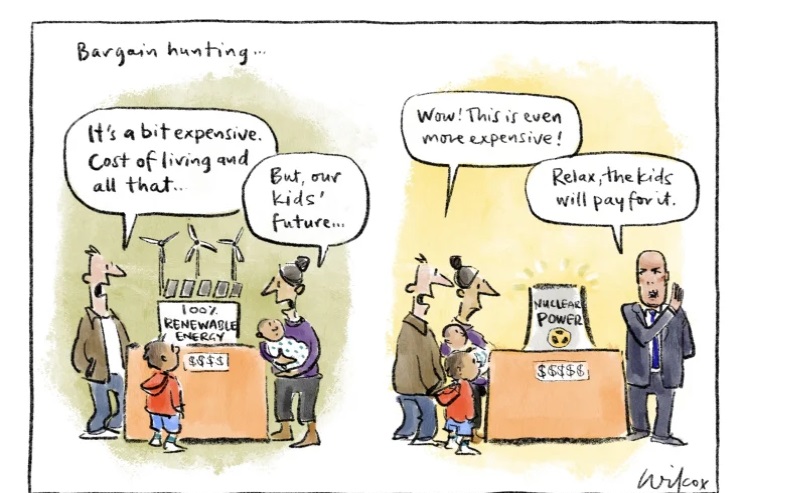
Prime Minister Anthony Albanese said developing nuclear projects when wind and solar delivered cheaper energy was ‘economic madness’ following claims it would cost $600 billion to build the seven nuclear plants.
The Coalition is preparing to unveil policies for gas-fired power stations and household renewable programs
The research also found that 43 per cent of voters support using renewables as well as gas-fired power, while 33 per cent prefer the Coalition’s proposal for nuclear energy.
The remainder were undecided.
‘This tells us that while many voters do not reject nuclear out of hand, they can favour an energy pathway that does not include it,’ Resolve director Jim Reed told the Sydney Morning Herald.
Voters prefer renewables over all other forms of energy, with to 84 per cent in favour of rooftop solar.
There was comparatively little support for large-scale wind farms, with only 37 per cent holding a favourable view of those on land, and 34% of turbines off-coast.
Meanwhile, 37 per cent favoured nuclear power when the option was listed alongside renewables and fossil fuels, and only 33 per cent supported coal power.
53 per cent of voters backed gas-fired electricity.
The Resolve Political Monitor surveyed 1003 eligible voters from Thursday to Sunday.
The questions were put to respondents soon after the Coalition announced plans to fund seven nuclear power plants.
“Jam tomorrow, jam yesterday, but never ever jam today!” So says the White Queen in Lewis Carroll’s Through the Looking Glass and What Alice Found There.” It’s entered the vernacular to describe a never-fulfilled promise. It turns out it’s also the federal Coalition’s energy policy.
Last Wednesday, on a single sheet of parchment, the Australian electorate was presented with a faint outline of the Coalition’s nuclear plans. There was precious little detail. A couple of reactors in this state, a couple in this one, and so on, all at sites hosting current or former coal fired power stations.
There were no costings. Just a lot of promises to stop renewables, and bulldoze any opposition from the states, the site owners and local communities, and to have the first nuclear operating by 2035, a timeline no one believes.
Over the weekend, there was nothing but confusion. Consider this exchange from Coalition energy spokesman Ted O’Brien and the ABC’s David Speers.
O’Brien: “Peter Dutton has made it clear. He’s more than happy for this election to be a referendum on cheaper, cleaner and consistent electricity.”
Speers: “And he said nuclear energy.”
O’Brien: “Nuclear is part of a balanced energy mix.”
Speers: “If you don’t win, that’s it?”
O’Brien: “Very happy to be public about that.”
Speers: “So if you don’t win, that’s it?”
O’Brien: “When it comes to, if we don’t win, firstly, we plan to win. And we are doing nuclear energy as part of that.”
Speers: “If you don’t win, you drop it?”
O’Brien: “It’s the right thing by this nation. There’s people like you who will run commentary on it.”
Speers: ‘I am asking if you accept the referendum.”
O’Brien: “I didn’t say it’s a referendum.”
Speers: “Peter Dutton said he’s very happy for this to be a referendum on energy and nuclear power.”
O’Brien: “You’re right. Because we want cheaper, cleaner and consisent”
Over the weekend the Smart Energy Council released a quick analysis that put the cost of the Coalition energy plan between $118 billion and $600 billion, pointing to the series of massive over-runs of every single large scale nuclear power station that has begun construction in western economies in the last three decades.
But just park those numbers for a moment. The killer observation was that the Coalition nuclear plan would account for less than four per cent of the country’s electricity needs by around 2045. Less than four per cent.
This was highlighted by energy transition expert Simon Mason on LinkedIn. He put the nuclear rollout in the context of Australia’s energy needs over the next few decades – assuming that coal closes as planned.
The Coalition wants to stop renewables, so transmission lines don’t need to be built. Do you spot the gap? The Coalition, apparently, wants to fill it with the most expensive fuel currently available, fossil gas.
O’Brien was asked about this on the ABC. How much nuclear will be part of the energy grid under the Coalition plan? He channelled the White Queen, again.
“Firstly, I’m a Liberal. I appreciate and respect that investors want to make money. But to be really clear, our focus is on the Australian people who want to save money. And so we have designed this policy with a crystal clear vision of Australians paying for cheaper, cleaner …”
No real answer there. He did go on to say that it was the Coalition’s hope that to build “multi” nuclear units at the seven sites it has chosen across five states.
That, if it’s true, will require a significant expansion of transmission infrastructure to support that. None of the sites chosen are fitted out to deal with any units of the size contemplated by the Coalition – up to 1.4 GW – let alone “multiple” units.
And the fact is that those sites are owned by private companies, which are already in the process of filling up available transmission capacity with billions of dollars of investments in their own battery, hydro and hydrogen projects.
So, if the Coalition were – as National leader David Littleproud repeatedly demands – to stop the rollout of wind, solar, storage and transmission, and to rip up contracts for wind and solar written by the Commonwealth – then Australia is simply not going to have enough power.
But are they really going to stop renewables? O’Brien didn’t seem to know. He refused to answer any questions about the planned “mix” of technologies.
If it doesn’t stop renewables in their tracks, then they are still going to need all the transmission lines – 5,000kms not the 28,000 kms that the Coalition claims – that the nuclear plan is supposedly designed to avoid. But of course, that claim is bunkum anyway.
The Coalition is forging ahead despite the fact that big energy users, such as the aluminium smelters, say they don’t want nuclear. The utility industry says it is not interested. Bankers and insurers won’t touch it with a barge pole, because of the risks.
Former chief scientist Allan Finkel, an admirer of nuclear technology, says it would not be possible to get nuclear in Australia before the mid 2040s, even if we wanted to. He says a focus on nuclear rather than renewables makes climate targets impossible to meet.
This was a point taken up, with typical vigour, by former prime minister Paul Keating over the weekend.
“Dutton, like Abbott, will do everything he can to de-legitimise renewables and stand in the way of their use as the remedy nature has given us to underwrite our life on earth,” Keating wrote.
“By his blatant opposition to renewables, Dutton calls into question and deprecates all the government has done to provide Australian business with a reliable and dependable framework for investment in renewables.”
But what do we hear? Ziggy Switkowski, who just a few years ago said large scale nuclear had had its day, is now singing its praises.
But another ardent support of the flick to nuclear is Dr Adi Patterson, the former boss at ANSTO, who describes the CSIRO GenCost report as a “form of fascism” and compares the Australian Energy Market Operator to “Animal Farm”. He says large scale nuclear is not a good idea, and says he has been saying as much for more than two years.
“People are not listening,” he told Sky News. “I think we should be building reactors at the scale of a large wind turbine.”
Patterson suggested that 5 MW so called “micro” reactors being promoted by the likes of Bill Gates, Westinghouse and Rolls Royce could be spread right across the grid. “They could literally be built in our backyard,” Patterson told Sky News. “These are being built now,” he added. Which is actually not true – they are an idea, not yet a thing.
Consider this, though. Just to match the capacity of retiring coal fired power stations, for a start, would require around 4,000 of these nuclear micro reactors to be scattered across the country – in our backyards, as Patterson suggests – a bit like Labor’s community batteries rollout , but with nuclear in place of lithium ion.
What could possibly go wrong?
“I’m sure I’ll take you with pleasure!” the White Queen said. “Two pence a week, and jam every other day.” Alice couldn’t help laughing, as she said, “I don’t want you to hire me – and I don’t care for jam.” “It’s very good jam,” said the Queen. “Well, I don’t want any to-day, at any rate.” “You couldn’t have it if you did want it,” the Queen said. “The rule is, jam to-morrow and jam yesterday – but never jam to-day.” “It must come sometimes to ‘jam to-day’,” Alice objected. “No, it can’t,” said the Queen. “It’s jam every other day: to-day isn’t any other day, you know.” “I don’t understand you,” said Alice. “It’s dreadfully confusing!”From: Through the Looking Glass and What Alice Found There.






 Antinuclear