Artist Anohni again joins the fight of Martu people against Western Australian uranium mine
Artist Anohni completes outback trek in fight with Martu people against WA uranium mine, ABC News, By Claire Moodie , 13 June 16 Oscar-nominated transgender musician Anohni has described the proponents of a uranium mine in Western Australia’s Pilbara as “desolate souls” after taking part in a protest march to the site of the proposed project.
Anohni, formerly known as Antony Hegarty of Antony and the Johnsons, made the comments after joining the Martu people on the 110 kilometre walk from the Parnngurr community to the site of Cameco’s Kintyre project, northeast of Newman. Continue reading
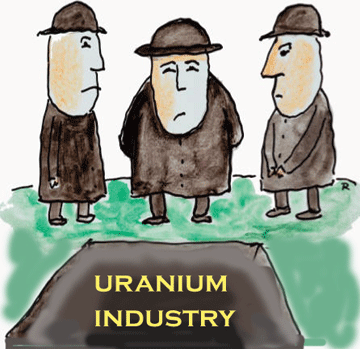
Things really are crook in the uranium industry
Australia’s uranium industry is also struggling just to stand still. The industry accounts for just 0.2 percent of national export revenue and less than 0.01 percent of all jobs in Australia. Those underwhelming figures are likely to become even less whelming with the end of mining and the winding down of processing at the Ranger mine in the NT.
Uranium on the rocks http://onlineopinion.com.au/view.asp?article=18236&page=0
| By Jim Green , 17 May 2016 Indicative of the uranium industry’s worldwide malaise, mining giant Cameco recently announced the suspension of production at Rabbit Lake and reduced production at McArthur River/Key Lake in Canada. Cameco is also curtailing production at its two U.S. uranium mines. About 500 jobs will be lost at Rabbit Lake and 85 at the U.S. mines. A Cameco statement said that “with today’s oversupplied market and uncertainty as to how long these market conditions will persist, we need to focus our resources on our lowest cost assets and maintain a strong balance sheet.”Christopher Ecclestone, mining strategist at Hallgarten & Company, offered this glum assessment of the uranium market: “The long-held theory during the prolonged mining sector slump was that Uranium as an energy metal could potentially break away irrespective of the rest of the metals space. How true they were, but not in the way they intended, for just as the mining space has broken out of its swoon the Uranium price has not only been left behind but has gone into reverse. This is truly dismaying for the trigger for a uranium rebound was supposed to be the Japanese nuclear restart and yet it has had zero effect and indeed maybe has somehow (though the logic escapes us) resulted in a lower price.”
Ecclestone adds that uranium has “made fools and liars of many in recent years, including ourselves” and that “uranium bulls know how Moses felt when he was destined to wander forty years in the desert and never get to see the Promised Land.” He states that uranium exploration “is for the birds” because “the market won’t fund it and investors won’t give credit for whatever you find”. Continue reading |
Environment groups slam NSW government attempts to generate interest in uranium trade.
 The future is renewable, not radioactive: Environment groups slam NSW government attempts to generate interest in uranium trade.
Environment groups have slammed attempts by the NSW government to talk up the potential for uranium exploration as well as coal seam gas to international investors.
The Sydney Morning Herald reported yesterday that at a conference held in Toronto in March, Department of NSW Trade and Investment spruiked NSW as a ‘greenfields’ opportunity for uranium, citing areas in the central west around Broken Hill and the New England region as possible hotspots.
Beyond Nuclear Initiative coordinator Natalie Wasley said “Minister Roberts is going head first down a radioactive rabbit hole. The uranium industry is outdated and unsafe and it is flat lining economically.”
“When the uranium exploration moratorium was overturned in 2012, environment groups were joined by trade unions and medical organisations, as well as the state ALP and Greens parties to launch the NSW Uranium Free Charter. There has historically been strong opposition to uranium exploration and mining in NSW and this has not waned over time.”
“Attempts to open a uranium mining industry here will be challenged head on.”
Kerry Laws from Uranium Free NSW added: “NSW has the potential to be a leader in renewables, but the government is instead trying to drag the state back into the dirty dark ages of the uranium trade.”
“Minister Roberts and Premier Baird could give some substance to Turnbull’s innovation bandwagon, by exploring and mapping out renewable options, rather than resorting to an industry that both damages our land and creates by-products that remain toxic for 100,000 years.”
“The future is in regional, renewable industries.”
Cameco uranium plan faces rocky road
 https://nuclearfree.wordpress.com/media/ , 11 May 16 Traditional Owners from the regions around the proposed Yeelirrie and Kintyre uranium operations in WA have today sent Cameco shareholders and stakeholders a clear message of opposition to any mining plans. The groups have released a joint statement to coincide with Cameco’s Annual General Meeting being held in Saskatoon, Canada.
Both communities have a long history of opposition to uranium mining plans at Yeelirrie and Kintyre, dating back to early uranium exploration in WA during the 1980’s. Both communities have also attracted the support of environment, social justice, union and health organisations and the state Labor and state and federal Greens parties in their fight against uranium mining.
“You can’t reverse what the old people have said before. We’re going to stop it” said Desmond Taylor, Karlamilyi Traditional Owner. “This is my spiritual birthplace, my dreaming place. Warturarra (the proposed Kintyre mine site) became my spiritual home; the bush food there became my totem. To mine there would take away my spirit and the totem, it will destroy the living things around it, that place would become empty.”
The joint statement is going to the Cameco Board, shareholders and major Canadian investors. It conveys the depth of the contest that company will face should it seek to advance uranium mining.
“Our country is special to us” said Kado Muir, a Yeelirrie Traditional Owner and Senate candidate for the National Party. “I’m not anti-mining I am speaking as a Traditional Owner communicating our view that Cameco and uranium mining are not welcome on our country. Uranium is different to other mining, because the risks remain for thousands of years. It is our responsibility to look after the land for future generations. We will continue to challenge the proposal to mine uranium at Yeelirrie.”
Members of the Parnngurr and Martu community will be walking from through the Karlamilyi National Park to the proposed uranium mine at Kintyre from the 4th – 12th of June in protest to Cameco and Mitsubishi’s uranium mine plans. See community interviews here.
The Walkatjurra Rangers and Yeelirrie Traditional Owners will also be walking in protest to the Yeelirrie uranium mine from the 7th of August – 7th September. This will be the sixth annual walk against uranium mining in the region. See community interviews here.
Minerals Council of Australia on the back foot with its pro uranium campaign
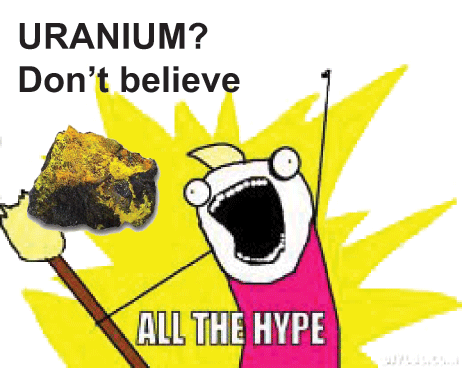 Pro-uranium social media campaign’s #epicfail Why are some still championing nuclear power when renewable energy generation has doubled worldwide over the past decade? Jim Green, SBS, 25 Apr 2016 www.sbs.com.au/news/article/2016/04/25/comment-pro-uranium-social-media-campaigns-epicfail
The Minerals Council of Australia launched a pro-uranium social media campaign on Wednesday. By that afternoon the twitter hashtag #untappedpotential was trending but ‒ as an AAP piece picked up by SBS and others noted ‒ contributors were overwhelmingly critical.
Nearly all contributors offered thoughts such as these: “A week away from the #Chernobyl 30-year anniversary and Minerals Council begins propaganda trip on the #untappedpotential of uranium. Huh?!” said Twitter user Jemila Rushton.
“We need to better harness the #untappedpotential of solar power”, tweeted Upulie Divisekera.
“#untappedpotential to put more communities at risk of nuclear waste dumps,” Ace Collective said.
“We concur that uranium has much #untappedpotential … for disaster, cost and time blowouts and proliferation,” Anglesea After Coal said.
No doubt the Minerals Council anticipated the negative publicity and is working on the basis that all publicity is good publicity. But what the MCA didn’t anticipate is that in recent days the uranium price has fallen to an 11-year low. Mining.com noted in an April 20 article that the current low price hasn’t been seen since May 2005. The current price, under US26/lb, is well under half the price just before the 2011 Fukushima disaster, and under one-fifth of the 2007 peak of a bubble.
Mining.com quotes a Haywood Securities research note which points out that the spot uranium price “saw three years of back-to-back double-digit percentage losses from 2011-13, but none worse than what we’ve seen thus far in 2016, and at no point since Fukushima, did the average weekly spot price dip below $28 a pound.”
Mining.com notes that five years after the Fukushima disaster only two of Japan’s 50 nuclear reactors are back on line, and that in other developed markets nuclear power is also in retreat. The last reactor start-up in the U.S. was 20 years ago. The French Parliament legislated last year to reduce the country’s reliance on nuclear power by one-third. Germany is phasing out nuclear power. The European Commission recently released a report predicting that the EU’s nuclear power retreat ‒ down 14% over the past decade ‒ will continue.
China is a growth market but has amassed a “staggering” stockpile of yellowcake according to Macquarie Bank. India’s nuclear power program is in a “deep freeze” according to the Hindustan Times (unfortunately the same cannot be said about its nuclear weapons program), while India’s energy minister Piyush Goyal said on April 20 that India is not in a “tearing hurry” to expand nuclear power since there are unresolved questions about pricing, safety and liability waivers sought by foreign companies.
Even if all of Japan’s 50 reactors are included in the count, the number of power reactors operating worldwide is the same now as it was a decade ago. Zero growth despite the endless rhetoric about a nuclear renaissance.
A decision on two planned reactors in the UK could be announced in the next fortnight and the price-tag for the reactors explains why nuclear power is stagnant worldwide and why the Minerals Council is talking about uranium’s ‘potential’ rather than its current contribution to export revenue and employment. The total price-tag for the two planned reactors is A$45 billion. If the project proceeds, the industry will be hoping it doesn’t go three times over budget, as reactor projects in France and Finland have.
South Australian academic Richard Leaver has neatly summed up the uranium industry’s tiresome rhetoric: “‘Potential’ is one of the most powerful chemicals available to the political alchemist. Any individual, firm or sector deemed to have potential is relieved of a massive and perpetual burden − the need to account for past and present achievements (or, more probably, the lack of them). The history of Australian involvement in the civil uranium industry offers an excellent example of this alchemy at work.”
Whatever the future potential of the uranium industry, it contributes next to nothing to the economy at the moment: <0.2 percent of national export revenue and <0.01 percent of all jobs in Australia. And those figures will fade further into irrelevance with the end of mining and the gradual winding down of processing at the Ranger uranium mine in the NT.
The stagnation and cost escalation of nuclear power contrast sharply with the trajectory of renewables. Driven by sharp cost reductions, renewable energy generation has doubled worldwide over the past decade and renewables now produce more than twice the amount of electricity as nuclear power. The gap is widening every day. Dr Jim Green is the national nuclear campaigner with Friends of the Earth, Australia.
Mierals Council’s Pro Uranium campaign – a fizzer already?
Pro-uranium campaign backfires on Twitter http://www.sbs.com.au/news/article/2016/04/20/pro-uranium-campaign-backfires-twitter A Minerals Council campaign urging people to discuss the ‘untapped potential’ of uranium on social media has been used against it. A resources industry campaign to promote uranium mining has been hijacked by Twitter users keen to voice their opposition to the practice.The Minerals Council of Australia launched the Uranium: Untapped Potential campaign on Wednesday, using social media content including videos and posters to highlight the benefits of uranium.
“The material is designed to showcase facts on the table about the uranium industry and the benefits it can provide to the Australian community, including the creation of hundreds of jobs,” the council’s executive director Daniel Zavattiero said in a statement.
It also aims to reassure the public on safety, while pointing out opportunities in nuclear medicine and the environmental upside of nuclear energy.
“A lifetime’s use of electricity from nuclear power plants produces the spent fuel equivalent of one soft drink can,” a poster says.
But the hashtag #UntappedPotential, which was trending by Wednesday afternoon, has attracted a large amount of undesired banter by environmentalists who have instead used it to express their concerns around the practice and advocate for alternative energy.
“#UntappedPotential for meltdowns and nuclear disaster?” said Twitter user Jemila Rushton.
“We need to better harness the #untappedpotential of solar power”, tweeted Upulie Divisekera.
“#UntappedPotential to put more communities at risk of nuclear waste dumps,” Ace Collective said on Twitter.
“We concur that uranium has much #untappedpotential – for disaster, cost and time blowouts and proliferation,” Anglesea After Coal said.
The Minerals Council is running the campaign on Twitter, Facebook and YouTube.
ERA’s uranium mining at Ranger ends: ERA can afford rehabilitation of site
 ERA to unveil strategy as Ranger mining ends BARRY FITZGERALD, RESOURCES EDITOR, THE AUSTRALIAN APRIL 12, 2016 MELBOURNE BARRY FITZGERALD HAS COVERED THE RESOURCES INDUSTRY FOR 30 YEARS. THE INAUGURAL WINNER OF THE DIGGERS & DEALERS MEDIA AWARD IN 2003, BARRY IS A COMMITTEE MEMBER OF THE MELBOURNE MINING CLUB, A NON-PROFIT ORGANISATION FORMED TO FOSTER INDUSTRY DEBATE.
Energy Resources of Australia is close to releasing the outcome of its strategic review into its future. The review was forced upon the company after Rio Tinto and Ranger’s traditional owners rejected its plan to extend the life of its uranium mining and processing operations inside Kakadu by developing the Ranger Deeps deposit.
Its pending release comes as ERA continues to narrow the gap between its cash balance and the $509 million needed to complete the rehabilitation of Ranger. At last report, ERA was holding cash of $433m and had no debt after adding $72m to its cash balance during 2015.
While mining operations have stopped, ERA continues to produce from stockpiled material, and has said previously it could possibly continue to do so until late 2020.
The rate of cash accumulation over the past five years suggests ERA could end up with cash surplus to the rehabilitation costs, raising the prospect of an eventual capital return to shareholders, depending on what plans for ERA’s future emerge from the strategic review. Continue reading
It’s wrong to sell Australian uranium to critically unsafe Ukraine
The Zaporizhia nuclear facility is Europe’s largest and is only 200 kilometres from the conflict zone in eastern Ukraine. Some commentators have described nuclear plants in the region as pre-deployed nuclear targets and there have already been armed incursions during the recent conflict period.
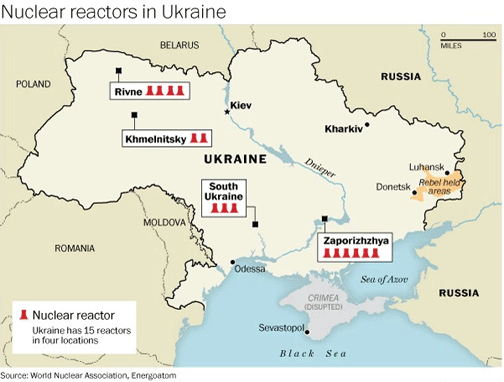
Australia shouldn’t sell its uranium to Ukraine http://www.smh.com.au/comment/australia-shouldnt-sell-its-uranium-to-ukraine-20160331-gnv0no.html, Dave Sweeney, 31 Mar 16 Foreign Affairs Minister Julie Bishop’s announcement this week to sell Australian uranium to Ukraine is an ill-advised and dangerous retreat from responsibility.
With timing and placement that a satirist could only dream of emulating – April Fool’s Day, the month of the 30th anniversary of the Chernobyl meltdown and while attending a nuclear security summit – Bishop is set to sign a uranium supply agreement this week with Ukrainian President Petro Poroshenko.
Australia, the country that directly fuelled Fukushima now plans to sell uranium to Ukraine, the country that gave the world Chernobyl – hardly a match made in heaven.
Thirty years ago the Chernobyl nuclear disaster spread fallout over large swathes of eastern and western Europe and five million people still live in contaminated areas in Belarus, Ukraine and Russia.
Serious containment and waste management issues remain at Chernobyl with a massive concrete shield now under construction in an attempt to enclose the stricken reactor complex and reduce the chances of further radioactive releases.
Against this backdrop there are deep concerns over those parts of the Ukrainian nuclear sector that are not yet infamous names, including very real security concerns about nuclear facilities being targeted in the current conflict with Russia. Continue reading
FAULTS EXPOSED WITH MULGA ROCK URANIUM PROPOSAL
 http://www.ccwa.org.au/faults_exposed_with_mulga_rock_uranium_proposal
The confirmation raises serious environmental concerns over land clearing, water consumption, waste management and impacts on rare and endangered species.
The public comment period for the proposal closed today with over 1100 individual submissions calling on the EPA to reject the mine proposal.
Vimy Resources’ proposal for a uranium project at Mulga Rock is in the Yellow Sandplain Priority Ecological Community, 250km north east of Kalgoorlie and upstream from the Queen Victoria Springs A Class Nature Reserve.
“Vimy want to take 15 million litres of underground water every day for their uranium operation,” said CCWA nuclear free campaigner Mia Pepper. “This ancient water is sustaining life and supporting this fragile desert ecosystem. Vimy would be voraciously consuming this precious water resource in a bid to extract a product that is unsafe, unnecessary and uneconomic.”
“Vimy are seeking to fast-track approvals for this project before next year’s state election even though the uranium price has flat-lined in the wake of Fukushima”.
The environment groups detailed submission has also identified deficiencies in the plans for the long term containment and management of radioactive mine tailings, including the presence of under reported seismic fault-lines in the proposed tailing dams region. Continue reading
Facts on Western Australia uranium mining proposals
Fact File: http://www.ccwa.org.au/faults_exposed_with_mulga_rock_uranium_proposal
- Since the WA Government lifted the ban on uranium over seven years ago not one uranium proposal has attained final approval to begin mine construction.
- The recent SA Nuclear Fuel Cycle Royal Commission preliminary findings found that “significant barriers to the viability of new uranium mine developments in South Australia” including the “current low price of uranium and uncertainty about the timing of any price increases” – a finding with direct relevance for WA
- Australian uranium production has been in decline since 2009
- In 2014-2015 the Australian uranium industry employed just 987 people nationally
- The uranium spot price is currently $32.15
- Nuclear energy contributes just 4.4% of the global energy mix
- Renewable energy contributes 6% of the global energy mix with a growth rate of
12%
- There are 62 reactors under construction worldwide – of these 47 are experiencing construction and commissioning delays.
- Globally over 130 reactors have operated for over 30 years – nearing their lifespan. 54 of those reactors have operated beyond their designed life span of 40 years. These reactors are required to be decommissioned and the industry will struggle to maintain its shrinking market share.
- There is no state bi-partisan political support for uranium mining in WA
Australian uranium fuelled Fukushima nuclear reactors at time of the catastrophe
Fukushima five years on, and the lessons we failed to learn, Guardian, Dave Sweeney, 11 Mar 16 “…….In October 2011 it was formally confirmed to the Australian parliament that not only was Australian uranium routinely sold to the corner-cutting Tepco but that a load of true blue yellowcake was fuelling the Fukushima complex at the time of the disaster. Australian radioactive rocks were the source of Fukushima’s fallout.
Surely after directly fuelling disaster Australia would have taken some steps to review and possibly reconsider our role in the global nuclear trade?
The UN thought so. In September 2011 the UN secretary-general called on Australia to conduct “an in-depth assessment of the net cost impact of the impacts of mining fissionable material on local communities and ecosystems”.
This has never happened. It needs to, and Australia’s uranium sector deserves some long overdue scrutiny.
The most recent independent assessment of the Australian uranium industry – a Senate inquiry in October 2003 – found the sector characterised by underperformance and non-compliance, an absence of reliable data to measure contamination or its impact on the environment and an operational culture focussed on short term considerations…….http://www.theguardian.com/commentisfree/2016/mar/11/fukushima-five-years-on-and-the-lessons-we-failed-to-learn
Australia’s uneconomic and declining uranium industry
Fukushima five years on, and the lessons we failed to learn, Guardian, Dave Sweeney, 11 Mar 16 “…….As home to around 35% of the world’s uranium reserves, Australia has long been a significant player in the global nuclear trade.
Since the 1980s Australian uranium mining has been dominated by two major operations – Ranger in Kakadu and Olympic Dam in northern South Australia. Both operations and their heavyweight owners have been voting with their feet and their finances since 2011. Processing of stockpiled ore continues at Ranger but mining has ended and parent company Rio Tinto is now preparing to commence costly and complex rehabilitation work.
At Olympic Dam the world’s biggest mining company BHP Billiton stunned the South Australian government in 2012 when it shelved an approved and long planned multi-billion dollar mine expansion.
Smaller mines like Honeymoon in South Australia have been placed on extended care and maintenance, junior companies have abandoned the field and the sectors prevailing business model is to get the paperwork in order and wait in hope for better times.
Historically the sector has been constrained by political uncertainty, restrictions on the number of mines, a consistent lack of social license and strong Aboriginal and community resistance.
Recent years have seen fewer political constraints but a dramatic decline in the price of uranium and popularity of nuclear power following Fukushima.
Australia now accounts for approximately 11% of global uranium production, down from over 18% a decade earlier. Australia’s uranium production of 5,000 tonnes in 2014 was the lowest for 16 years.The industry generates less than 0.2% of national export revenue and accounts for less than 0.02% of jobs in Australia. Less than one thousand people are employed in Australia’s uranium industry.
In an attempt to jump start the flat-lining uranium trade, successive federal governments have preferred enthusiasm to evidence. They have failed to conduct the requested industry review and instead fast-tracked increasingly irresponsible uranium sales deals, most recently with India.
Approvals are fast-tracked, regulators are complacent, community concerns are air-brushed away and all for a sector that never really made sense and now doesn’t even make dollars.
In short, Australia’s uranium sector is high risk and low return. It leaves polluted mine sites and home and drives nuclear risk and insecurity abroad. And it fuelled Fukushima – a profound environmental, economic and human disaster that continues to negatively impact lives in Japan and far beyond.http://www.theguardian.com/commentisfree/2016/mar/11/fukushima-five-years-on-and-the-lessons-we-failed-to-learn
Capping of Ranger open cut uranium mine
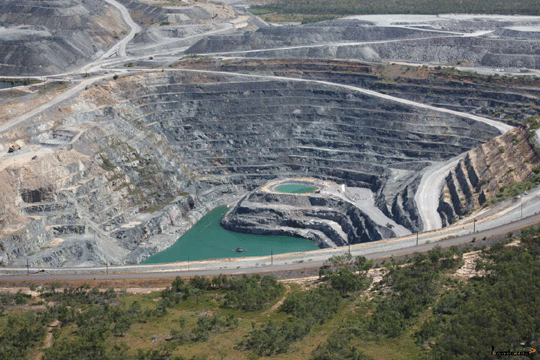
Ranger uranium mine open cut pit capped as part of ongoing site rehabilitation ABC Radio NT Country Hour By Daniel Fitzgerald 10 Mar 16 An open cut pit at the Ranger uranium mine in the Northern Territory has been capped after 20 years of rehabilitation work.
Energy Resources Australia (ERA) began filling in Pit 1 after mining in the pit ceased in 1996, with work continuing intermittently around other activities at the site, which is surrounded by Kakadu National Park. AUDIO: Tim Eckersley speaks about rehabilitation works at ERA’s Ranger mine (ABC Rural)
Leftovers from the processing operations at the mine, known as tailings, were dumped into the large pit and left to settle. General manager of operations at the Ranger mine, Tim Eckersley said the tailings were a “sandy, muddy mixture so it has taken quite some years to consolidate.”………..
Since 2012 ERA said it had spent more than $400 million on rehabilitation works at the mine.
Environmental management of the mine site had been marred by several incidents in recent years.Last year, a fire on the site burnt into Kakadu National Park and threatened nearby Indigenous cultural sites.ERA avoided charges over a 2013 incident when 1,400 cubic metres of radioactive slurry was spilt after a tank collapsed.
The mine has an uncertain future after traditional owners said they would not support mining operations after the mining lease ended in 2021. http://www.abc.net.au/news/2016-03-09/disused-open-cut-pit-at-ranger-uranium-mine-capped-era/7221720
Australia’s uranium -nuclear sector – high risk, low return
Failed Uranium Promises Highlights Need For Caution On Radioactive Waste Plans New Matilda, By Dave Sweeney on March 3, 2016 There’s no market, there’s no expertise, and there’s no need for Australia to become the world’s nuclear waste dump.
Having failed to deliver on promises of national wealth from uranium mining – nuclear industry promoters are now talking up the prospect of ‘stupendous’ riches from Australia hosting the world’s high-level radioactive waste.
The South Australian Nuclear Fuel Cycle Royal Commission, headed by former Governor Rear Admiral 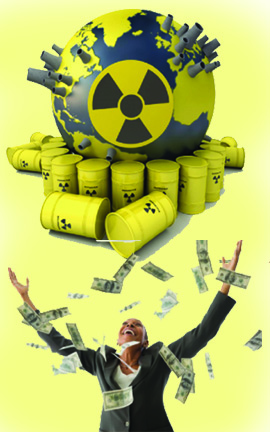 Kevin Scarce, has unleashed a frontier style enthusiasm that has seen SA’s Adelaide Advertiser newspaper trumpeting the “Scrooge McDuck levels of cash which the state would be swimming in”.
With the promised dollar signs shinier in the eyes of many politicians and commentators than the very real danger signs, it is time for some cool heads when it comes to plans to import hot wastes.
As home to around 35 per cent of the world’s uranium reserves, Australia has long been a significant player in the global nuclear trade and there are some useful lessons from this experience.
Since the 1980’s the ‘modern’ period of Australian uranium mining has been dominated by two major operations – Ranger in Kakadu and Olympic Dam in northern South Australia.
The sector has been constrained by political uncertainty, restrictions on the number of permissible mines, a consistent lack of social license and strong Aboriginal and community resistance.
Recent years have seen fewer political constraints but a dramatic decline in the price of uranium and popularity of nuclear power, following the Australian uranium fuelled Fukushima nuclear crisis – which is fast approaching its five year anniversary, and whose radioactive fallout continues to negatively impact lives in Japan and beyond.
Australia now accounts for approximately 11 per cent of global uranium production, down from over 18 per cent a decade earlier.
Australia’s uranium production of 5,000 tonnes in 2014 was the lowest for 16 years.
The industry generates less than 0.2 per cent of national export revenue and accounts for less than 0.02 per cent of jobs in Australia. Less than one thousand people are employed in Australia’s uranium industry.
In short, the sector is high risk and low return………. https://newmatilda.com/2016/03/03/failed-uranium-promises-highlights-need-for-caution-on-radioactive-waste-plans/
Northern Territory Mine Regulator gives a free pass for uranium mining companies to pollute
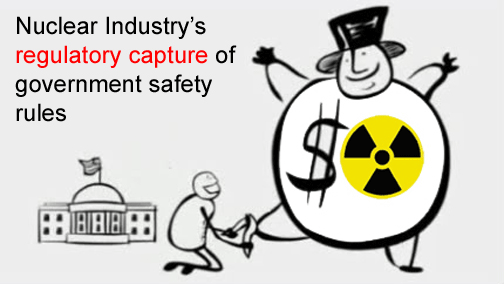 What is a regulator for again? http://linkis.com/greensmps.org.au/1cNkL 12 Feb 2016 The Northern Territory mine regulator is inviting uranium companies to ignore any environmental safeguards with their refusal to prosecute Energy Resources Australia, the Australian Greens said today.
“After more than two years, the NT regulator has given ERA a pass. The Ranger mine leaked nearly 1.5 million litres of radioactive acidic sludge into the plant area, and could have got people killed,” Australian Greens Deputy Leader Senator Scott Ludlam said today.
“Under estimates questioning we were told that the report into the leach tank spill was kept from the public while a decision was made about whether or not to prosecute. It’s hard to envisage a scenario that warranted the application of the full force of the law more than this one.
“The regulator failed to prevent the spill, they took years to deliberate, and came up with nothing. They’ve essentially announced to mining companies in the NT that there are no legal consequences for catastrophic negligence,” Senator Ludlam said.
“We urge the NT government to reverse this decision immediately and force ERA to be accountable.”
1 This month

of the week – Australians for War Powers Reform (AWPR)
To see nuclear-related stories in greater depth and intensity
 Antinuclear