Book review: Michael Shellenberger’s reheated critique of climate ‘alarmism’

Michael Shellenberger has been downplaying climate risks since 2010 if not earlier – his luke-warmism is reheated. The post Book review: Michael Shellenberger’s reheated critique of climate ‘alarmism’ appeared first on RenewEconomy.
Book review: Michael Shellenberger’s reheated critique of climate ‘alarmism’ — RenewEconomy
California-based Michael Shellenberger first courted controversy in 2004 with his ‘death of environmentalism’ critique of the environment movement and has continued to attract controversy by promoting nuclear power, demonising renewable energy (“renewables are worse for the environment than fossil fuels”) and demonising the environment movement that he claims to be part of.
Shellenberger’s is now into ‘luke-warmism’ — downplaying the risks associated with climate change and attacking environmentalists for climate and environmental ‘alarmism’.
That’s the focus of his new book, Apocalypse Never: Why Environmental Alarmism Hurts Us All. In fact, Shellenberger has been downplaying climate risks since 2010 if not earlier — his luke-warmism is reheated.
A number of factual rebuttals of Shellenberger’s claims about environmental alarmism have been written, and more will follow (1,2,3,4,5). Climate Feedback asked six scientists to review Shellenberger’s lengthy opinion piece which promotes his book.
They found its overall scientific credibility to be ‘low’ and most found it indulged in cherry-picking and misleading statements.
Shellenberger’s claim that “climate change is not making natural disasters worse” is inaccurate and contradicts numerous scientific studies linking climate change to temperature extremes, drought, precipitation patterns, and wildfires. Continue reading
Australia’s nuclear lobby targets young people, using Facebook and Instagram

Mining lobby pushes young people to embrace nuclear power , Financial Review, Aaron Patrick, 7 Aug 20,The mining industry has been wrestling for years with how to change one of the most entrenched rules in energy policy: a moratorium on nuclear power.Now, based on insights from a market researcher known for its political insights, the Minerals Council of Australia has begun a campaign to win over a group that could lead Australia to a nuclear industry: young people.
On Sunday, a week ago, 17 different ads started appearing on Facebook and Instagram promoting nuclear as safe, reliable and good for the environment.
Produced by the Mineral Council’s own staff, the ads are based on polling by JWS Research, which estimates support for nuclear power is 40 per cent, some 29 per cent of people are neutral or unsure, and women and people aged 18 to 34 are the least informed about nuclear power. Some aren’t even sure there is a connection between nuclear power and uranium, of which Australia is one of the world’s bigger producers.
After conducting focus groups and an online survey last year, JWS Research told the Minerals Council that support could rise to 55 per cent, or even higher, by providing more information to cou nter the reputational damage of the Three Mile Island, Chernobyl and Fukushima accidents.
“There is an obvious opportunity to educate Australians about nuclear power’s credentials,” JWS said in a report for the lobby group. “Low-level concerns about the cost of nuclear could be countered and its reliability and zero-emissions credentials should be promoted.”
The ad campaign isn’t a slick, big-budget production. Six ads, each about 1½ minutes long, contain statistics and information in graphical form set to music. “What are we afraid of,” says nuclear energy is the safest source of baseload electricity based on output, and no one died of radiation poisoning in the Fukushima meltdown in Japan in 2011.
Eleven other ads feature interviews about one minute long with experts and advocates discussing nuclear waste, medicine and reactor design at a nuclear conference in Sydney…….
In December, a parliamentary committee urged the government to legalise modern nuclear reactors, and in May Energy Minister Angus Taylor included nuclear among energy sources the government will study for investment. https://www.afr.com/companies/energy/mining-lobby-pushes-young-people-to-embrace-nuclear-power-20200729-p55gp
August 7 Energy News — geoharvey

Opinion: ¶ “How Falling Solar Costs Have Renewed Clean Hydrogen Hopes” • The world is increasingly banking on green hydrogen fuel to fill some of the critical missing pieces in the clean-energy puzzle. For decades, researchers have heralded a new “hydrogen economy,” but it’s barely made a dent in fossil fuel demand, so far. Now, […]
August 7 Energy News — geoharvey
Billing Olympics as ‘pandemic recovery games’ unfeasible: ex-Fukushima mayor — Fukushima 311 Watchdogs

Former Minamisoma Mayor Katsunobu Sakurai is seen talking to the Mainichi Shimbun in Minamisoma, Fukushima Prefecture, on July 3, 2020 August 5, 2020 MINAMISOMA, Fukushima — Katsunobu Sakurai, former mayor of Minamisoma, Fukushima Prefecture, who was in office during the March 2011 earthquake and tsunami disaster, firmly stated during a recent interview with the […]
Billing Olympics as ‘pandemic recovery games’ unfeasible: ex-Fukushima mayor — Fukushima 311 Watchdogs
Particles from Fukushima meltdown contained plutonium — Fukushima 311 Watchdogs

Local residents who live around the 20km exclusion zone around the Fukushima Dai-Ichi Nuclear Power Plant undergo a screening test for possible radiation at screening center on September 13, 2011 in Minamisoma, Fukushima Prefecture, Japan. August 6th, 2020 Posted by Stanford Microscopic particles emitted during the Fukushima nuclear disaster contained plutonium, according to a […]
Particles from Fukushima meltdown contained plutonium — Fukushima 311 Watchdogs
Japan’s plans for radioactive discharges violates principles of environmental protection and defies international maritime law — Fukushima 311 Watchdogs

Aug.4,2020 The threat of a million tonnes of highly contaminated water from the Fukushima Daiichi being discharged into the Pacific Ocean includes the potential environmental and human impacts, but also how a decision by the Japanese government relates to international law. What we conclude is that such a decision poses a direct threat to the […]
Japan’s plans for radioactive discharges violates principles of environmental protection and defies international maritime law — Fukushima 311 Watchdogs
Japan needs to halt its plan to dump contaminated water from Fukushima immediately — Fukushima 311 Watchdogs

A TEPCO employee tells reporters about the Fukushima Daiichi Nuclear Power Plant in June 2017. Aug.4,2020 With the world’s attention focused on the COVID-19 pandemic, the Japanese government has been pushing forward with its preparations to dump contaminated water from the Fukushima Daiichi Nuclear Power Plant into the ocean. After first announcing an initial plan […]
Japan needs to halt its plan to dump contaminated water from Fukushima immediately — Fukushima 311 Watchdogs
Peabody’s massive write-down concedes coal mines have little value, and a dim future — RenewEconomy

World’s largest privately owned coal company finally acknowledges a long-apparent reality: Thermal coal mines in US have little value and not much of a future. The post Peabody’s massive write-down concedes coal mines have little value, and a dim future appeared first on RenewEconomy.
Peabody’s massive write-down concedes coal mines have little value, and a dim future — RenewEconomy
Hung out to dry: The dark side of big solar — RenewEconomy

For all its success, there is a dark side to the big solar sector. And it came to the fore again this week when a leading sub-contractor filed for administration. The post Hung out to dry: The dark side of big solar appeared first on RenewEconomy.
Hung out to dry: The dark side of big solar — RenewEconomy
Hiroshima coverage from Richard Rhodes, Alex Wellerstein, Hidehiko Yuzaki — limitless life

Hiroshima coverage from Richard Rhodes, Alex Wellerstein, Hidehiko Yuzaki Was this email forwarded to you? Sign up here to stay current. August 6, 2020 HIROSHIMA & NAGASAKI Counting the dead at Hiroshima and Nagasaki How many people died in the bombings of Hiroshima and Nagasaki? It’s complicated. Historian Alex Wellerstein examines the conflicting reports, observing that various numbers […]
Hiroshima coverage from Richard Rhodes, Alex Wellerstein, Hidehiko Yuzaki — limitless life
Australia’s ICAN and Conservation Council of Western Australia commemorate Hiroshima Day


On August 5th, people from across Australia gathered, via Zoom, to commemorate the nuclear bombing of Hiroshima, and to hear speakers from ICAN Autralia (International Campaign to Abolish Nucleat Weapons).
Medlissa Clarke spoke of the human effects of this catastrophe, and of the efforts over time, towards disarmament. The biggest leap forward in this has been, in 2017, the U.N. Treaty on the Prohibition of Nuclear Weapons. The Treaty now has over 200 nations signed up, with 40 ratifications – not far from the 50 required to make it international law.
Most Australians want a nuclear weapons free world.But Australia’s policy does endorse nuclear weapons. A future Labor government might change that.
Dimity Hawkins described the misery experienced by the Japanese, the agonising stories of the survivors. Since Hiroshima, the nuclear bombs developed are greatly stronger, and have been tested over many years, on the Marshall Islands, on Maralinga, South Australia, and on other Pacific Islands, in nuclear colonialism that has never properly been cleaned up. Australia is part of that nuclear chain. But now,the survivors are speaking out. Red Cross and Red Crescent, the world’s greatest non government emergency service is strongly behind the Treaty movement, and the indigenous people, particularly Australia’s Aboriginals .
Former Senator Scott Ludlam commemorated the Hibakusha, and the impact of the nuclear weapons industry on indigenous people world-wide. He drew attention to the ?proud statement of U.S. Strategic Command – that their nuclear weapons are to be used in a “safe, secure and lethal way”.
The Treaty was an Australian initiative, brought about by the work of, at first, a few, who by-passed official systems, and went out getting signatures, setting up ICAN, which became an international movement.-, – showing that people can do this, have an effect and an influence. As cities will be the places to bear the catastrophe of nuclear annihilation, many Mayors of many have City Councils have signed up to the Treaty. The Treaty shows that no-one can now claim that nuclear weapons are acceptable, in the same way as biological and chemical warfare are unacceptable.
For information on the continuing CCWA webinar series go to http://www.ccwa.org.au/yellowcake_country_webinar_series
Another Hiroshima is Coming…Unless We Stop It Now
Today, an unprecedented campaign of propaganda is shooing us all off like rabbits. We are not meant to question the daily torrent of anti-Chinese rhetoric, which is rapidly overtaking the torrent of anti-Russia rhetoric. Anything Chinese is bad, anathema, a threat: Wuhan …. Huawei. How confusing it is when “our” most reviled leader says so.
The target is China. Today, more than 400 American military bases almost encircle China with missiles, bombers, warships and nuclear weapons. From Australia north through the Pacific to South-East Asia, Japan and Korea and across Eurasia to Afghanistan and India, the bases form, as one US strategist told me, “the perfect noose”.
In the Sydney Morning Herald, tireless China-basher Peter Hartcher described those who spread Chinese influence in Australia as “rats, flies, mosquitoes and sparrows”. Hartcher, who favourably quotes the American demagogue Steve Bannon, likes to interpret the “dreams” of the current Chinese elite, to which he is apparently privy. These are inspired by yearnings for the “Mandate of Heaven” of 2,000 years ago. Ad nausea.
To combat this “mandate”, the Australian government of Scott Morrison has committed one of the most secure countries on earth, whose major trading partner is China, to hundreds of billions of dollars’ worth of American missiles that can be fired at China.
At a quarter past eight on the morning of August 6, 1945, she and her silhouette were burned into the granite.
I stared at the shadow for an hour or more, then I walked down to the river where the survivors still lived in shanties.
I met a man called Yukio, whose chest was etched with the pattern of the shirt he was wearing when the atomic bomb was dropped.
He described a huge flash over the city, “a bluish light, something like an electrical short”, after which wind blew like a tornado and black rain fell. “I was thrown on the ground and noticed only the stalks of my flowers were left. Everything was still and quiet, and when I got up, there were people naked, not saying anything. Some of them had no skin or hair. I was certain I was dead.”
Nine years later, I returned to look for him and he was dead from leukaemia.
“No radioactivity in Hiroshima ruin” said The New York Times front page on 13 September, 1945, a classic of planted disinformation. “General Farrell,” reported William H. Lawrence, “denied categorically that [the atomic bomb] produced a dangerous, lingering radioactivity.”
Only one reporter, Wilfred Burchett, an Australian, had braved the perilous journey to Hiroshima in the immediate aftermath of the atomic bombing, in defiance of the Allied occupation authorities, which controlled the “press pack”.
“I write this as a warning to the world,” reported Burchett in the London Daily Express of September 5,1945. Sitting in the rubble with his Baby Hermes typewriter, he described hospital wards filled with people with no visible injuries who were dying from what he called “an atomic plague”.
For this, his press accreditation was withdrawn, he was pilloried and smeared. His witness to the truth was never forgiven.
The atomic bombing of Hiroshima and Nagasaki was an act of premeditated mass murder that unleashed a weapon of intrinsic criminality. It was justified by lies that form the bedrock of America’s war propaganda in the 21st century, casting a new enemy, and target – China.
During the 75 years since Hiroshima, the most enduring lie is that the atomic bomb was dropped to end the war in the Pacific and to save lives.
“Even without the atomic bombing attacks,” concluded the United States Strategic Bombing Survey of 1946, “air supremacy over Japan could have exerted sufficient pressure to bring about unconditional surrender and obviate the need for invasion. “Based on a detailed investigation of all the facts, and supported by the testimony of the surviving Japanese leaders involved, it is the Survey’s opinion that … Japan would have surrendered even if the atomic bombs had not been dropped, even if Russia had not entered the war [against Japan] and even if no invasion had been planned or contemplated.”
The National Archives in Washington contains documented Japanese peace overtures as early as 1943. None was pursued. A cable sent on May 5, 1945 by the German ambassador in Tokyo and intercepted by the US made clear the Japanese were desperate to sue for peace, including “capitulation even if the terms were hard”. Nothing was done.
The US Secretary of War, Henry Stimson, told President Truman he was “fearful” that the US Air Force would have Japan so “bombed out” that the new weapon would not be able “to show its strength”. Stimson later admitted that “no effort was made, and none was seriously considered, to achieve surrender merely in order not to have to use the [atomic] bomb”.
Stimson’s foreign policy colleagues — looking ahead to the post-war era they were then shaping “in our image”, as Cold War planner George Kennan famously put it — made clear they were eager “to browbeat the Russians with the [atomic] bomb held rather ostentatiously on our hip”. General Leslie Groves, director of the Manhattan Project that made the atomic bomb, testified: “There was never any illusion on my part that Russia was our enemy, and that the project was conducted on that basis.”
The day after Hiroshima was obliterated, President Harry Truman voiced his satisfaction with the “overwhelming success” of “the experiment”.
The “experiment” continued long after the war was over. Between 1946 and 1958, the United States exploded 67 nuclear bombs in the Marshall Islands in the Pacific: the equivalent of more than one Hiroshima every day for 12 years. Continue reading
Call for public release of ANSTO Nuclear Waste Reports and ARPANSA’s Response
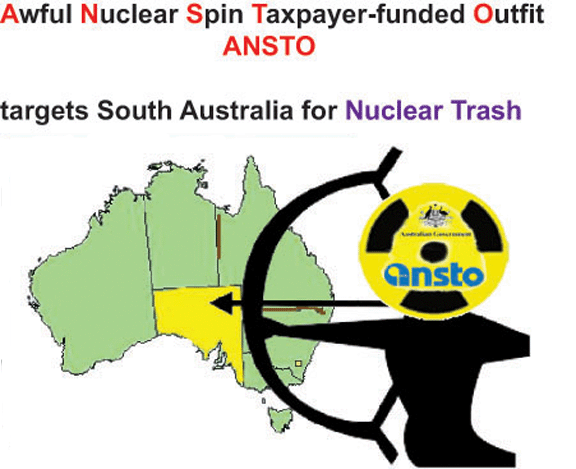
To: The Secretary, Senate Standing Economics Legislation Committee of Inquiry National Radioactive Waste Management Amendment Bill 2020 economics.sen@aph.gov.au
RE: David Noonan Supplementary Public Submission No.6.1
Call for public release of ANSTO Nuclear Waste Reports & ARPANSA’s Response; the Department fails test of transparency; and Concern over EPBC Act amendments to affect NRWMF assessment
Dear Secretary
Please consider matters raised in this Supplementary Submission, following my Public Submission No.6. in February 2020.
- Important ANSTO ILW nuclear waste reports due to ARPANSA by 30 June must be made public ASAP – along with the ARPANSA response, to provide for proper public scrutiny in this Inquiry.
- The Department has failed the test of transparency in its treatment of public submissions.
Note: Attachment of the Department’s redacted copy of my submission, to show the extent of redactions made, in blacking out over 50 public source quotations, without a proper basis to do so.
- Concern over proposed rushed changes to the EPBC Act to affect assessment & approvals of the NRWMF.
First: There are public interest concerns the scope of EPBC Act “whole of environment” nuclear action assessments will be replaced by new National Standards based on ARPANSA Codes, with limited “graded” assessments and use of pro-nuclear industry standards of IAEA origin.
Second: It should be no surprise that a Bill to amend the EPBC Act transfers EPBC Act assessment and approval of the NRWMF over to ARPANS Act Licensing.
Recommendation of this Supplementary Submission on assessment and approval of the NRWMF:
This Inquiry should investigate and report on the potential impact of pending changes to the EPBC Act on assessment & approval of the NRWMF, as flagged for introduction in a Bill in late August.
The Committee should call for EPBC Act “whole of environment” assessment of the NRWMF to be retained. The Committee should oppose potential transfer of EPBC Act environmental assessment of the NRWMF over to ARAPNS Act Licensing, Codes and Guides and limited “graded” assessment.
In Conclusion: The Committee must at a minimum reject the Bill’s proposal to legislate for specified siting of the NRWMF, and therefore of unnecessary less safe and more insecure imposition of above ground indefinite storage of ILW, at Napandee near Kimba on Eyre Peninsula in South Australia.
Rights to Judicial Review and Procedural Fairness must be retained for public interest reasons.
Please feel free to contact regarding any aspect of this public submission, by Mobile, Text or E-Mail.
Yours sincerely
Mr David J Noonan B.Sc., M.Env.St.
Independent Environment Campaigner and Consultant (ABN Sole Trader)
Napandee nuclear waste dump – potential impact on the neighbouring Pinkawillinie Conservation Park and Gawler Ranges National Park
Kazzi Jai No Nuclear Waste Dump Anywhere in South Australia 5 Aug 20 Not sure if this is relevant or not…but someone (not me, but wish I did) actually accessed FOI regarding the IMPACT or POSSIBLE IMPACT on the neighbouring Pinkawillinie Conservation Park and Gawler Ranges National Park with respect to the proposed Napandee site….and here is the DIIS reply…
Remember that these two parks, although neighbouring in the absolute sense of the definition, were not allowed to put in submissions against the nuclear dump being situated as a neighbour as they are State Owned, and it was decided by DIIS that they could not make a submission.
https://www.environment.sa.gov.au/…/200220-disclosure…
Actually…thinking along those lines…as they are State Owned…shouldn’t the PEOPLE OF SOUTH AUSTRALIA then have a justified say in this dump as VALID DIRECT NEIGHBOURS using the DIIS paradigm? Because these Conservation and National Parks BELONG to the PEOPLE of South Australia!
Oh…that’s right….”Ever Shifting Goalposts”!
https://www.environment.sa.gov.au/…/200220-disclosure… more https://www.facebook.com/groups/1314655315214929/
Labor’s carbon price proves effective climate policy is possible, Julia Gillard says
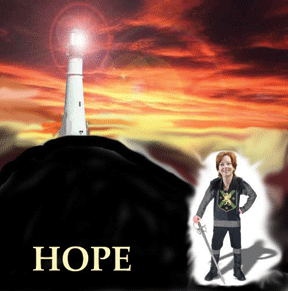 Labor’s carbon price proves effective climate policy is possible, Julia Gillard says, https://www.sbs.com.au/news/labor-s-carbon-price-proves-effective-climate-policy-is-possible-julia-gillard-says The former prime minister says Australia would be in a different place on climate if the carbon tax had continued.
Former prime minister Julia Gillard doesn’t want climate policy put in the too-hard basket, saying Australia can have a scheme that reduces emissions.
It has been almost 10 years since Ms Gillard’s federal election win, with her minority Labor government introducing a short-lived carbon price scheme that saw emissions drop.
Emissions rose again after the Abbott government repealed the policy.
Ms Gillard says Australia would be in a different place on climate if the scheme had continued.
“One of the frustrations of sliding door moments is, other than in the famous movie, you don’t actually get to go back in time and run the parallel universe,” she told a webinar hosted by the Australia Institute think-tank on Wednesday.
Australia is one of the last developed countries actively considering new coal-fired power stations
“What I hope is remembered from that period and taken forward into the future … is that it’s possible to put in place a scheme in Australia that does reduce our carbon emissions.
“The perceived history is ‘oh we’ve been fighting forever, nothing gets done, it’s all too hard’. I would like us to unpack to the next level: it can get done, it was done.
“We can be informed by past experience and we can get on with the job. So I do want to push back against that sort of received helplessness that it’s all too hard.”
To coincide with the online discussion the Australia Institute released a report mapping where the nation’s emissions would be if the carbon price had remained. “What I hope is remembered from that period and taken forward into the future … is that it’s possible to put in place a scheme in Australia that does reduce our carbon emissions. The think-tank says given the policy reduced emissions by two per cent, levels would be 25 million tonnes lower this year than they are.
1 This month.
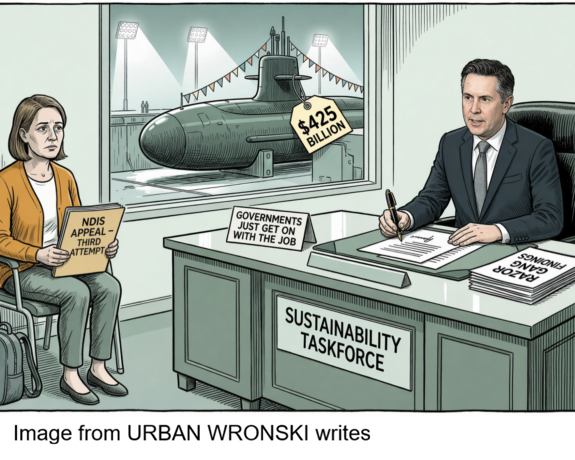

PETITION – To: Prime Minister Anthony Albanese and the Australian Labor Government
Chernobyl: The Lost Tapes – A good documentary on Chernobyl on SBS available On Demand for the next 3 weeks– https://www.sbs.com.au/ondemand/tv-program/chernobyl-the-lost-tapes/235274195556
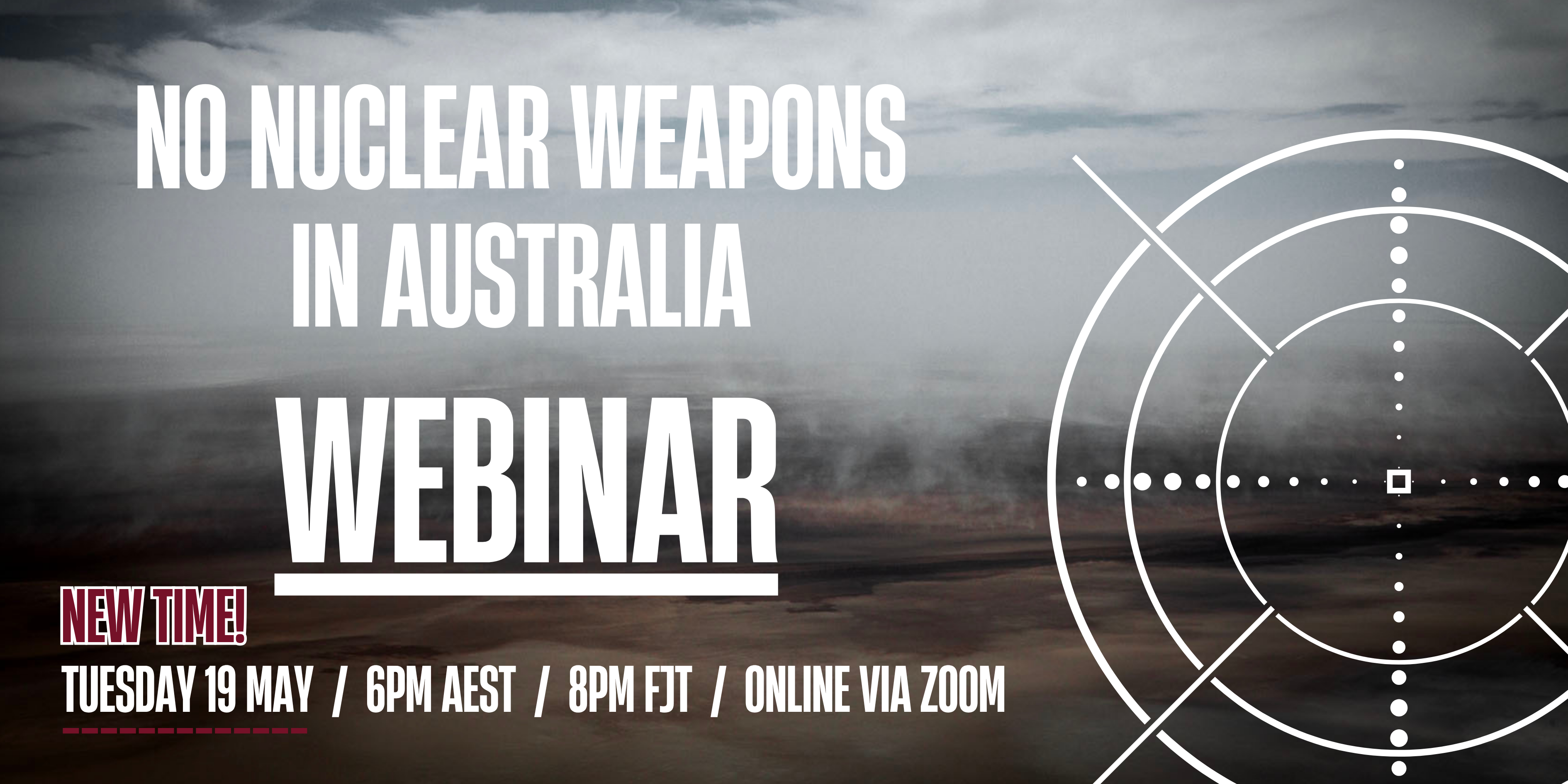
19 May – Webinar- Webinar: No Nuclear Weapons in Australia
Start: 2026-05-19 18:00:00 UTC Canberra, Melbourne, Sydney (GMT+10:00)
End: 2026-05-19 19:30:00 UTC Canberra, Melbourne, Sydney (GMT+10:00)
20 May – Webinar – The dangerous world of AUKUS, US, military occupation and suppression of dissent

National Webinar, 20th May, 2026, 6.30pm AEST. Confronting laws restricting/suppressing protest speech and action
Speakers: Former Sen. Rex Patrick, Lawyer Nick Hanna ,Arthur Rorris ,Jorgen Doyle, Sen David Shoebbridge,
Facilitator Kelley Tranter.

of the week – Australians for War Powers Reform (AWPR)
To see nuclear-related stories in greater depth and intensity
 Antinuclear