Safety concerns about the rush to put nuclear reactors on the moon
 America Wants to Put a Nuclear Power Plant on the Moon
What happens to all that highly enriched uranium in space? Popular Mechanics, BY CAROLINE DELBERT, JUL 30, 2020
- The U.S. Department of Energy (DoE) is looking for technology partners to help power the moon.
- This could begin a project that later includes powering a Mars surface mission.
- The Union for Concerned Scientists doesn’t want highly enriched uranium in space.
Scientists at the U.S. Department of Energy’s (DoE) Idaho National Laboratory have a new design for a nuclear power plant they say could allow humans to more easily live on the moon. As part of a form plan, the scientists say they want to have the fission reactor, safe launch, and landing system ready by 2027
What are the challenges of generating nuclear energy on the moon?
Design Development Today reports that the Union of Concerned Scientists expressed, well, concerns:
“Edwin Lyman, director of Nuclear Power Safety at the Union of Concerned Scientists, a nonprofit, said his organization is concerned the parameters of the design and timeline make the most likely reactors those that use highly enriched uranium, which can be made into weapons. Nations have generally been attempting to reduce the amount of enriched uranium being produced for that reason.”
While the Idaho National Laboratory and the DoE broadly are pushing for “advanced” reactor technology in terms of issues like modularity and safety, the “parameters of the design and timeline” they refer to—in this case advocating for a small, reliable, space-friendly design in just 6 years—almost definitely rules out the modular reactors being developed and certified now.
To fully test and regulate these reactors—and design the special edition to send to the moon in this timeframe—is probably impossible. To rush any nuclear approval is a terrible idea, not just for safety, but also for a public that’s already shy about nuclear energy.Technology like thorium fuel is still far from ready for the market….
Drones could be a real danger to nuclear facilities

What Happens When A Drone Comes For A Nuclear Reactor? Forbes, Kelsey D. Atherton, 31 Juky 20.
How seriously, exactly, should a nuclear reactor take the threat from a quadcopter?
This question sits at the center of a long investigation by The War Zone, built upon a trove of documents about a curious pair of incidents in September 2019. As the authors report:How seriously, exactly, should a nuclear reactor take the threat from a quadcopter?
This question sits at the center of a long investigation by The War Zone, built upon a trove of documents about a curious pair of incidents in September 2019. As the authors report:
The observed drone flights on September 29th were followed by multiple reported sightings on the night of September 30th. The full tale, about what action was taken, and what risks were prioritized, is worth reading in full, as it gives a deep sense of prioritization and uncertainty in the face of novel concern.
No more Hiroshima! No more Nagasaki! — limitless life
July 2020 We Hibakusha [A-bomb survivors] call the atomic bombs ‘weapons of the devil.’ We cannot allow even a single bomb to exist on this planet…. The pain of the victims of that day must not be forgotten. […]
No more Hiroshima! No more Nagasaki! — limitless life
Victoria delays setting interim emissions targets, again, as Covid digs in — RenewEconomy

Victoria Labor delays for a second time its decision on interim emissions reduction targets for the state, citing focus on curbing the spread of Coronavirus. The post Victoria delays setting interim emissions targets, again, as Covid digs in appeared first on RenewEconomy.
Victoria delays setting interim emissions targets, again, as Covid digs in — RenewEconomy
Australia’s two renewable export mega-projects say there is room for both, and more — RenewEconomy

Australia’s two largest renewable energy export projects, planning 25GW of wind and solar between them, see the growing Asian market as more than big enough for both. The post Australia’s two renewable export mega-projects say there is room for both, and more appeared first on RenewEconomy.
Australia’s two renewable export mega-projects say there is room for both, and more — RenewEconomy
Market operator’s 20-year transition plan remains an orphan without Taylor’s backing — RenewEconomy

AEMO’s Integrated System Plan is a fine piece of work, but may lack bite in the absence of support from Angus Taylor, and with Australia’s backward regulatory regime. The post Market operator’s 20-year transition plan remains an orphan without Taylor’s backing appeared first on RenewEconomy.
Market operator’s 20-year transition plan remains an orphan without Taylor’s backing — RenewEconomy
Covid and rooftop solar take another big bite out of Origin’s electricity business — RenewEconomy

Covid and rooftop solar take another big bite out of Origin Energy’s electricity business, as its main coal generator pushed close to minimum operational limit. The post Covid and rooftop solar take another big bite out of Origin’s electricity business appeared first on RenewEconomy.
Covid and rooftop solar take another big bite out of Origin’s electricity business — RenewEconomy
Biden presidency could put Australia back in ‘naughty corner’ over lack of climate action — RenewEconomy

A Biden presidency could herald a new era for climate action, while placing immense pressure on the Morrison government to actually to something on climate change. The post Biden presidency could put Australia back in ‘naughty corner’ over lack of climate action appeared first on RenewEconomy.
Biden presidency could put Australia back in ‘naughty corner’ over lack of climate action — RenewEconomy
July 31 Energy News — geoharvey

Science and Technology: ¶ “Flooding From Sea Level Rise Could Cost Our Planet $14.2 Trillion, Study Says” • If the world does nothing to mitigate rising sea levels, it could cost the global economy $14.2 trillion in lost or damaged assets by the end of the century, as larger areas of land, home to millions […]
July 31 Energy News — geoharvey
Nuclear waste for Napandee: transport, double handling, safety? Should South Australians get a vote on this?
 Jobs, safety and transport in the spotlight in Senate committee probe of Kimba waste plan, Michelle Etheridge, Regional Reporter, The Advertiser, July 28, 2020
Concerns about maritime workers facing safety risks and the Kimba community losing jobs promised for the local area have been raised before a Senate committee probing plans for a radioactive waste site.
Under the Federal Government’s project, low-level radioactive waste would be stored permanently at farming property Napandee, near Kimba, with intermediate-level waste stored there for several decades.
No long-term plan for intermediate-level waste has been set out – an issue raised by speakers during Tuesday’s committee meeting, which is looking into legislation the government says paves the way for the storage site.
Maritime Union of Australia (SA branch) secretary Jamie Newlyn said the Government should eliminate double-handling of the waste, also citing concerns for Whyalla-based members.
“Whyalla port has been considered … to take nuclear processing waste,” Mr Newlyn said.
“What they’re handling is 130-tonne casks of intermediate-level waste. That presents a massive risk.” A 2018 Federal Government technical report on Napandee said there was potential to ship waste from Port Kembla, NSW, to “port locations such as Whyalla, Port Pirie and Port Lincoln”.
Senator Rex Patrick also questioned whether the 45 long-term jobs promised to Kimba would stay there, now a Australian Radioactive Waste Agency has been announced for Adelaide.
A Kimba Council vote last year found 62 per cent of respondents supported the plan. Traditional landowners voted against it in a separate ballot.
Napandee owner Jeff Baldock said it was “time to accept the decision by the people of Kimba and move forward”.
“(The project) … has the potential to provide a lifeline to our community for decades to come,” Mr Baldock said.
Agriculture would benefit from the plan, he said, through a planned research and development centre.
Mr Baldock said it would also provide a much-needed new industry for the region.
This followed automation in farming and withdrawal of government agencies, which had led to a declining local population.
Wesley Schmidt, of Kimba-based Agsave Merchandise, said opposition to the project was coming from a “vocal minority”.
“We’re currently facing the third year running of drought conditions in Kimba. It’s more important than ever to establish another industry in our district,” he said.
Former Grey MP Barry Wakelin, based in the town, said the area had much to lose from picking up “something that nobody else in Australia wants”.
“Many people have said, why can’t we have an SA vote, at least, about this,” he said.
The Australian Conservation Foundation’s Dave Sweeney said: “In the absence of a clear, long-term approach for intermediate level waste, the best place to store this is at ANSTO (Australia’s Nuclear Science and Technology Organisation, in NSW).”
The Senate committee will report back by August 31.
A spokesman for the Australian Radioactive Waste Agency said the Government would consult on transport options with communities near potential routes and transport operators.
“The newly created Australian Radioactive Waste Agency will lead the separate process to site a facility to permanently dispose of Australia’s intermediate level waste,” he said.
He said the 45 jobs included security, administration, environmental monitoring and health and safety roles.
“The facility will need these onsite roles to ensure that the facility is managed safely and securely.” michelle.etheridge@news.com.au
Nuclear waste dump site selection process has made the Barngarla people “aliens in their own country”
 Barngarla continue fight against plan to dump nuclear waste on Country, https://www.sbs.com.au/nitv/article/2020/07/29/barngarla-continue-fight-against-plan-dump-nuclear-waste-country Barngarla mob say they were not properly consulted by federal government for plans to store radioactive waste on Country at Kimba in SA, and that their concerns continue to be ignored. By Royce Kurmelovs, NITV News 29 July 20
The 50-year-old Barngarla woman is talking about the enduring connection she has to Kimba when she tells how on the day she was born, her parents had been waiting for an ambulance that never came.
Forced to make their own way to the hospital, she says her mum made it as far as the tree outside before giving birth.
“So I’m born on Country,” she says.
Though she may not live there today, Jeanne says a part of her has never left. It is a detail that underscores the significance of the moment she learned Kimba was being considered as a dump for radioactive waste.
“I used to be a carer for my mum. When I first heard [about the facility], I told her. She goes: ‘no, no, no’ and got angry,” Jeanne says. “She said; ‘we don’t want it there’. She said to me: ‘you got to fight for this. You got to fight for it, we can’t have that place there. It’s a special place for us.’”
Most among the Barngarla have a similar story about the shock and confusion at learning their traditional Country was under consideration as part of a proposal to build a nuclear waste storage facility that would take in samples from 100 sites across the continent.
No one, they say, from the federal government contacted them beforehand to talk about the proposal, leaving most to find out through the news media or word of mouth.
Instead it was up to the Barngarla themselves, through the the Barngarla Determination Aboriginal Corporation (BDAC) to take the initiative and write to the government in April 2017 to find out what was going on.
‘Wasn’t interested in our views’
That first letter would plunge them into a fight that has so far lasted three years, until it entered a new phase in February when former Industry Minister Matt Canavan announced – a day before he resigned – that he had selected a site just outside of Kimba to situate the nuclear waste facility.
The location he chose was called Napandee, a slice of farmland about 25 kilometres west of Kimba. The precise area had been carved out of a 7500-hectare cereal and sheep property owned by the Baldock family and when built the facility promised to create 45 jobs and bring in $31 million to the community.
Over the course of its operating lifetime, the site would house low-to-intermediate level nuclear waste made up of medical waste drawn from 100 sites across the country. This material would include medical waste, but also the more serious TN81 canisters – casks of material once exposed to high levels of radiation that require containment for several hundred years.
If supporters of the proposal celebrated the financial windfall it would bring, critics worried the decision represented the thin end of a wedge that would eventually see the site expand to house higher-level toxic waste.
For the Barngarla people, however, the proposal represented something more significant: yet another decision where they have been overlooked, ignored and overruled in a process they describe as “divide and rule”.
“It’s like the government’s not listening to us,” Jeanne says. “It’s like if the government picks a place where they want to put rubbish like that, they’ll just go and do it and they don’t care what the people think. And that’s wrong. They should be listening to what the people want too.”
“I know there were people in Kimba that wanted it. We definitely know. We got the looks. We didn’t care. I didn’t care. This is something I believe in strongly and that’s why we don’t want it there, because of my strong beliefs and my family’s beliefs.”
After their early efforts to find out more, the Barngarla say they were stonewalled from the very beginning by both the Department of Industry, Science, Energy and Resources, and the Australian Radioactive Waste Agency (ARWA). That stance would become a pattern.
At first it began with the department initially dismissing the possibility that Aboriginal heritage sites may exist in the area and ignoring requests from the Barngarla for a meeting.
It took a year – until February 2020 – before the department offered to meet with the Barngarla people, though by the time the first and only meeting took place the government was already forging ahead to measure community support through a voting process.
In organising the vote, the local council limited those who could participate to ratepayers within the township, and provided a ballot with a single question: “Do you support the proposed National Radioactive Waste Management Facility being located at one of the nominated sites in the community of Kimba?”
Outraged by what they say was a clear act of voter suppression – a strategy common in the US where procedural tactics are used to discourage or prevent people from voting – the Barngarla took their fight to the courts.
They argued that the vote breached the Racial Discrimination Act by excluding the Traditional Owners who were openly opposed to the proposal. The matter would go all the way to the Federal Court, where it was ultimately dismissed on appeal.
Though the court found the local council had not excluded the Barngarla people on the basis of their ethnic identity, BDAC Chairperson Jason Bilney says the court did acknowledge the council had discretion about who to include in the vote, and they had deliberately chosen to exclude native title holders.
They basically created hurdles,” Bilney says. “The catchphrase was ‘rateable property’ – that’s white man’s terms ‘rateable property’. We’re the native title holders. That holds more weight than ‘rateable property’, so we should have been included.”
Around the time the Barngarla filed their lawsuit to challenge the vote, the first meeting with the department took place in August 2018 – a moment Bilney recalls with frustration.
He says Mr Canavan spoke for fifteen minutes before he left, taking all the government representatives with him.
“That’s it,” Bilney says. “He wasn’t interested in our views, he just wanted us to hear what he had to say.”
When the poll of Kimba residents was counted, it returned a result that saw 61.6 per cent of 824 participants vote in favour of the proposal.
BDAC responded by organising is own poll, asking its 209 members the same question that was asked of the broader Kimba residents.
The result would be a unanimous “No” from the 83 participants – a turnout figure explained by cultural and logistical factors that make it difficult to gather in any one place.
The Barngarla delivered the result to the department in November last year on the understanding Mr Canavan had promised to consider them together.
“Canavan said he would put the two together. He never did because if you put the two together there was clearly no broad community support,” says Bilney.
In its submissions to the senate, the department denies it agreed to incorporate the two votes, but says it only agreed to “consider” their outcomes.
Aliens in our own country’
What happens now is up to the Senate economics reference committee and a clutch of Labor, Greens and independent senators.
The Barngarla say the recent approach of the federal government – to legislate the precise location of the site – represents a new twist as it departs from the process established by the Gillard government under the National Radioactive Waste Management Act 2012.
Worse still, the Barngarla say the provisions of the bill will stymie their rights to seek a judicial review of the minister’s decision in the courts. The Parliamentary joint committee on human rights also raised concerns about the bill in April this year that it says may extinguish Native Title.
“In relation to any cultural and spiritual significance attaching to the land itself, it remains unclear how this would be protected once a radioactive waste facility is operational on the site. Further, it is unclear how Indigenous people will be able to access sites of cultural significance, should they be determined to exist,” the report said.
When NITV News contacted the Australia Radioactive Waste Agency for comment about the process to date, a spokesperson said in a statement the government is seeking to consult with the BDAC going forward.
“Napandee is privately owned, has no Native Title and has been used for agricultural purposes for 80 years. Preliminary assessments have identified no registered cultural heritage at the site,” the spokesperson said.
“Further ground cultural heritage surveys with Traditional Owner consultation are planned, to determine cultural heritage values at the site.
“That said, we have approached the Barngarla through BDAC numerous times during the past years to work together to identify heritage, without resolution.”
In addition, the federal government is seeking to establish a Barngarla economic plan backed by $3 million in government funding, employment opportunities at the site and a cultural heritage management plan.
The Barngarla view this as a bribe when for them it isn’t a matter of money, but one of self-determination concerning what happens on their Country, set against a much deeper history.
So far it has taken two decades for the Barngarla to have their Native Title claim to a 45,000 square kilometre stretch of the Eyre Peninsula recognised by the courts – a process during which they were once informed that they did not exist as a people.
Neither have they forgotten the horror at Maralinga when the British army tested nuclear weapons after falsely declaring there were no Aboriginal people in the area.
To the Barngarla, the government has only decided to talk after the big decisions have been made.
“We’re still flora and fauna to these people,” Bilney says. “They should have included us from the start. We heard about it on the news. We weren’t included in the vote.
“You know, the Barngarla [native title] claim was basically an unwinnable case, they said. It’s taken us 21 years. Twenty-one years to win Native Title under white man’s law. And yet we’re still classed as second-class citizens? Flora and fauna.
“We’re basically aliens in our own Country.”
Examining propaganda for NuScam’s small nuclear reactor
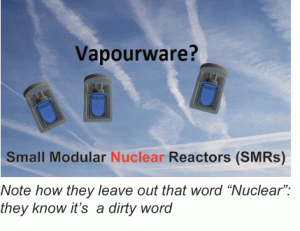 Derek Abbott shared a link. Nuclear Fuel Cycle Watch Australia, 30 July 20
New Mexico Governor opposes nuclear waste dump in that state
 Gov. argues against Holtec nuclear storage site, Albuquerque Journal , BY THERESA DAVIS / JOURNAL STAFF WRITER Gov. argues against Holtec nuclear storage site, Albuquerque Journal , BY THERESA DAVIS / JOURNAL STAFF WRITER
Tuesday, July 28th, 2020 Gov. Michelle Lujan Grisham sent a letter to President Donald Trump on Tuesday, arguing against a proposed nuclear waste interim storage facility in southeast New Mexico.
The proposed Holtec International site would store 500 stainless steel canisters of the nation’s spent nuclear fuel on 1,000 acres between Carlsbad and Hobbs, with a full storage capacity of 10,000 canisters. “New Mexico has grave concerns for the unnecessary risk to our citizens and our communities, our first responders, our environment, and to New Mexico’s agriculture and natural resource industries,” Lujan Grisham wrote in the letter…… The governor said it would be “economic malpractice” to store spent nuclear fuel underground in a region that depends on agriculture and oil and gas. She added that a “perceived or actual nuclear incident” could disrupt those industries. “The proposed (facility) would join the ranks of uranium mining, nuclear energy and defense-related programs that have long created risks to public health and the environment in the state of New Mexico that are disproportionately greater than such risks to the general population of the United States,” she wrote…… https://www.abqjournal.com/1480362/gov-argues-against-holtec-nuclear-storage-site.html
|
AEMO’s recipe for a cheap, clean and reliable energy future — RenewEconomy

The ISP’s doesn’t target lowest emissions. It targets a lowest-cost replacement of ageing fossil fuel power stations, with a minimum standard for reliability. It finds that the cheapest, most reliable way forward is clean. The post AEMO’s recipe for a cheap, clean and reliable energy future appeared first on RenewEconomy.
AEMO’s recipe for a cheap, clean and reliable energy future — RenewEconomy
AEMO says batteries will be cheaper and cleaner than new gas plants — RenewEconomy

The Integrated System Plan confirms that the gas lobby claims of gas as a transition fuel is tenuous – on both economic and environmental grounds, and because there are smarter alternatives. The post AEMO says batteries will be cheaper and cleaner than new gas plants appeared first on RenewEconomy.
AEMO says batteries will be cheaper and cleaner than new gas plants — RenewEconomy
1 This month.

PETITION – To: Prime Minister Anthony Albanese and the Australian Labor Government
Chernobyl: The Lost Tapes – A good documentary on Chernobyl on SBS available On Demand for the next 3 weeks– https://www.sbs.com.au/ondemand/tv-program/chernobyl-the-lost-tapes/235274195556

19 May – Webinar- Webinar: No Nuclear Weapons in Australia
Start: 2026-05-19 18:00:00 UTC Canberra, Melbourne, Sydney (GMT+10:00)
End: 2026-05-19 19:30:00 UTC Canberra, Melbourne, Sydney (GMT+10:00)
20 May – Webinar – The dangerous world of AUKUS, US, military occupation and suppression of dissent

National Webinar, 20th May, 2026, 6.30pm AEST. Confronting laws restricting/suppressing protest speech and action
Speakers: Former Sen. Rex Patrick, Lawyer Nick Hanna ,Arthur Rorris ,Jorgen Doyle, Sen David Shoebbridge,
Facilitator Kelley Tranter.

of the week – Australians for War Powers Reform (AWPR)
To see nuclear-related stories in greater depth and intensity
 Antinuclear