Spinbusting the extraordinarily inept nuclear waste media release from 3 Australian MPs.
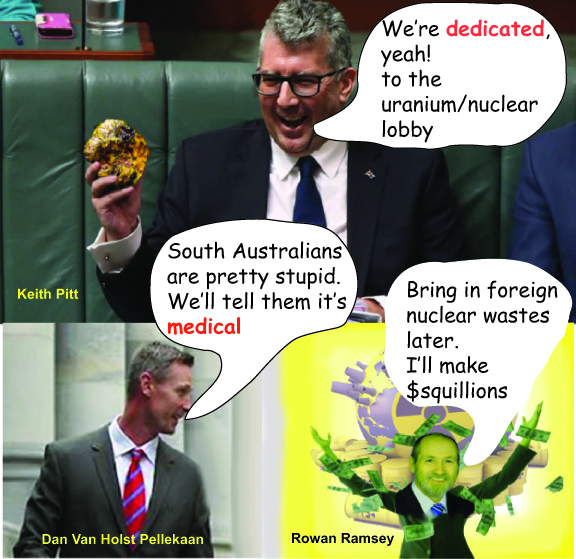
27 July 20, On 20th July, MPs Keith Pitt, Rowan Ramsey and Dan van Holst Pellekaan issued a joint media release, which announced the establishment of a new agency in Adelaide to manage Australia’s nuclear waste. The agency was to start that same day (even though they would be advertising for staff and a CEO) . It was obviously written in a hurry, and raised amazement among those who follow the ongoing drama of the Australian government’s attempt to impose a nuclear waste dump on a rural region. Amazement at the questions that remain unanswered.
Peter Remta critiques the statement, and raises some of those embarrassing questions:
The joint media release is inconsistent within itself and with other previous reports and is surely an embarrassment to the two ministers while confirming the long-held partiality of the local member , Rowan Ramsey.
It is badly composed with meaningless statements and lacks any precise reasons and explanations for what should be the creation of a major and nationally important organisation
The establishment by other countries of entities with similar objectives (even though it is hard to ascertain what they are in the case of this new Australian agency) has invariably involved lengthy and detailed planning including the views and suggestions of various members of the community together with commercial interests and other government agencies.
A most pertinent example is the Reset Initiative of the United States of America as to the management of its nuclear waste which was undertaken by the well known Stanford and George Washington Universities which are regarded as world leaders in that field.
The recommendations under the Initiative should have been followed in Australia as they are imperative for the proper and safe management of nuclear waste and it is surprising that none of the submissions or evidence by ANSTO and ARPANSA and also by the Department of Industry Science Energy and Resources made any mentioned of this well-known and internationally recognised study.
It is hoped that ANSTO will not be relying on this rather meaningless and inconsistent release as part of its submission requirements for ARPANSA which in turn should immediately as the regulatory and licensing authority require a full explanation of the reasons behind the release.
ARPANSA must not on this occasion hide behind its licensing independence in refraining from strong comment as the release could be viewed to be an attempt to usurp its status and functions which are recognised internationally,
Announcing this agency before the government has final parliamentary approval smacks of arrogantly taking both
the Senate and ARPANSA for granted
It also shows a cavalier attitude to proper governing to be committing taxpayers’ money before all approvals are in
place.
Even with the vagueness of the release the government should be seriously considering and examining the Azark
Project facility at Leonora which besides being considered as one of the best in the world would overcome or avoid
many of the problems inherent with the Napandee proposal It would also be a major financial saving for the government
Why has there not been any previous mention of this new agency?
How will it manage Australia’s radioactive waste?
How will it bring together this responsibility and expertise since it seems currently to be lacking the expertise and from past experience the responsibility?
“The Australian Radioactive Waste Agency (ARWA) will be based in Adelaide and be responsible for all functions of the
National Radioactive Waste Management Facility (the Facility), including engagement with the Kimba community.”
Why will it be located in Adelaide which has no history of competence or knowledge in this area despite the Scarce
Royal Commission and uranium mining in South Australia ?
How will it engage with the Kimba community and in what respect since it seems that the battle lines are well and truly
drawn in a seriously divided community.
Will it be replacing ANSTO as the operator of the facility at Napandee?
How will the new agency develop Australia’s radioactive waste management solutions and capabilities as neither the
government nor ANSTO has any realistic knowledge in this area?
Is not this another instance of rushed planning without a proper understanding and consideration of the factors
including the regulatory regime?
Will it not be an unnecessary duplication of the existing functions of ANSTO?
Is the agency going to assume or usurp some of the functions of ARPANSA in the regulatory context?
How will the agency’s location in Adelaide enhance the operations at Napandee as it was understood that this had
already been established through prior planning?
Parts of Victoria’s Bellarine Peninsula, Melbourne suburbs, at risk from sea level rise
important for local communities to know whether they were at risk so they could decide whether to invest in adaptation strategies, such as infrastructure, to protect the coastline, or simply retreat from the danger zone.
 How coastal communities on Victoria’s Bellarine Peninsula are dealing with the reality of sea level rises, ABC, By Nicole Mills, 26 Jul 20, As Vicki Perrett plays with her granddaughter Rachel on the beach in front of her home on Victoria’s Bellarine Peninsula, she knows she has to cherish these moments.Key points: How coastal communities on Victoria’s Bellarine Peninsula are dealing with the reality of sea level rises, ABC, By Nicole Mills, 26 Jul 20, As Vicki Perrett plays with her granddaughter Rachel on the beach in front of her home on Victoria’s Bellarine Peninsula, she knows she has to cherish these moments.Key points:
And not just because children grow up so fast. She also knows the beach they play on may not be there forever. “The beach is coming closer towards us, towards the road and towards our property,” Ms Perrett says. “It’s very prone to sea level rise here and to storm surges.” This stretch of coastline at Indented Head has already been earmarked as at risk of going underwater by 2100. Ms Perrett’s house is also in the danger zone………… Councils ordered to plan for sea level risesThe Victorian Government has instructed all councils to plan for a 0.8m sea level rise by the year 2100. That figure is based on a 2007 report from the United Nations Intergovernmental Panel on Climate Change, which agreed on the projected rise, but could not rule out larger increases. Although the worst impacts of sea level rises may still be decades away, this bayside community, about an hour-and-a-half south of Melbourne, has already had a taste of what is to come………. Dr McInnes leads the CSIRO’s climate extremes and projections group, which has contributed to the mapping of high-risk areas. Publicly available mapping tools, such as Coastal Risk Australia, allow anyone to find out how their local area would fare under different sea-level rise scenarios. Dr McInnes said it was important for local communities to know whether they were at risk so they could decide whether to invest in adaptation strategies, such as infrastructure, to protect the coastline, or simply retreat from the danger zone. “Land subject to inundation is land that is low-lying, that is potentially at risk from inundation during extreme sea-level events or even potentially high-tide events in the future,” Dr McInnes said. Dr McInnes says while the worst impacts will be felt during storm surges, there might be some areas that will suffer more permanent flooding. “If [the land] is low enough, it could be permanently inundated,” she said. “Parts of Swan Bay [on the Bellarine Peninsula] could potentially become quite affected by inundation, certainly high-tide inundation, in the future.” And it’s not just regional areas. Dr McInnes says Melbourne suburbs such as Elwood, Aspendale and Mordialloc are also at risk of more-regular flooding in future……….. https://www.abc.net.au/news/2020-07-26/climate-change-sea-level-rises-prompt-action-in-coastal-towns/12383968
|
|
NT $1.1b rare earths mine could help break China stranglehold
NT $1.1b rare earths mine could help break China stranglehold
The $1.1 billion Nolans mine planned for the Territory near Alice Springs could help break a China stranglehold by producing 10 per cent of the world’s rare earths Neodymium and Praseodymium (NdPr). … (Subscribers only)
When it comes to pandemics, prevention will be a lot cheaper than cure
 Cost of preventing next pandemic ‘equal to just 2% of Covid-19 economic damage’ https://www.theguardian.com/world/2020/jul/23/preventing-next-pandemic-fraction-cost-covid-19-economic-fallout World must act now to protect wildlife in order to stop future virus crises, say scientists, Damian Carrington Environment editor @dpcarrington, Fri 24 Jul 2020 The cost of preventing further pandemics over the next decade by protecting wildlife and forests would equate to just 2% of the estimated financial damage caused by Covid-19, according to a new analysis.Two new viruses a year had spilled from their wildlife hosts into humans over the last century, the researchers said, with the growing destruction of nature meaning the risk today is higher than ever.
It was vital to crack down on the international wildlife trade and the razing of forests, they said. Both bring wildlife into contact with people and their livestock. But such efforts are currently severely underfunded, according to the experts.
Spending of about $260bn (£200bn) over 10 years would substantially reduce the risks of another pandemic on the scale of the coronavirus outbreak, the researchers estimate, which is just 2% of the estimated $11.5tn costs of Covid-19 to the world economy. Furthermore, the spending on wildlife and forest protection would be almost cancelled out by another benefit of the action: cutting the carbon dioxide emissions driving the climate crisis.
“It’s naive to think of the Covid-19 pandemic as a once in a century event,” said Prof Andrew Dobson at Princeton University in the US, who led the analysis. “As with anything we’re doing to the environment, they’re coming faster and faster, just like climate change.”
Prof Stuart Pimm at Duke University in the US, part of the research team, said: “Investment in prevention may well be the best insurance policy for human health and the global economy in the future. We could stop future pandemics before they start.”
The UN’s environment chief welcomed the analysis. “The science could not be clearer,” said Inger Andersen. “As we emerge on the recovery side of Covid-19, we cannot afford a piecemeal approach to tackling diseases [from wildlife]. Irrespective of the final bill [for coronavirus], we can say with certainty that action now will save us billions in future costs, and avoid the tremendous suffering that we continue to see around the world.”
The analysis is the latest plea from experts for governments to address the destruction of the natural world and help prevent future pandemics. This month, a UN report said the world was treating the health and economic symptoms of the coronavirus pandemic but not the environmental cause. In June, experts said the pandemic was an “SOS signal for the human enterprise”; while in April, the world’s leading biodiversity experts said more deadly disease outbreaks were likely unless nature was protected.
The analysis, published in the journal Science, was carried out by experts in environment, medicine, economics and conservation. In particular it noted that wildlife enforcement networks are acutely underfunded. The network in south-east Asia has an annual budget of $30,000, while the global wildlife trade body Cites gets $6m a year.
“The wildlife trade is deeply corrupt,” said Dobson. “Some politicians would much rather that it not be stopped in many countries.
The researchers said indigenous peoples who rely on wildlife for food must be protected from any restrictions.
Ending the wild meat trade in China was key, the researchers said, and would require almost $20bn a year. “I was shocked at the number of people employed: it’s several million,” said Dobson. He said there were also very few wildlife veterinarians in China: “The troops in the frontline trenches are missing.”
Akanksha Khatri, head of the World Economic Forum’s nature action agenda, said: “Covid-19 has shown us that human beings and our economic activity depend on the planet’s ecological balance. If we continue to push against this delicate balance, we do so at our peril.”
Stéphane De La Rocque, a veterinary expert at the World Health Orgazisation, said the analysis was much needed and that, after Covid-19, leaders were starting to understand the issue: ““It is the first time that we really have had a discussion about wildlife [and disease] and realised we have no surveillance system for wildlife.”
710 million metric tons of plastic will enter the environment in the next two decades

|
A Billion More Tons of Plastic Could Blanket Earth by 2040, Wired, 26 July 20, Even with immediate action, 710 million metric tons of plastic will enter the environment in the next two decades, scientists show. Welcome to Plastic Planet. IMAGINE YOUR FAVORITE stretch of coastline—whitesand beaches, rocky tide pools, the cliffs of Dover, what have you. Now transport yourself ahead two decades, after plastic production and waste have continued to skyrocket. Humanity is now unloading 29 million metric tons of bottles, bags, and microplastics (little bits smaller than 5 millimeters) into the oceans annually. That means for every meter of your favorite coastline, 50 kilograms—that’s 110 pounds—of plastic is entering the sea every year.“Now imagine that’s happening for every meter of coastline around the world,” says Richard Bailey, who studies environmental systems at Oxford University. “That’s the amount we’re looking at—it’s a colossal amount.”
Over the past few years, scientists have been exposing the hazards of microplastics—or ground-up particles that easily blow around the world and work their way into plants and animals. But all the while, macro-plastics like bottles have been accumulating in the environment, shedding microplastics as they degrade. Writing today in the journal Science, Bailey and his colleagues are publishing the alarming findings of their comprehensive review of the cycle of all this plastic. If we as a species don’t collectively take action, they warn, 1.3 billion metric tons of plastic will flow into the sea and tumble across the land between the years 2016 and 2040. Even with immediate and drastic action, that figure could be 710 million metric tons—460 million of them on land and 250 million in the water. Making matters worse, throughout much of the world people burn the plastic they can’t easily recycle, to the tune of perhaps 133 million metric tons of waste by 2040. That spews dangerous toxins and CO2 (plastic is made of oil, after all), further warming the planet. To model the plastic waste ecosystem, the researchers created eight “geographic archetypes,” instead of picking apart the dynamics of how individual countries handle trash. “We didn’t want it to become a blame game,” says the study’s co-lead author, Winnie Lau, senior manager of the Pew Charitable Trusts’ project on ocean plastic pollution. “What we wanted to do was to understand the problem and how it came about, rather than pointing out specific countries.”…………
Without drastic and immediate measures, the fight against plastic pollution will follow the same path as the fight against climate change: We’ve waited far too long to stop CO2 from accumulating in the atmosphere, and we’re in danger of waiting far too long to turn off the plastic spigot. “What this paper makes clear is, really, any future scenario for a healthy planet is going to require that this kind of year-over-year growth in plastic production has got to stop,” says Leonard. “It began in 1950, and it continues to accelerate. And there’s really no viable solution that doesn’t result in bending that curve.” https://www.wired.com/story/billion-more-tons-of-plastic-could-blanket-earth/ |
|
|
Space archaeology, space junk and weapons, and long-lasting radioactivity

While the nuclear macho men plan more nuclear, and nuclear weapons in space, it seems that it takes a woman, Alice Gorman, to investigate the radioactive pollution on Earth and in space, due to these activities
Nuclear sites still dangerous in 24,000 years, say space archaeologists
Some nuclear tests were conducted also in outer space and nuclear fuel was employed as propellant for rockets. https://www.jpost.com/health-science/nuclear-sites-still-dangerous-in-24000-years-space-archaeologists-say-636379 By ROSSELLA TERCATIN JULY 26, 2020
Gorman said the issue presents two challenging elements: What materials can survive such a long time, and what form of language can be used to deliver the actual message?
“As for the first difficulty, we know that stones and pottery last a very long time,” she said. “But the second point raises a big archaeological question related to symbolic communication. If we look at rock art from 20,000 years ago, we can see that there are pictures of animals, but we do not know what those pictures mean. Therefore, it is possible that our current symbols to mark radioactive sites, the yellow [and] black sign, will be interpreted as an invitation to explore the area, rather than to keep away from it.”
If the UN Outer Space Treaty of 1967 prohibited nuclear weapons in space, the issue of its weaponization remains very relevant.
“Recently, Russia tested an anti-satellite weapon, reawakening the debate,” Gorman told the Post.
She began to work in space archaeology following years of work focused on stone-tool analysis and the aboriginal use of bottle glass after European settlement.
Space archaeology deals with the same issues of regular archaeology, understanding material culture, human behavior and the interaction with the surrounding environment, Gorman said.
Gorman was drawn to space archaeology by the idea of exploring space junk, those many objects that cannot even be seen in the sky circling the Earth. Currently, she is working on the archaeology of the International Space Station.
The recent attempt by Israel to land a robotic unit on the moon with the Beresheet mission represents a very interesting development for space archaeologists, Gorman said.
“For many decades, the only material cultures present on the moon were the American and the Soviet one,” she said. “As new countries have started to reach the moon, this has changed, bringing more diversity to the field.”
W.A. to spend $66m on solar and batteries for schools, communities and social housing — RenewEconomy

Western Australia unveils plan to spend $66.3m on solar and battery storage for schools, isolated communities and social housing as part of a $5.5bn Covid recovery plan. The post W.A. to spend $66m on solar and batteries for schools, communities and social housing appeared first on RenewEconomy.
W.A. to spend $66m on solar and batteries for schools, communities and social housing — RenewEconomy
Offer of weak, voluntary CO2 standards means Australia will remain dumping ground for dirty cars — RenewEconomy

Car industry’s proposed voluntary scheme on emissions so weak it will barely cause a change from business as usual, which is Australia being dumping ground for dirty cars. The post Offer of weak, voluntary CO2 standards means Australia will remain dumping ground for dirty cars appeared first on RenewEconomy.
Offer of weak, voluntary CO2 standards means Australia will remain dumping ground for dirty cars — RenewEconomy
July 25 Energy News — geoharvey

Opinion: ¶ “Biden Plots $2 Trillion Green Revolution But Faces Wind And Solar Backlash” • Joe Biden’s $2 trillion plan to eliminate all greenhouse gas emissions from the US electricity grid within 15 years has been applauded by climate campaigners, but the enormous overhaul will have to pick its way through a minefield of opposition. […]
July 25 Energy News — geoharvey
Victoria’s La Trobe University switches on massive 2.5MW solar array — RenewEconomy

A 2.5MW solar system installed across 25 rooftops at La Trobe University’s Bundoora campus in Melbourne’s north has been completed. The post Victoria’s La Trobe University switches on massive 2.5MW solar array appeared first on RenewEconomy.
Victoria’s La Trobe University switches on massive 2.5MW solar array — RenewEconomy
Population — GarryRogers Nature Conservation

population’s daughter product, climate change, might continue destroying life long after Humans are gone.
Population — GarryRogers Nature Conservation
Despite Minerals Council lobbying, Australia’s Environmental Law prohibits nuclear and limits uranium mining

K-A Garlick, Nuclear Free WA, 22 July 20, This week, the interim report of the review into the Environmental Protection Biodiversity Conservation (EPBC) Act – Australia’s federal environmental laws was released. This found that the Federal government should maintain the capacity to intervene in uranium mining and that there be no change to the existing prohibition on nuclear activities, including domestic nuclear power.
Environment groups have given a cautious welcome to this continuation of the status quo, especially in the face of lobbying by the Mineral Council of Australia to weaken nuclear protections and scrutiny. This outcome is a tribute to the efforts of those who have worked hard over years to highlight the deep community concerns with the nuclear industry.
While no amount of regulation can make uranium mining socially or environmentally acceptable, it can reduce the impacts. The reports sensible approach means it is now incumbent on both State and Federal government to ensure the highest standards or rigour, transparency and public interest.
The nuclear power ban has been retained despite years of concerted effort by the Mineral Council of Australia and pro-nuclear lobbyists to have this removed. Again, this is testimony to the power, importance and effectiveness of sustained community advocacy and action.
In future updates, there will be more information on further developments and action to take, but in the meantime zip over to the excellent resource page, Don’t Nuke the Climate, Australia for all information and myth-busting to keep sharing that nuclear power cannot solve the climate crisis. Click on website link https://dont-nuke-the-climate.org.au/
Australian govt trying to keep its $1.3bn arms purchase a secret, a dangerous precedent
Coalition says making public parts of $1.3bn Thales arms deal audit would penalise weapons company
Australian government claims disclosure would damage chances of multinational Thales to sell Hawkei combat vehicle to other countries, Guardian Christopher Knaus, The Australian government is arguing parts of an audit of a $1.3bn arms purchase must be kept secret because a multinational weapons company Thales would have trouble selling its product if they were disclosed.But the administrative appeals tribunal has heard that such an argument if allowed to stand would have a “devastating effect” on the auditor general’s ability to transparently and publicly criticise other government purchases.
 The tribunal is hearing a case between the Department of Prime Minister and Cabinet and crossbench senator Rex Patrick, who is fighting through freedom of information for full release of a 2018 audit report examining the government’s acquisition of the $1.3bn Hawkei combat vehicle fleet from French-based manufacturer Thales.
After representations from Thales, the attorney general, Christian Porter, made an extraordinary and largely unprecedented intervention to redact sections of the audit on the grounds they unfairly prejudiced Thales’s commercial interests and threatened Australia’s national security and defence.
The Guardian has since revealed the redacted material included a cost-comparison suggesting that Australia could have saved money by purchasing a different vehicle – the joint light tactical vehicle – from the United States……. https://www.theguardian.com/world/2020/jul/23/coalition-says-making-public-parts-of-13bn-thales-arms-deal-audit-would-penalise-weapons-company
The spread of climate denial on Facebook
‘Everybody’s entitled to their opinion – but not their own facts’: The spread of climate denial on Facebook‘The arguments are that people can’t trust scientists, models, climate data. It’s all about building doubt and undermining public trust in climate science’, Independent Louise Boyle, New York @LouiseB_NY, 24 July 20,
An article linking climate change to Earth’s solar orbit went viral last year, racking up 4.2million views on social media and widely shared on Facebook. It was the most-engaged with climate story in 2019, according to Brandwatch.
There was just one problem. It wasn’t true.
Facebook removed the article from Natural News, a far-right conspiracy outlet with 3 million followers, after it was reported.
But the spread of misinformation on the climate crisis by groups who reject climate science continues on Facebook and other social media platforms.
While tech giants have taken steps to remove, or label as false, potentially harmful misinformation on the Covid-19 pandemic, there has been a seeming acceptance of those who spread false theories on the climate crisis.
In August, an op-ed by two members of the CO2 Coalition, a pro-fossil fuel nonprofit with close ties to the Trump administration, was published in the Washington Examiner and subsequently posted to the group’s Facebook page.
The article, which claimed climate models are inaccurate and climate change has been greatly exaggerated, was initially tagged as “false” by five scientists from independent fact-checkers Climate Feedback who said it used “cherry-picked” evidence and deemed its scientific credibility “very low”.
Facebook doesn’t check content but outsources to dozens of third-party groups. A fact-checker’s false designation pushes a story lower in News Feed and significantly reduces the number of people who see it, according to Facebook policies.
The CO2 Coalition did not take the fact-checkers’ decision lying down, branding Climate Feedback “alarmists” and writing an open letter to Facebook CEO Mark Zuckerberg. They succeeded in having the false label removed.
Andy Stone, Facebook’s policy communications director, told the New York Times last week that all opinion content on the platform, including op-eds, has been exempt from fact-checking since 2016…………
A corrupt industry – bankrupt US nuclear financing schemes
 How bankrupt US nuclear financing schemes are going to be used to fund nuclear
  power in the UK to fund nuclear power. https://100percentrenewableuk.org/blog by David Toke 24 July, 20 As different types of corrupt pro-nuclear handouts in the USA unravel the British Government is expected to
  support bringing in a legalised version of bankrupt US nuclear financing practices to fund Sizewell C nuclear power plant.
The US nuclear power industry is in danger of implosion as corrupt practices used to maintain its old power plant and pay for new plant are the subject of prosecutions. In Ohio the Speaker of the House of Representatives has been arrested on account of charges that he was bribed to ensure that nuclear power and coal plant in Ohio were given bailouts whilst policies supporting renewable energy and energy efficiency were cut back.
Meanwhile in South Carolina the Securities and Exchange Committee has charged executives of the State’s monopoly utility with fraud after the abandonment of two of the only four nuclear reactors whose construction has been started in the USA this century. According to the Wall Street Journal: ‘The defendants claimed the project was on track even though they knew it was significantly delayed and wouldn’t be completed on time by Jan. 1, 2021, to qualify for $1.4 billion of federal tax credits, the securities regulator alleged’. In the process the electricity consumers were charges billions of dollars for the power plant which were not built through a similar cost recovery process that is proposed for the UK.
Over to Florida, and while nobody has been charged with any offences there is great controversy over the way the dominant state utility has charged the electricity consumer for a nuclear power plant that was never built. In this case they never even got as far as breaking ground, but the consumers had to pay out $871 million as well as lots more money for other bungled projects relating to nuclear energy. Florida, like other US states has simultaneously erected huge barriers stopping homeowners (in the so-called ‘Sunshine State’) from putting solar panels on their roofs.
According to the New York Times: ‘Florida is one of eight states that prohibit the sale of solar electricity directly to consumers unless the provider is a utility. There is also a state rule, enforced by the utilities, requiring expensive insurance policies for big solar arrays on houses’.
Meanwhile in Georgia, the third state to use the cost recovery method for financing nuclear plant, the only two nuclear power plant being built in the USA (Vogtle III and IV) are hopelessly delayed with massive cost overruns, again, yes you’ve guessed it, with costs paid by electricity consumers.
Of course all of these real or abandoned nuclear plant were financed under the so-called Regulated Asset Base (RAB) model that is being slated to pay for Sizewell C in the UK. This is hailed as a much cheaper way to pay for nuclear power compared with the way that Hinkley C is financed. Cheaper, for the developer (in this case EDF), certainly, but for the electricity consumer it’s a disaster! The consumer, as the US experience clearly illustrates, starts paying and continues paying for a nuclear power plant long before it is generating any energy, and there is no guarantee even that it will ever generate anything! But the consumer still pays, no matter what the constructions cost overruns turn out to be! And invariably, with nuclear power plant, there are very large cost overruns.
Added to this of course the bias in favour of new nuclear as opposed to new renewable energy schemes is also assured. The contracts nuclear power are being given assure them that they will get paid the premium price for energy generated even if wholesale electricity prices are negative whereas windfarms and solar farms will get nothing in such circumstances. See our report on this. Of course there’s nothing illegal in this because mountains of impenetrable contractual and accountancy paperwork make it so. It is just written by the the people who have the energy establishment’s interests at heart.
1 This month.


PETITION – To: Prime Minister Anthony Albanese and the Australian Labor Government
Chernobyl: The Lost Tapes – A good documentary on Chernobyl on SBS available On Demand for the next 3 weeks– https://www.sbs.com.au/ondemand/tv-program/chernobyl-the-lost-tapes/235274195556

19 May – Webinar- Webinar: No Nuclear Weapons in Australia
Start: 2026-05-19 18:00:00 UTC Canberra, Melbourne, Sydney (GMT+10:00)
End: 2026-05-19 19:30:00 UTC Canberra, Melbourne, Sydney (GMT+10:00)
20 May – Webinar – The dangerous world of AUKUS, US, military occupation and suppression of dissent

National Webinar, 20th May, 2026, 6.30pm AEST. Confronting laws restricting/suppressing protest speech and action
Speakers: Former Sen. Rex Patrick, Lawyer Nick Hanna ,Arthur Rorris ,Jorgen Doyle, Sen David Shoebbridge,
Facilitator Kelley Tranter.

of the week – Australians for War Powers Reform (AWPR)
To see nuclear-related stories in greater depth and intensity
 Antinuclear