Offshore wind defies COVID as renewables prove their resiliency — RenewEconomy

Offshore wind saw significant Final Investment Decisions over the first six months of 2020, resulting in the strongest 6-month period for the technology ever. The post Offshore wind defies COVID as renewables prove their resiliency appeared first on RenewEconomy.
Offshore wind defies COVID as renewables prove their resiliency — RenewEconomy
Methane emissions surge to new record in blow to gas lobby — RenewEconomy

Researchers say growth in gas production, including in Australia, and agriculture responsible for huge rise in methane emissions that put world on path to dangerous levels of global warming. The post Methane emissions surge to new record in blow to gas lobby appeared first on RenewEconomy.
Methane emissions surge to new record in blow to gas lobby — RenewEconomy
George Gear submits on Radioactive Waste Bill – that Kimba site is totally unsuitable
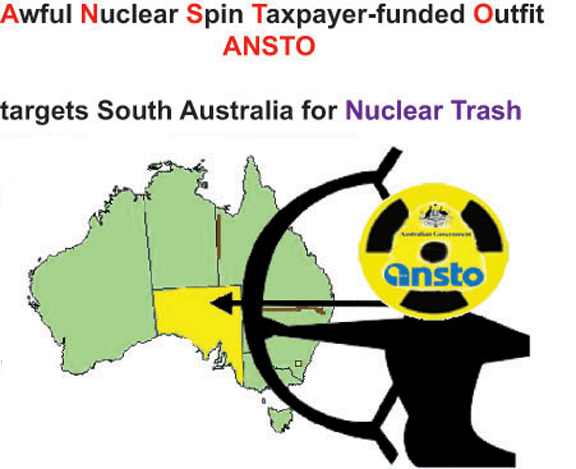
George Gear to Senate Economics Committee on NATIONAL RADIOACTIVE WASTE MANAGEMENT AMENDMENT (SITE SPECIFICATION, COMMUNITY FUND AND OTHER MEASURES) BILL 2020 [PROVISIONS] Addition to my submission. I have attached [on original] two short articles on radioactive storage which will be of assistance to the committee. As you will see the proposal by the government will not be licensed for storage in Australia. It fails to reach the International Atomic Energy Agency (IAEA) standards for the storage of Intermediate Level Waste (ILW).
Accordingly your committee must inform the senate that the Kimba proposal in the bill does not meet IAEA standards and should be withdrawn.
The first is written by Aurora who are the only company operating a (low level ) radioactive storage facility in Australia.
In it they draw attention to the following factors which are relevant to Kimba:
1. The buffer zone is inadequate, it is measured in hectares instead of kilometres. Leonora has a buffer zone of 15 kms.
2. The site should be at a location where there are “few active land uses” on surrounding land. As you know the Kimba site is in the middle of a prime wheat growing area. The site at Leonora is remote, nothing grows there and nobody goes there.
3. When the governments proposed site is finished with in 30 years and a new underground site has been established the redundant Kimba site will have to be managed (at taxpayer expense ) for 300 years.
4. Based on their experience none of the sites in SA would have been considered if it were not for the expression of interest model chosen by the government.
5. The Kimba site is unsuitable.
6. The decision to site the facility at Kimba is a political one and not based on technical or scientific considerations.The second article is by the AINS Group who are a specialist group in storing radioactive waste. They are based in Helsinki and this article is specific to the decision to establish the facility at Kimba. The main points of the article are:
1. Intermediate Level Waste (ILW) should be stored at intermediate level geological disposal. The Department already knows this. The quote below is taken straight from the “ National Radioactive Waste Management Facility Project” (NRWMFP) Facebook home page (attached). The statement that it will take several decades to site and build is wrong and they know it. The Leonora site can store the ILW at depth within a year and the NRWMFP have known this for 3.5 years.
Cleantech stocks bounce back from Covid, set scene for green recovery — RenewEconomy

Deloitte Australian CleanTech Index bounces back after shock from Covid-19 and rounds off seven years of significantly outperforming the ASX200. The post Cleantech stocks bounce back from Covid, set scene for green recovery appeared first on RenewEconomy.
Cleantech stocks bounce back from Covid, set scene for green recovery — RenewEconomy
July 13 Energy News — geoharvey

Opinion: ¶ “Whoosh! Wind Power Wins, Pipelines Implode In Fossil Fuel Week From Hell” • Last week, a 4000-MW transmission project to move power from Kansas wind farms to Illinois won the green light for a go-ahead. It was probably the last thing oil and gas stakeholders wanted to hear on top of a huge […]
July 13 Energy News — geoharvey
Queensland renewable energy zones a jobs goldmine — RenewEconomy

Solar Citizens report finds turbocharging Queensland large-scale renewable energy industry would create 9,300 construction jobs every year for 10 years and almost 6,000 ongoing jobs. The post Queensland renewable energy zones a jobs goldmine appeared first on RenewEconomy.
Queensland renewable energy zones a jobs goldmine — RenewEconomy
Renewables-dominated South Australia delivering cheaper power than Vic, NSW — RenewEconomy

South Australian consumers set to reap benefits of world-leading renewables grid, with falling wholesale electricity prices delivering cheaper power than Victoria or NSW. The post Renewables-dominated South Australia delivering cheaper power than Vic, NSW appeared first on RenewEconomy.
Renewables-dominated South Australia delivering cheaper power than Vic, NSW — RenewEconomy
The Vow From Hiroshima Should Be From Everywhere — limitless life

OpEdNews Op Eds 7/10/2020 at 15:21:55 H3’ed 7/10/20 The Vow From Hiroshima Should Be From Everywhere By David Swanson (Page 1 of 1 pages) (View How Many People Read This) No comments Become a Fan (139 fans) davidswanson.org (Image by Unknown Owner)DetailsDMCA The new film, The Vow From Hiroshima, tells the story of Setsuko Thurlow who was a school girl in Hiroshima when […]
The Vow From Hiroshima Should Be From Everywhere — limitless life
Patience pays off as world’s biggest solar contractor takes leading position in Australia — RenewEconomy

The world’s biggest solar EPC contracting company takes leading position in Australia solar market as local and international competitors fall by the wayside. The post Patience pays off as world’s biggest solar contractor takes leading position in Australia appeared first on RenewEconomy.
Patience pays off as world’s biggest solar contractor takes leading position in Australia — RenewEconomy
Increasing voices in Japan for the cancellation of the Tokyo Olympics — limitless life
Dear Friends, On 7th June Mr Yukio Hatoyama, former Prime Minister of Japan, addressed me a message, expressing his views on the Tokyo Olympics : ”I always thought that instead of spending money on the Tokyo Olympics, the state should use these funds for the decontamination of the affected areas and to compensate the Fukushima nuclear […]
Increasing voices in Japan for the cancellation of the Tokyo Olympics — limitless life
Cuba, Chernobyl and COVID-19 — Beyond Nuclear International

Join live online event about Cuban doctors and Chernobyl’s children
Cuba, Chernobyl and COVID-19 — Beyond Nuclear International
The week in nuclear and climate news
Can’t keep up with the Covid-19 news. Crazy world? Disney reopens Florida theme parks as state smashes US record for new coronavirus cases. Big global problems now more obviously intertwining – From Covid-19 to climate: what’s next after the global oil and gas industry crash?
Extreme weather, exacerbated by global heating just keeps on happening. The new normal for Northern Siberia – thawing permafrost,forests on fire. Millions in southern China face floods caused by heavy rains. Floods and landslides lash Nepal, scores dead. Deadly Flooding in Japan. Record heat possible from California to Florida on Sunday.
While the world is preoccupied with Covid-19, and with national responses, and economic effects, climate change should not be forgotten, as it moves on inexorably. Climate change’s big problem – there’s no quick fix. Climate change is seriously hitting women, right now.
July 16 will be the 75 years’ anniversary of the first nuclear bomb detonation. Why do we hear so little about this other sword of Damocles hanging over our collective heads. ? Globally taxpayers $billions go to nuclear weapons, with the ever increasing risk of nuclear war and nuclear winter, resulting from accident, human error, misunderstanding, or “limited” or unlimited nuclear attack.
A bit of (qualified) good news. – Why New Zealand decided to go for full elimination of the coronavirus. Coronavirus: No new cases of COVID-19 in managed isolation in New Zealand. Covid-19 coronavirus: Ashley Bloomfield’s warning as NZ records lowest testing day since March.
AUSTRALIA
CLIMATE. Australia a big world player in producing greenhouse gas emissions. Australia now the biggest exporter of global heating– the Saudi Arabia of coal and gas. In contradiction to Angus Taylor, Australia’s Minister On Behalf of Polluting Industries, the States are leading on clean energy. Revealed: How the big energy lobby tried to use Covid-19 to derail energy market reforms. Pressure on new member for Eden Monaro Kristy McBain to live up to climate credentials. Court action in India against Adani – allegations of ‘coercion, fraud and undue influence’.
NUCLEAR.
Keep Australia’s nuclear prohibition laws: it appears that nuclear is no part of climate action, not necessary.
Kimba “interim” nuclear waste site – bad news, uncannily like the misguided New Mexico waste plan.
RENEWABLE ENERGY . NSW sets itself for biggest and quickest transition from coal to renewables. Dubbo’s new renewables zone shows the path away from fossil fuels. West Australia ready to seize ‘once-in-a-generation’ battery storage opportunity. Queensland Energy Minister Lynham keen on renewable energy zones, warns LNP will bring renewables to a halt. “Five times size of Snowy 2.0” – V2G trial to tap potential of EVs as mass mobile storage . Uni Newcastle’s printable solar cell innovation gets real-world test. Foreign nuclear waste headed to Australia.
INTERNATIONAL
Paul Ehrlich warns that overpopulation and overconsumption are driving us over the edge .
Warning of serious brain disorders in people with mild coronavirus symptoms.
American-Israeli strategy developing for clandestine not-quite-war strikes on Iran?
Lower-latitude oceans drive complex changes in the Arctic Ocean. Faith in Climate Action — The Church’s Response to Hothouse Earth. Facebook allows climate denial propaganda, and restricts climate scientists.
Radiation-related health hazards to uranium miners.
Uni Newcastle’s printable solar cell innovation gets real-world test — RenewEconomy

Flexible and printable solar panels developed by the University of Newcastle get first real-world test in new community shade structures in Sydney. The post Uni Newcastle’s printable solar cell innovation gets real-world test appeared first on RenewEconomy.
via Uni Newcastle’s printable solar cell innovation gets real-world test — RenewEconomy
Dangerous nuclear waste casks should stay off roads and rails
Radioactive rail wreck, Dangerous nuclear waste casks should stay off roads and rails , rails https://beyondnuclearinternational.org/2020/07/12/radioactive-rail-wreck/, Beyond Nuclear By Laura Watchempino 12 July 20,
If the Nuclear Regulatory Commission’s (NRC) conclusion that it’s safe to move spent nuclear fuel from nuclear power plants across the country to a proposed storage facility in Lea County sounds vanilla-coated, it’s because the draft environmental impact statement for a Consolidated Interim Storage Facility submitted by Holtec International did not address how the casks containing the spent fuel would be transported to New Mexico.
It’s likely the casks would be transported primarily by rail using aging infrastructure in need of constant repair. But our rail systems were not built to support the great weight of these transport casks containing thin-wall fuel storage canisters.
Nor was the potential for cracked or corroded canisters to leak radiation studied because an earlier NRC Generic EIS for the Continued Storage of Spent Nuclear Fuel assumed damaged fuel storage canisters would be detected during an intermediary dry transfer system or a pool.
But Holtec’s proposal only addresses a new destination for the high-level nuclear waste – not the removal and transport of the fuel storage canisters from nuclear power plants to New Mexico.
Even transport casks with canisters that are not damaged will release radiation as they are transported from nuclear power plants to the storage facility, exposing populations along the transport routes in a majority of states and tribal communities in New Mexico to repeated doses of radiation.
Other issues not considered in the draft EIS were the design life of the thin-wall canisters encasing the nuclear fuel rods and faulty installation at reactor sites like San Onofre, or the self-interest of the Eddy-Lea Energy Alliance in using the land it acquired for a consolidated interim storage site.
Thin-wall canisters cannot be inspected for cracks and the fuel rods inside are not retrievable for inspection or monitoring without destroying the canister. NRC does not require continuous monitoring of the storage canisters for pressure changes or radiation leaks. The fuel rods inside the canisters could go critical, or result in an uncontrolled nuclear chain reaction, if water enters the canisters through cracks, admits both Holtec and the NRC. None of us are safe if any canister goes critical.
Yet a site-specific storage application like Holtec’s should have addressed NRC license requirements for leak testing and monitoring, as well as the quantity and type of material that will be stored at the site, such as low burnup nuclear fuel and high burnup fuel.
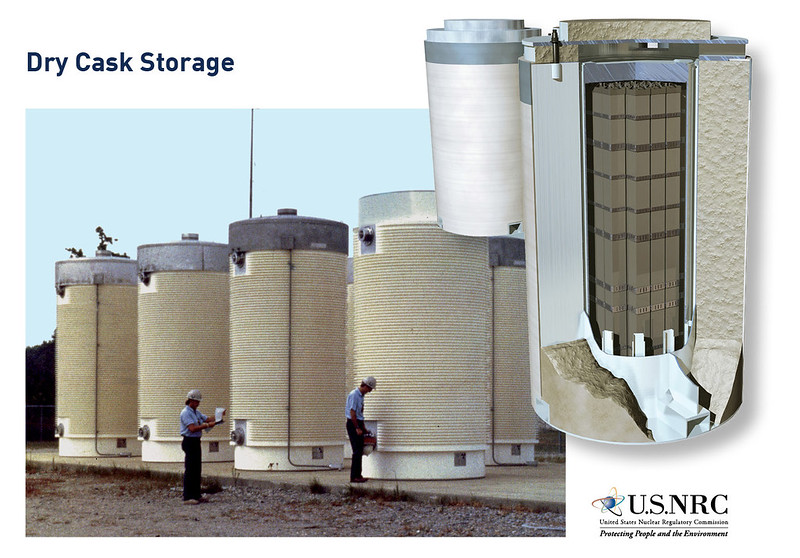
Irradiated nuclear fuel is safer (but not safe) stored at the reactor site rather than transported thousands of miles to New Mexico. (Image: U.S. Nuclear Regulatory Commission)
With so many deficiencies in the draft EIS, a reasonable alternative is to leave this dangerous radioactive nuclear waste at the nuclear plants that produced it in dry cask storage rather than multiply the risk by transporting thousands of containers that could be damaged across many thousands of miles and decades to southeastern New Mexico, then again to a permanent repository.
Interim storage of spent nuclear fuel at existing nuclear plant sites is already happening – there are 65 sites with operating reactors in the United States and dry cask storage is licensed at 35 of these sites in 24 states. But since the thin-wall canisters storing the fuel rods are at risk for major radioactive releases, they should be replaced with thick-walled containers that can be monitored and maintained. The storage containers should be stored away from coastal waters and flood plains in hardened buildings.
Attempting to remove this stabilized nuclear waste from where it is securely stored across hundreds or thousands of miles through our homelands and backyards to a private storage facility also raises some thorny liability issues, since the United States will then be relieved of overseeing the spent nuclear fuel in perpetuity.
The states and nuclear plants that want to send us their long-lived radioactive waste will also be off the hook, leaving New Mexico holding a dangerously toxic bag without any resources to address the gradual deterioration of man-made materials or worse, a catastrophic event. It’s a win/win, however, for Holtec International and the Eddy-Lea Energy Alliance.
Ironically, just a few years ago, the US Environmental Protection Agency had expressed opposition to mass transportation of another kind of radioactive waste. In a classic example of environmental injustice, the EPA balked at removing uranium mine waste on the Navajo Nation, because, it said, “Off-site disposal, because of the amount of waste in and around these areas, means possibly multiple years of hundreds and hundreds and hundreds of trucks going in and out of the community and driving for miles”.
The agency told the affected communities, during discussion about digging up the uranium mine waste and transporting it to a licensed repository in different states outside the Navajo Nation, that this option, also the Nation’s preference, was the most expensive. But now New Mexico is the destination for precisely the reverse, with hundreds and thousands of transports from different states coming to deposit the country’s nuclear waste site radioactive debris on Native soil.
Laura Watchempino is with the Multicultural Alliance for a Safe Environment/Pueblo of Acoma. A version of this article first appeared in the Albuquerque Journal and is republished with kind permission of the author.
Northern Siberia’s new normal – forests on fire
The Moscow Times reports economic losses from thawing permafrost alone is expected to cost Russia’s economy up to $2.3 billion US per year. Last year’s fires likely cost rural communities in the region almost $250 million US. In March, Russia announced 29 measures it would be taking to try to deal with climate change over its vast landmass but critics complained the efforts have been more focused on exploiting natural resources in the Arctic than mitigating the impacts of a warming climate.
“They are actively going after every mineral and oil and gas deposit that they can,”
As permafrost thaws under intense heat, Russia’s Siberia burns — again, https://www.cbc.ca/news/world/siberia-burning-climate-change-russia-1.5645428
Russia’s northern landscape is being transformed by heat and fire, Chris Brown · CBC News : Jul 12, Right around now, University of British Columbia climatologist and tundra researcher Greg Henry would usually be up at Alexandra Fiord on the central-east coast of Canada’s Ellesmere Island experiencing the Arctic’s warming climate up close.
Instead, the pandemic has kept his research team grounded in Vancouver — and his focus has shifted to observing the dramatic events unfolding across the Arctic ocean in northern Siberia.
“It’s remarkable — it’s scary,” said Henry of the incredible run of high temperatures in Russia’s far north that have been breaking records for the past month.
This week, a European Union climate monitoring project reported temperatures in June were up to 10 degrees higher than usual in some parts of Russia’s Arctic, with an overall rise of five degrees.
The heat and dry tundra conditions have also triggered vast forest fires. Currently, 1.77 million hectares of land are burning with expectations that the total fire area could eventually surpass the 17 million hectares that burned in 2019.
Equally striking is where the fires are burning.
“Now we are seeing these fires within 15 kilometres of the Arctic Ocean,” said Henry. “Usually there’s not much fuel to burn there, because it’s kept cold by the ocean so you don’t get ignition of fires that far north.”
This year though, he said the heat has dried the ground out enough to change the dynamics.
“It’s a harbinger of what we are in for because the Arctic has been warming at twice the rate of the rest of the planet.”
Environmental disaster Continue reading
1 This month.


PETITION – To: Prime Minister Anthony Albanese and the Australian Labor Government
Chernobyl: The Lost Tapes – A good documentary on Chernobyl on SBS available On Demand for the next 3 weeks– https://www.sbs.com.au/ondemand/tv-program/chernobyl-the-lost-tapes/235274195556

19 May – Webinar- Webinar: No Nuclear Weapons in Australia
Start: 2026-05-19 18:00:00 UTC Canberra, Melbourne, Sydney (GMT+10:00)
End: 2026-05-19 19:30:00 UTC Canberra, Melbourne, Sydney (GMT+10:00)
20 May – Webinar – The dangerous world of AUKUS, US, military occupation and suppression of dissent

National Webinar, 20th May, 2026, 6.30pm AEST. Confronting laws restricting/suppressing protest speech and action
Speakers: Former Sen. Rex Patrick, Lawyer Nick Hanna ,Arthur Rorris ,Jorgen Doyle, Sen David Shoebbridge,
Facilitator Kelley Tranter.

of the week – Australians for War Powers Reform (AWPR)
To see nuclear-related stories in greater depth and intensity
 Antinuclear