Busting Australian govt media spin about Napandee nuclear waste plan, – by AustralianGovtWatcher

Cut through this spin from the Department of Industry, Science, Energy and Resources – glossing over the licensing problem about waste classification. It is duplicitous about “medical” wastes. It ignores the plan’s failure to comply with all regulatory requirements, failure to properly inform local community. It makes dubious claims on economics and employment, and dubious claims about the selective community ballot, and duplicitous claims about Aboriginal involvement (AustralianGovtWatcher’s comments in red italics)
Department of Industry, Science, Energy and Resources National Radioactive Waste Management Facility: Hearings last Tuesday of the Senate Standing Committee on Economics
Media release
2 July 2020
The following can be attributed to a spokesperson from the Department of Industry, Science, Energy and Resources:
“The department was pleased to attend the committee hearings on Tuesday to discuss the proposed legislation to support the National Radioactive Waste Management Facility,” the spokesperson said.
“Specifically it was also an opportunity to address some questions about the process and proposed facility, including some those which have since been raised in the media, as outlined below.
Is there are need for a facility?
“The legislation delivers on the Australian Government’s commitment to site the facility at Napandee in Kimba, South Australia.
“The facility will be for the disposal of low-level waste and temporary storage of intermediate level waste, which will be stored at the facility only if it meets strict Waste Acceptance Criteria.”
The facility will fail to meet the safety codes and prescriptions of IAEA as adopted in Australia by ARPANSA
What is proposed to overcome this problem as otherwise ANSTO or whoever else will be the operator of the facility will not get the necessary licences
“About 80 per cent of Australia’s radioactive waste stream is associated with the production of nuclear medicine which, on average, two in three Australians will need during their lifetime.”
This is a dubious claim and depends entirely on the level of classification and the source of the waste – it should be specifically broken down into those categories.
“This medical waste, along with Australia’s historical radioactive waste holdings, is currently spread over more than 100 locations across the country, like science facilities, universities and hospitals.”
True but only a portion of that waste is held or controlled by the federal government.
“It is international best practice to consolidate this waste at a purpose-built facility.”
Agreed but the facility at Napandee will not achieve this.
Can’t the waste be permanently stored at ANSTO?
“Australia cannot indefinitely produce the vital nuclear medicine
that it needs, without responsibly and safely managing the radioactive waste by product.
“The national facility will not fit at ANSTO – it requires at least 40 hectares plus a buffer zone and enabling infrastructure.
“On the other hand, the whole ANSTO Lucas Heights campus, designed for nuclear medicine and research, is only 70 hectares in size, and already has more than 80 buildings on it.”
Although unavoidable due to simply adding new buildings when needed it still shows a dismissal lack of planning over many years which is acknowledged by former senior personnel at ANSTO
Do we need more scrutiny around the process to identify a site?
“The process to site the facility was developed with the assistance of an Independent Advisory Panel which included members with a range of academic, industry and environmental backgrounds, and people who are both generally supportive and against the proposal to establish the facility.”
Absolute nonsense since the choice of the site and subsequent development proposals fail to comply with all regulatory requirements.
Moreover the community members against the proposals were never given full and proper information despite their specific requests.
A good example of this was the issue of fire risks which is of prime importance with the proposed above ground structure in the heart of prime agricultural land.
The so-called Independent Advisory Panel proved to be ineffective and was not constituted as initially planned – it certainly did nothing of consequence to identify the location and provide any real scrutiny.
“And the process has already been independently scrutinised
on two occasions.
“In 2018, the Senate Economics References Committee ran an inquiry into the process for the selection of a site for the facility, and this found that that the process was sound.
“Four years of community engagement and three years of technical studies support the identification of Napandee as a site, which is suitable technically to safely and securely manage Australia’s waste, and broadly supported by the community.”
The Senate Committee inquiring into the selection process in 2018 could not possibly be regarded as being an independent scrutiny as seen from its conclusions and recommendations.
What was the second occasion of scrutiny?
Most importantly the community at Kimba has requested funding and governmental assistance in getting their own proper and independent expert scrutiny and assessment but the government has refused the requests.
The District Council of Kimba also refused a similar request despite claiming to represent the whole community.
What economic benefits would the facility deliver for regional Australia?
“Independent economic analysis conservatively estimated the facility would bring over $8 million in economic benefits to Kimba each year.”
How?
“The facility will also be the area’s largest employer, bringing 45 local jobs.”
Much larger facilities overseas employ a fraction of that number – it is more likely to be less than 10 employees in total and will no doubt depend on the infrequent deliveries of waste to the facility.
Hard to see where the yearly economic benefits of $8 million will come – it will do nothing to replace an agricultural industry at Kimba worth between $55 million to $85 million a year which based on recent overseas situations will suffer dramatically due to the presence of the facility.
“And some 62% of the local Kimba community supported the facility in a Council-run ballot undertaken last year.”
This is based on a very selective ballot the results of which have not been correctly interpreted.
Most importantly the ballot failed on the principle of informed consent as there was a lack of proper information given to the voters prior to the ballot.
What are the ways of protecting cultural heritage?
“While there is no native title or registered heritage at Napandee, which is cleared farming land, the department recognises the Traditional Custodians in the region, who have strong views about a radioactive waste facility being situated in the area.
“If the Barngarla People are willing to consider the opportunity, the department is seeking to engage with the objective of a funded agreement between BDAC and the Government, which could include:
• a Barngarla economic plan – including $3 million allocated
by the Australian Government,
• training, employment and business opportunities,
• a cultural heritage assessment and management program,
• the opportunity to ensure Barngarla heritage and cultural values are enhanced by the Facility and its design,
That is not what the Barngarla people say particularly as the proposed funding outlined by the government will in any case come from other existing financial assistance already available to them.
In any case the government should have been consulting the Barngarla for that type of agreement several years ago and certainly well before their legal actions were taken and which were strongly opposed by the government.
It seems that it will be hard to mend the bridges!
CONCLUSION
These comments are based on various expert advice from overseas which is far more credible in the areas of nuclear science and engineering then exists in Australia mainly due to there being no local nuclear generation industry .
This expert advice can be made available to the Senate committee if necessary
However the whole process of selection of a previously nominated site and the subsequent development proposals lack any community consideration of such inherent issues as the radionuclides inventories of the waste and the risk of fires
Napandee nuclear waste plan futile and unnecessary, as it lacks adequate knowledge of radionuclides involved

From the AINS Group (a multi-discipline engineering consultancy specialised in nuclear waste management services, Finland)
“… it is quite unlikely that Napandee could ever be commissioned by the regulatory body
Nonetheless the selection of a site would need a thorough safety assessment that includes climatic and groundwater conditions, rock stability, host rock composition, and the amounts and nature of the hazards of the waste (i.e. the radionuclide inventory). AS said before the AECOM report is not enough to demonstrate or ensure the safety of the site and the post closure monitoring for 300 years may also be an issue.
Final remarks. Knowledge of the inventory and mobility of the radionuclides in the wastes must be the first step in determining how and where the wastes should be stored and disposed of permanently.
Without this, it is not possible to even consider or decide the conditions or attributes of the waste management location and the manner of storage and disposal, and this will, or should be, the prime consideration in the licensing process.
This does not seem to have been done with the Kimba location and the nature of its facility and hence its selection and subsequent plans may prove to be futile and unnecessary….”
References. ARPANSA 2010 Safety guide. Classification of radioactive waste – Radiation protection series No.20. Eurajoki T 2006 Lovisa Low and Intermediate Level Waste Repositary Safety case LOKIT – 2543 Fortum Nuclear Services Ltd, Espaa Finland. IAEA 2006 Geological disposal of radioactive waste, IAEA Safety Standard Series No. WSR4
ANSTO has been completely disingenuous in communicating to Kimba community about radioactive waste levels

RADIONUCLIDES
Three internationally renowned nuclear science academic and research institutions from overseas have tried to find out the inventory of the radionuclides of the re-processed nuclear waste at Lucas Heights which is to be placed in aboveground storage at Napandee near Kimba
The reason is that this would help – but not definitively – to determine the true level of that waste which ANSTO claims is intermediate level but France as the re-processing country classifies it as high-level waste.
All attempts to get this information have proved unsuccessful and the three institutions quite independently of each other believe that the information was deliberately withheld from them as it was probably realised that it could be used in some form to reclassify the intermediate level waste held at Lucas Heights.
However the radionuclides for the low level waste are readily available on ANSTO’s website.
Is this believable?
Should this be correct then it means that ANSTO has been completely
deceptive and disingenuous in its public disclosures particularly with regard to the Kimba community and all further attempts or actions to establish the national facility at Napandee should cease immediately
EXTRACT FROM WIKIPEDIA:
A radionuclide (radioactive nuclide, radioisotope or radioactive
isotope) is an atom that has excess nuclear energy, making it unstable.
This excess energy can be used in one of three ways: emitted from the
nucleus as gamma radiation; transferred to one of its electrons to
release it as a conversion electron; or used to create and emit a new
particle (alpha particle or beta particle) from the nucleus. During those
processes, the radionuclide is said to undergo radioactive decay.
Australia must plan for permanent disposal of Lucas Heights nuclear waste, not hurriedly transfer it to Kimba “temporarily”
 Senator Sarah Hanson-Young, No Nuclear Waste Dump Anywhere in South Australia, 1 July 20,
ARPANSA has out on the record that there is NO urgency or safety concerns with the current storage at Lucas Heigts — then my questions is —- why move this intermediate-level waste before establishing long term plan for the disposal? Wouldn’t it make more sense? Otherwise we will be just double handling and risking the ILW to become potentially stranded at Kimba. https://www.facebook.com/groups/1314655315214929/
Queensland splinter political party North Queensland First pushing for uranium mining in Queensland
Jason Costigan wants Queensland to export uranium again, Canberra Times, Derek Barry 3 July 20
Small modular nuclear reactors distract from real climate solutions
 Small modular nuclear reactors distract from real climate solutions, Regina Leader Post, Darrin Qualman, Glenn Wright Jul 03, 2020 •Last fall, the premiers of Saskatchewan, Ontario and New Brunswick pledged their support for small modular reactors (SMRs). Last week, Saskatchewan’s government announced a Nuclear Secretariat to oversee development of those reactors. Many in Saskatchewan took these announcements at face value and began questioning the cost, feasibility and safety of these units. To do so, however, is to misunderstand what’s really happening. The reality is that three premiers lacking adequate emission-reduction plans pledged themselves to speculative technologies that will take a decade or two to get up and running, if ever. SMRs are another distraction to shift the focus away from provincial records of increasing emissions. The SMR announcement follows a pattern of past policy declarations that serve to distract the public and delay effective policies…..
Solutions are within reach. Jobs await. SMRs are a distraction. Let’s not be fooled again. Let’s demand rapid, effective emissions reduction now as part of a revitalized Saskatchewan economy.
Germany is first major economy to phase out coal and nuclear
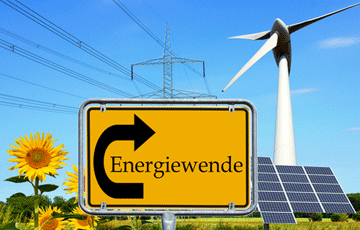 Germany is first major economy to phase out coal and nuclear, Economic Times, 3 July 20
The plan is part of Germany’s ‘energy transition’ – an effort to wean Europe’s biggest economy off planet-warming fossil fuels and generate all of the country’s considerable energy needs from renewable sources…….
The plan is part of Germany’s ‘energy transition’ – an effort to wean Europe’s biggest economy off planet-warming fossil fuels and generate all of the country’s considerable energy needs from renewable sources…….
The plan is part of Germany’s ‘energy transition’ – an effort to wean Europe’s biggest economy off planet-warming fossil fuels and generate all of the country’s considerable energy needs from renewable sources.
But the head of Germany’s main miners’ union, Michael Vassiliadis, welcomed the decision, calling it a “historic milestone.” He urged the government to focus next on an expansion of renewable energy generation and the use of hydrogen as a clean alternativ ..
July 3 Energy News — geoharvey

Science and Technology: ¶ “Warming Temperatures Threaten Hundreds Of Fish Species The World Relies On, Study Finds” • As the planet’s oceans and rivers warm, increased heat could pose a grave threat to the fish populations the world depends on by the end of this century. That’s the alarming conclusion of a study published in […]
Australia’s secretive defence operations HQ to get 1.9MW solar farm — RenewEconomy

Australia’s secretive defence operations headquarters, HQJOC, set to be solar powered with 1.9MW solar farm. The post Australia’s secretive defence operations HQ to get 1.9MW solar farm appeared first on RenewEconomy.
via Australia’s secretive defence operations HQ to get 1.9MW solar farm — RenewEconomy
Global energy body warns against rush to cut renewables and storage research funds — RenewEconomy

IEA warns against cuts to clean tech research funding as Australia’s Coalition government ponders future of Australian Renewable Energy Agency The post Global energy body warns against rush to cut renewables and storage research funds appeared first on RenewEconomy.
via Global energy body warns against rush to cut renewables and storage research funds — RenewEconomy
Deakin’s new Hub for world-leading energy storage and conversion — RenewEconomy

Deakin warmly welcomes the Australian Government’s announcement for the University to take stewardship of the Australian Research Council Industrial Transformation Research Hub in New Safe and Reliable Energy Storage and Conversion Technologies. The post Deakin’s new Hub for world-leading energy storage and conversion appeared first on RenewEconomy.
via Deakin’s new Hub for world-leading energy storage and conversion — RenewEconomy
Solar households may soon be charged network fee for exports to grid — RenewEconomy

Australian Energy Regulator revives talk of plans to charge households a network fee for exporting excess rooftop solar back into the grid. The post Solar households may soon be charged network fee for exports to grid appeared first on RenewEconomy.
via Solar households may soon be charged network fee for exports to grid — RenewEconomy
Solar mini-grids smarter, cheaper option for many global communities with no power — RenewEconomy

Solar-powered mini-grids can play a “critical role” in delivering universal electricity access across the globe, as they present smarter, cheaper options to main grid. The post Solar mini-grids smarter, cheaper option for many global communities with no power appeared first on RenewEconomy.
via Solar mini-grids smarter, cheaper option for many global communities with no power — RenewEconomy
Impressions of Senate hearings on nuclear waste dump Bill
 We saw ANSTO, ARPANSA and the Department of Industry etc being grilled by Senators Rex Patrick, Sarah Hanson-Young and ALP Jenny McAllister.
In Australian Senate Inquiry uncertainty grows over whether Kimba nuclear dump site is really needed
the day saw uncertainty grow over the need for the proposed Kimba site while there was a corresponding growth in clarity that there is no urgency re this decision. The govts plan might suit ANSTO but it is not Australia’s only option – and it faces growing scrutiny.
from Jim Green, 1 July 2020 , Yesterday, Tuesday June 30 , the Senate Inquiry into Minister Pitt’s planned amendments to the national radioactive waste laws to cement and secure Kimba as a Facility site took evidence in Canberra.
The Committee heard from Govt agencies and contractors and key themes included both the need for the planned new laws and, importantly, for the Facility itself – esp. around the double handling of Intermediate Level Waste from ANSTO’s Lucas Heights.
ANSTO – as ever, there was too much bluff and bluster and too many Dorothy Dixers – as invariably happens with them in Estimates – but there were some very interesting arisings:
- Confirmed there are ‘no safety concerns’ with current waste – although ‘we cannot say that in 40 or 50 years they (ANSTO’s waste stores) will be fit for purpose’ – clear acknowledgement that they could retain waste on site and four decades is more than enough for a credible review and a more integrated approach.
- Further, ANSTO has ‘proposals under development with government for pre-2027 construction of new storage’ for ILW waste
- Hardly credible that they did not know the general proportions of ANSTO origin waste at the proposed Facility (around 80% of total wastes, and more importantly, 95% of ILW)
- They see extended on-site storage as a ‘significant management challenge and significant financial cost’ and so want to both cost shift and physically waste shift. Again, this is ANSTO’s agency agenda – not a national imperative or Australia’s sole or best option.
- Odd claim that a delay in advancing Kimba would be ‘detrimental to our sense of ourselves’ however it would not be inconsistent with any international treaty obligations. No treaty or convention obligations require Kimba to be advanced in its current form – or at all. (also I would suggest that ignoring Traditional Owner opposition to the siting of a national radioactive waste facility poses a bigger threat to our national sense of self)
- No credible threat to secure access to nuclear medicine supply should Kimba be delayed – although there would be ‘some scenario’s’ where supply could potentially be impacted. This is a very significant reduction in ANSTO’s threat messaging and a long way from a pressing problem. As I understand the scenario referred to is that Kimba is not advanced and ANSTO has taken no steps to develop a contingency.
In summary Kimba is not essential for nuclear medicine nor is it essential for Australia’s compliance with international frameworks. ANSTO could extend interim storage at Lucas Heights but understandably would prefer to transfer both the waste and its continuing management cost to a non ANSTO purse and place. Not a good enough rationale for a deficient national plan.
ARPANSA
- ANSTO waste ‘can be safely stored at Lucas Heights for decades to come’ – absolutely critical point: there is no need to rush – we have time to develop a more credible approach.
- ‘International best practice is to store radioactive waste safely – current storage at the Lucas Heights site is fully aligned with international best practice’
- There will be distinct licensing applications required for the two waste streams – LLW and ILW (with no certainty that they will have a shared approval outcome)
Dept of Industry:
- Repeated reference to the ‘contentious’ nature of the siting decision
- Extremely deficient responses re the rational and process for the change in legislative decision making from Ministerial decision to legislative instrument. Some Senators not happy at Depts inability to answer basic process questions –it is very clear the rationale is to isolate against future legal challenge.
- Statement that decision to change the legislative basis of the siting was made sometime in 2019 – then a later statement that it was made by Minister Pitt (note: Pitt was sworn in 6/2/20)
- The Departments Sam Chard rear guard action was to state that the intent of the change was to enable Parliament ‘to test the merits of the action’ – that is long overdue – could we please do this as it simply doesn’t stack up
- Increasingly clear that the Dept is utterly adrift re Barngarla liaison – understandably as they simply do not want the Facility on their country – the Facility plan is heading for some pretty sharp rocks if it doesn’t change course.
Dept of Defence:
- strongly arguing against any siting on the Woomera Prohibited Area as this could reduce its functionality. Not at all keen.
- Hard pressed by Rex Patrick though about how credible is it to say ‘not possible’ for a 100 hectare Facility inside a site twice the size of Tasmania.
AECOM:
- Predictable defence of process, their expertise and kept referring to the restricted extent of their brief as the way to avoid any tricky questions (like Barngarla liaison)
- No tech or site reason why the Facility couldn’t be at Kimba
There were good efforts from Sarah Hanson Young, Rex Patrick and Labor’s Jenny McAllister to highlight and tease out issues.
In a nutshell I would say the day saw uncertainty grow over the need for the proposed Kimba site while there was a corresponding growth in clarity that there is no urgency re this decision. The govts plan might suit ANSTO but it is not Australia’s only option – and it faces growing scrutiny.
We now need to keep up the issue profile and the expectation on Labor and the cross-benches to oppose this legislation when it comes to the Senate and instead support a strategy that advances both human and environmental rights and responsible radioactive waste management.
1 This month.


PETITION – To: Prime Minister Anthony Albanese and the Australian Labor Government
Chernobyl: The Lost Tapes – A good documentary on Chernobyl on SBS available On Demand for the next 3 weeks– https://www.sbs.com.au/ondemand/tv-program/chernobyl-the-lost-tapes/235274195556

19 May – Webinar- Webinar: No Nuclear Weapons in Australia
Start: 2026-05-19 18:00:00 UTC Canberra, Melbourne, Sydney (GMT+10:00)
End: 2026-05-19 19:30:00 UTC Canberra, Melbourne, Sydney (GMT+10:00)
20 May – Webinar – The dangerous world of AUKUS, US, military occupation and suppression of dissent

National Webinar, 20th May, 2026, 6.30pm AEST. Confronting laws restricting/suppressing protest speech and action
Speakers: Former Sen. Rex Patrick, Lawyer Nick Hanna ,Arthur Rorris ,Jorgen Doyle, Sen David Shoebbridge,
Facilitator Kelley Tranter.

of the week – Australians for War Powers Reform (AWPR)
To see nuclear-related stories in greater depth and intensity
 Antinuclear