City of Sydney completes switch to 100 per cent renewable supply — RenewEconomy

City of Sydney now running on 100 per cent renewables, as power begins flowing from regional solar and wind projects. The post City of Sydney completes switch to 100 per cent renewable supply appeared first on RenewEconomy.
via City of Sydney completes switch to 100 per cent renewable supply — RenewEconomy
Nine new solar farms and two big batteries proposed for South Australia — RenewEconomy

Nine new solar farm proposals and two new big batteries unveiled in flood of applications to South Australia energy regulator. The post Nine new solar farms and two big batteries proposed for South Australia appeared first on RenewEconomy.
via Nine new solar farms and two big batteries proposed for South Australia — RenewEconomy
Labor rejects National Radioactive Management Amendment Bill. 2020- Josh Wilson MP
Hansard , Mr JOSH WILSON (Fremantle) Senate Committee Inquiry into National Radioactive Management Amendment Bill. 2020. “…….. There is no question that Australia needs to make progress when it comes to the proper long-term storage of nuclear waste. It is just that this bill doesn’t help take us towards that end. It’s taken us 40 years and it’s cost$55 million to get us to this point. ……..
Effectively this bill seeks to rush and force the issue of community acceptance, which is a mistake. The ministerhas the power to make the decision in question. You can only guess that the reason for this legislation is to lockin an outcome, when the minister and the government accept that there are some concerns with the communityacceptance process that has occurred so far.
The bill effectively also wants to ignore, avoid and further neglect the key issue of a permanent disposal site for intermediate-level waste. There are two kinds of waste that this bill proposes to send to a site in South Australia—low-level waste and intermediate-level waste—and they are very different. A lot of what has been said, including what the minister said in introducing this bill, glides over that difference in a way that is wrong and is certainly not helpful in terms of getting to where we need to get to with a permanent disposal site for low-level waste and a permanent site for intermediate-level waste…..
We have to get towards a long-term disposal solution, and yet this bill raises two serious questions about how the government wants to take us there. There’s concern over the site selection process, which goes to the question of consultation, engagement and community agreement, and there are concerns about the purpose and function of the facility…….
Departmental officials came before the energy and environment committee when we were inquiring into nuclear energy, and they gave us some very rough estimates of what the construction of the site itself would cost. That will be somewhere around $340 million to $350 million. That’s for the construction of the site, and that was described to us as a conservative estimate.Bizarrely, there is no current process underway with even a single dollar of government resources going towards the issue of a permanent disposal site for intermediate-level waste. It’s quite strange. It’s almost hard to believe that, when it’s taken us 40 years to get to the brink of a permanent site for low-level waste, there is not yet any departmental group or any taskforce on this and there’s not a single dollar going to the process of site selection,engineering design or anything else around the question of a permanent disposal site……
There is plenty of room [at Lucas Heights] in that interim storage facility, so there’s no issue with space as far as intermediate-level waste is concerned, and there’s no issue in relation to safety or health concerns either……where is the evidence that there is anyproblem with the intermediate-level waste staying where it is, as it should do, until the government of Australiaidentifies and resources an appropriate permanent disposal site for intermediate-level waste? …..When the interim facility was set up, there was no suggestion it was only for a few years. The licence that exists for the storage of the intermediate-level waste at Lucas Heights runs to 2055. …
ARPANSA is aware that some stakeholders have interpreted ARPANSA’s decisions regarding the IWS— which is the intermediate-level storage— as a requirement for relocation of the waste stored in the IWS, even suggesting that there is an urgent need for relocation. This is not correct. ARPANSA has not raised safety concerns regarding storage of waste at the IWS. ANSTO seems to share this view. ANSTO has indicated to ARPANSA that the mandatory recertification of the TN-81 casks every 10 years can be carried out at the IWS
But the claims that the government and government members in this place have made that intermediate-level storage needs to go to South Australia because there’s no room for it and that there are health and safety concerns about where it is currently are rubbish.
And so it should stay where it is as a spur to the government to get on with the process, which currently hasn’t even started, of finding and resourcing a permanent disposal site. That is not occurring, and that’s one of the chief flaws of this bill. ……
They need to immediately start and resource the process of a permanent disposal site for intermediate-level waste. They should commit to maintaining that waste where it is currently stored, which is another reason for an inquiry on this issue.
……..there are members of the government running around saying that nuclear power should be part of our energy mix in our communities across Australia. Frankly, that is not only deeply irrational but ridiculous and unhelpful in the task this bill presents to us.
This bill is not a sensible or appropriate way in which to move towards the waste storage solution. It puts the program at risk. That’s why we don’t support the bill.
South Pole warming at triple the global average
‘Nowhere to hide’: South Pole warms up with climate change a factor, https://www.smh.com.au/environment/climate-change/nowhere-to-hide-south-pole-warms-up-with-climate-change-a-factor-20200629-p55797.html, by Peter Hannam, June 30, 2020 The South Pole, the most remote part of the planet, has been warming at triple the global average, as natural variability joins with climate change to produce an abrupt shift in temperature trends.The findings, published Tuesday in the Nature Climate Change journal, show surface temperatures at the South Pole were stable in the first couple of decades of instrument records into the 1980s.
A record-breaking cold for a spell then made way for even warmer temperature anomalies from the early 2000s. For the 1989-2018 period, the mercury rose an average of 0.6 degrees per decade, or three times the global warming rate, the researchers found.
The report on the flipping of temperature trends at the most southerly point comes as abnormal warmth continues to bake the planet’s other polar extreme. The Russian town of Verkhoyansk last week reported 38 degrees, the warmest reading ever recorded within the Arctic Circle.
For Antarctica, the recent accelerated warming is estimated to be about two-thirds the result of natural variability with the role of rising greenhouse gases contributing about one-third, said Kyle Clem, a post-doctoral research fellow at New Zealand’s Victoria University.
The rapid warming “lies within the upper bounds of natural variability”, Dr Clem said. “It’s extremely rare and it appears very likely that humans played a role.”
The research shows “there’s no place on earth that’s immune to global warming”, he said. “There’s nowhere to hide – not even up on the Antarctic Plateau.”
Sitting at 2835 metres above sea level – or 600 metres higher than Mt Kosciuszko – on a rocky continent, the South Pole is exposed to different weather processes than its polar opposite. By contrast, the North Pole rests on shifting sea ice with the seabed more than four kilometres below.
Dr Clem, along with other researchers from the US and the UK, found changing circulation patterns in the Pacific and Southern Ocean determine which parts of Antarctica warm or cool.
For instance, the western tropical Pacific has periods when is warmer or cooler than usual.
The warmer period – known as the negative phase of the so-called Interdecadal Pacific Oscillation – set in about 2000. During this phase, there is more storm activity in the tropics which in turn spawns more high- and low-pressure systems that send heat far into the high latitudes.
The circumpolar westerly winds, which have been strengthening and contracting polewards under climate change – also play a role in amplifying the transfer of warmth into Antarctica.
When those two patterns align, as they have in recent decades, the South Pole warms but some parts, such as western Antarctica warm at a slow pace or even cool, as the frigid air shifts around.
Michael Mann, Director of the Earth System Science Centre at the University of Pennsylvania, said the study provided “a very detailed and useful analysis” of the forces at play in the far south.
If anything, though, the researchers’ use of model simulations to reach conclusions about regional trends probably understates the role of human-caused climate change.
“In short, what the authors attribute to natural internal cycles might just be a shift in atmospheric circulation that is actually due to human-caused climate change but isn’t accurately captured in the average over models,” Professor Mann said, in an email that included those italics.
The recent polar extremes – including eastern Siberian temperatures above 40 degrees – were important because “what happens in the poles doesn’t stay in the poles”, the prominent climate scientist said.
Changes at the South Pole itself were not as critical as the warming of the Southern Ocean, which is leading to the collapse of the West Antarctic ice shelves and the destabilisation of the interior ice sheet.
“This was not well predicted by climate models, meaning we are further along when it comes to the destabilisation of ice sheets and the commitment to rising sea levels than we expected to be at this point,” Professor Mann said.
It’s time to get emotional about climate change

Rebecca Huntley on why it’s time to get emotional about climate change, SMH, By Caitlin Fitzsimmons, June 28, 2020 —Rebecca Huntley had to submit her manuscript for her new book on climate change just as the country was entering lockdown for coronavirus.
The book, How to Talk about Climate Change in a Way that Makes a Difference, to be published this Thursday July 2, is based on social science rather than science. What scientists know about climate change is the jumping off point for Huntley’s exploration of the psychology behind activism, disengagement and denial.
“I nearly called it How to Talk about Climate Change with Your Drunk Uncle,” says Huntley, a social researcher and author. “It’s a bit derogatory but it’s about the idea that everybody who is concerned about climate change has somebody in their life who wants to pick a fight with them about it. Do we fight them or not?”
If the book is about the human factor in the climate change equation and society has just been through major disruption in the form of the pandemic and lockdown, it begs the question whether anything has changed since April, when she submitted her final edits.
The short answer is yes. Huntley says the way the pandemic has played out, at least in Australia, has given her unexpected hope.
She knew greenhouse emissions would go down if people stayed at home, industry was closed and flights were grounded and she knew there would be stories, some of them apocryphal, about wildlife reclaiming human spaces.
stories about low emissions and environmental rejuvenation would mean that people associated climate action with personal deprivation, that we’ve all got to be locked in our homes, losing our jobs, not being able to hug our aunt and uncle and not being able to go on holidays … or out to dinner and the movies,” Huntley says. “I thought if people thought that was the sacrifice we have to make in order to do something about climate change, it would be hugely detrimental.”
The book’s thesis is that the climate change argument won’t be won by reason alone: it’s time to get emotional. Huntley writes about her own emotional transformation from a citizen who believed in the science of climate change and tried to act accordingly to a citizen who believed in the science of climate change and organised her entire personal and professional life accordingly. Her belief in the scientific consensus did not shift, her world-view did……. https://www.smh.com.au/environment/climate-change/rebecca-huntley-on-why-it-s-time-to-get-emotional-about-climate-change-20200625-p5561z.html
France’s EDF in a financial pickle over huge costs of UK’s Hinkley C nuclear project
Dave Toke’s Blog 27th June 2020, The chickens are coming home to roost for EDF for their questionable decision to go ahead with 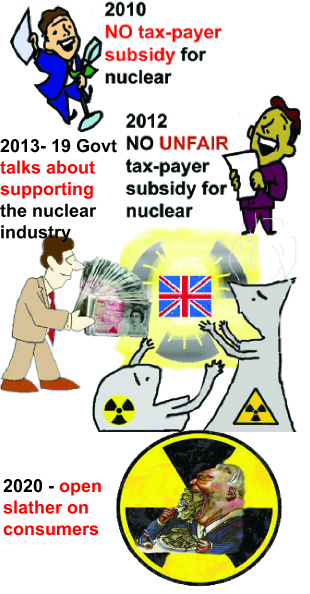 building Hinkley C -a decision they took despite the lack of certainty over whether they would get enough backing from the British Government.
Originally EDF was publicised as being offered UK Treasury loan guarantees that had been widely touted as a vital basis for building Hinkley C. But now the French Financial Markets Regulator has
sanctioned EDF for not flagging up how conditional such loan guarantees were. These loan guarantees have never materialised.
Essentially, EDF is now continuing to build Hinkley C using money borrowed on its own balance
sheets – borrowings which are much more costly than UK Government backed guarantees and which reduce its own (EDF) profitability.
The Finance Officer of EDF actually resigned at the time EDF decided to go ahead with building Hinkley C. Of course all this is happening at the same time when we are being asked to believe that the next EPR (at Sizewell C) is going to be delivered at low cost to the consumer if the risk of building the plant is transferred from EDF to the British taxpayer and consumer!
This is the so-called RAB mechanism, something that could well just turn out to be an
almost unlimited cash facility for EDF to park their financial black hole in the centre of British finances (as well as those of the French).
https://realfeed-intariffs.blogspot.com/2020/06/edf-sanctioned-by-french-regulators-for.html
Melbourne factories and universities sign bulk supply deal with Victoria wind farms — RenewEconomy

A group of prominent Melbourne universities, factories and other businesses targeting zero emissions sign bulk purchasing deal with Victorian wind farms. The post Melbourne factories and universities sign bulk supply deal with Victoria wind farms appeared first on RenewEconomy.
via Melbourne factories and universities sign bulk supply deal with Victoria wind farms — RenewEconomy
Ombudsman to have greater powers to protect consumers with solar, storage — RenewEconomy
Energy ombudsman could have new powers to oversee complaints relating to new energy technologies such as solar and battery storage provided by electricity retailers. The post Ombudsman to have greater powers to protect consumers with solar, storage appeared first on RenewEconomy.
via Ombudsman to have greater powers to protect consumers with solar, storage — RenewEconomy
June 29 Energy News — geoharvey
Opinion: ¶ “Maine Woods Would Benefit From Power Line Project” • Ensuring a healthy future for the Maine Woods – its plants and trees, animals and fish, jobs and industries – requires us to recognize its biggest threat: climate change. To reduce the devastating effects of climate change, we must take some big steps. And […]
Coal’s share of Australia’s grid scale generation tumbles below 70% for first time — RenewEconomy

TAI report shows that as renewables flourish, total sent-out coal-fired power fell to below 66% of total generation and to less than 70% of grid-level generation, excluding rooftop solar. The post Coal’s share of Australia’s grid scale generation tumbles below 70% for first time appeared first on RenewEconomy.
via Coal’s share of Australia’s grid scale generation tumbles below 70% for first time — RenewEconomy
Climate, nuclear, pandemic – news to 29 July
We are going to need to learn to live with the virus. Scientists just beginning to grasp how bad this Coronavirus is.
Will the pandemic open up global action to halt global heating? 16th Century colonisation, slavery began the planet’s damage, 21st Century pandemic response could repair it. Coronavirus is an SOS: Mend our broken relationship with nature, says UN and WHO.
Need for action on global heating – It’s 38°C in Siberia. One climate writer thinks that “it’s time to get emotional about climate”.
On the nuclear scene – same same – propagandists touting nuclear as a “cure” for climate change, and minimising the issue of costs. A European worry – about a cloud with tiny levels of radioactivity detected, over Scandinavia and European Arctic
AUSTRALIA
Julian Assange faces new indictment in USA. Julian Assange’s fiancée calls on the Australian government to secure his freedom
Killing Australia’s democracy – first kill the ABC.
NUCLEAR Labor reaches for bipartisanship on energy policy, but a DEFINITE NO TO NUCLEAR. Reality bats last-Small Nuclear Reactors just not economic for Australia (or anywhere else).
Misinformation about Energy Economics, from nuclear companies and their propagandists. Ben Heard and the fake environment group ‘Bright New World’. South Australian MP Rowan Ramsey, and Minister for Resources, Keith Pitt, talk nonsense about the planned nuclear waste dump at Napandee.
Radioactive Waste Facility Site – Woomera Amendment circulated in Senate.
There is really no market in India for Australia’s uranium . A journey from Tokyo to Mirrar country: Fukushima and Australia’s uranium trade.
Australian government to blame for failure of environment laws. Auditor general finds that Morrison government has failed in its duty to protect environment.
CLIMATE. ACTU warns Morrison: get real on climate and renewables, or lose metals industry. Australia could create hundreds of thousands of jobs by accelerating shift to zero emissions – report . Plan.Morrison government has failed in its duty to protect environment. Minerals Council slammed for “woefully inadequate” Climate Action .
RENEWABLE ENERGY.
- Up to 40 Energy jobs to be cut from CSIRO. Retain integrity of renewable energy agencies: ACF .
- Energy regulator considers options to control output of wind and solar farms.
- With Liberal Coalition business as usual on energy, thousands of renewable energy jobs will vanish. Engineers say technology roadmap should focus on cheap renewables, energy storage.
- NSW first renewable zone attracts stunning 27GW of solar, wind, storage proposals. New South Wales Liberal MP Kean says NSW can be renewable energy superpower, or stick its head in the sand. Huge 720MW solar farm and very big battery approved for connection to NSW grid.
- New 500MW wind farm and big battery planned for southern Queensland.
- Australian solar and wind forecasting technology to be live tested on S.A. grid
INTERNATIONAL
US, Russia nuclear arms talks end with plans for second round.
How we can manage the intermittency of renewables and attain 100% renewables.
New Zealand stood up to the nuclear bullies- the Rainbow Warrior story.
Misinformation about Energy Economics, from nuclear companies and their propagandists
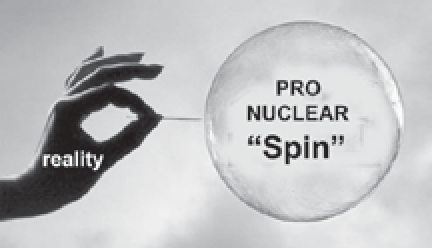
It is generally accepted in the energy industry that the cost of new nuclear is several times that of wind and solar, even when the latter are backed up by storage.
The nuclear lobby, however, has been insisting to the parliamentary inquiry that wind and solar are four to seven times the cost of nuclear, and to try and prove the point the lobby has been making such extraordinary and outrageous claims that it makes you wonder if anything else they say about nuclear – its costs and safety – can be taken seriously.
Supplementary Submission to the Victorian Parliament’s Standing Committee on Environment and Planning
Inquiry into Nuclear Prohibition Friends of the Earth Australia www.nuclear.foe.org.au
June 2020 – Extract
“……..MISINFORMATION REGARDING ENERGY ECONOMICS BY NUCLEAR COMPANIES AND ENTHUSIASTS
Highly questionable economic claims made by nuclear companies and enthusiasts are addressed in:
- submission #40 by Friends of the Earth Australia to the NSW nuclear inquiry[1]
- submission #64 to the NSW nuclear inquiry (see esp. sections 3.5 and 3.6)[2]
An important article by Giles Parkinson ‒ an energy expert and former business and deputy editor of the Australian Financial Review ‒ is particularly helpful in this regard. An excerpt is reproduced below but we encourage members of the Committee to read the full, referenced article. The article is focused on submissions to the federal nuclear inquiry[3] but many of the same claims have been presented to the NSW and Victorian inquiries.
Why the nuclear lobby makes stuff up about the cost of wind and solar
[1] https://www.parliament.nsw.gov.au/lcdocs/submissions/66217/0040%20Friends%20of%20the%20Earth.pdf
[3] https://www.aph.gov.au/Parliamentary_Business/Committees/House/Environment_and_Energy/Nuclearenergy
Giles Parkinson, 23 Oct 2019, ‘Why the nuclear lobby makes stuff up about the cost of wind and solar’, https://reneweconomy.com.au/why-the-nuclear-lobby-makes-stuff-up-about-cost-of-wind-and-solar-46538/
Giles Parkinson, 23 Oct 2019,
It is generally accepted in the energy industry that the cost of new nuclear is several times that of wind and solar, even when the latter are backed up by storage. The GenCost 2018 report from the CSIRO and the Australian Energy Market Operator (AEMO) puts the cost of nuclear at two to three times the cost of “firmed renewables”.
The nuclear lobby, however, has been insisting to the parliamentary inquiry that wind and solar are four to seven times the cost of nuclear, and to try and prove the point the lobby has been making such extraordinary and outrageous claims that it makes you wonder if anything else they say about nuclear – its costs and safety – can be taken seriously.
RenewEconomy has been going through the 290-something submissions and reading the public hearing transcripts, and has been struck by one consistent theme from the pro-nuclear organisations and ginger groups: When it comes to wind, solar and batteries, they just make stuff up.
A typical example is the company SMR Nuclear Technology – backed by the coal baron Trevor St Baker – which borrows some highly questionable analysis to justify its claim that going 100 per cent renewables would cost “four times” that of replacing coal with nuclear.
It bases this on modelling by a consultancy called EPC, based on the south coast of NSW, apparently a husband and wife team, Robert and Linda Barr, who are also co-authors of “The essential veterinarian’s phone book”, a guide to vets on how to set up telephone systems. of wind at A$157/MWh (before transmission costs), which is about three times the current cost in Australia, and A$117/MWh for solar, which is more than double.
The costs of wind and solar are not hard to verify. They are included in the GenCost report, in numerous pieces of analysis, and even in public announcements from companies involved, both buyers and sellers. St Baker could have helped out, as his company has signed two big solar contracts (for the Darlington and Vales Point solar farms) and we can bet he won’t be paying A$117/MWh.
Apart from costs, the EPC scenarios for 100 per cent renewables are also, at best, imaginative. For some reason they think there will only be 10GW of solar in a 100% renewables grid and just 100MW of battery storage. Big hint: There is already 12GW of solar in the system and about 300MW of battery storage. But we discovered that assuming wind and solar do not or won’t exist, and completely ignoring distributed energy, are common themes of the nuclear playbook.
The delivered cost of energy from wind and solar in the EPC modelling of a 100 per cent renewables grid? A hilariously outrageous sum of A$477/MWh (US$330/MWh).
Contrast this with SMR Nuclear Technology’s claims about the cost of a modern small modular reactor – US$65/MWh – even though it admits the technology “has not been constructed”, and which leading nuclear expert Ziggy Switkowski points out won’t likely be seen for at least another decade. …
Why the nuclear lobby makes stuff up about the cost of wind and solar
[1] https://www.parliament.nsw.gov.au/lcdocs/submissions/66217/0040%20Friends%20of%20the%20Earth.pdf
[3] https://www.aph.gov.au/Parliamentary_Business/Committees/House/Environment_and_Energy/Nuclearenergy
Giles Parkinson, 23 Oct 2019, ‘Why the nuclear lobby makes stuff up about the cost of wind and solar’, https://reneweconomy.com.au/why-the-nuclear-lobby-makes-stuff-up-about-cost-of-wind-and-solar-46538/
Why the nuclear lobby makes stuff up about the cost of wind and solar
[1] https://www.parliament.nsw.gov.au/lcdocs/submissions/66217/0040%20Friends%20of%20the%20Earth.pdf
[3] https://www.aph.gov.au/Parliamentary_Business/Committees/House/Environment_and_Energy/Nuclearenergy
Moltex, which says it is “developing” some sort of fission technology (it says it has a design but hasn’t actually built anything) uses the same trick as EPC to paint a daunting picture of renewable and storage costs, in this case by multiplying the cost of batteries by the total amount of electricity consumed in a single day. “Australia consumes 627 Gigawatt hours of electricity per day, and so the battery storage required to cover just one 24 hour period would cost A$138 billion,” it proclaims. It is such an incredibly stupid and misleading claim that it simply takes the breath away. …
But that’s what the nuclear industry feels it needs to do to make its yet-to-be invented technology sound feasible and competitive.
Let’s go to StarCore, a Canadian company that says it, too, wants to manufacture small modular reactors, and claims renewables are “seven times” the cost of nuclear, and which also has a fascination with the Nyngan solar farm. It uses the cost of Nyngan to make the bizarre claim that to build 405 of them would cost A$68 billion, and then compares this to what it claimed to be the “zero upfront capital costs” of one of StarCore’s plants.
Say what? Does the nuclear plant appear just like that? Solar and wind farms also usually have long-term power purchase agreements, but they still have to be built and someone has to provide the capital to do so. Nuclear with a zero capital cost? Really, you couldn’t make this stuff up.
Down Under Nuclear Energy, headed by a former oil and gas guy and a former professor at the University of Western Australia who specialises in mathematical social science and economics, also bases its solar costs on the Nyngan solar farm and makes this bizarre claim about battery storage: “The precipitous decline in solar technology is highly unlikely to be replicated in batteries, a technology already approaching 150 yrs of maturity,” it says.
Hey, here’s some breaking news. Costs of battery storage have already mirrored solar’s fall, down 80 per cent in last decade and utilities like Transgrid predict another 60 per cent fall over next 10-15 years.
And most large-scale storage batteries use lithium, an abundant resource, and this is battery technology that was actually invented just over 40 years ago by the winners of this year’s Nobel Prize for Chemistry. As the Nobel citation says: “(Co-winner Stanley) Wittingham developed the first fully functional lithium battery in the 1970s.” Not 1870.
Women in Nuclear and the Australian Workers Union both quote the Industry Super report on nuclear, which we debunked a while back, which puts the cost estimates of wind and solar plants at 10 times their actual cost.
The “capital cost” of the Dundonnel wind farm in Victoria, for instance, is put at A$4.2 billion (try A$400 million) according to their bizarre calculations, while the Darlington solar farm is put at $5.8 billion (try A$350 million). It’s pure garbage and the fact that it is being quoted really does beggar belief. …
But all the nuclear submissions have one common trait. They assume that the deployment of renewables is stopped in its tracks, either now or sometime soon. It’s more wish than analysis, but in that they will have found a willing fellow traveller in federal energy minister, Angus Taylor “there is already too much wind and solar on the grid” Taylor, who thought it a good idea to have the inquiry.
But the reality is that the rest of the energy industry wants to move on. They know that the grid can be largely decarbonised within the next two decades from a combination of renewables and storage. That’s a simple truth that the nuclear lobby cannot accept, and they’ve passed up the opportunity to have an open and honest debate by promoting utter garbage about renewables, to the point where it would be difficult to believe much of anything else they say.
A journey from Tokyo to Mirrar country: Fukushima and Australia’s uranium trade
Follow the Yellowcake Road, https://wordpress.com/read/feeds/72759838/posts/2780892164, A journey from Tokyo to Mirrar country, By Alexander Brown 28 June 20,
On 19 July 2019 I boarded a plane in Tokyo and headed to Cairns for two weeks of fieldwork connected with my research on transnational activism in the Asia-Pacific. My purpose was to learn about the pathways via which uranium travels from Australia to Japan and the resistance movements and grassroots connections which have formed along the way.
Prior to the Fukushima disaster, Australia supplied approximately one third of Japan’s uranium needs, something I first became aware of when anti-nuclear activists from Australia came to Japan in 2012 for the Global Conference for a Nuclear Power Free World.
Since that time I have pondered the nature of the nuclear relationship between my birthplace and my second home in Japan. After delving into the history of this relationship from my dusty office in Tokyo, it was time to make the physical journey along the yellowcake road and see where it might take me.
In Cairns I met with local Japanese-Australian people who organise Smile with Kids, a registered charity which brings junior high school students from Fukushima prefecture, whose lives have been disrupted in multiple ways by the March 2011 earthquake, tsunami and nuclear disaster, for a ten-day visit to Cairns.
The children’s visit happened to coincide with a visit to the city by Peace Boat, a cruise ship with a difference which holds peace and sustainable development education activities onboard during its global and regional voyages.
The ship is part of an NGO which campaigns around these issues and has played a significant role in fighting nuclear power in post-Fukushima Japan. Local activists took advantage of this fortuitous timing to organise a welcome event for Peace Boat passengers and staff at which the Fukushima children spoke about their experiences growing up in the wake of the nuclear disaster.
In Cairns the children stay with local homestay families and take part in an extensive educational programme. One day I accompanied them on a visit to the Cairns cenotaph, where a Cairns-based Japanese man gave a short talk on Australian’s war history and its conflict with Japan in the Second World War.
The following day they went to Spring Dew Farm, an organic farm located in the Atherton Tablelands which practices natural farming methods. The farmer is a Japanese-Australian man who took part in an eight-month walk across Australia and Japan in 2003 and 2004 visiting uranium mines and nuclear installations in protest at the devastation wrought by the nuclear industry and in an effort to connect movements and memories in the two countries. After the children had prepared a meal using vegetables they had freshly-harvested from the farm, he spoke to them about the walk.
In Canberra I dove into the archives to unearth the history of anti-nuclear resistance in Australia and the ways it has been entwined with Japan’s nuclear energy needs and with anti-nuclear social movements. I wanted to see how witnesses testifying before the Ranger Uranium Environmental Inquiry between 1975 and 1977 understood the geography of the proposed Ranger uranium mine intended to be built in the Alligator Rivers region east of Darwin.
The results of my research confirmed what other sources had suggested: uranium mining advocates made much of anticipated demand from Japan to justify their desire to mine, while anti-nuclear activists pointed to growing anti-nuclear sentiment there. Connections between movements in the two countries were still embryonic at that time, but I found some evidence that connections were already forming which would later develop more fully in subsequent waves of anti-nuclear activism.
In Darwin I developed an understanding of how uranium mining for the Japanese market fits into the broad sweep of Northern Territory history, its imbrication with Asia and the white man’s ongoing search for a quick buck at the expense of Aboriginal land rights.
A local activist took me out to Kakadu where I was privileged to meet briefly with Yvonne Margarula, Senior Traditional Owner of the Mirrar people. I then spent two hours talking with staff at the Gundjeihmi Aboriginal Corporation, the body established by the Mirrar to manage their royalties from the Ranger uranium mine and maintain ‘a balance between sustainable development, traditional practice and living culture on their land’.
Here I learned about the centrality of the Japanese uranium market to the Ranger uranium mine and to the Mirrar’s own understanding of their struggle. We finished the day with a drive past the Ranger mine, where I peered into the deep hole created by the now defunct mine. The hole is now being filled with tailings from the storage dam as part of the clean-up effort. Thanks to the long Indigenous-led struggle, signs are good that Ranger will be cleaned up to a high standard.
I concluded my trip by attending the Independent and Peaceful Australia Network (IPAN) conference in Darwin. This organisation is made up of a patchwork of groups who are working to maintain and rebuild the struggle for peace across Australia and the region. The network was established in response to the US pivot to Asia and Australia’s role in this, such as via the establishment of a permanent ‘rotation’ of US marines in Darwin.
The diverse currents of the peace movement represented at the conference included everything from Christian groups to former diplomats and academics to the Maritime Union of Australia, a Greens senator, local Indigenous elders and many others, all infused with an anti-racist and internationalist outlook.
Amidst all of this diversity it might seem difficult to find the common, but at our protest action outside the Darwin military base where 2,500 US troops are now permanently ‘rotated’, I was reminded that praxis can often provide a way to resolve contradictions between people with differing perspectives.
A series of fortuitous timings structured my trip, giving me a lesson in the importance of chance, synchronicity and goodwill when conducting fieldwork in unfamiliar terrain. I had a basic plan and some contacts in each port of call, but I still had concerns about whether I would find the story I wanted to tell.
As I followed the yellowcake road, however, I uncovered a rich tapestry of people, places and things which weave Australia and Japan together in the atomic age and gained just the inspiration I needed to tell the story of the way uranium mining and the quest for energy resources have connected our two island nations in the nuclear age.
USA adds a new indictment to its charges against Julian Assange
 WikiLeaks founder Assange faces new indictment in US, By ERIC TUCKER, 29 June 20, WASHINGTON (AP) — WikiLeaks founder Julian Assange sought to recruit hackers at conferences in Europe and Asia who could provide his anti-secrecy website with classified information, and conspired with members of hacking organizations, according to a new Justice Department indictment announced Wednesday.
The superseding indictment does not contain additional charges beyond the 18 counts the Justice Department unsealed last year. But prosecutors say it underscores Assange’s efforts to procure and release classified information, allegations that form the basis of criminal charges he already faces.
Beyond recruiting hackers at conferences, the indictment accuses Assange of conspiring with members of hacking groups known as LulzSec and Anonymous. He also worked with a 17-year-old hacker who gave him information stolen from a bank and directed the teenager to steal additional material, including audio recordings of high-ranking government officials, prosecutors say.
Assange’s lawyer, Barry Pollack, said in a statement that “the government’s relentless pursuit of Julian Assange poses a grave threat to journalists everywhere and to the public’s right to know.”
“While today’s superseding indictment is yet another chapter in the U.S. Government’s effort to persuade the public that its pursuit of Julian Assange is based on something other than his publication of newsworthy truthful information,” he added, “the indictment continues to charge him with violating the Espionage Act based on WikiLeaks publications exposing war crimes committed by the U.S. Government.”
Assange was arrested last year after being evicted from the Ecuadorian Embassy in London, where he had sought refuge to avoid being sent to Sweden over allegations of rape and sexual assault, and is at the center of an extradition tussle over whether he should be sent to the United States.
The Justice Department has already charged him with conspiring with former U.S. Army intelligence analyst Chelsea Manning in one of the largest compromises of classified information in U.S. history by working together to crack a password to a government computer.
Prosecutors say the WikiLeaks founder damaged national security by publishing hundreds of thousands of classified documents, including diplomatic cables and military files on the wars in Iraq and Afghanistan, that harmed the U.S. and its allies and aided its adversaries.
Assange maintains he was acting as a journalist entitled to First Amendment protection. His lawyers have argued the U.S. charges of espionage and computer misuse were politically motivated and an abuse of power.
Assange generated substantial attention during the 2016 presidential election, and in investigations that followed, after WikiLeaks published stolen Democratic emails that U.S. authorities say were hacked by Russian military intelligence officials. An investigation by special counsel Robert Mueller revealed how Trump campaign associates eagerly anticipated the email disclosures. One Trump ally, Roger Stone, was found guilty last year of lying about his efforts to gain inside information about the emails. Assange, however, was never charged in Mueller’s Russia investigation.
The allegations in the new indictment center on conferences, in locations including the Netherlands and Malaysia in 2009, at which prosecutors say he and a WikiLeaks associate sought to recruit hackers who could locate classified information, including material on a “Most Wanted Leaks” list posted on WikiLeaks’ website.
According to the new indictment, he told would-be recruits that unless they were a member of the U.S. military, they faced no legal liability for stealing classified information and giving it to WikiLeaks “because ‘TOP SECRET’ meant nothing as a matter of law.”
At one conference in Malaysia, called the “Hack in the Box Security Conference,” Assange told the audience, “I was a famous teenage hacker in Australia, and I’ve been reading generals’ emails since I was 17.”
Cloud with tiny levels of radioactivity detected over Scandinavia and European Arctic.
 Radioactivity is blowing in the air https://thebarentsobserver.com/en/ecology/2020/06/various-reactor-related-isotopes-measured-over-scandinavia-and-svalbard?fbclid=IwAR2UsXspMQZSLInvisible for humans, but detectable for radiation-filters. A cloud with tiny levels of radioactivity, believed to originate from western Russia, has been detected over Scandinavia and European Arctic. By Thomas Nilsen, June 26, 2020
First, in week 23 (June 2-8), iodine-131 was measured at the two air filter stations Svanhovd and Viksjøfjell near Kirkenes in short distance from Norway’s border to Russia’s Kola Peninsula. The same days, on June 7 and 8, the CTBTO-station at Svalbard measured tiny levels of the same isotope.
CTBTO is the global network of radiological and seismic monitoring under the Comprehensive Nuclear-Test-Ban Treaty Organization.
Norway’s nuclear watchdog, the DSA, underlines that the levels are very small.
“We are currently keeping an extra good eye on our air-monitoring system,” says Bredo Møller with DSA’s Emergency Preparedness unit at Svanhovd.
While iodine-131 is only measured in the north, in the Kirkenes area and at Svalbard, Swedish and Finnish radiation authorities inform about other isotopes blowing in the skies over southern Scandinavia.
Bredo Møller says to the Barents Observer that his agency can’t conclude there is a connection between what is measured up north and what his Scandinavian colleagues measured in week 24.
“As part of our good Nordic cooperation we are currently exchanging data,” he says.
Møller tells about radiation just above detectable levels. “We found 0,9 microBq/m3 at Svanhovd and 1,3 microBq/m3 at Viksjøfjell.”
Finland’s Radiation and Nuclear Safety Authority (STUK) detected on June 16 and 17 small amounts of the radioactive isotopes cobalt, ruthenium and cesium (Co-60, Ru-103, Cs-134 and Cs-137).
STUK says the measurements were made in Helsinki where analysis is available on the same day. “At other stations, samples are collected during the week, so results from last week will be ready later.”
Likely from a reactor
All these isotopes indicate that the release comes from a nuclear-reactor. Iodine-131 has a half-life of 8 days, and given the small amount measured in the north, this isotope could be gone before the radioactive cloud reached the southern parts of Finland and Sweden a week after the first measurements in the north. That be, if the release was somewhere in the Arctic or northwestern Russia and winds were blowing south or southwest.
Neither of the Scandinavian radiation agencies will speculate about the origin.
“It is not possible now to say what could be the source of the increased levels,” writes the Swedish Radiation Safety Authority in a statement. Also the Swedes underline that the levels are low and do not pose any danger to people or the environment.
In the Netherlands, though, the National Institute for Public Health and the Environment (RIVM) has analyzed the data from Scandinavia and made calculations to find out what may have been the origin of the detected radionuclides.
“These calculations show that the radionuclides came from the direction of Western Russia,” RIVM concludes.
Calls for info-exchange
Senior Nuclear Campaigner with Greenpeace Russia, Rashid Alimov, says to the Barents Observer that the composition of the isotopes strongly indicates that the source is a nuclear reactor or a spent fuel element from a reactor.
“The Russian monitoring systems have not reported any unusual levels of radioactivity in June,” Alimov says, emphasizing that could be due to delayed publication of data.
Greenpeace calls for rapid international cooperation that includes Russia.
“We think information exchange is crucial,” Rashid Alimov says.
1 This month.


PETITION – To: Prime Minister Anthony Albanese and the Australian Labor Government
Chernobyl: The Lost Tapes – A good documentary on Chernobyl on SBS available On Demand for the next 3 weeks– https://www.sbs.com.au/ondemand/tv-program/chernobyl-the-lost-tapes/235274195556
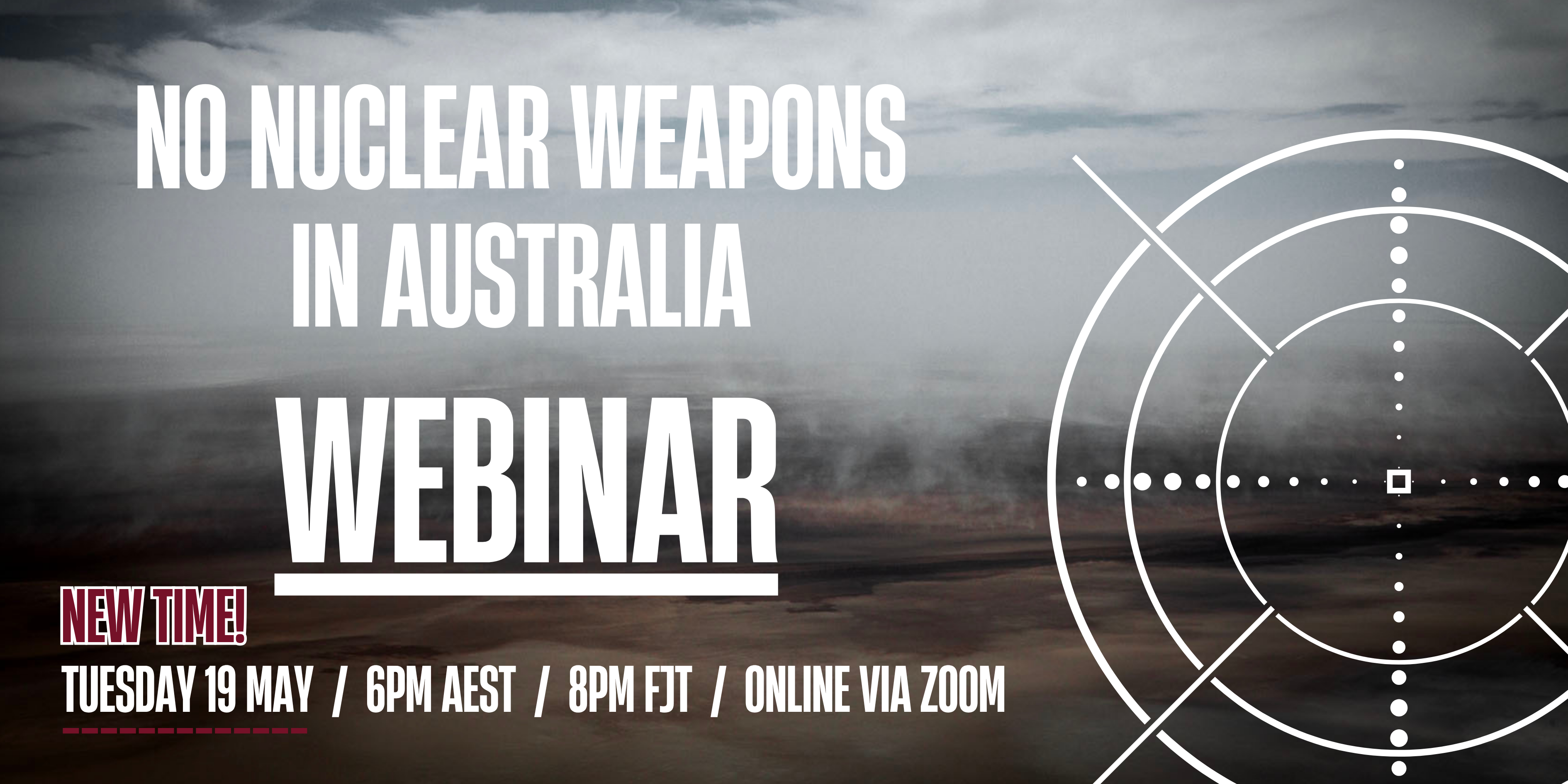
19 May – Webinar- Webinar: No Nuclear Weapons in Australia
Start: 2026-05-19 18:00:00 UTC Canberra, Melbourne, Sydney (GMT+10:00)
End: 2026-05-19 19:30:00 UTC Canberra, Melbourne, Sydney (GMT+10:00)
20 May – Webinar – The dangerous world of AUKUS, US, military occupation and suppression of dissent

National Webinar, 20th May, 2026, 6.30pm AEST. Confronting laws restricting/suppressing protest speech and action
Speakers: Former Sen. Rex Patrick, Lawyer Nick Hanna ,Arthur Rorris ,Jorgen Doyle, Sen David Shoebbridge,
Facilitator Kelley Tranter.

of the week – Australians for War Powers Reform (AWPR)
To see nuclear-related stories in greater depth and intensity
 Antinuclear