Kean says NSW can be renewable energy superpower, or stick its head in the sand — RenewEconomy

Energy minister Matt Kean says NSW can become renewable and economic superpower thanks to resources of low cost wind, solar and storage, if ideology doesn’t get in the way. The post Kean says NSW can be renewable energy superpower, or stick its head in the sand appeared first on RenewEconomy.
via Kean says NSW can be renewable energy superpower, or stick its head in the sand — RenewEconomy
Okinawa Governor Refuses to Host Prohibited U.S. Nuclear Missiles
Okinawa Governor Refuses to Host Prohibited U.S. Nuclear Missiles, By Jaya Ramachandran, GENEVA (IDN) 29 June 20, – Governor Denny Tamaki of Okinawa district has rejected the U.S. plans to base on the island missiles capable of threatening China – apparently as part of President Donald Trump’s move to challenge Beijing and upgrade the importance of Taiwan, 500 kilometres away from the island. If a plan for Okinawa to host such missiles were to develop, Tamaki said: “I can easily imagine fierce opposition from Okinawa residents.”
Okinawa comprises more than 150 islands in the East China Sea between Taiwan and Japan’s mainland. It’s known for its tropical climate, broad beaches and coral reefs, as well as World War II sites.
Okinawa has been a critical strategic location for the United States Armed Forces since the end of World War II. The island hosts around 26,000 U.S. military personnel, about half of the total complement of the United States Forces Japan, spread among 32 bases and 48 training sites.
The largest island (Okinawa) hosts the Okinawa Prefectural Peace Memorial Museum, commemorating a massive 1945 Allied invasion, and Churaumi Aquarium, home to whale sharks and manta rays.
Missiles the U.S. plans to base on Okinawa are prohibited by the 1987 Intermediate-Range Nuclear Forces (INF) Treaty between the U.S. and the Soviet Union which, after dissolution, reconstituted into the Russian Federation in 1991.
U.S. President Ronald Reagan and the then Soviet General Secretary Mikhail Gorbachev agreed to eliminate and permanently forswear all of their nuclear and conventional ground-launched ballistic and cruise missiles with ranges of 500 to 5,500 kilometres.
It was the first arms-control treaty to abolish an entire category of weapons systems. Besides, two protocols to the agreement established unprecedented procedures for observers from both nations to verify first-hand the other countries destruction of its missiles.
The INF Treaty led to the elimination of 2,692 U.S. and Soviet nuclear and conventional, ground-launched ballistic and cruise missile. The U.S. President Donald Trump formally withdrew from the treaty August 2, 2019, citing Russian noncompliance with the accord. The Pentagon tested two previously prohibited missiles in August and December 2019.
Since the United States withdrew from the Treaty, Australia, Japan, the Philippines, and South Korea have publicly said that they were not asked to nor are they considering serving as hosts for new U.S. ground-launched missiles. Secretary of Defence Mark Esper has previously suggested that he would like to see the deployment of such missiles in Europe and particularly Asia to counter China.
A senior Defence Department official told the Los Angeles Times that the Pentagon is “very attentive to our allies’ concerns, and we recognized their political challenges”. However, the official continued, “everything that’s said in the media is not necessarily what’s said behind closed doors”.
As the Washington-based Arms Control Association reported on June 26, Secretary-General of the North Atlantic Treaty Organization (NATO) Jens Stoltenberg said on June 17 after a NATO Defence Ministerial that the alliance has “no intention to deploy new land-based nuclear missiles in Europe”.
China is firmly opposed to any deployment of such missiles in the Asia-Pacific. “If the U.S. insists on the deployment, it will be a provocation at China’s doorstep,” said Chinese Defence Ministry Spokesperson Senior Colonel Wu Qian on June 24. “China will never sit idle and will take all necessary countermeasures,” he warned…….. https://www.indepthnews.net/index.php/armaments/nuclear-weapons/3648-okinawa-governor-refuses-to-host-prohibited-u-s-nuclear-missiles
Ukraine declassifies Chernobyl nuclear disaster documents
Ukraine declassifies Chernobyl nuclear disaster documents https://www.brusselstimes.com/all-news/119019/ukraine-declassifies-chernobyl-documents/
The archives, published in a book edited by the Ukrainian secret service, SBU, give an overview of the various construction errors, accidents and emergency interruptions at the plant between 1971 and the day of the disaster.
After Reactor 4 of the Soviet nuclear plant at Chernobyl exploded, a no-go zone was set up around the area due to the risk of radiation.
The biggest nuclear disaster in History caused the deaths of thousands of people, while tens of thousands had to be displaced.
On Sunday, a new fire occurred in the red zone around the plant, which is about three hectares in area. The Ukrainian authorities said on Monday that the fire had, for the most part, been put out.
In early April, a forest fire fed by gusty winds and unusually dry weather had broken out around the abandoned nuclear plant.
By the time it was brought under control in mid-May, about 11,500 hectares had been destroyed.
New Zealand a really independent nation – nuclear-free despite thr terrorism of the Rainbow Warrior bombing
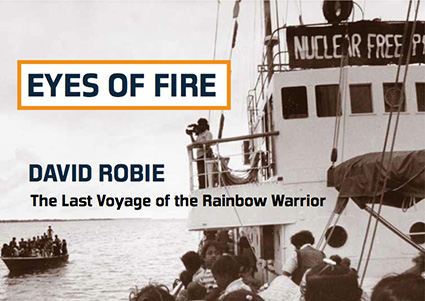
New Zealand established its credentials as an independent small nation after the fatal bombing of the Greenpeace flagship Rainbow Warrior in 1985, says an author and academic who spent weeks on the vessel shortly before it was attacked.
On 10 July 1985, the Rainbow Warrior was sunk at an Auckland wharf by two bombs planted on the hull of the ship by French secret agents.
The event is often referred to as the first act of terrorism in New Zealand.
LISTEN: The Afternoons with Jesse Mulligan Crime NZ interview with David Robie
WATCH: Eyes of Fire archival videos
READ: The Eyes of Fire book
Two French agents planted two explosives on the ship while it was berthed at Marsden wharf, the second explosion killing Greenpeace photographer Fernando Pereira.
Dr David Robie, who is an AUT professor of journalism and communication studies, as well as the director of the university’s Pacific Media Centre, had spent more than 10 weeks on the ship as a journalist covering its nuclear rescue mission in the Pacific.
He wrote about his experience in Eyes of Fire, a book about the last voyage of the first Rainbow Warrior – two other Rainbow Warrior ships have followed.
In 1985, Rongelap atoll villagers in the Marshall Islands asked Greenpeace to help them relocate to a new home at Mejato atoll. Their island had been contaminated by radioactive fallout from US atmospheric nuclear weapons testing in the Pacific.
Environmental journalism
“At the time I was very involved in environmental issues around the Pacific and in those days Greenpeace was very small, a fledgling organisation,” he tells Jesse Mulligan.
“They had a little office in downtown Auckland and Elaine Shaw was the coordinator and she was quite worried that this was going to be a threshold voyage.
“It was probably the first campaign by Greenpeace that was humanitarian, it wasn’t just environmental – to rescue basically the people who had been suffering from nuclear radiation.” ……….
Moruroa protest planned
The US had carried out 67 nuclear tests at the Marshall Islands. France was also carrying out 193 tests in the Pacific and Greenpeace had planned on confronting that situation at Moruroa Atoll after its Marshall Islands rescue effort.
New Zealand had already voiced disapproval of the testing in the region, with then Prime Minister David Lange in 1984 rebuking the French for “arrogantly” continuing the programme in the country’s backyard.
Dr Robie left the ship when it docked in Auckland after the Marshall Islands stage of the mission. Three days after the ship had docked, a birthday celebration was held for Greenpeace campaign organiser Steve Sawyer onboard. The attack happened after the party.
Just before midnight on the evening of 10 July 1985, two explosions ripped through the hull as the ship.
Portuguese crew member Fernando Pereira was killed after returning on board after the first explosion……..
Thirteen foreign agents were involved, operating in three teams. The first team brought in the explosives, the second team would plant these and the third was on stand-by in case anything went wrong with the first two teams.
“A commanding officer kept an overview of the whole operation. I think there was an element of arrogance, the same arrogance as with the testing itself. There was a huge amount of arrogance about taking on an operation like this in a peaceful country – we were allies of France at the time – and it is extraordinary that they assumed they could get away with this outrageous act.”
Two of the spies were caught. Two General Directorate for External Security (DGSE) officers, Dominique Prieur and Alain Mafart, were arrested on July 24. Both were charged with murder, pleaded guilty to manslaughter and were sentenced to 10 years’ imprisonment.
Repression of independence movements
“You have to see it within the context of the period of the time,” Dr Robie says.
He says that the French policy of repression against independence movements in New Caledonia and Tahiti, with assassinations of Kanak leaders like Eloi Machoro, needed to be understood to put the Rainbow Warrior attack in perspective. France was bitterly defending its nuclear force de frappe.
“New Zealand was unpopular with the major nuclear powers and there was certainly no sympathy for New Zealand’s position about nuclear testing. So, there wasn’t really any co-operation, even from our closest neighbour, Australia……..
The case was a source of considerable embarrassment to the French government.
“They did pay compensation after arbitration that went on with the New Zealand government and Greenpeace. But justice was never really served… the 10 years were never served, both Prieur and Mafart were part of the negotiations with French government.
NZ was held ‘over a barrel’
“Basically, France had New Zealand over a barrel over trade and the European Union, so compromises were reached and Prieur and Mafart were handed over to France for three years. Essentially house arrest at Hao atoll, the rear base of the French nuclear operations in Polynesia.”
Dr Robie said the rear base was widely regarded as a military “Club Med”.
He says they didn’t even spend three years there, but left for France within the time period.
While the attack was on an international organisation rather than New Zealand itself, most New Zealanders saw it as an attack on the sovereignty of the nation
Dr Robie says it left a long-lasting impression on New Zealanders.
“It was a baptism of fire. It was a loss of innocence when that happened. And in that context, we had stood up as a small nation on being nuclear-free. Something we should have been absolutely proud of, which we were, with all those who campaigned for that at the time. I think that really established our independence, if you like, as a small nation.
“I think we have a lot to contribute to the world in terms of peace-making and we shouldn’t lose track of that. The courage that was shown by this country, standing up to a major nuclear power. We should follow through on that kind of independence of thought.” https://asiapacificreport.nz/2020/06/29/nz-gained-international-creds-as-nuclear-free-nation-with-rainbow-warrior-bombing-says-author/
Australian government to blame for failure of environment laws
 Let there be no doubt: blame for our failing environment laws lies squarely at the feet of government, The Conversation June 29, 2020 Peter BurnettHonorary Associate Professor, ANU College of Law, Australian National University A long-awaited draft review of federal environment laws is due this week. There’s a lot riding on it – particularly in light of recent events that suggest the laws are in crisis.
Late last week, the federal Auditor-General Grant Hehir tabled a damning report on federal authorities’ handling of the Environment Protection and Biodiversity Conservation (EPBC) Act. Incredibly, he found Australia’s premier environmental law is administered neither efficiently or effectively.
It followed news last month that mining company Rio Tinto detonated the 46,000 year old Juukan rock shelters in the Pilbara. The decision was authorised by a 50 year old Western Australian law –and the federal government failed to invoke emergency powers to stop it.
Also last month we learned state-owned Victorian logging company VicForests unlawfully logged 26 forest coupes, home to the critically endangered Leadbeater’s possum. The acts were contrary both to its own code of practice, and the agreement exempting VicForests from federal laws.
As relentless as Hehir’s criticisms of the department are, let there be no doubt that blame lies squarely at the feet of government. As a society, we must decide what values we want to protect, count the financial cost, then make sure governments deliver on that protection.
Shocking report card
I’ve been involved with this Act since before it began 20 years ago. As an ACT environment official reading a draft in 1998 I was fascinated by its complexity and sweeping potential. As a federal official responsible for administering, then reforming, the Act from 2007-2012, I encountered some of the issues identified by the audit, in milder form.
But I was still shocked by Hehir’s report. It’s so comprehensively scathing that the department barely took a trick.
Overall, the audit found that despite the EPBC Act being subject to multiple reviews, audits and parliamentary inquiries since it began, the Department of Agriculture, Water and the Environment’s administration of the laws is neither efficient nor effective………
How did this happen?
The EPBC Act itself remains a powerful instrument. Certainly changes are needed, but the more significant problems lie in the processes that should support it: plans and policies, information systems and resourcing.
As I wrote last month, between 2013 and 2019 the federal environment department’s budget was cut by an estimated 39.7%.
And while effective administration of the Act requires good information, this can be hard to come by. For example the much-needed National Plan for Environmental Information, established in 2010, was never properly resourced and later abolished……..
A national conversation
There is a small saving grace here. Hehir says the department asked that his report be timed to inform Professor Graeme Samuel’s 10-year review of the EPBC Act. Hehir timed it perfectly – Samuel’s draft report is due by tomorrow. Let’s hope it recommends comprehensive action, and that the final report in October follows through.
Beyond Samuel’s review, we need a national conversation on how to fix laws protecting our environment and heritage. The destruction of the Juukan rock shelters, unlawful logging of Victorian forests and the Auditor-General’s report are incontrovertible evidence the laws are failing……https://theconversation.com/let-there-be-no-doubt-blame-for-our-failing-environment-laws-lies-squarely-at-the-feet-of-government-141482
Australia could create hundreds of thousands of jobs by accelerating shift to zero emissions – report
 could create hundreds of thousands of jobs by accelerating shift to zero emissions – report
Decarbonising the economy by investing in renewable energy, clean buildings, clean transport and manufacturing could help fight the recession, Guardian, Adam Morton Environment editor @adamlmorton, Mon 29 Jun 2020 Hundreds of thousands of jobs could be created in Australia by hurrying the shift to zero greenhouse gas emissions, a study backed by business and investment leaders has found.
The Australian Bureau of Statistics estimates 835,000 jobs have been lost since the coronavirus pandemic shutdown began in March. A report by Beyond Zero Emissions, an energy and climate change thinktank, says practical projects to decarbonise the economy could create 1.78m “job years” over the next five years – on average, 355,000 people in work each year – while modernising Australian industry.
Called the “million jobs plan”, it says further stimulus measures needed to fight the Covid-19 recession are “a unique opportunity to lay the foundations for a globally competitive Australian economy fit for 21st century challenges”.
The report focuses on proposals it says are already being planned and could create jobs by accelerating private and public investment in renewable energy, clean buildings, clean transport, manufacturing and land use that will happen in the years ahead anyway. Benefits would include improved air quality and new employment in regional areas.
Eytan Lenko, Beyond Zero Emissions’ interim chief executive, said the group had brought together investment, business and industry leaders to scope the best clean solutions that would drive productivity and growth.
“No one thought 2020 would turn out the way it has. We now have a unique opportunity to seize this moment, to retool, reskill, and rebuild our battered economy to set us up for future generations,” he said.
The plan would require hundreds of billions of dollars in investment. It says clean energy investors have indicated their willingness to spend on this scale, pointing to the more than $100bn of existing renewable energy projects proposed but yet to be built.
The report says Australia risks missing out on some of these opportunities, and others in electric transport, zero-carbon manufacturing and green steel, unless governments deliver policy certainty and help create an environment that encourages large clean investment deals. Reserve Bank research found the number of large-scale renewable energy projects reaching commencement fell about 50% last year after a record-setting 2018.
Beyond Zero Emissions says governments also have a role to play in direct investment in, for example, urgent transmission line projects to new renewable energy zones, the construction of energy-efficient social housing, and the introduction and expansion of electric buses and trains………. https://www.theguardian.com/australia-news/2020/jun/29/australia-could-create-hundreds-of-thousands-of-jobs-by-accelerating-shift-to-zero-emissions-report
New 500MW wind farm and big battery planned for southern Queensland — RenewEconomy

Developers behind Queensland’s “Battery of the North” are planning another massive project for the state’s south – a 500MW wind farm with 200MWh of battery storage. The post New 500MW wind farm and big battery planned for southern Queensland appeared first on RenewEconomy.
via New 500MW wind farm and big battery planned for southern Queensland — RenewEconomy
June 28 Energy News — geoharvey
Opinion: ¶ “Is GM’s ICE Business Worthless? Adam Jonas Seems To Say So” • Morgan Stanley auto analyst Adam Jonas says GM’s EV business is worth $100 billion. Jonas’s price target of $43 per share puts GM’s total value at $60 billion. Doesn’t that mean that GM’s internal combustion engine business is worth less than […]
ACTU warns Morrison: get real on climate and renewables, or lose metals industry — RenewEconomy
Australia’s peak trade union body calls on Morrison government to introduce “credible” emissions and renewables policies or risk losing some of the nation’s core industries. The post ACTU warns Morrison: get real on climate and renewables, or lose metals industry appeared first on RenewEconomy.
via ACTU warns Morrison: get real on climate and renewables, or lose metals industry — RenewEconomy
South Australian MP Rowan Ramsey, and Minister for Resources, Keith Pitt, talk nonsense about the planned nuclear waste dump at Napandee.

By Noel Wauchope, 27 June 20. Examining the Joint media release by the Member for Grey Rowan Ramsey MP and Keith Pitt, Minister for Resources, 11 June 2020 – “Important step for national radioactive waste facility in South Australia.” – here it is –
Legislation has been introduced to federal parliament that will pave the way for a critical piece of national infrastructure to support the increasing use of nuclear medicine in Australia and provide an economic boost to a regional South Australian
community. The National Radioactive Waste Management Amendment (Site Specification, Community Fund and Other Measures) Bill today passed through the House of Representatives.
Minister for Resources, Water and Northern Australia Keith Pitt said it’s an important milestone for the establishment of the facility.
“Governments have been attempting to find a solution to this issue for decades and today our Government has taken a
significant step in bringing the process to a conclusion,” Minister Pitt said.
My Response That just shows how hopeless and incompetent the government has been on this issue and still cannot do everything correctly and in an acceptable manner under internationally prescribed standards.
Moreover the government lacks the capacity or simply does not want to follow and adopt the most recent developments and advances in the field of nuclear waste disposal and storage.
The legislation will confirm the site near Kimba in South Australia as the home for the facility that will allow the continued growth of nuclear medicine in Australia.
My Response This has nothing to do with nuclear medicine and is a most dishonest representation. It again shows bad planning on the part of the government, particularly as the new nuclear medicine facility at Lucas Heights for the production of molybdenum is having persistent problems which could have led to a total shutdown last year.
Interestingly there was little public reporting of these problems by either ANSTO or ARPANSA as the regulatory authority which as a result had to issue only an interim operating licence.
“The site was one of 28 across the country that was voluntarily nominated, followed by extensive engagement and consultation with the surrounding community that has shown broad support for the project,” Minister Pitt said.
My ResponseThere have not been 28 voluntary nominations or the extensive engagement and consultations particularly as there has been no contact by the government with the Azark Project at Leonora in Western Australia since early 2018.
“There has also been extensive engagement with other stakeholders during this process, including with Traditional Owners.”
My Response Again, there has been no extensive engagement with Traditional Owners, particularly as the Azark Project has far more internationally based scientific and technical knowledge available to it in the areas of nuclear chemistry and engineering as to waste then possessed by the government through ANSTO and CSIRO There has not been any contact even with the traditional owners\ of the Azark site at Leonora.
Member for Grey, Rowan Ramsey, said the local community has heard enough and just wants work on the facility to begin. “I thank the landholders who nominated their properties and have been the centre of attention ever since and I also thank the whole community for engaging in the consultation process,” Mr Ramsey said.
My ResponseRamsey is being disingenuous as in all probability the proposal for Napandee will have difficulty getting the necessary licences for its establishment and operations.
No work can begin until those licences are issued.
The land owners concerned did not voluntarily nominate their properties but only did so at the suggestion of Ramsey and the government through the then Department of Industry Innovation and Science, since other properties in the Kimba region were found unsuitable.
The government has refused to produce the nomination forms for the properties at Napandee and Lyndhurst, as they were apparently filled out for them by the Department’s staff.
“Of course there are differing views, but the whole community has made a decision and most are looking forward to the commencement of work.”
My ResponseThis is absolute rubbish as Ramsey knows that there are many people who are against the proposed facility and if a proper and fully informed plebiscite were held then the government would struggle to get approval for its ill-conceived proposals.
Whichever way it is examined the government has failed to provide sufficient information for an informed decision or consent by the selected voters for the Kimba ballots and excluded many other persons who should have had a vote on this important issue.
Minister Pitt said the legislation will now head to the Senate and called on Labor and the cross-benchers to support the project.
My ResponseWishful thinking as discussions with both the opposition and cross-benchers in the Senate are already suggestive of lack of support for the legislation.
“Suggestions that a site in the Woomera area could be used for the facility are simply not practical due to the increase in Defence Force training activities that will limit access to the area,” Minister Pitt said.
My Response Is not the real reason that the Defence Force does not trust or rely on ANSTO and will not work with it in containing or disposing of any nuclear waste as Defence wants to retain complete control of its nuclear material?
“The passage of this Bill, and the construction of the facility, is crucially important to the future of nuclear medicine in Australia, which will benefit two in three Australians”.
My Response This, as already mentioned, has nothing to do with the future of nuclear medicine in Australia and this is confirmed by overseas experts who regard the proposals for Kimba as unrealistic and uncommercial with an obvious lack of research.
“Currently the waste is stored in around 100 locations across the country, including hospital basements, research facilities and universities”.
My Response Yes but only a relatively small portion of this waste is under the control of the federal government and again, from discussions with state government and private institutions having waste, is that they will not use the facility as they regard ANSTO as completely unreliable.
“The project at Kimba will support the future growth of nuclear medicine in Australia, and provide new job and economic opportunities for a South Australian regional community.”
My Response How will this support the future growth of nuclear medicine in Australia as its production has nothing to do with the storage issue?
Equally the numbers of 45 new jobs or others stated by the government are completely unrealistic, as much larger similar facilities overseas have only a fraction of that staff complement.
To be quite clear about the situation:
1. Even though it claims that it has not raised any concerns regarding the storage of waste at what is known as the interim waste storage facility at Lucas Heights, ARPANSA still requires ANSTO under existing licensing arrangements to report by 30 June 2020 on the plans for the storage and disposal of that waste.
2. This came about because when this waste was returned by the end of 2015 from overseas reprocessing, the intended storage facility for it which is described as the national radioactive waste management facility was not available.
3. As a result ARPANSA permitted by licence for ANSTO to temporarily store the reprocessed waste at the interim waste storage facility at Lucas Heights but on the condition that ANSTO provides plans for the final management of that waste by its removal.
4. It follows that the urgency is for the government through ANSTO to have firm plans for the removal by being able to specify the proposed facility at Napandee for that purpose.
5. This is obviously the reason for the rushed legislative process which will probably involve debating the bill in the Senate before the existing committee inquiry is completed.
6. A similar condition has been imposed by ARPANSA under the licence for ANSTO to operate the new nuclear medicine facility at Lucas Heights.
7. The waste in question is classified by the government as being of intermediate level but it is at the higher end of that class as to volatility and was classified as high level waste by France when being returned to ANSTO after reprocessing.
8. It is this level of waste about which the government has been rather backward in providing any information of a public nature as by the international safety prescriptions it should even for temporary storage be by appropriate geological burial which is simply not possible at Kimba.
9. It is a major reason for the obvious difficulties that ANSTO will encounter in trying to get the necessary licences for the storage facility at Napandee.
10. The other important aspect of the government’s proposals will be the disclosure by ANSTO of the inventory of radionuclides applicable to that waste which becomes the determining factor of the manner of storage and ultimate disposal to be used for that waste. That is why the level or quantum of radionuclides should be the first issue examined by the Senate inquiry as it will form the basis of the safety case and even indicate whether the Napandee facility plans should be pursued.
11. The ridiculous part of all of this is that the government has persistently refused to consider the Azark Project facility at Leonora , which would readily overcome the problems of storage and ultimate disposal of the intermediate level waste in a completely acceptable manner in accordance with all international standards and at a fraction of the cost of the government’s proposals.
It’s 38°C in Siberia – need for action on global heating!
|
The Arctic heatwave: here’s what we know, https://www.theguardian.com/commentisfree/2020/jun/25/arctic-heatwave-38c-siberia-scienceTamsin Edwards
It’s 38°C in Siberia. The science may be complicated – but the need for action now couldn’t be clearer Fri 26 Jun 2020 There’s an Arctic heatwave: it’s 38°C in Siberia. Arctic sea ice coverage is the second lowest on record, and 2020 may be on course to be the hottest year since records began. For many people, such news induces a lurch of fear, or avoidance – closing the webpage because they don’t want to hear yet more bad news. A few might think “It’s just weather,” and roll their eyes. How can we make sense of such an event? Climate is subtle and shifting, with many drivers and timescales. But we can use this northern heatwave to illuminate the complexity of our planet. We can break this question into parts, from fast to slow. Fast: the immediate effect is to increase wildfires. Siberia has seen “zombie fires” reignited from deep smouldering embers in peatland. This is bad news, releasing particulate air pollution and more carbon in 18 months than in the past 16 years. The immediate cause? Here in the mid-high northern latitudes, we live in unstable weather under the influence of the polar jet stream. This rapid current of air high above our heads drags weather in a conveyor belt from west to east, with alternating patches of cold and warm air, low and high pressure. Sometimes the weather patterns get stuck, creating a stable period of weather, like a heatwave. This is one long, severe example. Does climate change make this “blocking” more likely? Maybe. The jet stream is created by the contrast between cold polar air and the warmer south. The Arctic is warming twice as fast as the global average: that means less north-south contrast, so the jet stream can become more wobbly and meandering. Loops break off like the oxbow lakes of school geography lessons, stranding particular weather patterns in one place. And why is the Arctic warming faster? Because sea ice and snow are so bright. When they melt with global warming, the ocean and land beneath are darker, so they absorb more of the sun’s heat. Their loss amplifies our warming. The current low in Arctic sea ice is itself partly the result of the Siberian heatwave, amplifying the usual year-to-year fluctuations. But the trend is down: the more CO2 we emit, the more the planet’s temperature rises, and the more sea ice we lose. Scientists predict the Arctic will start seeing summers without sea ice by 2050. But it’s not irreversible. It’s not a tipping point. The sea ice would return if we could cool the climate again. Unfortunately we know only three ways to do that: extract vast amounts of CO2 from the air with trees or technology; reflect the sun’s rays at a planetary scale; or wait, for many generations. This Arctic heatwave is a sharp spike on top of the global warming trend. That’s what makes it more intense, more likely and more of a warning: it’s a taste of the future predicted for Russia, if we burn quickly through our fossil fuels. The real fear around the Arctic for the longer term, I find when talking to people, comes from the idea of “runaway” warming from methane release. Warming could release stores of methane – a strong greenhouse gas – from permafrost or frozen sediments at the bottom of the ocean, which would add to the warming from our own activities. There is more than twice the amount of carbon in the permafrost as in the atmosphere, and thawing has already begun. There are big local impacts – damage to roads and buildings, because the ground can no longer bear so much weight, and an appalling story involving what appears to be anthrax release from thawing burial grounds. Permafrost thaw was even blamed by a Russian mining company for the recent collapse of a fuel reservoir, contaminating the river with 20,000 tonnes of diesel, though other factors were probably also involved. So could this Siberian heatwave, or ones like it, trigger catastrophic warming? I see much fear about amplifying methane feedbacks, including the false idea that climate scientists don’t consider them (we do, just separately to the main global climate models). Yet for several years there has been growing evidence that this risk is less than originally thought. Carbon stored in permafrost and wetlands is predicted to contribute around 100bn tonnes of CO2 this century. That’s a lot, but we add around 40bn tonnes ourselves every year. The methane at the bottom of the ocean would take centuries to release, so as long as we limit global warming we should keep those stores mostly locked up. There are uncertainties, of course, but the stores’ impact on warming is likely to be tenths of a degree, not several degrees. Yet every tonne of CO2 released from permafrost means one tonne fewer we can emit if we are to reach net zero emissions by 2050. Every year’s equivalent of our emissions brings our deadline closer. Every tenth of a degree of warming brings us closer to our target of 1.5°C and makes more permafrost thaw, and the impacts of climate change worse for the most vulnerable people and species of the world. The Arctic heatwave shows us that there are few simple stories in climate change. There is always a mix of natural and human influence, bad news and slightly-less-bad news, and occasionally even hopeful news. So, more than ever, we need to avoid over-simplifying or slipping into easy tropes like “We’re all doomed” or “It’s all weather,” but to try to understand the details. Perhaps there is one simple story though: every bit of warming we avoid will help keep our planet a more familiar and an easier place to live on. • Dr Tamsin Edwards is a senior lecturer in physical geography at King’s College London |
|
16th Century colonisation, slavery began the planet’s damage, 21st Century pandemic response could repair it.

We’ve made enough concrete to cover the entire surface of the Earth in a layer two millimetres thick. Enough plastic has been manufactured to clingfilm it as well. We annually produce 4.8 billion tonnes of our top five crops and 4.8 billion livestock animals. There are 1.4 billion motor vehicles, 2 billion personal computers, and more mobile phones than the 7.8 billion people on Earth.
All this suggests humans have become a geological superpower and evidence of our impact will be visible in rocks millions of years from now. This is a new geological epoch that scientists are calling the Anthropocene, combining the words for “human” and “recent-time”. But debate still continues as to when we should define the beginning of this period. When exactly did we leave behind the Holocene – the 10,000 years of stability that allowed farming and complex civilisations to develop – and move into the new epoch?
Five years ago we published evidence that the start of capitalism and European colonisation meet the formal scientific criteria for the start of the Anthropocene.
Our planetary impacts have increased since our earliest ancestors stepped down from the trees, at first by hunting some animal species to extinction. Much later, following the development of farming and agricultural societies, we started to change the climate. Yet Earth only truly became a “human planet” with the emergence of something quite different. This was capitalism, which itself grew out of European expansion in the 15th and 16th century and the era of colonisation and subjugation of indigenous peoples all around the world.
In the Americas, just 100 years after Christopher Columbus first set foot on the Bahamas in 1492, 56 million indigenous Americans were dead, mainly in South and Central America. This was 90% of the population. Most were killed by diseases brought across the Atlantic by Europeans, which had never been seen before in the Americas: measles, smallpox, influenza, the bubonic plague. War, slavery and wave after wave of disease combined to cause this “great dying”, something the world had never seen before, or since.
In North America the population decline was slower but no less dramatic due to slower colonisation by Europeans. US census data suggest the Native American population may have been as low as 250,000 people by 1900 from a pre-Columbus level of 5 million, a 95% decline.
This depopulation left the continents dominated by Europeans, who set up plantations and filled a labour shortage with enslaved workers. In total, more than 12 million people were forced to leave Africa and work for Europeans as slaves. ……….
In addition to the critical task of highlighting and tackling the racism within science, perhaps geologists and geographers can also make a small contribution to the Black Lives Matter movement by unflinchingly compiling the evidence showing that when humans started to exert a huge influence on the Earth’s environment was also the start of the brutal European colonisation of the world.
In her insightful book, A Billion Black Anthropocenes or None, the geography professor Kathryn Yusoff makes it very clear that predominantly white geologists and geographers need to acknowledge that Europeans decimated indigenous and minority populations whenever so-called progress occurred.
Defining the start of the human planet as the period of colonisation, the spread of deadly diseases and transatlantic slavery, means we can face the past and ensure we deal with its toxic legacy. If 1610 marks both a turning point in human relations with the Earth and our treatment of each other, then maybe, just maybe, 2020 could mark the start of a new chapter of equality, environmental justice and stewardship of the only planet in the universe known to harbour any life. It’s a struggle nobody can afford to lose. https://theconversation.com/why-the-anthropocene-began-with-european-colonisation-mass-slavery-and-the-great-dying-of-the-16th-century-140661
Trump’s Justice department doubles down on USA allegations against Julian Assange
 ASSANGE EXTRADITION: Assange Hit With New Superseding Indictment, Reflecting Possible FBI Sting Operation The U.S. Justice Department on Wednesday unveiled the new superseding indictment against the WikiLeaks publisher, adding to existing computer intrusion charges. By Joe Lauria, Consortium News June 24, 2020 The Justice Department on Wednesday said it had filed a second superseding indictment against imprisoned WikiLeaks publisher Julian Assange, adding to existing computer intrusion charges.“The new indictment does not add additional counts to the prior 18-count superseding indictment returned against Assange in May 2019,” the DOJ said in a press release.
“It does, however, broaden the scope of the conspiracy surrounding alleged computer intrusions with which Assange was previously charged,” the release said. “According to the charging document, Assange and others at WikiLeaks recruited and agreed with hackers to commit computer intrusions to benefit WikiLeaks.”…….
The indictment quotes Assange at hacking conferences encouraging hackers to obtain a “Most Wanted Leaks” list of classified materials that WikiLeaks sought to publish.
It provides new allegations that Assange instructed a “teenager” from an unnamed NATO country to conduct various hacks “including audio recordings of phone conversations between high-ranking officials” of the NATO nation as well as members of parliament from that country. The indictment claims Manning “downloaded classified State Department materials” about this country.
WikiLeaks has identified the “teenager” as Sigurdur Thordarson, “a diagnosed sociopath, a convicted conman, and sex criminal” who had impersonated Assange to embezzle money from WikiLeaks………..
Thordarson, an Icelander, became an FBI informant, and was flown to Washington in May 2019 for an interview with the FBI.
The superseding indictment says Assange was allegedly able to learn from “unauthorized access” to a website of this government that police from that country were monitoring him. The indictment says the source of this information was a former member of Anonymous who worked with WikiLeaks named Sabu, identified in the press as Hector Monsegur, who became an FBI informant after being arrested in June 2011.
In the same month, Iceland’s Interior Minister Ögmundur Jonasson prevented FBI agents from entering Iceland, testifying that “FBI dirty-tricks operations were afoot against WikiLeaks.” He said the agents had been sent to seek “our cooperation in what I understood as an operation to set up, to frame Julian Assange and WikiLeaks.” The possibility remains that the new evidence against Assange was obtained in an FBI sting operation.
Jeremy Hammond, a hacker arrested for obtaining the Stratfor files, is named in the new indictment has having revealed information about his activities with Assange to Sabu in December 2011. Last September, Hammond, who was serving a 10-year sentence in Memphis, TN, was brought by prosecutors investigating Assange to Alexandria, VA to compel him to give testimony against Assange. Hammond has refused.
Reiterates Original Charges
The new indictment repeats the existing espionage and computer intrusion charges………
In 2010, Robert Parry, one of the best investigative reporters of his era, and the founder of this website, wrote that the then pending plans of the Obama administration to indict Assange “for conspiring with Army Pvt. Bradley Manning to obtain U.S. secrets strikes at the heart of investigative journalism on national security scandals.”
Parry added:
“That’s because the process for reporters obtaining classified information about crimes of state most often involves a journalist persuading some government official to break the law either by turning over classified documents or at least by talking about the secret information. There is almost always some level of ‘conspiracy’ between reporter and source.” [Emphasis added.]
Parry thus admitted to encouraging his sources to turn over classified information even if it meant committing the lesser crime of leaking classified information if it could help prevent a larger crime from being committed. In this way Assange encouraged Manning to turn over material such as the “Collateral Murder” video in the hope that it could end the illegal war in Iraq…….
The New York Times reported at the time that “federal prosecutors were reviewing the possibility of indicting Assange on conspiracy charges for allegedly encouraging or assisting Manning in extracting ‘classified military and State Department files from a government computer system,’” Parry wrote.
“The Times article by Charlie Savage notes that if prosecutors determine that Assange provided some help in the process, ‘they believe they could charge him as a conspirator in the leak, not just as a passive recipient of the documents who then published them,” wrote Parry.
This is precisely what the Trump Justice Department has done in the first computer intrusion indictment against Assange and now with this superseding one. https://consortiumnews.com/2020/06/24/assange-extradition-assange-hit-with-new-superseding-indictment-broadening-computer-intrusion-charges/?fbclid=IwAR3uZdqQkMLxeheGyUVLpkUYPIo0ywUZwFiQcu6pD9woYSYyPhZtyh3kiw4
We are going to need to learn to live with the virus

The shifting strategies are an acknowledgment that even the most successful countries cannot declare victory until a vaccine is found.
They also show the challenge presented by countries like the United States, Brazil and India, where the authorities never fully contained initial outbreaks and from where the coronavirus will continue to threaten to spread.
How the world is learning to live with a deadly pandemic, https://thenewdaily.com.au/news/world/2020/06/26/coronavirus-pandemic-2/
South Korea tells people to carry two types of masks for differing risky social situations.
Germany requires communities to crack down when the number of infections hits certain thresholds.
Britain will target local outbreaks in a strategy that Prime Minister Boris Johnson calls “whack-a-mole”.
Around the world, governments that had appeared to tame the coronavirus are adjusting to the reality that the disease is here to stay.
But in a shift away from damaging nationwide lockdowns, they are looking for targeted ways to find and stop outbreaks before they become third or fourth waves.
While the details differ, the strategies call for giving governments flexibility to tighten or ease as needed.
They require some mix of intensive testing and monitoring, lightning-fast response times by authorities, tight border management and constant reminders to their citizens of the dangers of frequent human contact.
They require some mix of intensive testing and monitoring, lightning-fast response times by authorities, tight border management and constant reminders to their citizens of the dangers of frequent human contact.
The strategies often force central governments and local officials to share data and work closely together, overcoming incompatible computer systems, turf battles and other long-standing bureaucratic rivalries. Continue reading
Scientists just beginning to grasp how bad this Coronavirus is
 Scientists just beginning to understand the many health problems caused by COVID-19
CHICAGO (Reuters) 26 June 20, – Scientists are only starting to grasp the vast array of health problems caused by the novel coronavirus, some of which may have lingering effects on patients and health systems for years to come, according to doctors and infectious disease experts.
Besides the respiratory issues that leave patients gasping for breath, the virus that causes COVID-19 attacks many organ systems, in some cases causing catastrophic damage.
“We thought this was only a respiratory virus. Turns out, it goes after the pancreas. It goes after the heart. It goes after the liver, the brain, the kidney and other organs. We didn’t appreciate that in the beginning,” said Dr. Eric Topol, a cardiologist and director of the Scripps Research Translational Institute in La Jolla, California.
In addition to respiratory distress, patients with COVID-19 can experience blood clotting disorders that can lead to strokes, and extreme inflammation that attacks multiple organ systems. The virus can also cause neurological complications that range from headache, dizziness and loss of taste or smell to seizures and confusion.
And recovery can be slow, incomplete and costly, with a huge impact on quality of life.
The broad and diverse manifestations of COVID-19 are somewhat unique, said Dr. Sadiya Khan, a cardiologist at Northwestern Medicine in Chicago.
With influenza, people with underlying heart conditions are also at higher risk of complications, Khan said. What is surprising about this virus is the extent of the complications occurring outside the lungs.
Khan believes there will be a huge healthcare expenditure and burden for individuals who have survived COVID-19.
LENGTHY REHAB FOR MANY
Patients who were in the intensive care unit or on a ventilator for weeks will need to spend extensive time in rehab to regain mobility and strength.
“It can take up to seven days for every one day that you’re hospitalized to recover that type of strength,” Khan said. “It’s harder the older you are, and you may never get back to the same level of function.”
While much of the focus has been on the minority of patients who experience severe disease, doctors increasingly are looking to the needs of patients who were not sick enough to require hospitalization, but are still suffering months after first becoming infected. …….. https://www.reuters.com/article/us-health-coronavirus-effects/scientists-just-beginning-to-understand-the-many-health-problems-caused-by-covid-19-idUSKBN23X1BZ
1 This month.


PETITION – To: Prime Minister Anthony Albanese and the Australian Labor Government
Chernobyl: The Lost Tapes – A good documentary on Chernobyl on SBS available On Demand for the next 3 weeks– https://www.sbs.com.au/ondemand/tv-program/chernobyl-the-lost-tapes/235274195556

19 May – Webinar- Webinar: No Nuclear Weapons in Australia
Start: 2026-05-19 18:00:00 UTC Canberra, Melbourne, Sydney (GMT+10:00)
End: 2026-05-19 19:30:00 UTC Canberra, Melbourne, Sydney (GMT+10:00)
20 May – Webinar – The dangerous world of AUKUS, US, military occupation and suppression of dissent

National Webinar, 20th May, 2026, 6.30pm AEST. Confronting laws restricting/suppressing protest speech and action
Speakers: Former Sen. Rex Patrick, Lawyer Nick Hanna ,Arthur Rorris ,Jorgen Doyle, Sen David Shoebbridge,
Facilitator Kelley Tranter.

of the week – Australians for War Powers Reform (AWPR)
To see nuclear-related stories in greater depth and intensity
 Antinuclear