Auditor general finds that Morrison government has failed in its duty to protect environment
|
Morrison government has failed in its duty to protect environment, auditor general finds
Conservation groups call for independent environment regulator after scathing review of national laws, Guardian, Lisa Cox, 25 Jun 2020 The government has failed in its duty to protect the environment in its delivery of Australia’s national conservation laws, a scathing review by the national auditor general has found.
The Australian National Audit Office found the federal environment department has been ineffective in managing risks to the environment, that its management of assessments and approvals is not effective, and that it is not managing conflicts of interest in the work it undertakes. The report also finds a correlation between funding and staffing cuts to the department and a blow-out in the time it is taking to make decisions, as highlighted by Guardian Australia. The review, which comes in advance of the interim report on Australia’s Environment Protection and Biodiversity Conservation Act, has prompted renewed calls for the establishment of an independent national environmental regulator……. Among its findings, the auditor found the department could not demonstrate that the environmental conditions it set for developments were enough to prevent unacceptable risk to Australia’s natural environment. Of the approvals examined, 79% contained conditions that were noncompliant with procedures or contained clerical or administrative errors, reducing the department’s ability to monitor the condition or achieve the intended environmental outcome. The report also found that a document the department is required to produce to show how the proposed environmental conditions would produce the desired environmental protections was in most cases not being written……. “This report is a scathing indictment of the federal government’s administration of our national environment law and highlights why we need a stronger law and a new independent regulator,” said James Trezise, a policy analyst at the Australian Conservation Foundation. Trezise said the audit showed the government and department had failed in their duty to protect Australia’s unique wildlife and environment. “Worryingly for an area of public policy in which commercial interests are constantly trying to influence, the auditor general found ‘conflicts of interest are not managed’,” he said.
He said the organisation had raised concerns with the auditor about the capacity for political interference in what should be independent decisions………. Australia’s conservation laws are currently subject to a statutory review by the former competition watchdog chair Graeme Samuel. In advance of the interim report, due next week, the government has expressed a desire to streamline approvals and cut so-called “green tape”. But environment groups said the audit confirmed Australia’s laws were “fundamentally broken”. The Wilderness Society’s Suzanne Milthorpe said the findings showed a “catastrophic failure” to administer the law and protect the environment. “This report shows that the natural and cultural heritage that is core to Australia’s identity is being put at severe risk by the government’s unwillingness to fix problems they’ve been warned about for years,” she said. “It shows that even when the department is aware of high risks of environmental wrongdoing, like with deforestation from agricultural expansion, they are unwilling to act…….. https://www.theguardian.com/environment/2020/jun/25/morrison-government-has-failed-in-its-duty-to-protect-environment-auditor-general-findshu |
|
With Liberal Coalition business as usual on energy, thousands of renewable energy jobs will vanish
Up to 11,000 renewable energy jobs at risk if the government ignores calls for new policies, https://www.sbs.com.au/news/up-to-11-000-renewable-energy-jobs-at-risk-if-the-government-ignores-calls-for-new-policies Renewable energy groups are calling for greater public investment as companies risk losing thousands of jobs if the government ignores calls for a policy refresh. BY OMAR DEHEN, 26 June 20, Up to 11,000 jobs in Australia’s renewable energy sector could be lost over the next two years if no additional policies are introduced by the Morrison government, a new report has found.
Modelling from the University of Technology Sydney looked at several scenarios that predicted a reduction of jobs in the industry.
The modelling also examined scenarios that increased employment and reduced electricity costs across Australia.
Assange faces new indictment in US
 WikiLeaks founder Assange faces new indictment in US, https://apnews.com/218d39782d70c434533b8faa033eb45e By ERIC TUCKER, 26 June 20 WikiLeaks founder Assange faces new indictment in US, https://apnews.com/218d39782d70c434533b8faa033eb45e By ERIC TUCKER, 26 June 20WASHINGTON (AP) — WikiLeaks founder Julian Assange sought to recruit hackers at conferences in Europe and Asia who could provide his anti-secrecy website with classified information, and conspired with members of hacking organizations, according to a new Justice Department indictment announced Wednesday. The superseding indictment does not contain additional charges beyond the 18 counts the Justice Department unsealed last year. But prosecutors say it underscores Assange’s efforts to procure and release classified information, allegations that form the basis of criminal charges he already faces. Beyond recruiting hackers at conferences, the indictment accuses Assange of conspiring with members of hacking groups known as LulzSec and Anonymous. He also worked with a 17-year-old hacker who gave him information stolen from a bank and directed the teenager to steal additional material, including audio recordings of high-ranking government officials, prosecutors say. Assange’s lawyer, Barry Pollack, said in a statement that “the government’s relentless pursuit of Julian Assange poses a grave threat to journalists everywhere and to the public’s right to know.” “While today’s superseding indictment is yet another chapter in the U.S. Government’s effort to persuade the public that its pursuit of Julian Assange is based on something other than his publication of newsworthy truthful information,” he added, “the indictment continues to charge him with violating the Espionage Act based on WikiLeaks publications exposing war crimes committed by the U.S. Government.” Assange was arrested last year after being evicted from the Ecuadorian Embassy in London, where he had sought refuge to avoid being sent to Sweden over allegations of rape and sexual assault, and is at the center of an extradition tussle over whether he should be sent to the United States. The Justice Department has already charged him with conspiring with former U.S. Army intelligence analyst Chelsea Manning in one of the largest compromises of classified information in U.S. history by working together to crack a password to a government computer. Prosecutors say the WikiLeaks founder damaged national security by publishing hundreds of thousands of classified documents, including diplomatic cables and military files on the wars in Iraq and Afghanistan, that harmed the U.S. and its allies and aided its adversaries. Assange maintains he was acting as a journalist entitled to First Amendment protection. His lawyers have argued the U.S. charges of espionage and computer misuse were politically motivated and an abuse of power. Assange generated substantial attention during the 2016 presidential election, and in investigations that followed, after WikiLeaks published stolen Democratic emails that U.S. authorities say were hacked by Russian military intelligence officials. An investigation by special counsel Robert Mueller revealed how Trump campaign associates eagerly anticipated the email disclosures. One Trump ally, Roger Stone, was found guilty last year of lying about his efforts to gain inside information about the emails. Assange, however, was never charged in Mueller’s Russia investigation. The allegations in the new indictment center on conferences, in locations including the Netherlands and Malaysia in 2009, at which prosecutors say he and a WikiLeaks associate sought to recruit hackers who could locate classified information, including material on a “Most Wanted Leaks” list posted on WikiLeaks’ website. According to the new indictment, he told would-be recruits that unless they were a member of the U.S. military, they faced no legal liability for stealing classified information and giving it to WikiLeaks “because ‘TOP SECRET’ meant nothing as a matter of law.” At one conference in Malaysia, called the “Hack in the Box Security Conference,” Assange told the audience, “I was a famous teenage hacker in Australia, and I’ve been reading generals’ emails since I was 17.” |
|
Doctors accuse UK and US of Assange ‘psychological torture’ amid new indictment
US prosecutors are seeking the WikiLeaks founder’s extradition on grounds that he damaged national security by publishing classified documents. More than 200 doctors from 33 countries have signed a letter saying British public officials could be held accountable for the “psychological torture” of Julian Assange.
It came as the WikiLeaks founder faced a new indictment in the US, which alleges that he sought to recruit hackers at conferences to train in obtaining official secrets.
In their letter, printed in The Lancet, the Doctors for Assange group accuse UK and American officials of “intensifying Julian Assange’s psychological torture” and call for his immediate release.
They add in the letter, which has also been sent to Justice Secretary Robert Buckland, that Assange is at medical risk because of increasing abuse of his “fundamental human and legal rights at the hands of judicial, prison and contracted security authorities”.
Earlier this month, the 48-year-old was said to be too ill to attend the latest court hearing in his extradition case.
He is wanted in the US to face 17 charges under the Espionage Act as well as conspiracy to commit computer intrusion after the publication of hundreds of thousands of classified documents in 2010 and 2011……
US prosecutors are seeking his extradition on the grounds that he damaged national security by publishing hundreds of thousands of classified documents, but Assange maintains he was acting as a journalist entitled to First Amendment protection.
His full extradition hearing is set to take place on September 7, having originally been scheduled for May 18, although a crown court has not yet been found to take the case.
A further administrative hearing is due to take place on June 29.https://www.expressandstar.com/news/uk-news/2020/06/25/doctors-accuse-uk-and-us-of-assange-psychological-torture-amid-new-indictment/?fbclid=IwAR28IW4pqkYDsqMW-GxrZ3kGC7l0xE4aVan58Ppt34RhTCQpP5hJebTbAvw
Renewable generation eclipses coal, nuclear for 2nd straight month
Renewable generation eclipses coal, nuclear for 2nd straight month in April, S and P Global Market Intelligence,
Krizka Danielle Del Rosario, 26 June 20, Although U.S. net generation in April fell 6.6% below the same month in 2019, renewable generation has continued to grow as a source of the nation’s supply and surpassed nuclear and coal for the second month in a row.
Renewables accounted for 23.3% of the total, expanding its lead on nuclear generation as the second-largest source of power supply. Nuclear generation made up 21.5% of the nation’s electricity, while gas-fired generation remained the largest supplier of power with a 39.3% share……. https://www.spglobal.com/marketintelligence/en/news-insights/blog/essential-energy-insights-june-11-2020
Coronavirus is an SOS: Mend our broken relationship with nature, says UN and WHO — limitless life

By Damian Carrington, June 22, 2020 Category 5 Super Typhoon Trami, on its way to Japan and Taiwan in September, 2018. Image courtesy of European Space Agency/Alexander Gerst. Editor’s note: This story was originally published by the Guardian. It appears here as part of the Climate Desk collaboration. Pandemics such as coronavirus are the result of humanity’s destruction of […]
via Coronavirus is an SOS: Mend our broken relationship with nature, says UN and WHO — limitless life
June 26 Energy News — geoharvey

Opinion: ¶ “Energy Giants Want To Thwart Reforms That Would Help Renewables And Lower Power Bills” • Australia doesn’t encourage competition and that’s holding back the transition to renewable energy. Important reforms to modernize the market are on the way, but big energy companies are seeking to use the cover of Covid-19 to prevent the […]
June 25 Energy News — geoharvey

Opinion: ¶ “Facebook Creates Fact-Checking Exemption For Climate Deniers” • Facebook is “aiding and abetting the spread of climate misinformation,” said environmental sociologist Robert Brulle. “They have become the vehicle for climate misinformation, and thus should be held partially responsible for a lack of action on climate change.” [PR Watch] World: ¶ “73.5% of Londoners […]
Huge 720MW solar farm and very big battery approved for connection to NSW grid — RenewEconomy

UPC\AC Renewables Australia’s 720MW New England solar farm plus 400MWh battery cleared for connection by network provider Transgrid. The post Huge 720MW solar farm and very big battery approved for connection to NSW grid appeared first on RenewEconomy.
via Huge 720MW solar farm and very big battery approved for connection to NSW grid — RenewEconomy
Ben Heard and the fake environment group ‘Bright New World’

Ben Heard and the fake environment group ‘Bright New World’ that accepts secret corporate donations, Jim Green, Nuclear Free Campaign, Friends of the Earth
For factual rebuttals of the misinformation promulgated by other nuclear advocates, please visit: https://nuclear.foe.org.au/propaganda/
Ben Heard – corporate-funded greenwasher Ben Heard is arguably the most aggressive and abusive of Australia’s nuclear advocates − see for example this temper tantrum and compare it with the matter-of-fact tone of the paper he is attacking. He has repeatedly indulged in personal, defamatory attacks.Like so many other nuclear advocates, Heard very rarely or never says or does anything about the problems of the nuclear industry such as its systemic racism (abundantly evident in his home state, South Australia) or the inadequate nuclear safeguards system.
A mining industry magazine article says that Heard was “once a fervent anti-nuclear campaigner”. However Heard never had any involvement whatsoever in anti-nuclear campaigning. Heard made no effort to correct the error in the magazine article – indeed he put the article, uncorrected, on his own website. His website was later corrected, but only after his dishonesty was publicly exposed. Likewise, Heard made no effort to correct an ABC article which describes him as a “former anti-nuclear advocate”.
A November 2015 ABC article falsely describes Heard as a scientist. It isn’t clear whether this was an error by the ABC or the latest fabrication and misrepresentation by Heard. Either way, it’s a safe bet that Heard won’t be correcting the error. And again in March 2016, Heard was described as a scientist in the media (inDaily); and again it’s a safe bet that Heard won’t correct the error.
Heard has a recurring disclosure problem. He rarely disclosed his consulting work for uranium company Heathgate when spruiking for the nuclear industry. More recently, he rarely discloses corporate funding – indeed his fake environment group has a policy of accepting secret corporate donations. He said the reason he rarely disclosed his consulting work with Heathgate was that it was mentioned on his website. So any time you hear anyone speaking about anything in the media, it’s your responsibility to do a web-search to see if they have a financial interest!
Heard’s university supervisor was none other than Barry Brook, best known for insisting there was no risk of a serious accident at Fukushima even as multiple meltdowns were in full swing, and for promoting a bogus ‘outstanding scientist’ award on his university website and leaving it there long after he knew it was bogus.
Ben Heard’s “outright lie”, massive hypocrisy and extreme censorship
June 2020 ‒ Long story short … RenewEconomy published a FoE article about small modular reactor economics. Ben Heard demanded a right of reply. RenewEconomy told him that anyone is welcome to submit a contribution and it would be reviewed. Heard said he had been denied a reply. That was an “outright lie” according to the RenewEconomy editor. Anyhoo … Heard’s response to the FoE article was published on his Bright New World website. He denied me a right of reply (!) so I replied in the comments section and my comments were deleted by Heard! And my comment alerting readers to a substantive response on this FoE webpage was not published!
An “outright lie”, massive hypocrisy and extreme censorship … all in a day’s work for Australia’s foremost ‘ecomodernist’ and his lobby group (which accepts secret corporate donations from the nuclear industry).
Here are the comments censored by Heard.
Ben Heard: “Then find the cost estimates, add them up and divide it by three, and float that as the cost of SMR nuclear that will inform decision-making in Australia.”
Response: Yes, real-world SMR construction cost data is limited but it is a better guide than self-serving industry claims. Also relevant are real-world data about cost overruns including the huge overruns with SMR projects and the A$10+ billion-dollar overruns with large reactors in western Europe and the US.
Ben Heard: “If Friends of the Earth thinks +50% is too low, they could have stated their reasoning, made their case (succinctly, if at all possible) and proposed their loading.”
Response: The general recent pattern is that EARLY vendor estimates underestimate true costs by an order of magnitude (see my article – citing AP1000s, EPRs, and Argentina’s SMR as examples), while estimates around the time of initial construction underestimate true costs by a factor of 2-4 (numerous examples cited in my article).
So a 100% loading above NuScale’s estimate would be the minimum starting point.
Note that the WSP / Parsons Brinckerhoff LCOE estimate for a NuScale SMR (A$225 or ~US$150 per MWh) is 2.5 times greater than NuScale’s estimate, and it is roughly twice the BNW estimate.
Ben Heard: “We went with vendor first-of-a-kind estimate +50%, consistent with this being a Class 4 cost estimate, independently verified, based on well-known and understood technology …”
Response: None of that changes the fact that real-world projects have been subject to vastly greater cost overruns.
Ben Heard: “We look forward to the author securing employment with a major accounting firm and explaining this [that NuScale’s cost estimate is bollocks] the next time the estimates are verified.”
Response: Heard himself adds a 50% loading. WSP / Parsons Brinckerhoff’s LCOE estimate is 2.5 times greater than NuScale’s estimate. No-one believes NuScale’s estimate.
Ben Heard: “Friends of the Earth didn’t understand ‘Class 4 estimate’. It is a defined term, established for estimates of engineer/procure/construct in civil projects. This is clearly described in our submission. We doubt they read it.”
Response: Yes, I do understand the term and have read your various articles and submissions – and referenced three of them at the top of my article. The real-world evidence, for both small and large reactors, demonstrates that Class 4 estimates need a rethink, especially the demonstrably false assertion that a 50% loading will cover any conceivable overruns.
Ben Heard: “‘NuScale’s estimate (per kW) is just one-third of the cost of the Vogtle plant’. Drawing comparison with large nuclear units, the very paradigm SMR is devised to disrupt, while not entirely irrelevant, is pretty dubious.”
Response: The relevance is that there is a solid body of expert opinion that construction costs per kW and LCOE will be greater for SMRs compared to large reactors. For example a 2015 report by the IEA and the OECD Nuclear Energy Agency predicts that costs per MWh for SMRs will typically be 50−100% higher than for current large reactors, and a UK report estimated a 30% cost increase per MWh.
Ben Heard: “‘BNW objected to the previous CSIRO/AEMO estimate of five years for construction of an SMR and proposed a “more probable” three-year estimate’. We neither objected, nor proposed a ‘more probable’ 3 years, nor even used the words ‘more probable’!”
Response: From the cited BNW paper: “No SMR developer is working on the basis of 5-year construction. This would also raise the LCOE considerably compared with a more probable 3 three years on the basis of what those bringing SMR to market are actually devising.”
As noted in my article, SMR projects typically take about a decade from start of construction to completion or near-completion (8 to 12.5 years).
Ben Heard: “‘100% agreed with Friends of the Earth [that there’s no empirical basis, nor any logical basis, for the learning rate assumed in the GenCost report]. There remains lack of transparency and replicability as regards the SMR learning rates applied in GenCost.”
Response: So do the maths … what is a reasonable learning rate based on the 12.5 year Russian floating plant?
What is a reasonable learning rate based on the Argentinian SMR, conceived in the 1980s, with construction of the first prototype currently stalled due to the project’s ‘serious financial breakdown’?
What is a reasonable learning rate based on mPower, abandoned after the expenditure of US$500 million and before construction of a first prototype began?
What is the learning rate for fast neutron reactors? That question could be answered based on 70 years of mostly-failed projects and would usefully inform current SMR / Gen 4 debates. My guess is that the FNR learning rate is negative.
What are the learning rates for large light water reactors? Well, we can answer that question, and I did so in my article: a very slow learning rate with modest cost decreases, or a negative learning rate.
Heard / Bright New World claims about SMR learning rates are 100% speculative.
Ben Heard: “‘Even with heroic assumptions resulting in CSIRO/AEMO’s low-cost estimate of A$129 per MWh…’. Friends of the Earth has studiously avoided all of the other necessary corrections identified by Bright New World, in particular operating costs and capacity factor, which bring this right down to more like $100/MWh.”
We have considered all the real-world data and plenty more besides. That research is synthesised in the RenewEconomy article and there’s loads more info in submissions such as this:
Our conclusions are shared by informed expert opinion (cited in the submission), e.g. the pro-nuclear US academic researchers who concluded that for SMRs to make a significant contribution to US energy supply, “several hundred billion dollars of direct and indirect subsidies would be needed to support their development and deployment over the next several decades”.
Ben Heard: “‘NuScale Power…hasn’t yet begun construction of a single prototype’. The reference case technology uses the most commercially established fuel cycle in the world, with standard fuel.”
Response: mPower was based on conventional light water technology, but still went bust after the expenditure of US$500 million. Rolls-Royce is proposing light water technology for SMRs in the UK but won’t proceed unless and until a long list of demands are met and hefty subsidies granted…….. https://nuclear.foe.org.au/ben-heard-secret-corporate-donations/?fbclid=IwAR3GNEcscxXXrxshahmX6K76lufOPFnr6QXcgXnQrSnG_LAVjK8uw1poX24
Radioactive Waste Facility Site – Woomera Amendment circulated in Senate
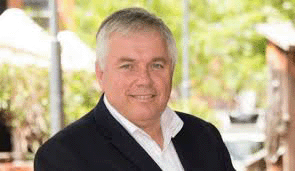 Senator Rex Patrick No Nuclear Waste Dump Anywhere in South Australia, 25 June 20,
The process that led to Kimba being selected as the site was flawed from inception, has bitterly divided the community and ignored the views of First Nations people. Thankfully the process has been stopped and the Parliament has been asked to decide the site. The Government has asked the Parliament to choose prime farmland, I’m asking the Parliament to choose a remote desert Defence secured site (after consultation).
I circulated my Woomera Prohibited Area (WPA) amendment to the Senate yesterday. The Senate Economics Committee looking into the site selection will hold its first hearing on Tuesday in Canberra and then come to SA for a hearing. The Committee has also resolved to conduct a WPA site visit.
I encourage you to participate in democracy and make a submission to the Committee. You’ll find a link to it’s website in the comments. mre https://www.facebook.com/groups/1314655315214929/
There is really no market in India for Australia’s uranium

 No market for Australian uranium in India, 23 June 2020, M V Ramana and Cassandra Jeffery, https://www.eastasiaforum.org/2020/06/23/no-market-for-australian-uranium-in-india/
In 2011, the Australian Labor Party (ALP) voted to overturn a ban on uranium sales to India. The Civil Nuclear Cooperation Agreement between Australia and India was then signed in 2014. The Australian Parliament subsequently passed a bill permitting its uranium mining companies to supply nuclear material to India. These efforts were supposedly intended to allow Australia to profit from Indian uranium purchases.
At the 2011 ALP national conference, then prime minister Julia Gillard argued that India was planning to generate 40 per cent of its electricity with nuclear energy by 2050. ‘Having access to this market is good for Australian jobs’, said Gillard during the conference. The Australian Uranium Association projected that ‘Australia could expect to sell some 2500 tonnes of uranium annually to India by 2030, generating export sales of AU$300 million’ (US$205 million). But nearly a decade later, what is the reality?
Aside from a small shipment of uranium sent to India for testing in 2017, no uranium appears to have been exported to India from Australia. In 2018, India’s Ministry of Atomic Energy stated that the country had signed contracts with firms from Kazakhstan, Canada, Russia and France to procure uranium. And in March 2020, India signed a contract with Uzbekistan. There has been no mention of Australia.
A large order for Australian uranium appears unlikely in the future as well. With a net generating capacity of only 6.2 gigawatts (GW), India does not have a large requirement for uranium in the first place. Further, Australian uranium can only be used for reactors under International Atomic Energy Agency (IAEA) safeguards, which attempt to ensure that no materials are used for nuclear weapons. Such reactors amount to less than 2 GW of India’s capacity.
India’s nuclear fleet will not expand dramatically either. India’s Department of Atomic Energy (DAE) has a long history of setting ambitious nuclear power generation targets and failing to meet them. In 1984, the DAE promised a nuclear capacity of 10 GW by 2000. The actual figure in 2000 was 2.7 GW. By then the DAE had set a new target, 20 GW by 2020. Again, today’s current capacity (6.2 GW) is nowhere close to this target.
Seven more reactors, with a total capacity of 4.8 GW, are under construction. But five of these reactors have been significantly delayed. Four of them were supposed to be commissioned in 2015 and 2016. But these reactors are now expected to start operating in October 2020, September 2021, March 2022 and March 2023 respectively.
The fifth is India’s flagship project, the Prototype Fast Breeder Reactor (PFBR). Construction started in 2004 and the reactor was supposed to start functioning in 2010 but is now ‘expected to commence production of electricity in October 2022’.
Costs have increased, too. The PFBR’s estimate has jumped from Rs 34.9 billion (US$457 million) to Rs 68.4 billion (US$896 million). And the PHWRs will cost around 40–45 per cent more than initially projected.
In contrast, India’s renewable energy sector is a different story. Wind and solar power have only recently been introduced to India’s energy mix, but both technologies are expanding rapidly while becoming significantly cheaper. Between 2016 and 2019, installed solar capacity increased from 9.6 GW to 35 GW, while wind capacity increased from 28.7 GW to 37.5 GW. In 2019, both wind (63.3 terawatt-hours (TWh)) and solar (46.3 TWh) power contributed more to overall electricity generation in India than nuclear power (45.2 TWh).
India’s renewable energy sector is expected to continue growing, while nuclear energy will likely remain stagnant. Recently, the Department of Economic Affairs assembled a task force to ‘identify technically feasible and financially viable infrastructure projects that can be initiated in fiscals 2020–25’. The task force foresaw renewable capacity increasing from 22 per cent of the total installed electrical capacity in 2019 to 39 per cent by 2025. Conversely, nuclear capacity stays around 2 per cent of installed capacity.
Even the Indian government expects the divergence between the growing renewable energy sector and the stagnant nuclear sector to increase as the rapidly falling cost of solar power makes nuclear power redundant.
Australian policymakers who advocated for exporting uranium to India were betting on the wrong energy source. Perhaps there were ulterior motives, including recognising India as a major power. But good policy cannot be made on the basis of false claims.
Australian uranium companies continue to insist that India is expanding its nuclear power capacity. Energy Resources of Australia Ltd’s 2017 annual report claims that ‘India has 22 reactors in operation and plans to generate as much as 25 per cent of electricity from nuclear power by 2050’. Paladin and Yellow Cake made similar claims in 2019.
Nuclear power has never constituted more than a few per cent of India’s electricity supply. Given current trends, it will never amount to much more. Nuclear reactors are expensive and time-consuming to construct, factors that explain why the share of electricity supplied by nuclear power plants globally has declined continuously, from 17.5 per cent in 1996 to 10.15 per cent in 2018. This global trend must be considered by Australian policymakers as they deal with lobbyists for uranium mining and the push there to build nuclear plants.
M V Ramana is Professor, Simons Chair in Disarmament, Global and Human Security, and Director of the Liu Institute for Global Issues at the School of Public Policy and Global Affairs, the University of British Colombia. Cassandra Jeffery is a recent Master‘s of Public Policy and Global Affairs graduate of the University of British Columbia.
Labor reaches for bipartisanship on energy policy, but a DEFINITE NO TO NUCLEAR

Albanese says Labor will not support domestic nuclear power. The Morrison government has flagged examining “emerging nuclear technologies” as part of Australia’s energy mix in the future in a new discussion paper kicking off the process of developing its much-vaunted technology investment roadmap.
Let’s end Australia’s climate and energy warfare, Albanese tells Morrison https://www.theguardian.com/australia-news/2020/jun/24/lets-end-australias-climate-and-energy-warfare-albanese-tells-morrison
Labor leader sets out policy pivot in challenge to PM to display genuine bipartisanship Katharine Murphy Political editor @murpharoo
Wed 24 Jun 2020, Anthony Albanese has dumped Labor’s former backing of Malcolm Turnbull’s national energy guarantee and opened the door for taxpayer support for carbon capture and storage technologies, in a major overture to Scott Morrison to reach bipartisan agreement on energy policy.
The Labor leader will use a speech to the National Press Club on Wednesday to set out his guiding principles for an agreement to end more than a decade of political warfare on climate and energy policy.
In a letter sent to the prime minister before Wednesday’s address, Albanese says Labor is open minded on a new policy mechanism to guide investment as long as the emissions reduction targets are scalable – meaning a future government of either persuasion could dial them up, or wind them back – and as long as the mechanism isn’t the Coalition’s existing emissions reduction fund.
The Labor leader has also told the prime minister the opposition is open to CCS, which remains a controversial technology with many environmentalists, as long as projects are not funded through the national renewable energy bodies the Clean Energy Finance Corporation and the Australian Renewable Energy Agency.
But Albanese says Labor will not support domestic nuclear power. The Morrison government has flagged examining “emerging nuclear technologies” as part of Australia’s energy mix in the future in a new discussion paper kicking off the process of developing its much-vaunted technology investment roadmap.
While Albanese has signalled that Labor cannot accept the Coalition’s emissions reduction fund – the heavily criticised policy that replaced Labor’s carbon price in 2013 – as the bipartisan mechanism, he says a future Labor government would not seek to unwind contracts entered during this parliament, including any contracts involving support for CCS.
Labor’s new position reflects an attempt by Albanese to balance divided views within his own ranks. Some in the right faction believe Labor’s commitment to climate policy ambition has cost the party electorally, and Labor will not win the next federal election unless it reconnects with workers in carbon-intensive industries in New South Wales and Queensland.
But it is also an effort to challenge Morrison to use the post Covid-19 recovery to display genuine bipartisanship in the service of fixing a problem that has festered in Australia for more than a decade. Albanese’s repositioning also comes as the major parties accelerate their campaigns in the marginal seat of Eden-Monaro, where climate change is an issue, with the byelection due on 4 July.
The Coalition has successfully weaponised climate change against Labor at every federal election since 2013, but the government is also under pressure from business groups and major institutions to end the policy uncertainty that is undermining investment in critical infrastructure.
Facing sustained pressure to adopt a 2050 target of net zero emissions, pressure it is continuing to resist despite signing the Paris agreement which has that ambition embedded within it, the government plans instead to develop the technology roadmap as the cornerstone of the Coalition’s mid-century emissions reduction strategy.
Given that the government has launched the roadmap, Labor is taking the opportunity to launch its own pivot on energy policy, and attempt to open the door to a new round of discussions.
A leading Australian business organisation, the AiGroup, has called for the two biggest economic challenges in memory – recovery from the Covid-19 pandemic and cutting greenhouse gas emissions – to be addressed together, saying that would boost economic growth and put the country on a firm long-term footing. A number of other community and investor groups have expressed similar sentiments.
In his letter to Morrison, Albanese says Australia has lacked a national energy policy since the renewable energy target was met in late 2019 and Morrison dumped Turnbull’s Neg shortly after taking the prime ministership. Labor adopted the Neg as policy during the last parliament in an effort to see whether any common ground could be reached between the major parties, but that proved fruitless.
The letter says the lack of a settled mechanism has increased investor uncertainty “and new investment in renewable energy generation fell by 50% in 2019, according to the Reserve Bank of Australia and industry analysis”.
“We have an opportunity to move past partisan approaches to energy policy, to draw on the community’s clear desire for more bipartisan approaches to difficult policy areas, and to finally deliver an enduring, effective and bipartisan energy policy for Australia,” Albanese writes.
Labor has adopted a net zero target by 2050 as policy post-election, but it remains unclear what interim emissions reduction targets will be.
Killing Australia’s democracy – first kill the ABC
Latest $84 million cuts rip the heart out of the ABC, and our democracy, The Conversation, Alexandra Wake, Program Manager, Journalism, RMIT University, Michael Ward, PhD candidate, University of Sydney, 24 June 20
In the latest cuts, wrapped up as part of the national broadcaster’s five-year plan,
- 250 staff will lose their jobs
- the major 7:45am news bulletin on local radio has been axed
- ABC Life has lost staff but somehow expanded to become ABC Local
- independent screen production has been cut by $5 million
- ABC News Channel programming is still being reviewed………
- Clearly the coronavirus pandemic has slashed Australia’s commercial media advertising revenues. But the problems in the media are a result of years of globalisation, platform convergence and audience fragmentation. In such a situation, Australia’s public broadcasters should be part of the solution for ensuring a diverse, vibrant media sector. Instead, it continues to be subject to ongoing budget cuts.
Moreover, at a time when the public really cannot afford to be getting their news from Facebook or other social media outlets, cutting 250 people who contribute to some of Australia’s most reliable and quality journalism and storytelling – and literally saving lives during the bushfires – appear to be hopelessly shortsighted.
The latest Digital News Report 2020 clearly showed the ABC is the media outlet Australians trust the most.[table on original shows this]……
- the end of short wave radio services to the Northern Territory
- a reduction in live concerts on Classic FM
- a contraction of Australian drama
- cut costs for Australian children’s programming
- reductions in women’s and local sport
- an end to the coverage of international events such as the Olympics cancelled
- an end to non-news and current affairs television outside of Sydney and Melbourne
- the closure of ABC Open
- 100 websites shut down.
- ……… It is against this background the latest funding freeze, due to a failure to meet the impact of inflation costs, occurs. While it doesn’t sound like a lot, the three year impact is $84 million, and has resulted in the cuts announced today.But more importantly, these ongoing cuts represent an attack by the federal government on the broadcaster, its role in democracy, and in keeping Australians safe, informed and entertained. https://theconversation.com/latest-84-million-cuts-rip-the-heart-out-of-the-abc-and-our-democracy-141355
Australian govt current energy policies will mean 11,000 renewable energy jobs lost
 Up to 11,000 renewable energy jobs could be lost under Morrison government policies Up to 11,000 renewable energy jobs could be lost under Morrison government policiesThe job losses will be equivalent to the entire local coal industry if the renewable energy target is not replaced, Guardian Adam Morton Environment editor @adamlmorton, Thu 25 Jun 2020 Up to 11,000 renewable energy workers are expected to lose their jobs over the next two years under current government policies, according to a university analysis. If correct, the loss of jobs would be equivalent to the abolition of the domestic-focused coal industry, which employs a little more than 10,000 people in mining thermal coal for local use and running Australia’s coal-fired power plants. Described as the first large-scale survey of renewable energy jobs in Australia, the research from the University of Technology Sydney found the industry would be a major source of jobs in the medium term, but its short-term future would depend on how Covid-19 stimulus packages were deployed. About 26,000 people are employed in renewable energy, but the study found this would fall to about 15,000 by 2022 under existing policies, including the Morrison government not replacing the national renewable energy target. The target, which requires energy companies to source about 23% of electricity from clean sources, was reached last year, triggering a 50% drop in large-scale renewable energy investment compared with 2018. Conversely, renewable energy jobs would be expected to reach about 45,000 by 2025 under a “step change” scenario, set out by the Australian Energy Market Operator, consistent with the goals of the 2015 Paris agreement. The study says on this path employment in renewables would be likely to fall to about 30,000 as construction eased later this decade before rising again after 2030. Chris Briggs, a research principal at the UTS Institute for Sustainable Futures, said up to two-thirds of renewable energy jobs would be expected to be created in regional areas. “It’s a difference of 30,000 jobs in the next few years depending on government policy,” he said. Many of the jobs would be expected to be in identified renewable energy zones. The zones overlap with existing coal regions but are more widespread. Briggs said it suggested renewable energy could play a meaningful role alongside other industries in creating replacement jobs in coal regions as the world reduced reliance on fossil fuels, but only if the transition was well planned and funded……… https://www.theguardian.com/environment/2020/jun/25/up-to-11000-renewable-energy-jobs-could-be-lost-under-morrison-government-policies |
|
1 This month.

PETITION – To: Prime Minister Anthony Albanese and the Australian Labor Government
Chernobyl: The Lost Tapes – A good documentary on Chernobyl on SBS available On Demand for the next 3 weeks– https://www.sbs.com.au/ondemand/tv-program/chernobyl-the-lost-tapes/235274195556

19 May – Webinar- Webinar: No Nuclear Weapons in Australia
Start: 2026-05-19 18:00:00 UTC Canberra, Melbourne, Sydney (GMT+10:00)
End: 2026-05-19 19:30:00 UTC Canberra, Melbourne, Sydney (GMT+10:00)
20 May – Webinar – The dangerous world of AUKUS, US, military occupation and suppression of dissent

National Webinar, 20th May, 2026, 6.30pm AEST. Confronting laws restricting/suppressing protest speech and action
Speakers: Former Sen. Rex Patrick, Lawyer Nick Hanna ,Arthur Rorris ,Jorgen Doyle, Sen David Shoebbridge,
Facilitator Kelley Tranter.

of the week – Australians for War Powers Reform (AWPR)
To see nuclear-related stories in greater depth and intensity
 Antinuclear