NSW first renewable zone attracts stunning 27GW of solar, wind, storage proposals — RenewEconomy
NSW plan for first Renewable Energy Zone attracts “phenomenal” 113 registrations of interest for projects totalling 27GW and valued at $38 billion. The post NSW first renewable zone attracts stunning 27GW of solar, wind, storage proposals appeared first on RenewEconomy.
via NSW first renewable zone attracts stunning 27GW of solar, wind, storage proposals — RenewEconomy
Big utilities split over delays to key reform that backs battery storage — RenewEconomy
Two big utilities that operate big batteries – EnergyAustralia and AGL – split from peers and argue against proposed delays to five-minute settlement period. The post Big utilities split over delays to key reform that backs battery storage appeared first on RenewEconomy.
via Big utilities split over delays to key reform that backs battery storage — RenewEconomy
June 22 Energy News — geoharvey

Opinion: ¶ “Latin America’s Potential Green Hydrogen Economy” • The Covid-19 pandemic and crisis has led to increasing calls to redouble efforts toward an energy transition that would help the world reduce CO₂ emissions. For many countries of the Latin American region, clean hydrogen markets can be a key part of the economic recovery. [Inter […]
Engineers say technology roadmap should focus on cheap renewables, energy storage — RenewEconomy

Australian engineers’ peak body join submissions calling for a technology roadmap based around cheap solar and wind and energy storage technologies. The post Engineers say technology roadmap should focus on cheap renewables, energy storage appeared first on RenewEconomy.
via Engineers say technology roadmap should focus on cheap renewables, energy storage — RenewEconomy
Amazon signs biggest corporate solar PPA in Australia with Suntop project — RenewEconomy
Amazon identifies solar farm in NSW that will support the biggest corporate PPA with a solar project to date in Australia. The post Amazon signs biggest corporate solar PPA in Australia with Suntop project appeared first on RenewEconomy.
via Amazon signs biggest corporate solar PPA in Australia with Suntop project — RenewEconomy
Minerals Council slammed for “woefully inadequate” Climate Action Plan — RenewEconomy
Minerals Council of Australia unveils Climate Action Plan with no dates or milestones for emissions reduction and no mention of phasing out coal mining or coal-fired power. The post Minerals Council slammed for “woefully inadequate” Climate Action Plan appeared first on RenewEconomy.
via Minerals Council slammed for “woefully inadequate” Climate Action Plan — RenewEconomy
Australian made hydrogen must be green, or it will have no export market — RenewEconomy
Global markets will increasingly require ‘green hydrogen’ certification as they decarbonise their economies in line with Paris goals. To get distracted by anything less would be a fool’s errand. The post Australian made hydrogen must be green, or it will have no export market appeared first on RenewEconomy.
via Australian made hydrogen must be green, or it will have no export market — RenewEconomy
Week to 23 June in nuclear/climate news – Australia
With a record world increase in coronavirus cases, Brazil and North America in the spotlight – media attention has been rightly focussed on the pandemic. FAIR exposes the false claims about China and COVID-19 . At the same time, global heating seems to be at a runaway pace, affecting the Northern Hemisphere, and especially the Arctic. https://www.youtube.com/watch?v=w-gEhYTu4Xs&t=42s To protect our planet – we need to transform, not grow, the economy.
Global nuclear news is mainly just the same old collection of handouts from the nuclear industry, faithfully regurgitated by journalists who want to keep their jobs. Otherwise, not much is happening.
A bit of good news – Coronavirus more than 1500 treatment studies are underway world-wide.
AUSTRALIA
Is Australia getting a second wave of Coronavirus?
NUCLEAR
National Radioactive Waste Management Mysterious, manipulative and corrupt process whereby Napandee was selected for nuclear dump site. Kimba community unaware that Australia’s medicine does not need nuclear reactor. South Australia targeted: easy to later bring international waste in to nuclear dump.
Australian Radiation Protection and Nuclear Safety Agency (ARPANSA) sits on the fence regarding Napandee choice for nuclear waste dump.
Senator Rex Patrick provides Federal Parliament with another option for nuclear waste storage. South Australia outlaws nuclear facilities, but yet not one S.A. Liberal MP voted against the waste dump!
Submissions to Senate Inquiry.
- Neville Reid – In a corrupt and undemocratic process, the Napandee nuclear waste decision has ignored environmental safety dangers.
- Carole Faulkner – Senate should reject Nuclear Waste Bill and recommend new consultation involving all Barngarla people
- Kimba farmer, neighbouring Napandee, stands firm against nuclear waste dump on agricultural land.
The seriousness of mobility of radionuclides in developing the nuclear waste facility at Kimba, South Australia
Expensive, dirty and dangerous: why we must fight miners’ push to fast-track uranium. Scott Morrison gives a boost to uranium mining at Olympic Dam.
Gabrielle Costigan- another one revolving from tax-paid jobs to weapons industry!
Coalition’s push to deregulate environmental approvals will lead to extinction crisis will lead to extinction crisis.
CLIMATE CHANGE.
Australia’s best energy measure – to lift energy efficiency – Chief Scientist says. Morrison government just doesn’t get it, on climate change. The number of climate deniers in Australia is more than double the global average, new survey finds. “Too late for gradual transition”: Quiggin calls for coal exit by 2030.
Foreign ownership of Victorian water hits whopping high – Herald Sun
RENEWABLE ENERGY. Renewables will power Australia’s economic growth. South Australia: The first big grid where rooftop solar could eliminate all demand. South Australia fast-tracks energy plan to dodge blackouts and meet 100% renewables goal. Rooftop solar reshapes Western Australia. grid, and retiring coal units won’t be missed Tesla says energy market reform must be accelerated in Australia
INTERNATIONAL
Now, the nuclear arms race has become even worse.
Joint Project Nuclear Risk and Public Control.
Explaining ionising radiation -a film about nuclear fallout https://www.youtube.com/watch?v=UaH5heMIC_k&t=96s
COVID-19, nuclear war, and global warming: lessons for our vulnerable world.
Covid-19 pandemic – ‘fire drill’ for effects of climate crisis. COVID-19 recovery plans – excellent opportunity for global renewable energy development.
The seriousness of mobility of radionuclides in developing the nuclear waste facility at Kimba. South Australia
has the government explained why the reprocessed nuclear waste has been reclassified by ANSTO from high level to intermediate on arrival in Australia ?
has anyone from the community and even the Kimba District Council ever sought any information as to the inventories and movement of the radionuclides in the intermediate level waste for above ground storage at Kimba?
The mobility of radionuclides is probably the prime and initial factor in determining the location and manner of nuclear waste management by storage and disposal
Although nearly thirty years old but still current the Code of practice for the near-surface disposal of radioactive waste in Australia (1992) prescribed radioactive waste hazards as:
The health risk to humans presented by radioactive waste depends upon the radionuclides present, the type of radiation emitted by the particular radionuclides, their concentrations, and their chemical and physical form. The hazard may arise from external irradiation of the body or internally as a result of radioactive substances entering the body by ingestion, inhalation or absorption through the skin. The radioactive waste specifically covered by this code may also present a long-term hazard to the environment and to future generations if disposal is not carried out in a responsible manner.
Even though the Code deals with disposal rather than storage the requirements for both are basically similar with the only difference being the retrieval of the waste as seen from the definitions in the Code being:
Waste disposal means the placement of radioactive waste in a structure and in a manner such that there is no intention of retrieval.
Storage means the emplacement of waste in a facility with the intent and in a manner such that it can be retrieved at a later time.
From this I trust that you understand the seriousness and importance of radionuclides mobility in the selection and development of the management facility at Kimba
IN VIEW OF THIS SOMEONE FROM KIMBA SHOULD FORMALLY IN WRITING ASK THE KIMBA DISTRICT COUNCIL THESE QUESTIONS
COPIES SHOULD BE SENT TO:
THE SENATE COMMITTEE CHAIRMAN
MINISTER PITT
MR ROWAN RAMSEY MP
ANSTO CEO PATERSON
BARNGARLA IF THOUGHT APPROPRIATE
EXCLUDE ARPANSA AS IT MAY BE COMPROMISING TO IT AND IT WILL IGNORE THE LETTER IN ANY CASE
Questions:
(a) whether there have been any discussions or arrangements regarding fire as a risk at the Kimba facility – had this ever been covered by the government in its presentations as one of the main reasons for underground burial of nuclear waste is to avoid any fire risks?
(b) has the government explained why the reprocessed nuclear waste has been reclassified by ANSTO from high level to intermediate on arrival in Australia ?
(c) has the community ever been informed of the radionuclides movement activity of the intermediate level waste to be sent to Kimba?
(d) what explanation was given as to the radionuclides movement and immobilisation in above the ground storage as opposed to geological burial?
(e) has anyone from the community and even the Kimba District Council ever sought any information as to the inventories and movement of the radionuclides in the intermediate level waste for above ground storage at Kimba?
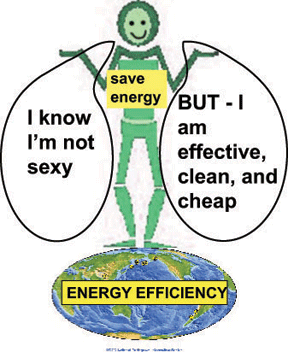
Australia’s best energy measure – to lift energy efficiency – Chief Scientist says
|
Chief scientist joins calls for Australia to dramatically boost energy efficiency
Alan Finkel calls saving electricity the ‘best form of generation’ as groups push for efficiency measures to lead economic recovery, Guardian, Adam Morton Environment editor @adamlmorton, Sun 21 Jun 2020 Australia’s chief scientist, Alan Finkel, has warned the country is not doing enough to lift energy efficiency, and described measures to save electricity as the “best form of energy generation you could possibly ever hope to have”.
Speaking in his role as chair of a panel advising the Morrison government on a low emissions technology statement, Finkel told an industry seminar that Australia had ongoing issues with energy efficiency and productivity, and noted a national energy productivity plan, agreed by federal and state energy ministers in 2015, did not appear on a list of national climate and energy policies. “I don’t think we’re anywhere close to having that nailed,” he said on energy efficiency. “There is no lack of appreciation from myself or my colleagues on the taskforce … that a gigawatt of power not needed because you’ve done an efficiency measure is the best form of energy generation that you could possibly ever hope to have.” Finkel’s view is in line with a raft of groups from across Australian society that are calling for federal and state governments to back an energy-efficiency drive for homes and other buildings to help address both the coronavirus-triggered recession and the climate crisis. Many have called for policies that focus on social and low-income housing. Buildings are responsible for nearly a quarter of national greenhouse gas emissions. The organisations calling for better energy efficiency say it could cut emissions, create tens of thousands of jobs and, unlike some other proposed stimulus measures, be delivered immediately. Household-level energy efficiency measures can include boosting thermal performance by sealing leaks and improving insulation, replacing gas appliances with those run on clean electricity, encouraging better lighting and installing solar panels and a battery to generate electricity onsite. Four separate reports on the issue were released last week. In one, more than 50 social, property, business, environment and other groups called for an energy efficiency and solar package focused on low-income houses. The 50, led by the Australian Council of Social Service (Acoss), said the government’s HomeBuilder stimulus program had helped high-income earners planning expensive renovations, but failed to do anything for those most in need, or to cut emissions. They recommended the federal government match state funding for energy efficiency upgrades and solar panel installations in social housing, work with local government to improve low-income homes, offer grants to landlords to fix inefficient rental properties and subsidise the replacement of inefficient appliances. Kellie Caught, an Acoss climate and energy senior advisor, said a low-income energy productivity program could quickly create more than 60,000 jobs in training, auditing, installation, manufacturing and local retail……… The groups calling for energy efficiency improvements are part of a push including global organisations, banks, major institutional investors and some governments, for a green recovery from the Covid-19 shutdown. A report by the International Energy Agency released last week found governments were planning to spend US$9tn globally on rescuing their economies from the coronavirus crisis, and the stimulus packages created this year would determine the shape of the global economy for the next three years. It warned emissions must start to fall sharply and permanently within that time or climate targets will be out of reach. The Morrison government and its National Covid-19 Coordinating Commission have emphasised gas, a fossil fuel, as being central to pandemic recovery……. https://www.theguardian.com/australia-news/2020/jun/21/chief-scientist-joins-calls-for-australia-to-dramatically-boost-energy-efficiency |
|
Foreign ownership of Victorian water hits whopping high
Herald Sun , 21 June
A shocking report has revealed just how much of our water is now owned by overseas interests, with China continuing to buy up to buy up precious Australian resources. – (subscribers only)
Learning about ionising radiation – this film helps
Invisible Fallout https://beyondnuclearinternational.org/2020/06/21/invisible-fallout/,June 21, 2020
There are many ways to teach people about radiation. But if you want to make that lesson accessible, compelling and even moving, then this film is the way to do it.
Let’s go on a journey. A journey to learn about radiation exposure from fallout after a nuclear power plant accident. We have the perfect guide. It is the independent French radiation research laboratory known as CRIIRAD, and its director, Dr. Bruno Chareyron.
The organization’s full name in French is Commission de Recherche et d’Information Indépendantes sur la RADioactivité, hence the acronym. In English it is translated as Commission for Independent Research and Information about RADiation.
For those not familiar with CRIIRAD, our journey begins with a little history, and so does CRIIRAD’s brilliant new 45-minute film — Invisible Fallout (Invisibles retombées is the French title), which can be viewed in its entirety on YouTube and above. The film, written and produced by CRIIRAD staff and directed by Cris Ubermann, is in French and Japanese with English subtitles.
When the Chernobyl nuclear disaster hit in April 1986, the French government engaged in a notorious cover-up, claiming that France “has totally escaped any radioactive fallout.” The whole thing was a lie. Five days before the government denial, Chernobyl’s radioactive cloud had covered all of France.
As Invisible Fallout recounts, after Chernobyl, it took 15 years until the French government published fallout maps of France. But the CRIIRAD laboratory, formed right after Chernobyl precisely to establish that France’s immunity was a myth, had already done the work that debunked the official line that the disaster was just a Soviet problem. French citizens not only got dosed by Chernobyl fallout, but would live in perpetual danger of a similar catastrophe at home, with a country almost 80% reliant on nuclear-generated electricity from its 58 reactors.
But Invisible Fallout does not linger long in the past. It segues quickly to the next nuclear catastrophe — the 2011 Fukushima-Daiichi meltdowns in Japan — and it is there that the CRIIRAD team, led by Chareyron, take us to learn about the effects of radiation exposure from nuclear power plants.
Just sixteen days after the Fukushima disaster, Japanese citizens began to detect fallout. They desperately needed to do independent monitoring but found it hard to get their hands on Geiger counters. The downplays and cover-ups by Japanese authorities, attempting to minimize the dangers and avoid mass evacuations, meant official figures could not be trusted.
An unlikely leader stepped forward in the person of composer and artist, Wataru Iwata, who, one month after the disaster, asked CRIIRAD for Geiger counters. They sent them, along with email tutorials on radioactivity, its health risks and how to protect against them. The laboratory also prepared a series of simple, clear, instructional “emergency” videos in English, designed for non-specialists, which they put online for everyone to access. This included an instructional segment on how to use a Scintillometer, one of the dozen devices CRIIRAD had sent to the Japanese activists.
We then get a short instructional video of our own on exactly how the Scintillometer is able to rapidly detect Gamma radiation in counts per second, and what those measurements mean. It glides into clarity for us, abetted by the smooth tones of the film’s excellent French narrator, Nicolas Planchais. We forget completely we are in class. Everything is, indeed, illuminated.
And we see Iwata taking his device into Fukushima Prefecture where he helps others measure the radiation levels. At a restaurant 55km away from the destroyed reactors, where people were going about their daily lives, he is shocked to record radiation levels that are 50 times higher than normal. In other areas, levels are 1,000 times higher.
Two months after the accident, CRIIRAD decided to show up in person, and Japan’s Citizens Radioactivity Monitoring Stations (CRMS), were born. CRIIRAD set up nine CRMS in Fukushima Prefecture and one in Tokyo.
Quickly realizing that ingestion of radioactively contaminated foodstuffs was as much of a threat as external exposure, Iwata asked for ways to measure radiation in food. This would help the people who had stayed — or who had been forced to remain — in contaminated areas to make informed choices about the food they consumed. CRIIRAD brought over a device sensitive enough to detect radiation in food, then conducted a seminar for residents of Fukushima City on on how to use it. We too, as viewers, get the tutorial.
Indeed, all of these lessons in science are subtly woven into the film, but cleverly attached to the lived experiences of real people in Japan, making it relevant and relatable.
And then, as we learn how to measure radiation levels and what they mean, we start to meet the people to whom it matters the most. We encounter a farmer who abided by the rules not to sell contaminated crops but whose family ate the food themselves so it would not go to waste. And we watch his palpable emotion as he recounts his attachment to the land and the known risks he and his family took.
CRIIRAD and its Japanese partners begin to find radioactive particles everywhere— on rooftops, in soil and vegetation, at the foot of trees, in the cracks of tarmac, even inside greenhouses.
At a school which, in denial, refused to have radiation measurements taken, Iwata is shown taking readings in the school grounds. They start at 6,000 to 7,000 counts per second, but rise to 27,000 counts per second at ground level.
The CRIIRAD team encounter what they describe as their most difficult moment when an elderly peasant farmer asks them to conduct measurements on her land just 30km away from the nuclear site. She herself was forced to evacuate, but her farm was not in the zone designated for permanent evacuation. So she came back with CRIIRAD to assess the situation.
We watch them take measurements, then gently show the results to her. She begins to sob. Then she tells them, “Thank you for coming all this way. I was in darkness and you have brought me light.” But, she knows she must now abandon the farm forever.
After an interlude for another lesson, this time on gamma rays, we are back to some chilling truths about their effects. In Fukushima City, we learn that at an elementary school there, children are asked to frequently change places in class so that the same children are not always sitting by the window where the radiation levels are higher.
This prompts CRIIRAD to remind us that, “when it comes to radiation protection, there is no threshold below which it is harmless.” And they point out that the Japanese decision to raise the annual allowable radiation dose from 1mSv to 20mSv, “means accepting a risk of cancer 20 times higher, and this applies equally to children and pregnant women” for whom such doses present a far higher risk.
CRIIRAD warns that people living in the contaminated region will be exposed for decades and across vast areas. They will be exposed to external radiation from powerful gamma rays emitted by the soil and contaminated surfaces. They will be exposed through inhalation of radioactive dust suspended every time the wind blows, and by activities such as sowing crops, ploughing and construction work. And they will be exposed through eating foodstuffs cultivated on contaminated land in contaminated soil.
But thanks to CRIIRAD, many of them will now know how to measure these levels, what they mean and how to protect themselves. It’s a lesson that’s well worth learning for all of us.
For more information, please see the CRIIRAD website, in its original French, and in English.
Anti-nuclear resistance in Russia: problems protests, reprisals
Standing up to Rosatom
Anti-nuclear resistance in Russia: problems protests, reprisals
The following is a report from the Russian Social Ecological Union (RSEU)/ Friends of the Earth Russia, slightly edited for length. You can read the report in full here. It is a vitally important document exposing the discrimination and fear tactics used against anti-nuclear organizers in Russia and details their courageous acts of defiance in order to bring the truth of Russia’s nuclear sector to light.
Rosatom is a Russian state-owned corporation which builds and operates nuclear power plants in Russia and globally. The state-run nuclear industry in Russia has a long history of nuclear crises, including the Kyshtym disaster in 1957 and Chernobyl in 1986. Yet Rosatom plans to build dozens of nuclear reactors in Russia, to export its deadly nuclear technologies to other countries, and then to import their hazardous nuclear waste.
This report is a collection of events and details about the resistance to Russian state nuclear corporation, Rosatom, and other activities that have led to the pollution of the environment and violation of human rights. Social and environmental conflicts created by Rosatom have been left unresolved for years, while at the same time, environmental defenders who have raised these issues, have consistently experienced reprisals.
Nuclear energy: failures and Lies
For a safe world climate, we need to transform the economy, not grow it
“So, we have to get away from our obsession with economic growth – we really need to start managing our economies in a way that protects our climate and natural resources, even if this means less, no or even negative growth.
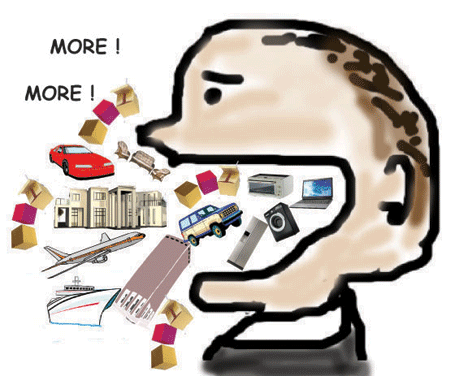 “In Australia, this discussion isn’t happening at all – economic growth is the one and only mantra preached by both main political parties. It’s very different in New Zealand – their Wellbeing Budget 2019 is one example of how government investment can be directed in a more sustainable direction, by transforming the economy rather than growing it.”
Overconsumption and growth economy key drivers of environmental crises https://www.eurekalert.org/pub_releases/2020-06/uons-oag061820.php
21 June, 20, ,
Scientists’ warning on affluence, UNIVERSITY OF NEW SOUTH WALES, A group of researchers, led by a UNSW sustainability scientist, have reviewed existing academic discussions on the link between wealth, economy and associated impacts, reaching a clear conclusion: technology will only get us so far when working towards sustainability – we need far-reaching lifestyle changes and different economic paradigms.
In their review, published today in Nature Communications and entitled Scientists’ Warning on Affluence, the researchers have summarised the available evidence, identifying possible solution approaches.
“Recent scientists’ warnings have done a great job at describing the many perils our natural world is facing through crises in climate, biodiversity and food systems, to name but a few,” says lead author Professor Tommy Wiedmann from UNSW Engineering.
“However, none of these warnings has explicitly considered the role of growth-oriented economies and the pursuit of affluence. In our scientists’ warning, we identify the underlying forces of overconsumption and spell out the measures that are needed to tackle the overwhelming ‘power’ of consumption and the economic growth paradigm – that’s the gap we fill.
“The key conclusion from our review is that we cannot rely on technology alone to solve existential environmental problems – like climate change, biodiversity loss and pollution – but that we also have to change our affluent lifestyles and reduce overconsumption, in combination with structural change.”
During the past 40 years, worldwide wealth growth has continuously outpaced any efficiency gains.
“Technology can help us to consume more efficiently, i.e. to save energy and resources, but these technological improvements cannot keep pace with our ever-increasing levels of consumption,” Prof Wiedmann says. Continue reading
Exposing the false claims about China and coronavirus
 Debunking Trump and Corporate Media’s WHO/China Coverup Conspiracy Theories FAIR
The Trump administration suspended funding to WHO in April—the UN’s primary infectious disease–fighting body—accusing it of “severely mismanaging and covering up the spread of the coronavirus,” and of taking China’s allegedly deceptive claims about its handling of Covid-19 at “face value.” But corporate media had already been boosting these same talking points.
The Wall Street Journal’s “The World Health Organization Draws Flak for Coronavirus Response” (2/12/20) effectively accused WHO of being “too deferential to China in its handling of the new virus,” and criticized WHO Director-General Tedros Ghebreyesus for “bending to Beijing” after lauding China’s unquestionably effective swift quarantine of 60 million people, and for declaring that “China is actually setting a new standard for outbreak response” and identifying the virus in “record time.” The Journal further expounded the conspiracy theory of a seemingly omnipotent China having WHO under its thumb:
Over its decades of battling epidemics, the WHO has rarely had to deal with an entity as politically and economically powerful as China today. It can’t afford to alienate the country’s leadership, whose clout and financial largess it aims to attract to global health causes. It needs Beijing’s cooperation in preventing a full-blown pandemic—and this may not be the last time. China is the source of many emerging pathogens, which jump from animals to humans in its teeming live markets and can cause deadly epidemics.
According to the Journal’s logic, when WHO praises China for an effective response containing Covid-19 and giving the rest of the world ample time to take health precautions, it is “compromising its own epidemic response standards, eroding its global authority, and sending the wrong message to other countries that might face future epidemics.” When Dr. Bruce Aylward—a Canadian medical expert with 30 years of experience combating polio, Ebola and other global health emergencies—concluded that he “didn’t see anything that suggested manipulation of numbers,” after leading a team of experts visiting China for WHO, that can’t be an accurate observation. For corporate journalists, it can only be because he was duped by the devious Chinese government “underreporting both total cases and deaths it’s suffered from the disease” (Bloomberg, 4/1/20).
The Journal flimsily explained that China wields such formidable control over the WHO because China is a “future source of funds and a partner with which to tackle the biggest global health problems,” and not as a “current donor.” That would be because a cursory examination of WHO’s funding would reveal that the US donated more than 10 times more money to WHO ($893 million) than China ($86 million), despite the US having almost $200 million in arrears before suspending payments (Axios, 4/15/20).
Neither does the Journal explain how or why WHO could possibly withhold information from Western nations even if it wanted to, when its leadership is stacked with Americans and Europeans, and 15 US officials were embedded with the WHO in Geneva, given that the US is the most “politically and economically powerful” nation on Earth. This makes the Trump administration’s declaration of the US terminating its membership in WHO after threats to permanently cut funding especially egregious.
Nor can the Journal explain the source of China’s fearsome influence over independent and prestigious medical journals like Nature (5/4/20), Science (3/28/20) and the Lancet (3/7/20), which also credited the effectiveness and transparency of China’s response for saving thousands of lives (CGTN, 5/1/20, 5/10/20). Does China’s mysterious and awe-inspiring influence extend over Western medical journals as well?
When Foreign Policy (5/12/20) reported on the exclusive scoop of a leaked dataset of coronavirus cases and deaths from the Chinese military’s National University of Defense Technology, it confirmed that the leaked information “matches” the publicly available numbers the Chinese government posts online—which poses an inconvenience to those spouting conspiracy theories of a Chinese government coverup. Corporate media accounts of Chinese deception and fake statistics also fail to explain how the Chinese government possesses the fantastical ability to deceive governments and independent medical experts around the world, even if it wanted to. As FAIR’s Jim Naureckas (4/2/20) pointed out earlier:
The reality is that it’s very hard to hide an epidemic. Stopping a virus requires identifying and isolating cases of infection, and if you pretend to have done so when you really haven’t, the uncaught cases will grow exponentially. Maintaining a hidden set of real statistics and another set for show would require the secret collusion of China’s 2 million doctors and 3 million nurses—the kind of improbable cooperation that gives conspiracy theories a bad name…. If China is merely pretending to have the coronavirus under control, the pathogen will rapidly surge as people resume interacting with their communities. Once international travel is restored, it will be quite obvious which countries do and don’t have effective management of Covid-19.
Countries revising their figures upon receiving new information is to be expected, and is not necessarily evidence of deceit, as plenty of nations besides China revise their data upwards. Yet only China is singled out as being exceptionally deceptive. For example, in the same week New York revised its death toll upwards by nearly 3,800, China’s adding almost 1,300 dead to its Wuhan data was presented as a possible coverup (Politico, 4/14/20; Guardian, 4/17/20). The Moon of Alabama blog (4/1/20) explained some of the complexities in reporting numbers during a pandemic in real-time:
Does one include co-morbids or not in the count? What about casualties of a car accident that also test positive for Covid-19 when they die? What about those who died with Covid-19 symptoms but could not be tested for lack of test kits? Are the tests really working reliably?… What about asymptomatic cases that test positive. Are these false positives, or do these people really have the virus? One can only know that by testing them a month later for antibodies………
this manipulation of public opinion by the US government and corporate media appears to be working. According to a recent Ipsos survey, more than 30% of Americans have witnessed someone blaming Asian people for the coronavirus pandemic (even though new research indicates that travel from New York City was the primary source of the US outbreak, with New York’s outbreak originating in Europe). Pew Research (4/21/20) found that around two-thirds of Americans have an unfavorable view of China, which is the most negative rating for the country since Pew began asking the question in 2005. This suggests that public opinion has been turned against China, despite it being the first to detect the virus, alert the world and provide a model for containing it.https://fair.org/home/debunking-trump-and-corporate-medias-who-china-coverup-conspiracy-theories/
1 This month.


PETITION – To: Prime Minister Anthony Albanese and the Australian Labor Government
Chernobyl: The Lost Tapes – A good documentary on Chernobyl on SBS available On Demand for the next 3 weeks– https://www.sbs.com.au/ondemand/tv-program/chernobyl-the-lost-tapes/235274195556

19 May – Webinar- Webinar: No Nuclear Weapons in Australia
Start: 2026-05-19 18:00:00 UTC Canberra, Melbourne, Sydney (GMT+10:00)
End: 2026-05-19 19:30:00 UTC Canberra, Melbourne, Sydney (GMT+10:00)
20 May – Webinar – The dangerous world of AUKUS, US, military occupation and suppression of dissent

National Webinar, 20th May, 2026, 6.30pm AEST. Confronting laws restricting/suppressing protest speech and action
Speakers: Former Sen. Rex Patrick, Lawyer Nick Hanna ,Arthur Rorris ,Jorgen Doyle, Sen David Shoebbridge,
Facilitator Kelley Tranter.

of the week – Australians for War Powers Reform (AWPR)
To see nuclear-related stories in greater depth and intensity
 Antinuclear