June 19 Energy News — geoharvey

Opinion: ¶ “The Tide Is Turning (And Is It Ever!)” • Something really important was buried in FERC’s latest Energy Infrastructure Update, and though SUN DAY Campaign mentioned it, the rest of the media let it slip. In the US, renewables are expected to see fifty times as much net capacity added in the next […]
June 19 Energy News — geoharvey
Tokyo Olympic Games (Message to President Thomas Bach) — limitless life
Dear Friends, I am sending you my message addressed to President Thomas Bach, President of the IOC. I pointed out that “ a new change in conformity with the law of history that does not allow immorality to last indefinitely seems to be around the corner.” With warmest regards, Mitsuhei Murata Former Japanese Ambassador to […]
Tokyo Olympic Games (Message to President Thomas Bach) — limitless life
South Australia: The first big grid where rooftop solar could eliminate all demand — RenewEconomy

South Australia breaking new ground in share of solar and management of the grid. And cautious market operator wants to be able to switch off rooftops if needed. The post South Australia: The first big grid where rooftop solar could eliminate all demand appeared first on RenewEconomy.
South Australia: The first big grid where rooftop solar could eliminate all demand — RenewEconomy
South Australia fast-tracks energy plan to dodge blackouts and meet 100% renewables goal — RenewEconomy

South Australia to fast-track new link to NSW, and allow rooftop solar to be “shed” by market operator as it faces becoming first gigawatt scale grid in world to face zero operational demand. The post South Australia fast-tracks energy plan to dodge blackouts and meet 100% renewables goal appeared first on RenewEconomy.
South Australia fast-tracks energy plan to dodge blackouts and meet 100% renewables goal — RenewEconomy
ARPANSA sits on the fence regarding Napandee choice for nuclear waste dump
ARPANSA to Senate Committee on National Radioactive Waste Management Amendment (Site Specification, Community Fund and Other Measures) Bill 2020 [Provisions] Submission 86 (Extracts)
(…….“ARPANSA does not have specific comments on the Amendment Bill per se, as the Bill does not relate to thehealth and safety criteria that are core to any review and assessment under the ARPANS Act and Regulations. It is also premature for ARPANSA to comment on the suitability of the specified site at Napandee, near Kimba in South Australia. The site, the design of the facility and the plans and arrangements for managing safety will be considered in ARPANSA’s review and assessment of an application for a licence to prepare a site for the facility”… )
…. the IWS was designed and constructed as a contingency solution. The bulk of the activity in the repatriated waste is immobilised in a glass matrix and contained in a dual-purpose (transport and storage) TN-81 cask; and the remainder technological waste is made up of less active material in cemented form.
Additional ILW remains in the UK from reprocessing of HIFAR spent fuel, and is planned to be returned to Australia in 2022. Should the shipment take place at that time, the NRWMF will (again) not be available, which in all likelihood leaves Lucas Heights as the preferred (by ANSTO) option, and possibly the only feasible destination. ARPANSA is aware that the waste in this second shipment is likely to be immobilised and contained in a TN-81 cask with considerably less activity content than the first cask. ARPANSA expects an application from ANSTO for approval to make a change with significant implications for safety under section 63 of the Regulations10, supported by a revised safety analysis report and an updated safety case well in advance of the time the second shipment is intended to be loaded on a vessel for shipment to Australia.
8 A chemical process by which fissile material (uranium and plutonium) is separated from fission products for which no further use is foreseen and therefore considered waste; this waste is repatriated.
9 The CEO’s Statement of Reasons is at
https://www.arpansa.gov.au/sites/default/files/legacy/pubs/regulatory/ansto/SOR operationIWS.pdf
10 Section 63 states a licence holder must obtain approval from the CEO before changing anything described in the application for the licence or modifying the controlled apparatus, controlled material or controlled facility described in the licence
Production of molybdenum-99 in the ANSTO Nuclear Medicine Facility (ANM). ANSTO received a licence to operate the ANM Facility on 12 April 2018. In the facility, molybdenum-99 (Mo-99; a fission product) is extracted from uranium plates that have been irradiated in the OPAL reactor. The immediate decay product of Mo-99 is technetium-99m (Tc-99m), used in the majority of nuclear medicine procedures.
in Australia and overseas. ANSTO was authorised to commence routine production for the domestic and international nuclear medicine markets on 24 May 2019.
The liquid residue from the Mo-99 extraction and purification process is classified as ILW. The storage tanks at the ANM can accommodate six years of Mo-99 production. ANSTO’s intention is to immobilise the radioactive substances in the liquid waste in an inert ceramic matrix in a planned facility at Lucas Heights known as the SyMo Facility. ANSTO received ARPANSA’s authorisation to prepare a site and construct the facility in 201411. Construction is under way and an application for a licence to operate the facility is preliminarily expected by mid-2021.
Implications of ILW generation and storage at Lucas Heights for the NRWMF. The licence decisions regarding the IWS were predicated on the fact that the intended storage facility (the NRWMF) was not available; that no alternative interim solution other than the IWS was feasible; and that there was some urgency as Australia was under obligations to enable repatriation from France before the end of 2015.
Furthermore, there was at the time of the decision no consideration given to disposal of ILW in the national plans, only to storage. The Australian Nuclear Science and Technology Organisation Act 198712 prevents disposal of waste at the ANSTO premises at Lucas Heights; this is supported by ARPANSA.
The CEO of ARPANSA, therefore, imposed a condition on the licence to operate the IWS which requires ANSTO to provide plans for the final management of the waste held in the IWS: “the licence holder must submit to the CEO, no later than 30 June 2020 and in a form acceptable to the CEO, plans for the removal of waste stored in the facility.”
Likewise, the CEO included a condition in the licence to operate the ANM Facility that requires ANSTO to report by 30 June 2020 on, inter alia: plans for storage and disposal of the ILW, and contingency plans should one or several components of the ILW management system not eventuate or fail. This condition complements the condition issued with the IWS licence.
ARPANSA is aware that some stakeholders have interpreted ARPANSA’s decisions regarding the IWS as a requirement for relocation of the waste stored in the IWS, even suggesting that there is an urgent need for relocation. This is not correct. ARPANSA has not raised safety concerns regarding storage of waste at the IWS. ANSTO seems to share this view. ANSTO has indicated to ARPANSA that the mandatory recertification of the TN-81 casks every 10 years can be carried out at the IWS; and in response to a request for identification of contingency measures in the short to medium term, ANSTO Identified the following:
Retention of the returned residues at ANSTO until the availability of a final disposal optionRetention of the returned residues at ANSTO until the availability of the NRWMF for storage
……..Regarding the ILW planned to be processed in the SyMo facility, ARPANSA anticipates that information on storage, including whether this would involve the NRWMF, is included in the forthcoming report developed by ANSTO, in compliance with the condition issued with the operating licence for the ANM facility.
Radioactive Waste at Woomera
CSIRO holds just under 10,000 drums of waste at the Woomera Prohibited Area. CSIRO currently estimates that less than 200 of these barrels would require management at a future NRWMF. These 200 barrels are estimated to be LLW, with no ILW currently detected. These drums are undergoing characterisation work to improve the inventory of waste held. ARPANSA has been monitoring CSIRO’s characterisation work since 2016. This includes environmental monitoring of radiation levels. CSIRO is developing a pilot program to test new methods to manage their waste, however, this will require ARPANSA’s approval prior to implementation.
Radioactive Waste at ARPANSA
ARPANSA has custody of approximately 68 m3of radioactive waste, being legacy waste from activities carried out by the ARL and its predecessors at a time these organisations were involved in production of radiopharmaceuticals. The waste will be kept in safe storage until such time it can be safely disposed of in a suitable facility.
About half of the waste is stored at ARPANSA’s premises in Melbourne, comprising 137 x 220 litre steel drums (i.e. approximately 30 m3). Most of these drums are filled with building material contaminated with radium. This material was recovered from the decontamination and subsequent demolition of the former Commonwealth Radiation Laboratory (one of ARL’s predecessors) in Melbourne. About 27 m3 could be considered LLW, with the remaining three m3 considered ILW due to its radium content.
The waste at the Defence site comprises 76 x 220 litre steel drums (i.e. approximately 15 m3) and 42 x 540 litre High Integrity Containers (i.e. approximately 23 m3). Much of this waste is a mixture of disused
medium-lived radioactive material (cobalt-60, cesium-137 and strontium-90) and long-lived laboratory waste from the operations of the ARL and the Materials Research Laboratory. There are also a number of drums and containers enclosing consumer materials recovered from the public, such as watches and compasses with radium dials and luminous paints containing radium. About 27 m3 could be considered LLW, whereas about 11 m3 could be considered ILW.
ARPANSA’s requirements for a licence application for the NRWMF
The requirements ARPANSA places on an applicant for a licence for a radioactive waste storage or disposal facility are in accordance with the ARPANS Act and Regulations, regulatory guides and ensures that international best practice is considered.
The licence requirements are extensive and can be found in the ARPANSA Regulatory Guide: Applying for a Licence for a Radioactive Waste Storage or Disposal Facility, REG-LA-SUP-240L v3.1 January 2019. In addition, any disposal facility for solid radioactive waste should meet the requirements set out in nationally agreed Radiation Protection Series (RPS) C-3 Code for Disposal Facilities for Solid Radioactive Waste 2018……
Kimba community unaware that Australia’s medicine does not need nuclear reactor
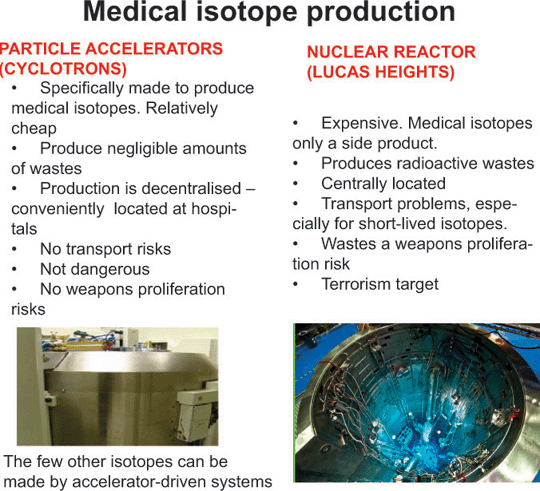
even ANSTO is using cyclotrons for generating imaging isotopes! And we actually have imaging/cyclotron partnerships set up in almost every major city in Australia….do not produce nuclear wastes.……..(expanding nuclear production) so that ANSTO can become one of the major players in the global export market. Where was this information in the glossy handouts given to Hawker and Kimba?
Name withheld. to Senate Committee on National Radioactive WasteManagement Amendment (Site Specification, Community Fund and Other Measures) Bill 2020 [Provisions] Submission 39 Excerpt
“States and territories are responsible for managing a range of radioactive waste holdings, accounting for about one per cent of total radioactive waste holdings in Australia.”…according to the DIIS – “Australian Radioactive Waste Management Framework April 2018”page 7
https://www.industry.gov.au/sites/default/files/2019-
04/australian_radioactive_waste_management_framework.pdf
And what about the requirement of the diagnostic isotope for Australians? It is afterall in our best interests to maintain this? This is an interesting question. In Senate Estimates Adi Paterson in 2017 stated…. ”As we submitted to the question on notice, currently approximately 28 per cent of molybdenum-99 produced by ANSTO is used domestically. Approximately 72 per cent of Mo-99 produced by ANSTO is exported, meeting a global need for access to life-saving nuclear medicines.” https://parlinfo.aph.gov.au/parlInfo/search/display/display.w3p;db=COMMITTEES;id=committees%
2Festimate%2F0493150c-8738-423c-a856- 9cb37d9e9073%2F0009;query=Id%3A%22committees%2Festimate%2F0493150c-8738-423c-a856- 9cb37d9e9073%2F0000%22
He then goes on to say later at the Senate Estimates, “The research use of isotopes predominantly takes place in our Camperdown facility, where we produce flourine-18, carbon-15 and oxygen-11.
These are cyclotron-based isotopes which are used for different types of clinical development of new imaging techniques, for developing new drugs and understanding the biological function of human living systems. That is a research cost for the production of those isotopes. There are small
amounts of isotopes whose inclusion into clinical trials we support. We do that under a very careful set of rules that ensures that should those clinical trials be successful we will be able to sell into the market the isotopes we produce that have supported the clinical trials. We have very good protocols on that which are very clear. We also sometimes undertake trials with stable isotopes, which are sourced from different jurisdictions. These are not radioactive isotopes, but with our careful tracing capabilities we can make use of those isotopes as well.”
So, even ANSTO is using cyclotrons for generating imaging isotopes! And we actually have imaging/cyclotron partnerships set up in almost every major city in Australia. For example Adelaide has one set up in the SAHMRI building. The thing about cyclotrons is that the isotopes are generatedon site, and do not have a distance factor involved and do not produce nuclear reactor quantities of nuclear waste!
And just for those interested, there are now advancements being made in immunotherapy and nanotechnology which means that patients can now receive treatment in a way which does not disrupt normal cells as a consequence. Immunotherapy is genetically modifying your own cells and
then reinjecting them into you to fight the cancer cells specifically. And nanotechnology is a way of specifically directing chemotherapy drugs specifically to cancer cells. Scott Morrison has injected almost half a billion dollars into Victoria to aid in this cutting edge technology. And neither involve nuclear reactors. https://www.abc.net.au/news/2016-01-11/nanocrystals-could-change-the-waycancer-
is-treated/7079958
https://www.heraldsun.com.au/news/victoria/peter-maccallum-cancer-centre-to-become-globallifesaving-
cancer-treatment-hub-under-budget-boost/newsstory/
7e6e0880ddac37973d1588c56c13a064
But getting back to the quantities of Molybenum-99 produced by ANSTO. Only 28% is used by Australians. This is for 550,000 doses produced per annum. And 72% is exported. Now, ANSTO has a brand new ANM building which they are intending to use to generate 10 MILLION DOSES PER
ANNUM, so that ANSTO can become one of the major players in the global export market. Where was this information in the glossy handouts given to Hawker and Kimba? With higher production of course comes higher levels of nuclear waste. It is one of the reasons why Canada exited the global
market scene because it was too expensive for their own taxpayers to continue to subsidize.
“Scheduled to be turned on just next year, once the ANM Project is fully operational, Australia will go from producing 550,000 doses of medicine a year to more than 10 million doses a year.“Our medicine production will increase exponentially. We’ll be producing enough medicine to meet more than a quarter of world demand,” said ANSTO CEO Dr Adi Paterson.” https://anstoprod.
cd.pnx.com.au/news/four-million-nuclear-medicine-doses-produced-and-going-strong
The ANM Project received operational licence by ARPANSA in late 2018.So for people like our MP’s to say that we all as Australians use the medical isotopes and therefore are responsible for the nuclear waste generated runs a bit hollow when we are actually propping up a major player in an export market!…..”
Why we must fight miners’ push to fast-track uranium mines
 Expensive, dirty and dangerous: why we must fight miners’ push to fast-track uranium mines https://theconversation.com/expensive-dirty-and-dangerous-why-we-must-fight-miners-push-to-fast-track-uranium-mines-139966?fbclid=IwAR173tiUPtRX3YkqQh5VlmoWHWWCUHxSFtCFxFIxKtuvI3IaghgbGhAEBAM, Gavin Mudd, Associate Professor of Environmental Engineering, RMIT University, June 18, 2020 Of all the elements on Earth, none is more strictly controlled under law than uranium. A plethora of international agreements govern its sale and use in energy, research and nuclear weapons.
Australian environmental law considers nuclear actions, such as uranium mining, as a “matter of national environmental significance” under the Environment Protection and Biodiversity Conservation (EPBC) Act. This means uranium involves matters of national and international concern for which the Australian government is solely responsible.
The states, which own minerals, cannot exercise such oversight on uranium exports and use. So any new uranium mine needs both state and federal environmental approvals.
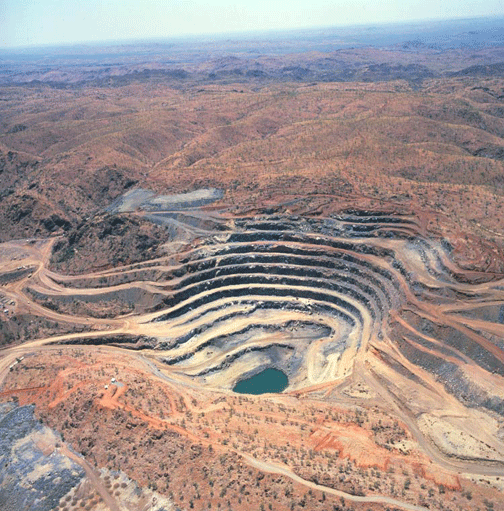
On Monday, Prime Minister Scott Morrison announced that BHP’s proposed expansion of the Olympic Dam copper-uranium-gold-silver mine in South Australia was one of 15 major projects set to be fast-tracked for environmental approval. This would include a single, joint state and federal assessment.
But responsibility and past performance make a compelling case to maintain our federal environmental laws more than ever. Here’s why uranium mining must remain a federal issue.
Our international obligations
Australia is a signatory to several international treaties, conventions and agreements concerning nuclear activities and uranium mining and export.
As of the end of 2018, the nuclear material safeguarded under international agreements derived from our uranium exports totalled 212,052 tonnes – including 201.6 tonnes of separated plutonium.
In response, a spokesperson for the Minerals Council of Australia said a national mechanism to manage safeguards already exists through the Australian Safeguards and Non-Proliferation Office, adding:
Uranium is further regulated through the Australian Radiation Protection and Nuclear Safety Agency (ARPANSA) […] under the provisions of the ARPANS Regulations 1999. The object of the ARPANS Act is “to protect the health and safety of people, and to protect the environment, from the harmful effects of radiation”.
Successful rehabilitation has yet to be seen
Uranium mines are difficult to rehabilitate at the end of their lives. In my 24 years of research, including visiting most sites, I’ve yet to see a successful case study of Australia’s 11 major uranium mines or numerous small sites.
For example, the Rum Jungle mine near Darwin, which operated from 1954 to 1971, left a toxic legacy of acidic and radioactive drainage and a biologically dead Finniss River.
The former Mary Kathleen mine, also part of Rio Tinto’s corporate history, operated from 1958-63 and 1976-82.
Rehabilitation works were completed by 1986 and won national engineering awards for excellence. But by the late 1990s, acid seepage problems emerged from the tailings dam (where mining by-products are stored) and overlying grasses were absorbing toxic heavy metals, creating a risk for grazing cattle.
Both Rum Jungle and Mary Kathleen were rehabilitated to the standards of their day, but they have not withstood the test of time.
Australia’s biggest uranium mine, Ranger, is fast approaching the end of its operating life.
Rio Tinto is also the majority owner of Ranger. Despite Ranger’s recent losses, Rio has retained control and given Ranger hundreds of millions of dollars towards ensuring site operations and rehabilitation.
Site rehabilitation is required to be complete by January 2026, with Rio Tinto and Ranger assuming 25 years of monitoring – although plans and funding for this are still being finalised.
Recently, it emerged that Ranger had not agreed to continue its share of funding the scientific research required for the rehabilitation – an issue still unresolved. So despite promises of world’s best ever rehabilitation, concerns remain.
The Conversation contacted Rio Tinto to respond, and it referred us to Energy Resources Australia (ERA), which operates Ranger. An ERA spokesperson stated:
ERA is required to cease processing in January 2021 in accordance with the expiration of its Authority to Operate under the Commonwealth Atomic Energy Act. Given the impending cessation in processing, ERA believes it is appropriate and reasonable to review the current research funding arrangements.
No other former uranium mine in Australia can claim long-term rehabilitation success. Nabarlek, Radium Hill-Port Pirie, South Alligator Valley and other small mines all have issues such as erosion, weeds, remaining infrastructure, radiation hot-spots and/or water contamination. They all require ongoing surveillance.
Uranium mining is set to be outcompeted
Even if Olympic Dam expands (and especially if it stops extracting uranium in favour of tellurium, cobalt and rare earths also present), this trend is expected to increase in the coming years as Ranger closes and the world transitions to renewable energy and electric vehicles to help address climate change.
In response, the Minerals Council of Australia stated that lithium’s contribution to large-scale electricity storage is just beginning, arguing:
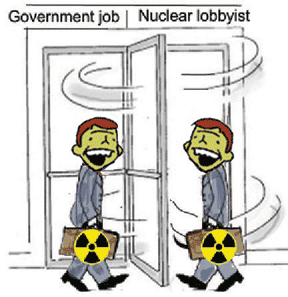
Gabrielle Costigan- another one revolving from tax-paid jobs to weapons industry!
 Gabrielle Costigan MBE https://www.michaelwest.com.au/gabrielle-costigan-mbe/
MILITARY INDUSTRY REVOLVING DOOR
A former Colonel in the Australian Army who led logistic operations for the Australian and US governments. Left the military to move into a US-based military industry company. Currently, CEO of BAE Systems Australia.
Current Positions
Corporate
CEO, BAE Systems Australia (1.1.18-present)
Publicly funded
Chair, Council for Women and Families United by Defence Service (term: 17.5.19–14.5.2021)
Previous Positions
Corporate positions
CEO (designate), BAE Systems Australia (2.10.17-31.12.17)
CEO, Linfox International Group (May 2014-June 2017)
Vice President, Military Programs and Business Development Commercial Aircraft, VAS Aero Services, LLC (USA) (July 2013-Mar 2014)
Vice President, Military Programs, VAS Aero Services, LLC (USA) (July 2012-June 2013)
Publicly funded positions
Board member, Australia-ASEAN Council [Joined board while at Linfox; no longer listed on board. Emailed DFAT-AAC for dates 15.2.20; no reply]
Military positions
Director, Multi-National Logistics Division, United States Central Command (Jan 2010-July 2012)
Military Assistant to the Chief of Joint Operations Command, Australian Defence Force (Jan 2008-Dec 2009)
Australian Command and Staff College, Australian Defence Force (Jan 2007-Dec 2007)
Australian Army, various positions (Jan 2002-Dec 2006)
Defence departmental positions
Project Manager–Simulation, Defence Department (1999-2002)
Related Items
June 2019: Awarded MBE by the United Kingdom, Queen’s Birthday honours list, “for services to UK/Australia relations.”
Another Australian wonderful lead – in CLIMATE DENIAL!!!!
 The number of climate deniers in Australia is more than double the global average, new survey finds, The Conversation, Caroline Fisher, Co-author of the Digital News Report: Australia 2020, Deputy Director of the News and Media Research Centre, and Assistant Professor of Journalism, University of Canberra, Sora Park, Lead Author of Digital News Report: Australia 2020, Associate Dean of Research, Faculty of Arts & Design, University of Canberra, June 16, 2020 Australian news consumers are far more likely to believe climate change is “not at all” serious compared to news users in other countries. That’s according to new research that surveyed 2,131 Australians about their news consumption in relation to climate change.
The Digital News Report: Australia 2020 was conducted by the University of Canberra at the end of the severe bushfire season during January 17 and February 8, 2020.
Read more: Media ‘impartiality’ on climate change is ethically misguided and downright dangerous
It also found the level of climate change concern varies considerably depending on age, gender, education, place of residence, political orientation and the type of news consumed.
Young people are much more concerned than older generations, women are more concerned than men, and city-dwellers think it’s more serious than news consumers in regional and rural Australia.
15% don’t pay attention to climate change news
More than half (58%) of respondents say they consider climate change to be a very or extremely serious problem, 21% consider it somewhat serious, 10% consider it to be not very and 8% not at all serious.
Out of the 40 countries in the survey, Australia’s 8% of “deniers” is more than double the global average of 3%. We’re beaten only by the US (12%) and Sweden (9%).
While most Australian news consumers think climate change is an extremely or very serious problem (58%), this is still lower than the global average of 69%. Only ten countries in the survey are less concerned than we are.
Strident critics in commercial media
There’s a strong connection between the brands people use and whether they think climate change is serious.
More than one-third (35%) of people who listen to commercial AM radio (such as 2GB, 2UE, 3AW) or watch Sky News consider climate change to be “not at all” or “not very” serious, followed by Fox News consumers (32%)……. https://theconversation.com/the-number-of-climate-deniers-in-australia-is-more-than-double-the-global-average-new-survey-finds-140450
Who will work in a radioactive waste dump in the dwindling community of Kimba?
You can bet it wont be a farmer come nuclear profiteer or his retired old man, whom are both selling the kid inheritance, and it wont be the small coterie of sell up farmers following their lead.
Then again, do you think it might be an ageing politician void of a statue, bust or plaque in the towns square a politician trying to earn brownie points before his destined retirement with a guaranteed government pension.
What about the operators of the stay afloat businesses with plenty of time on their hand watching the reduced community going to other regions for their supplies.
You never know council workers maybe called upon to serve time at the coal face. Scary, Huh!
This just maybe another proposal to mimic a nuclear program of placing the cart before the horse. https://www.facebook.com/groups/941313402573199/
Record-breaking heatwave in Siberia
Climate crisis: alarm at record-breaking heatwave in Siberia https://www.theguardian.com/environment/2020/jun/17/climate-crisis-alarm-at-record-breaking-heatwave-in-siberia
Thu 18 Jun 2020 A prolonged heatwave in Siberia is “undoubtedly alarming”, climate scientists have said. The freak temperatures have been linked to wildfires, a huge oil spill and a plague of tree-eating moths.
On a global scale, the Siberian heat is helping push the world towards its hottest year on record in 2020, despite a temporary dip in carbon emissions owing to the coronavirus pandemic.
Temperatures in the polar regions are rising fastest because ocean currents carry heat towards the poles and reflective ice and snow is melting away.
Russian towns in the Arctic circle have recorded extraordinary temperatures, with Nizhnyaya Pesha hitting 30C on 9 June and Khatanga, which usually has daytime temperatures of around 0C at this time of year, hitting 25C on 22 May. The previous record was 12C.
In May, surface temperatures in parts of Siberia were up to 10C above average, according to the EU’s Copernicus Climate Change Service (C3S). Martin Stendel, of the Danish Meteorological Institute, said the abnormal May temperatures seen in north-west Siberia would be likely to happen just once in 100,000 years without human-caused global heating.
Freja Vamborg, a senior scientist at C3S, said: “It is undoubtedly an alarming sign, but not only May was unusually warm in Siberia. The whole of winter and spring had repeated periods of higher-than-average surface air temperatures.
“Although the planet as a whole is warming, this isn’t happening evenly. Western Siberia stands out as a region that shows more of a warming trend with higher variations in temperature. So to some extent large temperature anomalies are not unexpected. However, what is unusual is how long the warmer-than-average anomalies have persisted for.”
Marina Makarova, the chief meteorologist at Russia’s Rosgidromet weather service, said: “This winter was the hottest in Siberia since records began 130 years ago. Average temperatures were up to 6C higher than the seasonal norms.”
Robert Rohde, the lead scientist at the Berkeley Earth project, said Russia as a whole had experienced record high temperatures in 2020, with the average from January to May 5.3C above the 1951-1980 average. “[This is a] new record by a massive 1.9C,” he said.
In December, Russia’s president, Vladimir Putin, commented on the unusual heat: “Some of our cities were built north of the Arctic Circle, on the permafrost. If it begins to thaw, you can imagine what consequences it would have. It’s very serious.”
Thawing permafrost was at least partly to blame for a spill of diesel fuel in Siberia this month that led Putin to declare a state of emergency. The supports of the storage tank suddenly sank, according to its operators; green groups said ageing and poorly maintained infrastructure was also to blame.
Wildfires have raged across hundreds of thousands of hectares of Siberia’s forests. Farmers often light fires in the spring to clear vegetation, and a combination of high temperatures and strong winds has caused some fires to burn out of control.
Swarms of the Siberian silk moth, whose larvae eat at conifer trees, have grown rapidly in the rising temperatures. “In all my long career, I’ve never seen moths so huge and growing so quickly,” Vladimir Soldatov, a moth expert, told AFP.
He warned of “tragic consequences” for forests, with the larvae stripping trees of their needles and making them more susceptible to fires.
Hauling dangerous nuclear waste across America
 Say NO to hauling dangerous nuclear waste across America, NIRS, 17 June 20 The Nuclear Regulatory Commission (NRC) is accepting comments on two proposals to build Consolidated Interim Storage (CIS) facilities in New Mexico and Texas. Building these so-called ‘interim’ sites would require hauling dangerous, high-level nuclear waste all over the country twice: Once to the ‘interim’ sites, then once again to the permanent site—if that is ever built. If the permanent site is not built, the ‘interim’ sites could become de-facto permanent storage sites. Communities in New Mexico and Texas would become the latest sacrifice to the nuclear industry.
We can’t allow this dangerous, high-level nuclear waste to be hauled around the country to storage sites that won’t be permanent solutions to our nuclear waste problem. Tell the NRC and your member of Congress to say NO to the CIS facilities in New Mexico and Texas….. https://org2.salsalabs.com/o/5502/p/dia/action4/common/public/?action_KEY=27069
Total renewable investment on renewable energy predicted to $16 trillion over the next decade – Goldman Sachs
 Goldman Sachs says renewable-energy spending will surpass oil and gas for the first time ever in 2021 — and sees total investment spiking to $16 trillion over the next decade, Business Insider, 17 June 20,
- Green-energy investing will account for 25% of all energy spending in 2021 and, for the first time ever, surpass spending on traditional fuel sources like oil and gas, Goldman Sachs said in a Tuesday note.
- Should the US aim to hold global warming within 2 degrees Celsius, the pivot to renewable energy sources will create between $1 trillion and $2 trillion in yearly infrastructure spending, the team of analysts added, or an investment opportunity as big as $16 trillion through 2030.
- While past economic downturns halted efforts to lift clean energy initiatives, the coronavirus recession “will be different,” the firm said.
- Green technologies “are now mature enough to be deployed at scale,” and the transition can benefit massively from cheap capital and “an attractive regulatory framework,” according to Goldman.
The transition to renewable power from traditional fuels will create a $16 trillion investment opportunity through 2030 as spending shifts to new infrastructure, Goldman Sachs analysts said Tuesday.
The bank projects green-energy spending to pass that of oil and gas for the first time ever next year and account for roughly 25% of all energy spending. The share stood at just 15% in 2014, but a dive in fossil-fuel investing over the past decade shifted more dollars to clean energy initiatives.
If the nation aims to hold global warming within 2 degrees Celsius, the move toward renewable energy would create between $1 trillion and $2 trillion in yearly infrastructure spending, the team led by Michele Della Vigna wrote in a note to clients.
Economic downturns have historically slowed efforts to boost clean energy investing, but Goldman sees the coronavirus downturn bucking that trend and accelerating the nationwide pivot. …… https://markets.businessinsider.com/news/stocks/renewable-energy-trillion-investment-opportunity-surpass-oil-first-time-goldman-2020-6-1029318482
Enviro groups slam Morrison’s Covid Commission over false claims of consultation — RenewEconomy
A group of leading environmental groups slam NCCC head Nev Power for falsely claiming they had been consulted on Covid-19 economic response. The post Enviro groups slam Morrison’s Covid Commission over false claims of consultation appeared first on RenewEconomy.
via Enviro groups slam Morrison’s Covid Commission over false claims of consultation — RenewEconomy
“Impacts of Climate Change on Nuclear Safety and Supply Security”
 Nuclear Risk & Public Control (accessed) 17th June 2020, Nuclear & Climate** Currently nuclear energy promoters are trying to make use the climate crisis for their goals by claiming that nuclear energy is a solution. But can nuclear energy contribute to a decarbonized future? Rather the contrary: climate change poses new challenges and risks to the operation of nuclear power plants, increasing nuclear risk and challenging supply security. In this Joint Project – Nuclear Risk & Public Control webinar we presented our new working paper “Impacts of Climate Change on Nuclear
Safety and Supply Security”. A report of the webinar can be downloaded here.
1 This month.


PETITION – To: Prime Minister Anthony Albanese and the Australian Labor Government
Chernobyl: The Lost Tapes – A good documentary on Chernobyl on SBS available On Demand for the next 3 weeks– https://www.sbs.com.au/ondemand/tv-program/chernobyl-the-lost-tapes/235274195556

19 May – Webinar- Webinar: No Nuclear Weapons in Australia
Start: 2026-05-19 18:00:00 UTC Canberra, Melbourne, Sydney (GMT+10:00)
End: 2026-05-19 19:30:00 UTC Canberra, Melbourne, Sydney (GMT+10:00)
20 May – Webinar – The dangerous world of AUKUS, US, military occupation and suppression of dissent

National Webinar, 20th May, 2026, 6.30pm AEST. Confronting laws restricting/suppressing protest speech and action
Speakers: Former Sen. Rex Patrick, Lawyer Nick Hanna ,Arthur Rorris ,Jorgen Doyle, Sen David Shoebbridge,
Facilitator Kelley Tranter.

of the week – Australians for War Powers Reform (AWPR)
To see nuclear-related stories in greater depth and intensity
 Antinuclear