There may be potential claims made in relation to asbestos relates diseases from asbestos at the ANSTO site – potential costs have not been identified
The Government has formally agreed (21/04/2016) to indemnify ANSTO and ANSTO officers, and ANM and ANM Officers from any loss or liability arising from claims caused by ionising radiation. This is in place until April 2026.
The Government claims it has already indemnified the Maralinga Tjarutja people in respect of claims arising from test site contamination (through the terms of the Maralinga Nuclear Test Site Handback Deed.)
Cessation of funding for the development of a detailed business case for the National Radioactive Waste Management Facility
Budget Paper 2.
Expenses * British Nuclear Test Veterans * three different figures (pg’s 48,57, 59, 175 &186) *more details on pg 93 of Budget Paper 4.
$133.1 over four years for health care (public or private) for any medical condition, irrespective of whether the condition is linked to their service. Includes participants in the British nuclear test program in Australia and vetereans of the British Commonwealth Occupation Force (who were deployed in or near Hiroshima).
National Medical Stockpile. Pg – 188.
The government will provide $85.4 million over 3 years to replenish national medial stockpiles – a strategic reserve in response to any chemical, biological or nuclear event.
Budget Paper 3.
Rum Jungle, pg 55
Environmental Management of the former Rum Jungle uranium mine site: $6.1 million 2017-2018, and $4 million in 2018-2019. This funding is a National Partnership payment to support State environment services. The funding is for a program of work established to improve the management of the site and further develop a rehab strategy.
Ranger, pg 77
Commonwealth provides general assistance to the NT on uranium at Ranger (because the Commonwealth owns NT uranium) *payments are made at a royalty rate of 1.25 % of net proceeds of sales. *** unclear what $ if any goes from Commonwealth to the NT….
It’s budget night, and while the government was tight-lipped about measures affecting Indigenous Australians, there were a number of leaks ahead of the treasurer’s announcments.
On Monday afternoon, it transpired that the Veteran’s Affairs Minister, Dan Tehan, was preparing to announce that Aboriginal people who were near British nuclear testing in the in 1950s and 1960s would finally receive a gold health card, which would mean access to improved health care, and most costs covered.
“The measure will provide Gold Cards to Indigenous people present at or near Maralinga, Emu Fields or the Monte Bello Islands at the time of the British Nuclear Tests in the 1950s or 1960s,” Mr Tehan told the ABC’s Q&A program.
The Government will also provide a gold card to cover the health care costs of the surviving participants of the British Nuclear Test program and veterans who served as part of the British Commonwealth Occupation Force (BCOF).The Government has allocated $133.1 million for this initiative to cover eligible veterans.
The announcement has been a long time coming for many Indigenous people and veterans alike, who have campaigned for decades to receive compensation.
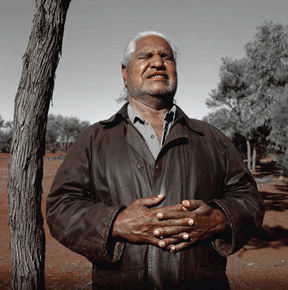
Yankunytjatjara man Yami Lester, who was blinded by atomic fallout says the support comes “60 years too late”.
“Most of our people have passed away. They were young ones then, now they’re older ones now, a few of them still living now today.”
Atomic veterans to be recognised after 61 years, Mandurah Mail, 8 May 17, The service of veterans exposed to British atomic testing off the coast of Western Australia in the 1950s is to be recognised in the federal budget on Tuesday.
On Sunday Canning MP Andrew Hastie announced $133 million would be spent giving the men who served in the Montebello Islands, where three nuclear weapons tests took place in 1952 and 1956, access to Department of Veterans Affairs gold cards.
Mr Hastie said the gold cards, which entitled the veterans to free public and private health care, were an acknowledgment the men had served in dangerous circumstances.
“It says to them that the Australian government, on behalf of the Australian people, care about them and are going to see their responsibility to care for them through,” he said.
“For these men it is recognition they did serve in hazardous conditions, that they were exposed to nuclear radiation after atomic testing, so for them it means a lot, especially since quite a few of them have suffered from cancer.”
Only 51 of the 89 servicemen who were conscripted to assist with the atomic tests are still alive.
Half of those who have since died succumbed to cancer……..
Many of the veterans said they had not been told of the dangers of nuclear radiation and were not issued protective gear.
“We got up there and didn’t even know what was happening, all we knew is that something big was happening so we got out on the upper deck and the count down came down,” Australian Ex-Services Atomic Survivors Association secretary Jim Marlow said.
“We were told to turn our backs, so we turned our backs and there was a blinding flash and a push of wind and a whole lot of noise and we turned back again and saw the smoke going up.”
Mr Marlow said he was back working in the ship 10 minutes after the blast.
Victoria
Origin stuns industry with record low price for 530MW wind farm Origin to buy output from 530MW Stockyard Hill wind farm at less than $60/MWh in price that will stun Australian industry. Following numerous solar deals, it expects renewables to account for more than 25% of its supply by 2020. http://reneweconomy.com.au/origin-stuns-industry-with-record-low-price-for-530mw-wind-farm-70946/
Origin stuns industry with record low price for 530MW wind farm Origin to buy output from 530MW Stockyard Hill wind farm at less than $60/MWh in price that will stun Australian industry. Following numerous solar deals, it expects renewables to account for more than 25% of its supply by 2020. http://reneweconomy.com.au/origin-stuns-industry-with-record-low-price-for-530mw-wind-farm-70946/
Tunnel collapses at Hanford; no radiation released, officials say http://www.king5.com/news/local/hanford/tunnel-collapses-at-hanford-no-radiation-released-officials-say/438227872Hundreds of workers were told to take cover at the Hanford Nuclear Reservation after a tunnel full of highly contaminated materials collapsed Tuesday morning. But officials say no radiation was released and no workers were hurt.Officials say a collapsed patch of ground above the tunnel was larger than first believed. The U.S. Department of Energy said the collapse covered about 400 square feet (37.1 square meters) instead of the 16 square feet (1.4 square meters) first reported.
Hundreds of workers were told to go into a “take cover” position after the tunnel in a plutonium uranium extraction (PUREX) plant collapsed.
The agency says the rail tunnels are hundreds of feet long, with about eight feet (2.4 meters) of soil covering them. The U.S. Department of Energy says the incident caused the soil above the tunnel to sink between 2 and 4 feet (half to 1.2 meters).
“I would underscore this is confined to a small area of the Hanford site,” Destry Henderson, deputy news manager for the Hanford Joint Information Center, told NBC News. “The facility does have radiological contamination right now but there is no indication of a radiological release,” Henderson said.
A manager sent a message to all personnel telling them to “secure ventilation in your building” and “refrain from eating or drinking.”
A source said “take cover” status was expanded to the entire site at 10:35 a.m. The source also said that crews doing road work nearby may have created enough vibration to cause the collapse, and that Vit Plant employees were in cover mode as well.
“With the federal budget set to be announced tomorrow, this is a big week for Australian Parliament.
For the government, it’s a time of champagne and cigars on the lawn.
For the rest of us (more precisely: young people, poor people, anyone who doesn’t own three investment properties) it’s a time of intense anxiety.
“This week the government is also proposing amendments to the Native Title Act that would clear the way for the controversial Adani coal mine in Queensland. Now, in defence of climate justice, a team of volunteers have got in early and spelled out a clear message in candles all over the Parliament House lawns. … ”
Unviable economics of nuclear power catches up with Cameco, Independent Australia, Jim Green 9 May 2017 Multinational uranium producer Cameco is battling a uranium downturn, the tax office, disinterested customers and Traditional Owners, Dr Jim Green reports.
ECONOMICS is killing the nuclear power industry.
Westinghouse, a giant of the industry, recently filed for bankruptcy protection and its parent company Toshiba may also go bankrupt — both companies brought undone by $15 billion cost overruns building four reactors.
In France, nuclear utilities EDF and Areva would have gone bankrupt if not for repeated multi-billion-dollar government bailouts — their most immediate problem is cost overruns of $18 billion building just two reactors.
The question arises: will them nuclear power crisis create similar carnage in the uranium industry? Might it bring down a uranium industry giant like Cameco, which provides about 17% of the world’s production from mines in Canada, the U.S. and Kazakhstan?
The short answer is that Cameco will likely survive, but the company has been downsizing continuously for the past five years:
In 2014, Cameco cut its growth plans and uranium exploration expenses, warning that the “stagnant, oversupplied short-term market” was not going to improve any time soon.
Another 120 workers are to be sacked by May 2017 at three Canadian uranium mines ‒ McArthur River, Key Lake and Cigar Lake ‒ and production at McArthur River, already reduced, will be suspended for six weeks in mid-2017.
Cameco’s revenue dropped US$238 million (AU$321 million) in 2016 and the company posted a US$46 million (AU$62 million) loss for the year. The loss was largely the result of US$267 million (AU$360 million) in impairment charges, including US$91 million (AU$123 million) related to the Rabbit Lake mine and a write-off of the full US$176 million (AU$237 million) value of the Kintyre uranium project in Western Australia.Continue reading →
Proper consultation with Indigenous Leaders needed
Adani shouldn’t determine Native Title reform agenda
“The Attorney General George Brandis has cut corners and conducted a shabby consultation process on the Native Title Bill to be debated in the Senate this Wednesday, failing to include Traditional Owners across Australia, say Wangan and Jagalingou Traditional Owners fighting Adani’s coal mine in Central Queensland.
“Senior spokesperson for the Wangan and Jagalingou (W&J)Traditional Owners Council, Mr Adrian Burragubba said, “The Attorney General has whipped up a false sense of urgency so he can push through this Bill, which is designed for everyone but the Traditional Owners whose rights it is meant to uphold.
““Brandis has engineered a cursory and limited consultation process which is grossly inadequate for amendments which will have such a significant and long term impact on our rights. …
“The Labor Party, who were the original architects of native title laws under Prime Minister Paul Keating, understood that good native title laws are built on direct consultation with a broad group of Aboriginal leaders, and are meant to right an historic wrong.
““We are encouraged by reports that the Opposition, in this 25th anniversary year of the Mabo decision,
is troubled by the Government’s handling of this Bill,
and is seeking to ensure proper consultations with Traditional Owners.
We have urged all Labor, Green and Xenophon Senators not to pass this bill. …
“Youth spokesperson for the W&J Traditional Owners Council, MsMurrawah Johnson, said, “As Traditional Owners we have a right to determine our own future and make our own decisions about our lands and waters. It is not up to unelected CEOs and lawyers who are talking to the Government.
““The Government has failed to make a case for why this Bill is urgent, or make a convincing argument why it needs to overturn the Federal Court’s decision in McGlade. …
NHK World, May 1, 2017 (emphasis added): Wildfire continues in Fukushima — A wildfire has been raging for more than 2 days near the damaged Fukushima Daiichi nuclear power plant. The area is part of a zone designated as “no-entry” due to high radiation levels… Fukushima and Miyagi prefectures and the Self-Defense Forces are using helicopters to fight the blaze. They are also looking at the possibility of using ground crews. Footage from an NHK helicopter on Monday morning showed smoke rising from wide areas and fires burning in several locations
Mainichi, May 1, 2017: Wildfire rages in highly radioactive Fukushima mountain forest — A fire broke out in a mountain forest near the crippled Fukushima No. 1 Nuclear Power Plant on the evening of April 29, consuming an area approximately 20 hectares in size, according to prefectural authorities… As the fire continued to spread, however, helicopters from the GSDF, Fukushima Prefecture and other parties on May 1 resumed fire extinguishing operations from around 5 a.m. … As of May 1, there were no major changes to radiation levels in the heart of Namie and other areas near the fire scene, according to the Ministry of the Environment. “We will continue to closely watch changes in radiation doses in the surrounding areas,” said a ministry official.
Common Dreams, May 1, 2017: Sparking Fears of Airborne Radiation, Wildfire Burns in Fukushima ‘No-Go Zone’; Contaminated forests such as those outside fallout sites like Fukushima and Chernobyl ‘are ticking time bombs’ — A wildfire broke out in the highly radioactive “no-go zone” near the crippled Fukushima nuclear power plant over the weekend, reviving concerns over potential airborne radiation… Local officials were forced to call in the Japanese military… In a blog post last year, Anton Beneslavsky, a member of Greenpeace Russia’s firefighting group who has been deployed to fight blazes in nuclear Chernobyl, outlined the specific dangers of wildfires in contaminated areas. “During a fire, radionuclides like caesium-137, strontium-90 and plutonium rise into the air and travel with the wind,” Beneslavsky wrote. “This is a health concern because when these unstable atoms are inhaled, people become internally exposed to radiation.” Contaminated forests such as those outside fallout sites like Fukushima and Chernobyl “are ticking time bombs,” scientist and former regional government official Ludmila Komogortseva told Beneslavsky. “Woods and peat accumulate radiation,” she explained “and every moment, every grass burning, every dropped cigarette or camp fire can spark a new disaster.”
Sputnik News, May 1, 2017: Japanese Authorities Fighting Wildfire in Evacuation Zone Near Fukushima NPP… There were no reports either about the wind direction or the changes in the background radiation level in relation to the fire.
Unviable economics of nuclear power catches up with Cameco, Independent Australia, Jim Green 9 May 2017 “…….CAMECO’S INCIDENTS AND ACCIDENTS: 1981‒2016
This table lists many of Cameco’s accidents and controversies since 1981 — leaks and spills, the promotion of dangerous radiation junk science (in WA and elsewhere) appalling treatment of Indigenous people, systemic and sometimes deliberate safety failures and so on.
Date and Location
Description of Incident
1981−89:
Saskatchewan, Canada
153 spills occurred at three uranium mines in Saskatchewan from 1981 to 1989. Cameco was fined C$10,000 for negligence in relation to a 1989 spill of two million litres of radium- and arsenic-contaminated water from the Rabbit Lake mine.
1990, May 13:
Blind River Uranium Refinery
Leak shuts down the Canadian refinery. Approximately 178 kg of radioactive uranium dust leaked into the air over a 30-hour period.
1993:
Canada/US
Inter-Church Uranium Committee from Saskatchewan reveals export of at least 500 tons of depleted uranium to the US military by Cameco, despite several Canadian treaties to export uranium only for “peaceful purposes”.
1998:
Kyrgyzstan
A truck en route to a Cameco gold main spills 2 tons of cyanide into the Barskoon River, a local drinking water and agricultural water source. 2,600 people treated and more than 1,000 hospitalized.
2001−
onwards:
Ontario
A 2003 report by the Sierra Club of Canada provides details of 20 major safety-related incidents and unresolved safety concerns at the Bruce nuclear power plant.
2002:
Kyrgyzstan
Fatality at Cameco’s Kumtor Gold Mine. Death of a Kyrgyz national, buried in the collapse of a 200 meter-high pit wall.
2003, April:
McArthur River, Saskatchewan
Cave-in and flood of radioactive water at the McArthur River mine. A consultant’s report found that Cameco had been repeatedly warned about the water hazards right up until the accident happened.
2004:
Key Lake uranium mill, Canada
Canadian Nuclear Safety Commission approves Key Lake license renewal, despite continuing pit sidewall sloughing into the tailings disposed in the Deilmann pit. One million cubic meters of sand had already slumped into the tailings.
2004, April:
Port Hope, Ontario
Gamma radiation discovered in a school playground during testing in advance of playground upgrades. Although the Canadian Nuclear Safety Commission and AECL tried to dismiss the findings, the material under the school had to be removed when it was converted to low-cost housing in 2011. The contaminated material came from the uranium processing facility in Port Hope, now owned by Cameco.
2006, April:
Cigar Lake, Saskatchewan
A water inflow began at the bottom of the 6-meter wide shaft, 392 meters below the surface. All the workers left the area and removed equipment. According to a miner, “the mine’s radiation alarm kept going off, but the radiation technician merely re-set the alarm, assuring us that everything was fine.”
2006, Oct.: Cigar Lake, Saskatchewan
Cameco said its “deficient” development of the Cigar Lake mine contributed to a flood that delayed the mine project by three years and would double construction costs.
2007:
Port Hope, Ontario
Substantial leakage of radioactive and chemical pollutants into the soil under the uranium conversion facility ‒ leakage not detected by monitoring wells.
2008:
US/Canada
Uranium mines owned by Cameco in Nebraska, Wyoming, and Canada have all had spills and leaks. Cameco made a settlement payment of $1.4 million to Wyoming for license violations, and $50,000 to Nebraska for license violations.
2008, January:
Rabbit Lake mill
Seepage underneath the mill discovered after a contract worker noticed a pool of uranium-tainted ice at an outdoor worksite.
2008, May:
Port Hope, Ontario
It was discovered during soil decontamination at the suspended Port Hope uranium processing facility that egress from degraded holding floors had contaminated the harbour surrounding the facility, which flows into Lake Ontario.
2008, June:
Key Lake
Canadian Nuclear Safety Commission intends to approve the license renewal for Cameco’s Key Lake mill although CNSC staff assigned ‘C’ ratings (“below requirements”) in four out of 10 program areas assessed, including waste management, fire protection, environmental protection, and training.
2010:
Rabbit Lake
Uranium discharges from Rabbit Lake (highest by far in Canada) showed increase rather than the predicted decrease in 2010.
2011: Ship from Vancouver to China
A number of sea containers holding drums of uranium concentrate are damaged and loose uranium is found in the hold.
2012, August:
Port Hope, Ontario
Spill of uranium dioxide powder resulted in one worker being exposed to uranium and three other workers potentially exposed during clean-up.
2012:
Northern Saskatchewan
Draft agreement between Cameco, Areva and the Aboriginal community of Pinehouse includes extraordinary clauses such as this: “Pinehouse promises to: … Not make statements or say things in public or to any government, business or agency that opposes Cameco/Areva’s mining operations; Make reasonable efforts to ensure Pinehouse members do not say or do anything that interferes with or delays Cameco/Areva’s mining, or do or say anything that is not consistent with Pinehouse’s promises under the Collaboration Agreement.”
2012, June 23: Blind River refinery, Ontario
Three workers exposed to airborne uranium dust after a worker loosened a ring clamp on a drum of uranium oxide, the lid blew off and about 26 kg of the material were ejected into the air.
2013‒ongoing: Canada
Cameco is battling it out in tax court with the Canada Revenue Agency (CRA). Up to US$1.6 billion in corporate taxes allegedly went unpaid. Cameco also involved in tax dispute with the US IRS. According to Cameco, the IRS is seeking an additional $32 million in taxes, plus interest, and may also seek penalties.
2013: English River First Nation, Canada
English River First Nation sign deal with Cameco and Areva, agreeing to support Millennium uranium mine and drop a lawsuit over land near the proposed mine. Some English River First Nation band members reacted strongly to the agreement. Cheryl Maurice said. “I am speaking for a group of people who weren’t aware that this agreement was being negotiated because there was no consultation process.”
2013, June: Saskatchewan
Federation of Saskatchewan Indian Nations Chief Perry Bellegarde says the provincial government should not issue any new permits for potash, uranium or other resource development until First Nations concerns are addressed. Bellegarde said the province’s lack of a revenue-sharing deal with First Nations stemmed from “economic racism.” “Do not issue a licence to Cameco or Areva or BHP until indigenous issues are addressed,” he said.
2013, August:
Troy, Ohio, USA
A fire occurred on a truck carrying uranium hexafluoride which originated from Cameco’s refinery in Port Hope, Ontario. Nuclear regulators in Canada – where the cargo originated – and in the US were not informed of the incident.
2013, Sept.:
Northern Saskatchewan
Sierra Club Canada produces a detailed report on Cameco’s uranium operations in Northern Saskatchewan. It details systemic corporate failure by Cameco as well as systemic regulatory failure.
2014, Jan.:
Port Hope
About 450 Port Hope homeowners have had their soil sampled and properties tested in the first phase of the biggest radioactive clean-up in Canadian history. Some 1.2 million cubic metres of contaminated soil will be entombed in a storage facility. More than 5,000 private and public properties will undergo testing to identify places which need remediation. Port Hope is riddled with low-level radioactive waste, a product of radium and uranium refining at the Eldorado / Cameco refinery. The clean-up will cost an estimated US$1.3 billion.
2014, March
A statement endorsed by 39 medical doctors calls on Cameco to stop promoting dangerous radiation junk science. The statement reads in part: “Cameco has consistently promoted the fringe scientific view that exposure to low-level radiation is harmless. Those views are at odds with mainstream scientific evidence.”
2015
A uranium supply contract was signed by Cameco and India’s Department of Atomic Energy on April 15, 2015. Nuclear arms control expert Crispin Rovere said: “As with the proposed Australia–India nuclear agreement, the text of the Canadian deal likewise abrogates the widely accepted principle that the nuclear recipient is accountable to the supplier. This is ironic given it was nuclear material diverted from a Canadian-supplied reactor that led to the India’s break-out in the first place. It would be like the citizens of Hiroshima deciding it would be a good idea to host American nuclear weapons within the city – the absurdity is quite astonishing.”
2015: Saskatchewan
Cameco’s uranium operations in Saskatchewan are facing opposition from the Clearwater Dene First Nation. A group called Holding the Line Northern Trappers Alliance has been camping in the area to block companies from further exploratory drilling in their territory. The group set up camp in November 2014 and plans to remain until mining companies leave. Concerns include Cameco’s uranium deal with India and the health effects of Cameco’s operations on the Indigenous people of northern Saskatchewan.
2015:
Key Lake mill, Canada
Cameco personnel identify the presence of calcined uranium oxide within a building. Five workers receive doses exceeding the weekly action level of 1 mSv.
2016: Smith Ranch ISL uranium mine, Wyoming, USA
The US Nuclear Regulatory Commission finds that a supervisor from Cameco subsidiary Power Resources deliberately failed to maintain complete and accurate records of workers’ exposure to radiation. The NRC issues a Notice of Violation to Cameco.
2016: Smith Ranch ISL uranium mine, Wyoming, USA
The Nuclear Regulatory Commission issued a Confirmatory Action Letter to Cameco subsidiary Power Resources documenting actions that the company has agreed to take before resuming shipments of radioactive sludge to a Utah facility. The letter followed two incidents in which containers of radioactive barium sulfate sludge, a byproduct of uranium ore processing, arrived at their destination with external contamination from leakage during transport.
Lynne Loss was a little girl during that era living in Los Alamos when her father worked as an engineer in the lab and mother worked on site buying nuclear supplies.
“My brother used to go down into the canyon with his friends behind our house on Walnut Street and he would come home and tell mama that the deer had tumors on them,” Loss said.
In 1957, her family moved to Colorado, but she fears the damage was already done by then. Her father Henry Davis was frequently exposed to radiation and beryllium, a lightweight metal used in weapons.
“And then he would come home with it on his clothes and we would have to wash his clothes with ours and sit on the furniture, eat dinner, and whatever you do when you’re a family,” Loss said.
Davis suffered for 40 years from beryllium disease and radiation exposure, finally dying in 1994. Soon after, Loss learned she had colon cancer.
“‘God’, I said, ‘don’t put my family through all of this,'” she said. “I have two beautiful sons and five grandkids. I said I don’t want them to go through this with me. I said, ‘I want you to take me now or heal me’ and God I guess so far has wanted me to stay here and do this interview and help others.”
Loss is helping by pleading with Congress to add family members to the Radiation Exposure Compensation Act. It’s a law that allows the federal government to pay out employees whose jobs exposed them to radiation while helping to build America’s nuclear arsenal.
Sen. Tom Udall, D-N.M., is sponsoring amendments to the act.
“That’s an issue that we’ve been working on a lot over time,” Udall said. “And I think if a family member can show they have significant exposure, then there is a good argument they should be included.”
Udall admits at this point, family members of employees aren’t covered under the act, but it may be in the works.
“I think what we’ve done with the family members specifically is to try to do all of the studies, to include money to do research, to find out what the impact specifically has been on the families,” he said. “I believe there is probably an impact on families, especially if a miners, millers or others were working in the industry to produce the material for atomic bombs, national security work — I believe if they brought that material on their clothes and into their house, if they didn’t leave it at work, if they brought souvenirs and pieces of rock that would leak radon, all of those things could make a real difference.”
It would help children of lab employees like Loss. Her cancer has hurt her physically and financially.
“Oh my god, David and I lost all of our retirement money, $300,000 paying my medical,” she said. “My deductibles went up. My premiums went up. Everything went up sky high.”
Thousands of men and women helped to make the country safer and stronger by lending their brains and hands to research that could eventually cost them their lives and now the lives of their children. Lynne Loss hopes her country won’t forget about her.
Apr 15, 2026 01:00 AM in Canberra, Melbourne, Sydney
Join the International Physicians for the Prevention of Nuclear War (IPPNW) on Tuesday, April 14th for a timely webinar exploring the risks associated with nuclear power and challenging the myth that it offers a simple, safe, carbon-free solution to the climate crisis
21 April Webinar: No Nuclear Weapons in Australia
Start: 2026-04-21 18:00:00 UTC Canberra, Melbourne, Sydney (GMT+10:00)
End: 2026-04-21 19:30:00 UTC Canberra, Melbourne, Sydney (GMT+10:00)
Event Type: Virtual A virtual link will be communicated before the event.




 Antinuclear