Guano, Nuclear Testing, Chemical Weapons Another guano claim converted for U.S. military use is Johnston Atoll (Kamala), located about 800 miles southwest of Honolulu.
One phase of expansion on Johnston Island involved construction of a launch pad for high-altitude missile tests for Operation Dominic in the 1960s. Two of the tests were aborted, with radioactive contamination falling on the runway. Forty years later, in 2002, the Air Force “finished burying thousands of cubic meters of plutonium-contaminated waste in a 25-acre landfill on the atoll.”
The question, then, is not when will islands be submerged, but when will sea-level rise make life on low-lying islands impossible.
The answer to that question is close at hand for a number of Pacific islands.
Perhaps the biggest legal stride in New Zealand is Prime Minister Jacinda Ardern’s recent announcement of plans for a special refugee visa for Pacific Islanders, starting with 100 places annually. “We are anchored in the Pacific,” Ardern told reporters. “Surrounding us are a number of nations, not least ourselves, who will be dramatically impacted by the effects of climate change. I see it as a personal and national responsibility to do our part.”
American Polynesia, Rising Seas and Relocation, By Laray Polk, Global Research, January 06, 2018 The Asia-Pacific Journal: Japan Focus 22 December 2017In the next 30 to 50 years, rising sea levels caused by global warming will subsume low-lying islands in the Pacific Ocean. Inhabitants will have to relocate, but there are few choices. Among nations (with the exception of Fiji and New Zealand) there is little preparation for the inevitable migration of Pacific Islanders. Which nations should commit to the processes of equitable relocation?
The following article will address this question through historical context and colonial occupation; current legal debates surrounding climate change and maritime migration; and the potential rights of “deterritorialized” states, such as retention of exclusive economic zones. Historical context includes an examination of U.S. insular territories in the Pacific and the continued exercise of presidential authority over island possessions.
There are strong arguments to be made that the United States has ethical obligations to assist Pacific Islanders as sea levels continue to rise, with assistance taking many forms. The U.S. is obligated namely because it is the second largest emitter of greenhouse gases, and the largest carbon emitter historically; it has extensively tested atomic and hydrogen bombs and biochemical agents in the Pacific Ocean (Marshall Islands, Christmas Island, Johnston Atoll); Continue reading →
The bomb for Australia? (Part 2) https://www.aspistrategist.org.au/bomb-australia-part-2/, 19 Jan 2018|Ramesh Thakur As we consider whether Australia should obtain nuclear weapons, we need to ask who might subject us to nuclear blackmail. In the authoritative statement of China’s strategic vision in President Xi Jinping’s address to the 19th Communist Party Congress on 18 October last year, the three core elements of China’s vision of the new world order were parity in China–US relations; growing Chinese influence in writing the underlying rules and in designing and controlling the governance institutions of the global order; and more assertive Chinese diplomacy in that new international system.
The world therefore should prepare for a surge in Chinese international policy activism. It seems reasonable to conclude that—regardless of who may be at fault in initiating hostilities—the possibility of a future conflict with China can’t be ruled out. At the same time, Paul Dibb and Richard Brabin-Smith argue in their recent ASPI report, Australia’s management of strategic risk in the new era, that ‘it’s difficult to imagine any other major power … attacking Australia’. And there, for ASPI’s Andrew Davies, lies the rub, because ‘China is a nuclear power’.
But it does not follow that Australia must prepare for Chinese military or political use of nuclear weapons. For eight years or so, China has indulged in bellicose rhetoric and engaged in assertive behaviour against several neighbours, stoking their fears about its motives and intentions with growing capabilities. That said, of the nine leaders with fingers on the nuclear button, whose quality of nuclear decision-making is likely to be more responsible than Xi Jinping’s? Certainly not those who boast about the size of their button.
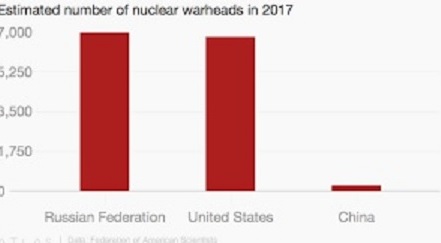
China’s nuclear stockpile is below 300, compared to nearly 7,000 warheads each for Russia and the US. Fan Jishe argues in an APLN policy brief that—notwithstanding its massively growing economy—China has consciously refrained from engaging in a sprint to nuclear parity with Russia and the US because its governing doctrine envisages only one role for nuclear weapons: to prevent nuclear blackmail.
Despite the total transformation in China’s economic fortunes since the 1960s, its nuclear doctrine, acquisitions program, and deployment and employment policies have remained essentially unchanged. It’s the only one of the nine possessor countries to be committed fully to an unequivocal no-first-use policy. Conversely, of the nuclear nine, only the US can be suspected of harbouring designs to shift from mutual vulnerability (the basis of deterrence) to nuclear primacy (which would enable use without fear of nuclear retaliation).
Of course, we can’t simply rely on the word of a potential adversary. But there are two further considerations. On the one hand, the international reputational cost to the next country to use nuclear weapons would be very high for breaking the global taboo. The cost would be even greater for a power that has a firm no-first-use policy. And the costs have been raised still higher by the new UN nuclear ban treaty. The treaty’s primary impact is intended to be normative, not operational, as I argue in the current issue of The Washington Quarterly, through moral stigmatisation and legal prohibition. It specifically prohibits the threat of use, along with banning any actual use of nuclear weapons. Instead of welcoming the treaty as a contribution to our national security, Australia has opposed and rejected it. On the other hand, an Australia reduced to a post-nuclear-attack atomic wasteland would be of no commercial, strategic or any other value to China, so the reputational cost would come with no compensating material or geopolitical gain.
According to a careful statistical analysis of 210 militarised ‘compellent threats’ from 1918 to 2001 by Todd Sechser and Matthew Fuhrmann (Nuclear weapons and coercive diplomacy, 2017), nuclear powers succeeded in just 10 of them, and even then the presence of nuclear weapons may not have been the decisive factor. Non-nuclear states were more successful at coercion than nuclear-armed states (32% of cases versus 20%) and nuclear monopoly gave no more assurance of success. In a different dataset of 348 territorial disputes between 1919 and 1995, possessor and non-possessor states won territorial concessions at almost the same rate (35% and 36%, respectively).
Lacking compellent utility against non-nuclear adversaries, nuclear weapons can’t be used for defence against nuclear-armed rivals either. Their mutual vulnerability to second-strike retaliatory action is so robust for the foreseeable future that any escalation through the nuclear threshold really would amount to mutual national suicide.
The only purpose and role of nuclear weapons, therefore, is mutual deterrence. They are credited with having preserved the long peace among the major powers in the north Atlantic (the argument that holds NATO to have been the world’s most successful peace movement) and deterred attack by the conventionally superior Soviet forces throughout the Cold War. Yet that too is debatable. How do we assess the relative weight and potency of nuclear weapons, West European integration and West European democratisation as explanatory variables in that long peace? No evidence exists to show that either side had the intention to attack the other at any time during the Cold War but was deterred from doing so because of the other side’s nuclear weapons.
BY ANDREAS NIDECKER, EMILIE GAILLARD AND ALYN WARE, OPINION CONTRIBUTORS — 01/18/18 As nuclear tensions increase, dangerous times have raised legally-loaded questions about nuclear weapons. Should the U.S. violate or undermine the Iran nuclear deal? Does the president have unfettered power to launch a preemptive nuclear strike on North Korea? What’s the legal status of the Trump administration’s intention, telegraphed in the newly leaked Nuclear Posture Review, to expand U.S. nuclear capabilities and arsenals when the Nuclear Non-Proliferation Treaty supposedly commits us to cutting and eventually eliminating them?
But there’s an even broader legal dilemma looming over production, testing and threatened use of nuclear weapons: how they affect the human rights of future generations. Those threats to the future are also compounded by nuclear energy, which generates radioactive waste we’re manifestly unable to control, and by destabilizing the climate that has enabled and sustained human civilization.
Can such crimes against the future be legal? How can we respect the human rights of future generations in view of them? International symposia at the University of Basel (Switzerland), University of Caen (France) and Charles University in Prague (Czech Republic) recently grappled with those questions. The Basel conference produced a declaration on human rights and trans-generational crimes resulting from nuclear weapons and nuclear energy.
Protecting future generations from the threat of nuclear weapons was an important consideration in the International Court of Justice’s 1996 affirmation that threat or use of nuclear weapons is generally illegal, given their long-term and indiscriminate impact. But despite the Court’s decision, most nuclear-armed states retain (illegal) policies to use nuclear weapons, including in a first, pre-emptive strike.
In general, current law fails to safeguard the rights of future generations. But that doesn’t make failure defensible, sustainable or in accord with legal principles. Evolution of this area of law is necessary and inevitable.
Some 2000 nuclear weapons were detonated for “testing” since 1945, releasing millions of curies of radiation. This impacted human health globally, and will continue to do so for generations. Most nuclear testing victims live in remote areas like the Pacific islands, the Kazakhstan steppe, or the North African Sahara. They have largely been forgotten; today’s younger generations are unaware of their sacrifice. Yet forgetting is perilous, because today’s youth will be tomorrow’s victims unless the cycle is broken.
There are some legal efforts to break it. For example, the 2017 Treaty on the Prohibition of Nuclear Weapons obligates signatories to provide environmental remediation and assistance for nuclear testing victims. But the provision is unenforceable, because none of the nine nuclear weapons states signed the treaty.
Like nuclear weapons, nuclear energy also poses enduring threats to human health. The Chernobyl explosion caused widespread contamination across the region and the whole European continent. High volumes of radiologically contaminated water from Fukushima continue to leak into the Pacific.
These, too, are crimes against the future. Some lethal isotopes in nuclear waste have half-lives of thousands of years. Waste repositories will need to be guarded for unimaginable time periods, with associated financial, logistical and security implications for future societies, an enormous burden we leave to our descendants.
Like the Treaty on the Prohibition of Nuclear Weapons, the International Covenant on Economic, Social and Cultural Rights (ICESCR) asserts a human right to health, applicable to nuclear contamination. But in practice that right isn’t respected.
For example, Japan ratified the covenant, and the Japanese constitution even defends the trans-generational principle of human rights in articles 11 and 97. But despite those legal principles being articulated, the Japanese media is still prevented from reporting on current events in Fukushima, and medical research on the effects of the meltdown is still restricted. The Japanese government maintains that small amounts of radiation are harmless, so limits for public radiation exposure could be increased from 1 to 20 millisieverts per year, the same as for radiation workers.
That’s unconscionable and untenable, not to mention discriminatory against young women and children who are much more susceptible to radiation exposure than men, with higher risks of cancer and non-cancerous diseases. Radiation exposure may present mutations and diseases in their offspring decades later. That’s why Japan’s handling of the Fukushima fails to accord with its own constitution as well as the ICESCR.
Failing to combat climate change effectively is also a crime against the future. The chances of meeting the Paris goal of limiting global warming to 2°C are receding since the U.S. withdrew and financial contributions of many signatories remain out of scale with the problem. Greenhouse gas emissions have risen in the two years since the Paris accord. If we stay on this too-little, too-late trajectory, we’ll not only fail to protect human rights, but much of life on earth.
Can all this be considered legal? Not for long. The dawn of the nuclear age marked the acquisition of unprecedented human power over the earth and all forms of life, as the Caen symposium pointed out. Many legal experts believe that in this new anthropocene era, a new code of medical and legal ethics is necessary. Trans-generational impacts of nuclear war, nuclear catastrophes and climate change must now be seriously considered, and require a paradigm shift in our legal thinking about the future.
The District Court of Hague took a step in that direction in 2015 when it affirmed in Urgenda Foundation v. the Dutch State that the government had a responsibility to protect future generations by limiting greenhouse gas emissions. A similar case in the United States — People v Climate Change — was granted jurisdiction and is proceeding to consideration of its merits.
There remains a long way to go to adapt the current legal framework to the realities of nuclear threats and climate change. Current laws need better implementation, and new laws need to be established. But those changes are vital to protecting the human rights of future generations.
Emilie Gaillard is an Assoc. Professor of law and a researcher at the University of Caen Normandy (France). She is a member of the Pôle Risques, Qualité et Environnement Durable at Maison de la recherché et des Sciences de l’Homme (Caen).
Andreas Nidecker MD is a Professor Emeritus of Radiology at the University of Basel, Switzerland. Board member and past president of PSR / IPPNW Switzerland and member of the organizing Committees of the symposium “Human Rights, Future Generations & Crimes in the Nuclear Age.”
Alyn Ware is a member of the World Future Council and consultant for the International Association of Lawyers Against Nuclear Arms.
Paul took that further in The Australian, canvassing the idea of investing in capabilities that would reduce the lead time for getting the bomb to give us more options for dealing with growing strategic uncertainty. North Korea’s nuclear advances and diminishing confidence in the dependability of US extended nuclear deterrence add to the sense of strategic unease.
In reply, Hughpolitely, gently but firmly rejected the implication that he’s a closet supporter of Australia taking the nuclear weapon path. He neither advocates nor predicts that Australia should or will go nuclear. He professes uncertainty about the role of nuclear weapons in shaping Asia’s emerging strategic landscape, highlights the importance of getting the decisions right on conventional capabilities first, and points to the choices and trade-offs that would then have to be made between the security benefits and risks of a weaponized nuclear capability.
Who will call out the nuclear emperor for being naked? Nuclear weapons haven’t been used since 1945—Hiroshima was the first time and Nagasaki the last. Their very destructiveness makes them qualitatively different in political and moral terms, to the point of rendering them unusable. A calculated use of the bomb is less likely than one resulting from system malfunction, faulty information or rogue launch.
On the other hand, the non-trivial risks of inadvertent use mean that the world’s very existence is hostage to indefinite continuance of the same good fortune that has ensured no use since 1945.
Curiously, Hugh, Paul and Andrew don’t explore the roles that nuclear weapons might play, the functions they would perform, and the circumstances and conditions in which those roles and functions would prove effective. This is a crucial omission. The arguments I canvassed in a review of the illusory gains and lasting insecurities of India’s nuclear weapon acquisition apply with equal force to Australia, albeit with appropriate modifications for our circumstances.
In short, the nuclear equation just does not compute for Australia.
Consistent with the moral taint associated with the bomb, the most common justification for getting or keeping nuclear weapons isn’t that we’d want to use them against anyone else. We’d only want them either to avert nuclear blackmail or to deter an attack. Neither of those arguments holds up against the historical record or in logic.
The belief in the coercive utility of nuclear weapons is widely internalised, owing in no small measure to Japan’s surrender immediately after Hiroshima and Nagasaki. Yet the evidence is surprisingly clear that the close chronology is a coincidence. In Japanese decision-makers’ minds, the decisive factor in their unconditional surrender was the entry of the Soviet Union into the Pacific war against Japan’s essentially undefended northern approaches, and the fear that the Soviets would be the occupying power unless Japan surrendered to the US first. Hiroshima was bombed on 6 August 1945, Nagasaki on 9 August. Moscow broke its neutrality pact to attack Japan on 9 August and Tokyo announced the surrender on 15 August.
There’s been no clear-cut instance since then of a non-nuclear state having been bullied into changing its behaviour by the overt or implicit threat of being bombed by nuclear weapons.
The normative taboo against the most indiscriminately inhumane weapon ever invented is so comprehensive and robust that under no conceivable circumstances will its use against a non-nuclear state compensate for the political costs. That’s why nuclear powers have accepted defeat at the hands of non-nuclear states (for example, Vietnam and Afghanistan) rather than escalate armed conflict to the nuclear level. Non-nuclear Argentina even invaded the Falkland Islands in 1982 despite Britain’s nuclear arsenal.
Australia’s nuclear breakout would also guarantee the collapse of the NPT order and lead to a cascade of proliferation. Each additional entrant into the nuclear club multiplies the risk of inadvertent war geometrically. That threat would vastly exceed the dubious and marginal security gains of possession. The contemporary risks of proliferation to, and use by, irresponsible states in volatile conflict-prone regions, or even by suicide terrorists, outweigh realistic security benefits. A more rational and prudent approach to reducing nuclear risks to Australia would be to actively advocate and pursue the minimisation, reduction and elimination agendas for the short, medium and long terms identified in the Report of the International Commission on Nuclear Non-Proliferation and Disarmament—an Australian initiative that was co-chaired by distinguished former Australian and Japanese foreign ministers.
In this three-part series, I examine the counter-arguments that proponents of Australia obtaining nuclear weapons need to address before the nation contemplates such a move.
Groups opposed to new nuclear licence march in Ottawa, Opposition groups say private consortium lacks proper oversight for nuclear labs,By Julie Ireton, CBC News Jan 18, 2018 Ole Hendrickson, a former government research scientist, worries that if Canadian Nuclear Laboratories gets the 10-year licence the private consortium wants to keep running the Chalk River nuclear labs in eastern Ontario, approval of a proposed nuclear waste site won’t be far behind.
Hendrickson will be among the concerned citizens, Indigenous leaders, environmentalists and former nuclear scientists marching through downtown Ottawa on Thursday, as they deliver their objection to the licence proposal to municipal and federal politicians.
Nuclear waste in Chalk River will cost billions to deal with and leave a legacy that will last centuries, notes Hendrickson.
In 2014, the federal government gave Canadian Nuclear Laboratories (CNL) control over nuclear operations at Chalk River. The government continues to own the nuclear assets.
The Canadian Nuclear Safety Commission will hold public hearings in Pembroke, Ont., from Jan. 23 to 25 to consider CNL’s licence.
Dozens of delegations have registered to comment at the hearings.
Lynn Jones, who worked in public health for years and now represents a coalition of concerned citizens, will be among those speaking out at the Pembroke hearings next week.
“Personally I have a big problem with profit being part of dealing with nuclear waste. I’m not alone in that,” Jones said.
She noted that two-thirds of the 88 interventions take issue with the 10-year licence and what they perceive as “reduced oversight”.
Lack of stability, oversight: scientists
In submissions already published, former Atomic Energy of Canada scientists write that “a decision by the Commission to grant a 10 year licence to CNL would be an unsafe and unsound decision.”
The scientists allege “instability in CNL management, lack of knowledge of key regulations and international obligations, and lack of open and transparent public engagement.”
Canadian firm, SNC Lavalin is one of the members of the CNL consortium.
The world has been living with the threat of a nuclear apocalypse since the 1950s. Over the past decade, intelligence experts have increasingly warned about the threat of a catastrophic cyber attack. Now the two fears appear to have merged, with the US on the point of revising its defence policy — to allow the use of nuclear weapons, in retaliation for a devastating cyber attack. The Trump administration has not yet released America’s revised, “Nuclear Posture Review”. But the draft document has leaked to the press. According to the New York Times, it would change US policy to allow the first use of nuclear weapons, in response to “attempts to destroy wide-reaching infrastructure, like a country’s power grid or communications, that would be most vulnerable to cyberweapons”.
Developed nations are now almost completely reliant on the internet and functioning computer systems. That, however, increases their vulnerability to cyber warfare. Security experts lose sleep worrying about a range of nightmarish scenarios — including viruses that shut down transport infrastructure, such as air-traffic control; or that disrupt the operations of banks, causing the financial system to seize up. Among the most common horror scenarios are fears for the vulnerability of power generation and distribution.
In recent years, there have been some indications that these scenarios are moving from the pages of science fiction into reality. A computer virus that disrupted Britain’s National Health Service last year, seems to have originated in North Korea. As long ago as 2007, operatives in Russia unleashed a “denial-of-service” attack on Estonia, disrupting the operation of the internet there. A really concerted cyber attack, targeting critical infrastructure, could cause social turmoil and mass casualties. Experts have considered a number of responses to this threat. There are frequent calls for a new international treaty to establish some rules for cyber space. Intelligence agencies have also considered the possibilities for cyber-retaliation — and the balance between offensive and defensive capabilities. Introducing nuclear weapons into the equation is, however, a new departure. It demonstrates how seriously the US is now taking the threat of cyber warfare; and is clearly designed to massively increase America’s deterrence capacity.
At the same time, however, the policy shift carries considerable risks. By lowering the bar to the first use of nuclear weapons, it makes nuclear war more thinkable. The dangers of such a move are increased because concerns about nuclear proliferation are mounting — with North Korea’s nuclear weapons programme making rapid progress, and both Pakistan and Russia incorporating the early use of nuclear weapons into their war-fighting plans. Another danger is that any nation contemplating a cyber attack, may now also have to consider efforts to disable an adversary’s nuclear capability. The US, for example, has almost certainly considered whether, in the event of a war, there are cyber or electronic means of taking out North Korea’s nuclear missiles. Other nations will now have to make similar calculations about the US. gideon.rachman@ft.com
Thursday’s sudden outage of Victoria’s Loy Yang B unit marked the 13th failure of a major coal unit this summer – and offered just the latest illustration of the vulnerability of Australia’s ageing and increasingly intermittent coal fleet.
From VOA: “India Conducts Fifth Test of Nuclear-Capable ICBM Last Updated: January 18, 2018 9:06 AM, by Anjana Pasricha NEW DELHI — India conducted the fifth test of its nuclear capable intercontinental ballistic missile on Thursday from the Abdul Kalam Island off Odhisa’s coast in the east. The country’s most advanced missile, the Agni V, […]
Opinion: ¶ “Trump’s ‘America First’ Policy Could Cripple the US Solar Industry” • In the United States, 260,000 people work in the solar energy industry, and 88,000 of them may be at risk of losing their jobs. President Donald Trump is expected to decide by January 26 whether to “protect” two foreign-owned makers of solar […]






 Antinuclear