US Lawmakers Ask Ecuador President to Turn Over ‘Global Security Threat’ Assange
 Why, when the Australian government helps convicted murderers and drug dealers overseas – why is it doing nothing to help Julian Assange?
|
https://sputniknews.com/world/201810221069114229-us-house-lawmakers-letter-to-lenin-on-assange/ Last week, Julian Assange’s attorney made preparations to file a lawsuit against the Ecuadorian government in whose London Embassy he has sought refuge over the last six years.
US House of Representatives lawmakers Eliot Engel (Democrat, New York) and Ileana Ros-Lehtinen (Republican, Florida) of the House Committee on Foreign Affairs have written a letter to Ecuadorian President Lenin Moreno urging his government to turn over the co-founder of WikiLeaks. Talking about the “significant progress” made by Moreno’s administration and hinting at the prospects of the resumption of US development aid, the little reported on letter spoke of the need to “first resolve a significant challenge” created by the president’s predecessor, Rafael Correa. Expressing “concern” over Assange’s continued presence in the Ecuadorian embassy in London and his receipt of Ecuadorian citizenship last year, the letter charged Assange with repeatedly “compromis[ing] the national security of the United States.” Assange, the letter claims, harmed US security interests “by publicly releasing classified government documents, along with confidential materials from individuals connected to our country’s 2016 presidential election.” Furthermore, accusing him of using “his standing in the international media to meddle in the affairs of foreign governments,” the letter suggested that it was “clear that Mr. Assange remains a dangerous criminal and a threat to global security, and he should be brought to justice.” Saying they remained “hopeful” about improving US-Ecuador relations, the lawmakers said that it would be “very difficult for the United States to advance our bilateral relationship until Mr. Assange is handed over to the proper authorities.” The lawmakers joined a series of other US officials who have demanded that Assange’s asylum be revoked in recent years. Last week, the whistleblower’s lawyer said he would be filing a case against Ecuador’s government for violating Assange’s “fundamental rights and freedoms” by cutting off his communications to the outside world. During a press conference, Assange attorney Baltasar Garzon also said that there were presently no plans to take Assange to Russia amid rumors that the Ecuadorian Embassy may expel him. Julian Assange has been trapped in the Ecuadorian Embassy in London since 2012, fearing arrest by UK authorities for a violation of bail and deportation to the US. The Embassy cut Assange’s internet access in early 2018, but partially restored it last week. In August, President Moreno raised the issue of terminating Assange’s asylum at the embassy, saying that Ecuador would be “happy” to let Assange go, but only if UK authorities would guarantee his safety. |
|
A legal precedent – France is being sued over its Pacific nuclear tests
|
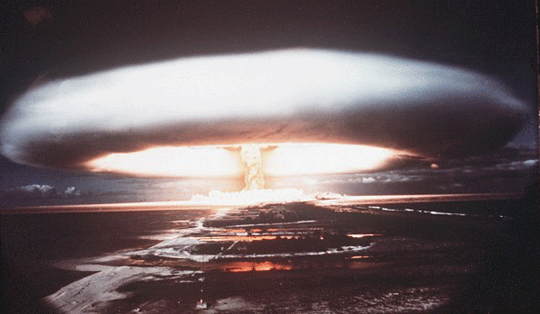
Last week France was sued at the International Criminal Court for crimes against humanity over nuclear tests conducted on atolls in the Pacific Ocean. Sputnik spoke to Alexandre Dayant, a research fellow at the Lowy Institute, about the consequences of the French nuclear tests. Mururoa and Fangataufa atolls in the South Pacific saw 196 nuclear tests over three decades until President Jacques Chirac finally ended the programme in the 1990s. The French also conducted nuclear tests in the Sahara Desert. A French Polynesian opposition leader, Oscar Temaru, filed a complaint at the International Criminal Court (ICC) in The Hague on October 10 claiming France had carried out crimes against humanity, in the form of local islanders. Alexandre Dayant, a research fellow at the Lowy Institute in Australia, said the French carried out the tests between 1966 and 1996, first in the atmosphere and then in the sub-soil. French Polynesians Have Paid Heavy Toll For Tests Mr. Dayant said thousands of inhabitants have paid a heavy toll through birth deficits, congenital malformations and infirmities. “The testing programme and its intentions were kept secret, and little information was provided about the possible effects of radiation to the people who worked there. For decades, France argued that the controlled explosions were clean,” Mr. Dayant told Sputnik. “In the absence of an exhaustive epidemiological study, it was very difficult to estimate the number of potentially affected people at the time. Throughout the period of the Sahara and Polynesia trials, approximately 150,000 site workers (military contingent, contingent, civilian workers) and a local population of 80,000 were potentially exposed to doses of radioactivity,” Mr. Dayant told Sputnik. French Polynesia, an overseas territory with a population of 290,000, is best known for the tourist resort island of Tahiti, 300 miles west of Mururoa and Fangataufa. “This case aims to hold all the living French presidents accountable for the nuclear tests against our country,” Mr. Temaru said when he filed the complaint. The Armaments Observatory published a study showing “the explosions have weakened the seabed and the soil is contaminated sustainably because of the fallout and the presence of toxic and radioactive debris (heavy metals and plutonium)” which threaten the population and the environment. Despite the mounting evidence, the French government denied all suggestion that the nuclear tests were harmful to health until 2010, when it introduced the Morin Law, a programme to give compensation to victims of radiation exposure. Nevertheless, the number of compensation cases accepted between 2010 and 2017 scandalized victims’ associations — only 13 out of more than a thousand filed. The main reason came from the fact that it was still difficult for victims to prove the link between their disease and the tests,” Mr. Dayant told Sputnik. Call For French Polynesia to Become Independent He said Mr. Temaru was a separatist who wanted the islands to eventually become independent like nearby Fiji and Kiribati. Mr. Temaru claimed the Polynesians had sought a “responsible dialogue” with France since 2013 but their pleas had been “ignored and despised”. “Fifty years after the first nuclear test on Mururoa, French Polynesians are still fighting for recognition of the effects of nuclear testing. This is why this claim, in front of the ICC, can help to put events back on the agenda,” Mr. Dayant told Sputnik. “I don’t think Polynesians believe their claim will be heard. For the pro-independence party in French Polynesia, making this claim is more of a useful way to put events back on the political agenda, and on the international scene,” said Mr. Dayant who pointed out that when the ICC was set up it made it clear it would not prosecute crimes committed before July 2002. Will other countries face similar claims at the ICC? “It is a difficult question to answer to, due to the different geopolitical relationships that other Pacific Islands countries have with the US, UK and Russia. However, if successful, this particular legal procedure can be used as a precedent for future international claims,” Mr. Dayant told Sputnik. |
|

Distrust of TEPCO Hampers Decommissioning — Fukushima 311 Watchdogs

Friday, October 19 A major challenge at the Fukushima Daiichi nuclear power plant is disposing of water containing a large amount of radioactive tritium. The Japanese government proposed diluting and releasing the water into the sea, but many fisheries in Fukushima are voicing strong opposition to the proposal. Disposal of the tainted water is a […]
via Distrust of TEPCO Hampers Decommissioning — Fukushima 311 Watchdogs
Added ‘development’ in the Medical Data Obtained from Minami-soma Municipal General Hospital in Fukushima — Fukushima 311 Watchdogs

It was very courageous to the city council Koichi Oyama to leak to the public those medical data, despite the new laws to stop medical staff releasing data on health effects that may be caused by the nuclear disaster. This new controvertial law (against the supposed new open transparency purported by the nuclear industry post […]
Denials dominate 1st trial questioning of ex-TEPCO VP over tsunami-triggered nuke disaster — Fukushima 311 Watchdogs

Former Tokyo Electric Power Co. Vice President Sakae Muto October 17, 2018 TOKYO — Denials of allegations dominated the questioning on Oct. 16 of former Tokyo Electric Power Co. (TEPCO) vice president Sakae Muto in the criminal trial he and other ex-TEPCO leaders face over their responsibility to predict and prevent damage caused by […]
October 22 Energy News — geoharvey

Science and Technology: ¶ “Counting the Ways to Store Renewable Energy” • A mind-boggling array of energy storage technologies is being tested in labs and workshops across the globe. Among them are chemical, electro-chemical, mechanical, and thermal energy storage systems, all competing to get the attention of whoever whats to store energy. [Chemical & Engineering […]
Coalition fast-tracks proposal for new “firm” generation, open to coal plant extensions — RenewEconomy

Coalition fast-tracks tender for new “firm capacity” – the proposal looks rushed and designed to encourage life extensions for existing coal fired generators. The post Coalition fast-tracks proposal for new “firm” generation, open to coal plant extensions appeared first on RenewEconomy.
1 This month

of the week – Australians for War Powers Reform (AWPR)
To see nuclear-related stories in greater depth and intensity
 Antinuclear