Japan developing smart energy efficiency and renewable energy
 In the Wake of Fukushima: Japan’s Nuclear Energy Policy Impasse 60% of Japan’s 48 viable nuclear reactors,are not as yet being considered for application to the Nuclear Regulation Agency (NRA) for restart By Andrew Dewit Global Research, April 07, 2014
Asia-Pacific Journal
“…….Smart Cities
Amazingly, a smart and green, ICT-centred growth strategy was approved by the Abe Cabinet on June 14 of 2013. The growth strategy is also very powerfully informed by the disruptive potential opened up by the rebuild of the devastated regions on the basis of renewable and distributed energy.23 But it also has a larger purchase in the political economy debate because – as with ICT-centered “industrial Internet,” “machine to machine,” “big data,” and related emergent paradigms – it is aimed at a profound restructuring of the energy economy as well as much of the rest of the infrastructures that make up the modern urban community and the exchange of resources and information among citizens, businesses and their governments.
This emergent paradigm is not peculiar to Japan. The smart city model began to take shape in the early 2000s. But from the beginning of the 2010s, worsening resource, economic, and climate crises were paralleled by such technical advances as the diffusion of “big data” analytics via the cheapening and miniaturization of sensors.24 These and other developments increasingly point to the disruption not just of centralized power generation and transmission but also of a resource-intensive growth dynamic that has characterized the developed economies over the past six decades.25
The “dematerialization” of the economy has been an aim in Japan and Germany since the 1980s, with an increasing sophistication of policies and programs for reducing resource waste through greater efficiency and recycling, development and deployment of more sustainable practices, and the other initiatives. But these initiatives were generally seen as more or less costly interventions in the mainstream economy to reformat and reduce its throughputs and polluting outputs. The ICT strategy, through its deployment of sensors that monitor a multitude of aspects of the ambient environment as well as system parameters, is already working to accelerate this transformation of the conventional economy through increasing the payback from new processes.
In this respect, it is very ironic but telling that some of the most aggressive deployment of ICT is evident in conventional energy. The mining firm Rio Tinto, for example, revealed in early 2014 that its initial deployment of “big data” ICT to enhance efficiencies saved it USD 80 million over 2013.26 The oil industry’s use of “big data” in what it refers to as the “digital oil field” is another example. Their per-barrel price for oil exploration and production has roughly quintupled over the past decade, to over USD 100/barrel. Their aggressive of ICT shows what very hard-pressed actors can do in the face of rapidly rising costs.27
Team Abe might want to learn a lesson from this, and stress the ICT-centred renewable and radical efficiency policies they have already passed. The same goes for the simplistic anti-nuclear critics who would be satisfied with continuing to burn more coal.
Andrew DeWit is Professor in the School of Policy Studies at Rikkyo University and an Asia-Pacific Journal coordinator. With Iida Tetsunari and Kaneko Masaru, he is coauthor of “Fukushima and the Political Economy of Power Policy in Japan,” in Jeff Kingston (ed.) Natural Disaster and Nuclear Crisis in Japan. Recommended citation: Andrew DeWit, “Japan’s Energy Policy Impasse,” The Asia-Pacific Journal, Vol. 12, Issue 14, No. 1, April 7, 2014. http://www.globalresearch.ca/in-the-wake-of-fukushima-japans-energy-policy-impasse/5376899?utm_source=rss&utm_medium=rss&utm_campaign=in-the-wake-of-fukushima-japans-energy-policy-impasse
Cost of Australia’s decentralised solar energy is plunging, despite opposition from electricity utilities
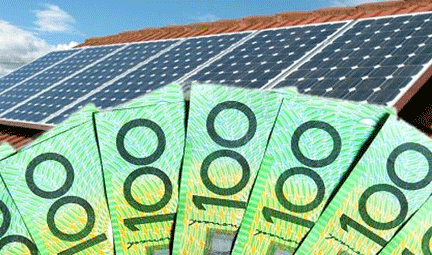 Australia’s Plunging Cost Of Solar Energy (Stats) (Excellent graphs) http://cleantechnica.com/2014/04/07/australias-plunging-cost-solar-energy-graphs/ Giles Parkinson…...“People are told that solar is too expensive,” Greene says. “But we have seen a staggering reduction of the cost of solar in the last couple of years, so I hope that these graphs frame what the actual cost of solar is.”…..
All of this is causing some fierce push-back from the utility industry. Greene and other speakers cited numerous ways that distributors are seeking to slow down the uptake of solar – one is by drawing out the application process (taking 65 business days for each amendment or query), requiring systems to be installed to stop exports back into the grid, or simply refusing the installation.
That, of course, leads to users thinking that they might be better off without the grid. How far is that away?…….
Uncertainty over Renewable Energy Target puts large solar farm in doubt
First Solar reconsiders Australian investments amid ‘uncertainty’ over Renewable Energy Target, ABC News, By environment reporter Jake Sturmer The company building the southern hemisphere’s largest solar plant says it is reconsidering future investments in Australia because of uncertainty about the Government’s Renewable Energy Target.
Multinational solar panel maker First Solar is building a $450 million plant in the far west of New South Wales for energy provider AGL.
It would be enough to power 50,000 homes, the company said.
First Solar’s vice-president of business development, Jack Curtis, says a lot has changed in the eight months since the former federal government announced the project.
“Those projects … reached financial close in a different political and business environment which was almost a year ago now,” Mr Curtis said. “That’s obviously changed quite dramatically since the election. There’s now a much greater deal of uncertainty around future projects like this.”
Mr Curtis says this is partly due to the Coalition Government’s review of the Renewable Energy Target (RET), which currently aims to have 20 per cent of Australia’s electricity generated by clean energy sources by 2020……http://www.abc.net.au/news/2014-04-08/solar-company-reconsiders-investment-in-australia/5373664
Public Health Association concerned about health dangers of planned Ranger uranium mine expansion
 Proposed Ranger 3 Deeps expansion too risky says PHAA , 7 April 14, The Northern Territory Branch of the Public Health Association of Australia (PHAA NT) is today launching its submission to the Social Impact Assessment process for the proposed ‘Ranger 3 Deeps’ (R3D) underground expansion at the Ranger uranium mine. This comes ahead of a public forum about the future of Ranger in Darwin titled “Reconsidering Ranger”.
The PHAA NT submission focusses on the health and safety impacts for the local population, mine workers and the environment as well as the impacts the exported uranium is having overseas.
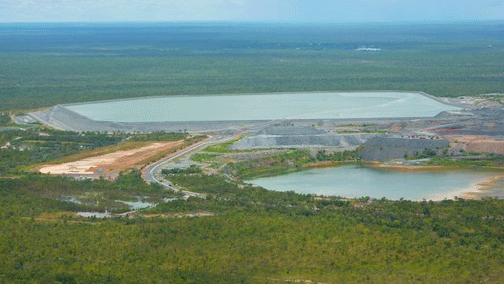 “There have been over 200 significant safety incidents at Ranger in its 30 years of operation, including the December 2013 spillage of more than 1 million litres of radioactive and acidic slurry from a storage tank,” said Dr Michael Fonda, PHAA NT Branch Secretary.
“It is of great concern that Energy Resources Australia intends to use the same ageing processing equipment for its proposed R3D expansion,” Dr Fonda said.
PHAA NT is concerned about the health impacts underground mine workers will face from radon exposure.
“Radon inhalation is a particularly dangerous form of radiation exposure and PHAA NT wants reassurances that the R3D design would meet world’s best practice standards. Evidence has emerged linking Ranger to adverse impacts on the surrounding population and environment,” said Dr Fonda.
A 2006 Australian Institute of Aboriginal and Torres Strait Islander Studies report investigating cancer rates in the local population found that the number of actual cases of cancer was 90% higher than expected.
“The research findings to date are very alarming. We believe it is unsafe and unethical to approve this underground expansion before further studies into the health effects in the region have been carried out,” he added.
In the wake of the 2011 Fukushima reactor disaster, which was fuelled in part by Australian uranium, the United Nations called for an urgent review into the health and environmental impacts of uranium mining in Australia. “This review still has not been initiated by the Australian Government. We believe Australia needs an inquiry into its entire nuclear industry before proceeding with any further expansions and PHAA have repeatedly called for this,” Dr Fonda said.
Dr Fonda will be talking about these issues along with other speakers at the “Reconsidering Ranger” public forum being held at the Hilton Hotel in Darwin on Tuesday 8 April 2014. Entry is free and doors open at 6:30pm.
For further information/comment:
Dr Michael Fonda, NT Branch Secretary, Public Health Association of Australia 0429 435 595
This media release – and the related submission – will be available on the PHAA website at: www.phaa.net.au
The Greens’ Scott Ludlam polled16% of the primary vote, in Western Australia’s Senate election
 Western Australia Senate election: is this a new moment for the Greens? Ben Eltham theguardian.com, Monday 7 April 2014 Scott Ludlam’s victory in Western Australia has some important implications for those keen to write off the Greens as a political force
Saturday’s Senate by-election in Western Australia is certainly good news for the environmental party. The Greens polled nearly 16% of  the primary vote, a result that saw Scott Ludlam handily re-elected with quota to spare. The result represented a swing to the Greens of more than 6%.
Ludlam’s result is a personal triumph for the soft-spoken Western Australian. After narrowly losing his seat in the contested result of 2013, Ludlam has roared back into the Senate for another six years on the back of a highly effective Greens campaign.
Beginning with the unexpected social media success of his “Welcome to Western Australia, Tony” speech, Ludlam honed a re-election campaign that was well targeted and technologically savvy. He leveraged his excellent online profile and policy expertise on issues like the NBN andsurveillance to attract a wider following of voters under 40. In just a month, Ludlam has tweeted and DJ’d his way from likely has-been to future leader.
While Saturday’s result may not herald a new age of verdant ascendancy, it does have some important implications for those keen to write off the Greens as a political force in Australia. Their demise is regularly forecast by major party figures and journalists, many of whom appear to believe that the environmental party will one day share the fate of the Australian Democrats……….http://www.theguardian.com/commentisfree/2014/apr/07/western-australia-election-is-this-a-new-moment-for-the-greens
Make a submission to keep Renewable Energy Target – ANYONE can do this!
 Call For Renewable Energy Target Review Submissions http://www.energymatters.com.au/index.php?main_page=news_article&article_id=4251 The Panel conducting Australia’s Renewable Energy Target (RET) review has called for submissions.
The Panel has released a paper (PDF) to assist those preparing submissions; which close on 16 May 2014.
The announcement is the first official communication from the panel since the Federal Government released the Terms of Reference for the review in February. The review panel consists of Dick Warburton AO LVO, Dr Brian Fisher AO PSM, Shirley In’t Veld and Matt Zema.
The Clean Energy Council is urging all its members to contribute a submission.
“Now is the time to tell the Federal Government that you want Australia’s Renewable Energy Target left alone,” says the CEC’s Deputy Chief Executive. “Now we need your help to ensure the Australian Government understand what the people of Australia want, and what’s at risk for the renewable energy industry if they get this wrong.”
It’s not just industry participants who are invited to contribute a submission – anyone can.
Much is at risk if the Renewable Energy Target is abolished. Thousands of jobs and billions of dollars of future investment will be lost – and it will have little impact on reducing electricity prices for end consumers.
So far, the RET – which includes a large and small scale component – has generated more than $18.5 billion in investment and created more than 30,000 jobs at a current cost of between 3% – 5% of electricity bills; which will further decrease if the RET is left untouched.
The impact of the small scale solar component of the RET is already minimal and expected to halve over the next two years to less than 1% of a power bill. Further down the track, it will have zero net cost impact on household power bills.
The Renewable Energy Target provides support for the purchase of solar power systems. If that support is cut, it could add thousands of dollars onto the price of system; locking many Australians out of the opportunity to slash their power bills.
France allows no criticism of its State-owned AREVA nuclear company
 Adieu Free Speech in Nuclear France: Areva Rules 31 Mar 2014 miningawareness Almost two months ago, the French government condemned a French citizen-NGO for criticizing the almost completely French government owned nuclear company AREVA. (http://fr.wikipedia.org/wiki/Areva)
How can a government sue its own citizen for raising a question of possible corruption? Shouldn’t the government provide 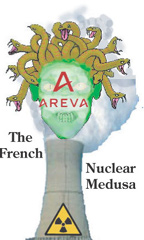 documents proving that there was no corruption instead?
Since when do citizens have no right to criticize their own government or question its actions? This shows that France has no free speech and is no democracy.
We find AREVA a very worrisome entity. It is a majority French government owned nuclear multinational, and by all appearances, the French government seems willing to put the weight of the French military, and now French courts, behind it. What is this other than a Nuclear Empire?
And, AREVA is more widely present throughout the world than realized. It has been present at Fukushima, having provided its MOX fuel, and operating a post-nuclear disaster water purification system, which apparently failed, and other projects. (1) It is involved in the WIPP nuclear waste dump (2), which has recently leaked radiation in the USA; it is involved in the Savannah River MOX plant, which ran over cost and is being moth-balled by the USA. AREVA mines for uranium in Africa, where, by all appearances, the French military is throwing its weight around to protect its mining interests. AREVA works closely with majority French government owned EDF, as well.
The outcome of the appeal in this case, appears yet to be announced. But, the fact that AREVA sued a French citizen, running a tiny NGO-blog site, for defamation, and that a judge ruled in AREVA’s favour, shows just how out of control AREVA and the French State really are. It is hence unsurprising that AREVA has almost two hundred entries in Wise Uranium’s “Hall of Infamy”:http://www.wise-uranium.org/uccoghi.html
Below is our translation of the February 7th statement by the NGO,Observatoire du nucléaire, dealing with this topic. (French original here:http://observ.nucleaire.free.fr/obs-fait-appel-don-areva.htm)
“Observatoire du nucléaire
Statement of 7 février 2014
Condemned at the demand of Areva,
l’Observatoire du nucléaire, appeals this judgement which
seriously endangers the right
to denounce the misdeeds of the nuclear lobby
Friday, 7 February 2014, despite damning evidence made public byl’Observatoire du nucléaire (see http://www.observatoire-du-nucleaire.org), the 17th Criminal Chamber of the Court of Paris saw fit to condemn (to several thousand euros in financial penalties, details shortly) for ‘defamation’ this association, at the urging of the radioactive multinational Areva.
t is edifying to remark that it is not only the justice system, but almost the entirety of French society, the main political parties, with the majority of the ‘big’ media, at the forefront, who conscientiously turn their eyes away, in order to profit from the plunder of Niger’s uranium. So, Areva was finally just executing this dirty work.
France is too happy to be able to fuel its nuclear reactors by grabbing Niger’s uranium at a derisory price: it’s probably hundreds of billions of euros, which should be reimbursed to Niger, especially if one takes into account the serious environmental damage (contamination, drying up of groundwater) and public health (multiple cancers, displacement of the local population, etc.)
The supposedly ‘environmentalist’ party EELV, through its two ministers, and by the complicit silence of its parliamentary groups, is directly the accomplice of Areva and of the nuclear lobby……..http://miningawareness.wordpress.com/2014/03/31/adieu-free-speech-in-nuclear-france-areva-rules/
Nuclear power run by technocratic government – looks good, at the beginning
 Why nuclear power worked once in France and might work again in China http://johnquiggin.com/2014/04/04/why-nuclear-power-worked-once-in-france-and-might-work-again-in-china/ John QuigginThat’s the question I looked at a while back in this piece in the National Interest, which I was too busy to post about
  at the time. TNI’s headline, which I didn’t pick, is the more definitive ‘China Can Make Nuclear Power Work‘. The key point is that, when France embarked on a crash program to implement nuclear energy in the early 1970s, all the right ingredients were in place: a centralised state in which a skilled technocratic elite could push projects through without much regard to public opinion, the ability to fix on a single standardised design, low real interest rates and preferential access to capital, and the ability to fix pricing structures that eliminated much of the risk in the enterprise.
Over time, these factors were eroded, with the result that as the program progressed, the cost per megawatt of French nuclear plants tripled in real terms. As the Flamanville fiasco has shown, whatever the secret of French success 40 years ago, it has been well and truly lost now. And the picture is equally bleak for nuclear power in other developed countries.
New nuclear power is far more expensive than renewables, even after making every possible allowance for the costs of intermittency, the various subsidies available, and so on. That’s why, despite the vast range of different policy settings and market structures in developed countries, the construction of new nuclear plants has been abandoned almost everywhere.

But China today looks, in many respects, like France in the 1970s, a technocratic state-capitalist society with the capacity to decide on, and implement, large scale projects with little regard to anyone who might object. If nuclear power can be made to work anywhere, it’s probably in China.
Obviously, pro-nuclear commenters like Hermit and Will Boisvert are welcome to have their say on this one.
Australian Renewable Energy Agency (ARENA) funding towards Wave Energy
 Australian wave energy company receives grant funding, Renewable Energy Magazine, Robin Whitlock, 04 April 2014 Ocean Power Technologies (OPT) has announced that its partner company, Victorian Wave Partners, has received A$5 Million Initial Grant Funding from the Australian Renewable Energy Agency (ARENA) Victorian Wave Partners (VWP) is a project-specific entity that is wholly-owned by OPT (Australasia) Pty. Ltd (OPTA), which is in turn 88 percent owned by OPT. The funding is the first payment under the A$66.5 million grant that was awarded by ARENA to VWP toward the cost of building and deploying its planned wave power station project off the coast of Australia……http://www.renewableenergymagazine.com/article/australian-wave-energy-company-receives-grant-funding-20140406
1 This month
7 April – WEBINAR – Australia and the Doomsday Clock – Preventing nuclear war through NoFirstUse and other policies
Online | Tuesday April 7, 4:00-5:30pm, Australian Eastern Time / 8:00-9:30am Central Europe Time
– Access the registration link
15 April – Zoom –Nuclear Power is Not the Solution
Apr 15, 2026 01:00 AM in Canberra, Melbourne, Sydney

Join the International Physicians for the Prevention of Nuclear War (IPPNW) on Tuesday, April 14th for a timely webinar exploring the risks associated with nuclear power and challenging the myth that it offers a simple, safe, carbon-free solution to the climate crisis

21 April Webinar: No Nuclear Weapons in Australia
Start: 2026-04-21 18:00:00 UTC Canberra, Melbourne, Sydney (GMT+10:00)
End: 2026-04-21 19:30:00 UTC Canberra, Melbourne, Sydney (GMT+10:00)
Event Type: Virtual
A virtual link will be communicated before the event.
Host Contact Info: australia@icanw.org

of the week – Australians for War Powers Reform (AWPR)
To see nuclear-related stories in greater depth and intensity
 Antinuclear