Nuclear brawl erupts over powering Australia’s AI data boom
Ronald Mizen, Financial Review, Aug 25, 2026
A political fight has broken out over using small modular nuclear reactors to meet the soaring electricity demand from data centres, and new research shows that using renewable power could make Australia a regional hub for low-carbon computing power capacity.
On Monday, Coalition frontbencher Jonno Duniam said using SMRs to power data centres should be part of the conversation, and the government should end the moratorium on nuclear power.
Duniam is leading a push within the Coalition to land a largely bipartisan position on artificial intelligence.
Last week, he was appointed deputy chairman of a bipartisan committee on AI and recently travelled to the United States where he held talks with major AI and data centre companies.
“It was clear to me when talking with representatives of major AI and data centre operatives that, if the moratorium was not in place, these companies would be seriously looking to nuclear SMRs to power their operations and not drive up prices,” he told The Australian Financial Review on Tuesday.
The fresh brawl over nuclear power comes ahead of a meeting of the national cabinet on Wednesday during which Prime Minister Anthony Albanese will seek support from premiers and chief ministers for his AI agenda.
The Albanese government wants to force the owners of next-generation, large-scale data centres – those that train and power artificial intelligence agents – to use renewable electricity, and to add more power to the grid than they consume.
This proposal is opposed by Coalition governments in the Northern Territory and Queensland, which want an energy-agnostic policy, including allowing gas.
Grattan Institute energy program director Tony Wood said that despite having as many SMRs today as there are unicorns, Australia needed a plan B to get its electricity emissions to zero.
“It could be [viable],” Wood said of using SMRs. If the technology is viable, it should be part of the energy mix, he said.
Industry Minister Tim Ayres labelled the idea “an ideological fantasy” and said “nobody in the real world with real money” was talking about nuclear power. Energy Minister Chris Bowen said he was opposed based on “cost and delay”, not safety.
“I’m not aware of any proposals to do that in Australia,” Bowen said.
But the AI sector, in Australia and overseas, is keeping a close eye on the development of SMRs, which some believe could power data centres in as little as three to five years.
In late 2024, Google signed a world-first agreement to purchase up to 500 MW of nuclear energy for its data centres from Kairos Power in the US. The first SMR is scheduled to be online in 2030, and the rest are targeted for 2035.
Local industry sources are reluctant to speak publicly on the topic, given how politically charged it is.
A report commissioned by Data Centres Australia from economic consultancy Mandala, being released on Wednesday, shows Australia could become a big exporter of green computing power capacity to the Asia-Pacific region because emissions from hosting this locally are far less than in other countries…………………..https://www.afr.com/politics/federal/nuclear-brawl-erupts-over-powering-australia-s-ai-data-boom-20260825-p60rce
“No economic case:” Global experts say nuclear has role in some countries, but makes no sense in Australia

Giles Parkinson, Oct 12, 2026, https://reneweconomy.com.au/no-economic-case-global-experts-say-nuclear-has-role-in-some-countries-but-makes-no-sense-in-australia/
As Australia’s ultra conservative political parties embark on a headlong race towards nuclear and away from renewables, a major new report by global experts says nuclear has a role in some countries, but makes no sense and will only cause delays and increased costs in Australia.
The new report from the Energy Transitions Commission, a think-tank comprising dozens of energy experts around the world, including those in the nuclear industry, says nuclear capacity could double over the next three decades or so, but it will stay play a relatively minor role in the overall transition away from fossil fuels.
And, they point out in the report – “The Role of Nuclear in the Energy Transition: Complementary but Limited” – it will only make sense in a few countries – a situation the report suggests will not be greatly changed by the hype and interest generated by AI and the push for massive energy-hungry data centres around the world.
For countries like Australia, rich in lower cost renewable resources like wind and solar, the report says nuclear makes no economic sense at all, and trying to build a system around them will simply lead to delays and increased costs.
“In these countries, which include most of Africa, and much of Latin America and Australia, renewables (particularly solar) and batteries will provide the fastest and cheapest option for scaling electricity supply at suitable increments to align with financing availability and system needs,” the report says.
“In these markets, investing in nuclear concentrates scarce capital in a small number of centralised projects, committed roughly a decade before operations, during which the power system could change substantially.
“Developing nuclear would deliver no total system cost benefit, and would require a reliance on foreign nuclear supply chains, which would reduce energy security. Pursuing nuclear programmes in these countries would divert resources from cheaper alternatives, and nuclear shares should remain close to 0%.”
These conclusions, of course, are well understood by the energy industry in Australia, from the Australian Energy Market Operator, the CSIRO, policy makers and regulators, the network operators, the renewables industry and the major utilities who currently burn coal and gas for a living.
But the global fossil fuel and climate denial industry still has its tentacles around the conservative parties in Australia – particularly One Nation and its less popular sidekicks in the Liberals and Nationals – all of whom are determined to slow or even stop the renewable transition in Australia, legalise nuclear and have the government invest countless billions into the tech.
The Energy Transitions Commission highlights the folly of such an approach, and the report would make sobering reading for those politicians, assuming they would be bothered to read it.
Like the World Nuclear Status report released more than a week ago, it punctures a major hole in the nuclear hype, including the assumption that small modular reactors (SMR) will somehow change the game.
- “Small modular reactors remain 1-2 decades away from wide deployment, despite attracting large investment and political attention amid surging AI-driven power demand,” the report notes.
“Early US cost estimates range from ~$US140–$US270 per MWh, well above the large reactor cost range of $US40–$US190 per MWh. Similar reactor designs can cost 4–9 times more to build in the US and Europe than in China and South Korea – financing costs are key factor.”
The report also notes that depending on nuclear power would intensify supply chain risks, rather than easing them. Russia, it notes, controls 40% of global uranium enrichment capacity in 2025, and key nuclear equipment manufacturing is concentrated in just six countries.
“Nuclear supply chain concentration poses the greatest risk, rather than safety and waste management,” the report says.
The report looks at the recent commitment to treble nuclear capacity across the globe by 2050 to around 1,500 gigawatts of capacity. This it says, would require around 500 GW of nuclear extensions (although that itself might be too optimistic), and it struggles to see how 1,000 GW of new capacity could be built.
It says that would require a six-fold increase in contraction compared to recent years. And even if it was delivered, it wouldn’t reduce the need for new wind and solar, which would still have to be built at a rate of 1,500 GW each year, rather than over the next 25 years.
“While this contribution to the energy transition is useful in targeted countries, even this scale of nuclear buildout would be dwarfed by the required scale of investment in renewables to transition to low-carbon energy systems,” the report says.
“An investment of $200 billion per year in new nuclear build is likely to be less than 10% of the $2,200 billion per year needed in renewables, grids and storage.”
The report is at pains to note that nuclear technology may make sense in some countries, those with limited renewable resources and also those with billions already invested in the nuclear industry, including those with nuclear weapons.
More importantly, nuclear’s system value is highest where land is scarce and solar and windresources are weakest
Submission to the AUKUS Public Inquiry – cancel AUKUS, cease to be part of American militarism – Bevan Lee Ramsden
ED. This is a long and clearly argued submission. For reasons of space and time, I am here posting only extracts from it. It can be found in full at https://aukuspublicinquiry.com/
This submission argues that the AUKUS Security Pact should be cancelled and as a
starting point activating the six month cancellation clause in the Naval Propulsion
Agreement.
The AUKUS Security Pact should be cancelled for the following reasons:
- The eight nuclear-powered hunter-killer submarines are neither necessary nor
suitable for Australia’s territorial defence. Twenty air-independent submarines
would be far more effective, be easier to maintain and would cost only fraction
(8%) of the $375 billion. - AUKUS gives the United States porting and maintenance facilities for its nuclear
submarines which may be nuclear-armed and will make Australia a missile target
by enemies of the United States in war time. - AUKUS undermines our sovereign ability to make independent decisions about
involvement in US wars and will inevitably draw Australia into future US wars - AUKUS requires Australia to store toxic nuclear waste from the nuclear
submarines with consequential health risks to present and future populations and
exposes local populations to the health risks of a nuclear radiation leak or
accident. - AUKUS Pillar 2 ties Australian defence manufacturing and research into the arms
manufacturing programs of the United States and for their benefit not Australia’s. - AUKUS compromises Australia in undermining its commitment to the Nuclear
Non-Proliferation Treaty and the Treaty of Rarotonga (South Pacific nuclear-free
zone) as well as providing an impediment to Australia signing the TPNW. - The enormous public expenditure anticipated for this narrowly focussed
acquisition of up to eight nuclear subs will severely compromise national efforts to
address other urgent matters of human security including fuel and food security,
housing and medical security and to address the climate crisis.
I will now provide the arguments for cancellation of the AUKUS Security Pact
starting with Pillar 1.
Pillar 1- The acquisition of nuclear-powered attack submarines.
……………………………………………………………………….. The remaining argument used by nuclear submarine proponents is that they are
needed for defence of Australia’s territorial waters. However, Australia’s territorial
waters are in many places too shallow for the large, noisy, nuclear-powered
submarines to operate in safely and without detection, If submarines are needed
for defence of our territorial waters, smaller vessels are available from Japan and
Sweden which would be far more suitable. These vessels have quieter,
air-independent propulsion, cost far less and are free of radiation hazards. Former SA Senator and submariner Rex Patrick has said that Australia could acquire 20
air-independent subs for $30 billion, which is only 8% of the $375 billion for the 8
nuclear-powered vessels.
The arguments for Australia needing nuclear-powered submarines for our defence
clearly do not withstand scrutiny.
So why are successive governments committed to acquiring them?
There appears to be only one answer.
The US views nuclear subs as a vital part of its strategy to contain China, to track
and destroy Chinese naval vessels in the event of war with China. Our subservient
Australian leadership wants us to participate in such a war as we have done in all
the other post-WW2 wars the US has instigated,………………………..
Conclusion one: The eight nuclear-powered hunter-killer submarines are neither
necessary nor suitable for Australia’s territorial defence. Twenty air-independent
submarines would be more effective for territorial defence, be easier to maintain
and would cost only fraction (8%) of the $375 billion.
Conclusion two: The US has made it clear that it will expect Australia’s
nuclear-powered subs to participate in any US-instigated war and be subject to US
orders. To acquire such submarines in order to join a war with the US against
China would not only be extremely foolish but an economic disaster for Australians
and bring an unnecessary war to our soil.
The cost
Cost has to be another reason for questioning the acquisition of these
nuclear-powered submarines. Five of the eight submarines are of a new type, the
SSN series, to be designed by the UK and built largely at the Osborne shipyards in
South Australia. Given that they are yet to be designed and are to be built at a
facility that has no prior experience in building such vessels, the estimated cost of
$375 billion has to be regarded as a massive under-estimate………………………………………………………………..
Under Aukus and the Force Posture Agreement $8 billion of tax-payers fund will be
spent on the development of porting and maintenance facilities at HMAS Stirling,
Garden Island in WA for US and UK nuclear submarines. This development includes
a “controlled industrial facility” which will store the low -level nuclear waste from
these submarines. Greens Senator David Shoebridge has found out that
intermediate-level nuclear waste could also be dumped at this location.
The AUKUS Agreement has thus opened the door to Australia having to store
submarine nuclear waste and the concern is that the high level nuclear waste from
the nuclear reactors that drive the propulsion system of these submarines will also
have to be stored somewhere in Australia when those reactors have passed their
use-by-date.. Such a facility has not been determined yet and the provision of such
a secure facility which will prevent toxic leaks for centuries has proved a problem
for many countries and therefore presents a potential toxic threat to Australians in
the future. It should be noted that these nuclear propulsion reactors use
weapons-grade enriched uranium.
No costing has been done on the design and provisioning of such a facility in
Australia…………………………………………..
The Australian Naval Nuclear Power Safety Bill, 2023 declares Garden Island in WA
and Osborne in SA to be nuclear zones, areas in which the scenarios determined
by ARPANSA, would apply
The residents living near Garden Island and the Osborne Shipyard have not been
ad-vised of the ARPANSA risk analysis and emergency responses in relation to a
nucle-ar radiation leak or accident and so have had no opportunity to ask questions or raise any opposition based on this concern.
It is becoming clear that whether Australia receives or builds its own nuclear
subma-rines, this porting and maintenance facility at Garden Island and also the
proposed similar porting and maintenance at a facility on the east coast of
Australia, will be-come southern ocean ports for the US navy,its nuclear
submarines and perhaps more of its naval fleet pulling Australia even more
securely into US war plans.
In doing so they make Australia a missile target by enemies of the United States in
times of war.
AUKUS introduces nuclear weapons into Australia………………………………………………
The flawed process of signing onto the AUKUS Security Pact
The decision-making process behind AUKUS reeks of authoritarianism and
contempt for the Australian people and parliament. There was no public or
parliamentary discussion as one would expect prior to making such a significant
and costly national decision.
Scott Morrison was the Prime Minister who in 2021 secretly signed us up for AUKUS
together with an unknown number of faceless security advisors. He then sold the
idea to the leaders of the ALP in a two- hour power point presentation with no
documentation, no business case and no costing detail.
The ALP leadership enthusiastically embraced AUKUS and have never questioned
its legitimacy and never held any public discussion or inquiry into AUKUS and the
nuclear submarine acquisition. It has become bipartisan policy of the ALP and
Liberal Coalition with One Nation applauding in the background.
Only the Greens and some Independents have voiced questions and opposition regarding AUKUS.
AUKUS was entered into by a deeply flawed and anti-democratic process and
should be subjected to an immediate review in the form of a Royal Commission or
independent public inquiry.
AUKUS Pillar 2- Integrating Australian research and manufacturing with the US to
increase supply to the US war machine.
………………………………………………………………………………. Under Pillar 2, Australian defence industry will also be increasingly dominated by
the big three US software corporations (which already dominate and surveil all of
us), us-ing massive data centres and military focussed artificial intelligence (AI)
corporations such as Anduril and Palantir.
In practice, Australian defence developments and research will be acquired by the
US military. The Pillar II focus on sharing technologies between partners means in
prac-tice a mostly one-way sharing that is towards the US and building up its war
industry. So they will suck our brains for their benefit.
Under Pillar 2, Australian industry will become increasingly integrated into the US
mili-tary industrial complex – serving the needs of US government and US military rather than Australia.
We do not need Pillar 2. We need a publicly -owned, sovereign defence industry
manufacturing to meet our territorial self-defence needs which is quite a different
role to one designed to meet the needs of the US in its wars of aggression.
Alternatives to AUKUS.………………………….
The United States is a fractured, undemocratic society flouting international law
with impunity. We can have no affinity with this dangerous “ally” as former PM
Malcom Fraser said in his book “dangerous allies”.
The heavy US military footprint on our country will only attract a missile attack by
enemies of the US when they are at war. AUKUS is part of the US military footprint
on Australia…………………………………………………………………….
For a peaceful, independent and more secure future, AUKUS must be cancelled
and the Force Posture Agreement terminated, a consequence of which will be the
regaining of sovereignty and ending the heavy US military footprint on our
continent.
Submission to the AUKUS Public Inquiry – against Australia’s interest to be aligned with aggressor USA – Diane Atkinson
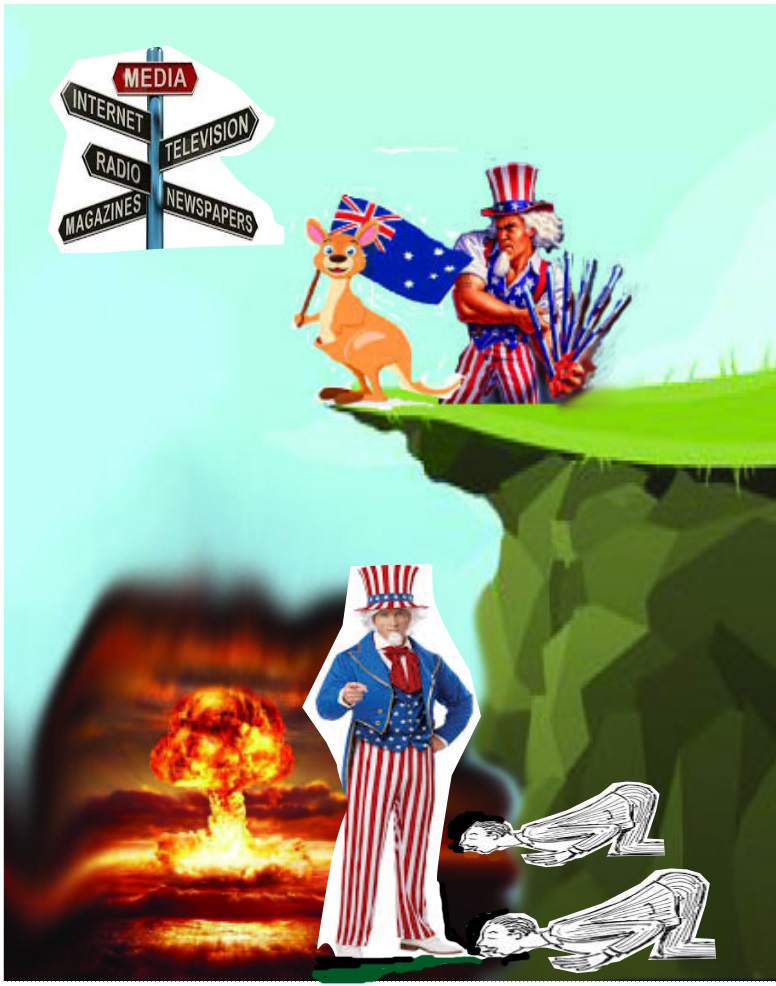
When they attacked Iran, the United States acted as a rogue state. They launched this attack in defiance of rules laid down in the United Nations’ charter, against wars of aggression. This war is already proving to be very much against Australia’s interests
Australia should be seeking to extricate ourselves from the alliance with the US, given the nature and direction of its wars of aggression, rather than tying ourselves more deeply to this alliance through AUKUS.
the danger that wars will be launched from Australian territory by the US, and that Australia will bear the brunt of retaliation against the US.
No 233.
AUKUS represents a very large investment by Australia: $368 billion over 30 years. This is a very
significant portion of our total budget, so we would want to ensure that we get good value, and that
it prepares Australia for the future. However, there is plenty of evidence that this commitment is
taking Australia in the wrong direction. Where we need to be contributing to a more stable and
cooperative world, so that we can solve collective challenges, we will instead be contributing to the
humanitarian and environmental damage that will be wrought by a declining empire, with no
tangible benefit to Australia.
We need to carefully weigh the security threats that are unfolding at this point in history, before we
commit to 30 years of spending. We know that climate change represents a major threat, which is
proving very difficult to confront. Building goodwill and cooperation would contribute to this task,
however the AUKUS alliance does the opposite. Australians have always resisted the nuclear
industry, but this deal forces us to accept the presence of nuclear-powered submarines, and the
waste that will require disposal on our soils. Having nuclear submarines present here is likely to
drive a regional arms race. At a time when resources need to be spent finding solutions to pressing
problems such as climate change, we will instead spend those resources on wasteful weapons of war.
The increased military spending will be perceived as a threat by other powers, and will undermine
the goodwill and global cooperation needed to produce binding agreements to reduce carbon
emissions. Instead, other countries will be obliged to also waste more resources on military
production.
When they attacked Iran, the United States acted as a rogue state. They launched this attack in
defiance of rules laid down in the United Nations’ charter, against wars of aggression. This war is
already proving to be very much against Australia’s interests. It threatens the availability of diesel
fuel and fertilizers, which are so important to Australia’s food security. At this time in history,
Australia should be seeking to extricate ourselves from the alliance with the US, given the nature and
direction of its wars of aggression, rather than tying ourselves more deeply to this alliance through
AUKUS.
Australia’s national security interests are not identical with those of our military ally, the United
States of America. The Global Financial Crisis of 2008 did not impact Australia in the severe way that
it impacted the USA or Europe. One of the reasons that Australia barely registered a recession
during this crisis, is the strength of our trade with China, which accounts for 25% of Australian trade,
based on 2025 figures from DFAT. It could be argued that we are too dependent on trade with China,
but when we think about our national interests, this current reality of China being our strongest
trading partner, needs to be factored in. Australia’s interests are not identical to those of the USA or
Europe, and this is a reflection of both geographical and economic differences. Our proximity with
Asia means that it makes sense for us to trade with Asia, including China. This also makes sense
because we have natural resources that these markets need, while we have lost or failed to develop
our manufacturing base, and our Asian neighbours can supply low-cost manufactured goods. We
made a decision to reduce tariffs and close down some of our industries. These decisions have
consequences for our security.
There is no identifiable threat to Australia’s security that currently emanates from our Asian
neighbours, including China. However, as a result of our free trade policies, we do now face an
economic threat, if our trade is interrupted. This could happen as a result of war, or of trade wars. Neither are in Australia’s interests, given our lack of self-reliance. Australia’s lack of self-reliance in
oil stands in contrast to the position of the United States. The problems in the Strait of Hormuz,
caused by US attacks on Iran, impact Australia more heavily than our military ally.
The United States has different defence priorities to Australia. The US seeks to suppress the rising
powers that have begun to challenge US hegemony. This has become obvious through their attacks
on Iran, which also have a negative impact on both Russia and China, since Iran is at the centre of key
trade corridors, and for that reason both countries have substantial investments in Iran. US leaders
make it very clear that they are hostile to China and Russia, along with a list of nations that are not
willing to accept US domination.
Since the US dollar is the world reserve currency, and this confers huge economic benefits on the US,
challenges such as the BRICS nations trading in their own currencies and using their own payment
systems, are likely to have negative consequences for the position that the US has enjoyed. The
power to shape institutions like the World Bank and trade rules such as the GATT arises from the
overwhelming economic power that the US has held, and this is ultimately backed by their military
power, which has been used to thwart countries that want to reduce the economic and political
dominance of the US over their internal governance. This was manifest in repeated military
interventions in Latin America last century, and in the Middle East more recently.
However, Australia is in a very different position. We are not an empire with hegemony to defend.
We are a smaller power, very reliant on trade, and therefore we have an interest in a stable world
order, and good relations with our Asian neighbours. We have already been adversely affected by
the war on Iran, and this could lead to a direct threat to our national security. One dimension of this
is food security. Diesel and fertilizers are essential inputs to our farming sector, and any resumption
of the war on Iran is likely to cause shortages of both.
The other threat to Australia’s security is the danger that wars will be launched from Australian
territory by the US, and that Australia will bear the brunt of retaliation against the US. We have seen
this happen in the Middle East. Iran retaliated against US military bases in the UAE, Kuwait, Iraq,
Bahrain, Qatar and most recently Jordan, since the US launched their attacks from those bases.
Military agreements such as the Force Posture Agreement and AUKUS prevent Australia from
controlling what the US does on our soil. We may not expect retaliation from Iran because US bases
in Australia in all likelihood provide intelligence for attacks on Iran, but we could well expect
retaliation if the US goes to war with China. Based on US threats, this scenario is currently the most
likely reason that any country might attack Australia.
Australia is currently allied with the very country that is launching wars of aggression. Even the
average person living in the US does not benefit from these wars. They have seen their standard of
living deteriorate over past decades. This deterioration is caused by a shift in the US economy,
whereby it is increasingly dominated by private monopolies, and the public sector increasingly serves
the interests of these rather than the general public interest. This tendency has reduced the
vibrancy of US industry. Even the arms industry, which receives so much public funding, produces
expensive equipment which is proving to be obsolete on the battlefield. Aircraft carriers and
battleships have repeatedly been withdrawn from the area of engagement in the Strait of Hormuz, as
they make easy targets for cheap drones and for missiles. The USA is not demonstrating that it can
use military force to great effect, and yet it relies on such force increasingly, suggesting once again
that it is an empire in decline.
In its attempts to shore up this loss of power, the US is leaning more heavily on its allies like Australia.
We are expected to subsidize the extravagant expenditure on arms that continued world domination
would require, at the expense of our own interests. AUKUS arose out of Australian attempts to
purchase non-nuclear submarines from France. We now find that the Australian prime minister who
undermined that process, and instead committed Australia to purchasing nuclear submarines from
the US and the UK, is now working for the US arms industry. It is obvious that as prime minister, he
was already promoting those interests. Instead of obtaining working submarines in a reasonable
timeframe at a reasonable cost, we now have a program that commits Australia to massive spending,
with no guarantees as to what Australia will get in return. Meanwhile AUKUS spending is driving a
war economy. Education spending by the South Australian government subsidises degrees for the
arms industry, instead of degrees for health care workers and teachers. In this way we are directly
subsidising US owned arms manufacturers, while under-investing in the sectors that ensure our
collective well-being. In the midst of a housing crisis, when many young Australians cannot afford to
buy a home, and many cannot even find let alone afford rent, we neglect to make the necessary
investments in social housing, and instead spend to subsidise the operations of foreign arms
companies. We train our young people to build arms instead of building houses.
The secrecy surrounding AUKUS shows that its proponents have no faith in their ability to convince
Australians that this appalling decision is in our interests. Any reasonable person can see that it is
not.
Submission to AUKUS Public Inquiry – AUKUS a sellout of Australia’s security – Michael Gilligan
232. Michael Gilligan
I was responsible for Defence Department advice on options after retirement of
Oberon class submarines (Head of Force Development and Analysis Division in early 1980s). I am a Board member of Pearls and Irritations (P&I), online policy forum created by John Menadue. Regular contributor to P&I.
Despite its crippling cost, no Minister for Defence has ever explained what the
Virginia class submarine is meant to do. Why has such an obvious ministerial
obligation been evaded? Because it would reveal a sell-out of Australia’s security.
And an extraordinary direct underwriting of US shipbuilding and defence budgets
by Australian taxpayers – of perhaps half a trillion of our dollars. The Virginia class
submarine is not a general-purpose vessel such as our Collins class. It is designed
for supreme acoustic invisibility for a specific purpose – to find, doggedly track
underwater for months and be able to destroy submarines seen as a nuclear threat
to the US mainland. Principally Russian and Chinese SSBN boats. The United States
is stretched beyond its industrial capacity to deal with China’s growing SSBN fleet.
Assisting in that ongoing task is what Australia offered in AUKUS, and so the US
expects Australia’s submarines to do – effectively embedded into US military
command – against China’s burgeoning capacity to annihilate continental America
from under the sea.
LINK – https://johnmenadue.com/post/2026/06/australias-submarine-betrayal/
More broadly, the Minister for Defence has misled Australians habitually on the
value of submarines in defending Australia. His case rests on treating submarines
as essential to Australian sovereignty, while ignoring the powerful array of
capabilities which already protect Australia and its maritime approaches.
Assessments of the submarines’ marginal effectiveness in a whole-of-Defence
context raise serious questions about the value of submarines, even whether they
are warranted at all on cost-effectiveness grounds.
So, the debate on submarines currently consuming Australia’s headlines is
corrupted by two compounding Ministerial lies by omission – the submarines’ job
within AUKUS, and Australia’s range of defence capabilities purposefully created
over decades, which marginalise submarine importance to our security.
Submission to AUKUS Public Inquiry – dissolve AUKUS, stop being a cog in USA’s military industrial complex – Heidi Glaser.
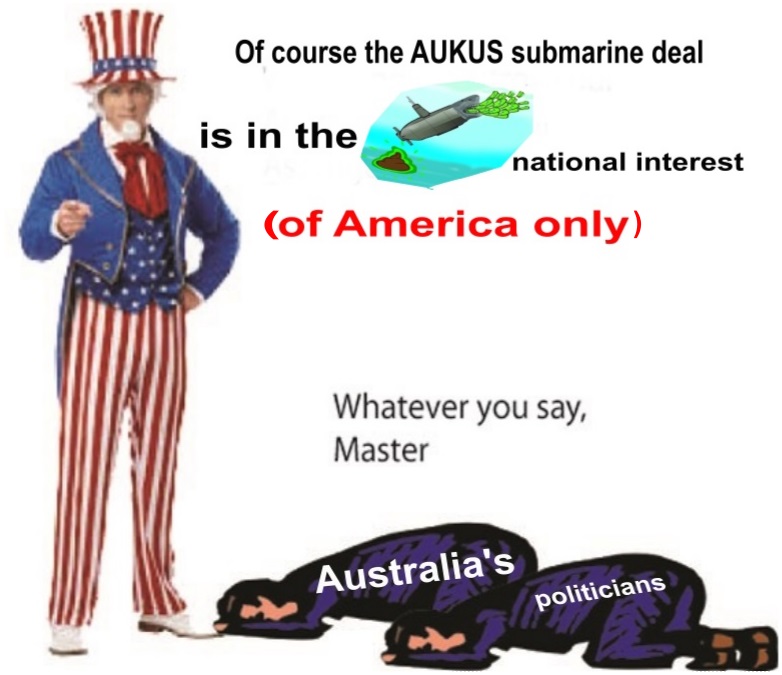
226. Heidi Glaser
AUKUS must be dissolved. It is beyond comprehension, the level of incompetence
and ignorance our government is capable of to think Australian’s would support
and agree to these conditions. It could not be more insulting to our intelligence.
We are a peaceful people. We have no interest in wars. We do not want to be
aligned with the US and participate in their forever wars. We have become a cog in
their military industrial complex. Why are we supporting a country we know are
involved in illegal wars who are committing war crimes with complete impunity?
Why would we sacrifice our country for them? The US are not our ally. We have
become a vasal state against our will. No wonder they mockingly refer to us as a
lap dog.
We are enabling them to continue their slaughtering of innocent civilians
around the world. We want no association with them, their bullying, coercion and
disruption globally needs to end now. We are paying them to become a military
target on their behalf, we are less safe because of AUKUS.
We have no interest in
conflict with China. They have no reason to attack us and have never threatened
our country. We rely on them for our economic success. We should be doing more
to partner with them and create a coalition in the global south to make Australasia
the safest and economically sound region in the world.
We have great relationships with our neighbours and AUKUS will destroy that. That is the
incredible insanity of this agreement. It is ensuring our future failure not
prosperity. If we spent this much time and money on peace in the world, and not
on planning for future wars, humanity would be thriving. Fearmongering from the
US must be stopped, not supported.
We can never allow nuclear dumping on this
land. These submarines shouldn’t even be made. Why are they even allowed to
build anything that produces a radioactive poisonous waste? They have no idea of
the long term damage to the planet and it’s unbelievable to hear they have never
had an established protocol around safe storage of the nuclear waste produced.
That is sickening to me. Stop making things that are killing us and the earth. We
need to protect this land. The first nations people are the oldest continuous
civilisation on the planet, the ancient history of their people and of their land is
sacred and it should be honoured and protected at all costs. We can not let them
down, we owe them to fight for this beautiful land.
We reject AUKUS, we don’t
want wars, we don’t want a world where we even need weapons. This can not be
allowed to proceed. No intelligent Australian supports this. It’s time Australia took
back it’s sovereignty. Imperialist America’s must be stopped and this is our chance
to cut all ties with them.
Submission to AUKUS Public Inquiry – concern about AUKUS Command unit within the Federal Police -Suzanne Pinchen
218 Suzanne Pinchen

the function of this unit will be to protect AUKUS related activities and facilities, including public order responsibilities.
this unit will be supplied with
firearms, and, what are referred to as, “crowd suppression munitions” including rubber bullets, tear gas and capsicum spray.
Question for Inquiry:
I am a grandmother of two identical twin boys aged 3 1⁄2, for whom AUKUS
will have real consequence. I am also retired after working in
Broadmeadows as a Social Worker working with women and their families
for 40 years. I am now a chorister – part of a choir which became the
unofficial choir for the Yes to the Voice to the Parliament Referendum in
Melbourne and a member of both the Australian Living Peace Museum
and Labor Against War.
The issue I would like to address is one I have already raised in person at
an electorate meeting with my local MP, Peter Khalil, Assistant Minister for
Defence. At this meeting Mr. Khalil advised that he was unable to answer
my question but requested that I email him the question and committed
himself to a quick response, which I have not received.
It is an issue that goes to the impact of AUKUS on internal relations
between agencies in Australia and its consequence for public expression
of concern raised by Australia’s binding relationship with the US. Now,
having not received an answer or acknowledgment of the email, I now
raise the issue with the Public Inquiry Commissioners in the hope that you
may be able to examine the issue.
You may be aware that there have been reports in the ABC, the Australian
and the Guardian gathered through FOI requests regarding the
establishment of an AUKUS Command as a unit within the Federal Police in
conjunction with the Department for Defence. These reports indicate that
the function of this unit will be to protect AUKUS related activities and
facilities, including public order responsibilities.
In addition, it has also been to reported that this unit will be supplied with
firearms, and, what are referred to as, “crowd suppression munitions”
including rubber bullets, tear gas and capsicum spray.
In particular, could the Inquiry please examine the impact of the
establishment of an AUKUS Command may have on the legitimate
expression of community dissent in Australia; both in areas surrounding
defence installations and other general venues.
Submission to AUKUS Public Inquiry – Radiation protection for workers and members of the public under AUKUS – Dr Tony Webb
No. 204 -Summary
Summary of key issues covered in this submission
The key issues I wish to raise for consideration as part of this Inquiry into the AUKUS
submarine program are:
That there is a potential risk to health of workers and the public from routine as well
as unpanned/accidental exposures to ionising radiation from many aspects of this
AUKUS program including: submarine construction, operation, maintenance,
decommissioning, and long-term management of radioactive waste materials.
It has long been an established principle for radiation protection that there is no
threshold or safe level of exposure – that even small doses may result in stochastic
health effects where probability of effect rises with the level of exposure rather than
disease outcomes being determined by dose. As a result, it is expected that all
exposures need to be justified against some expected social benefit, be kept as low
as reasonably achievable (ALARA) and be kept below strict annual worker and public
exposure limits.
These established principles are currently being challenged in the USA as a result of a
2025 Presidential directive that instructs the US Nuclear Regulatory Commission to
abandon the no threshold and ALARA principles and revise occupational and
exposure limits to reflect deterministic rather than stochastic health effects – changes
that, if implemented would significantly increase permissible exposures.
It is unclear how such changes might be applied to nuclear submarine operations
under AUKUS particularly where US or Australian-US co-owned/operated boats use
Australian facilities. Pressure from the US to operate within US standards can be
anticipated. It should be noted that Australia has already established a Naval
Nuclear Protection Standards Regulator (ANNPSR) – separate from the current
Radiation Protection and Nuclear Safety Agency (ARPANSA) – that will regulate all
aspects of safety for the AUKUS program.
The changes to US standards – already weaker than those applied under international
recommendations by most other countries, come at a time when scientific evidence
from large scale epidemiological health studies on workers employed in, and
communities living close to, nuclear facilities indicates that the estimates used in
setting current standards underestimate the risks to health and need to be
significantly tightened.
Details and evidence relating to these issues are outlined below. I will be happy to provide
further information and be questioned on matters arising if this would assist the Inquiry.
Impending changes to radiation protection standards
Changes for worse or better protection for workers and the public is on the international and
national political agenda in a number of countries. Trade Union, environment and public
health groups around the world are concerned that the USA is considering proposals that
would weaken radiation protection standards at a time when the scientific evidence
suggests these need to be significantly tightened. These need to be resisted with pressure
to provide better not worse protection for workers and the public.
In May 2025 US President Donald Trump issued a Directive (EO 14300) i
requiring the US Nuclear Regulatory Commission (NRC) to review nuclear safety regulations with particular
reference to radiation protection of workers and the public. The Directive instructs the NRC
to abandon fundamental principles that have formed the basis for radiation protection for
much of the past century. These include: the internationally accepted position that there is
no threshold or safe level of exposure to ionising radiation; that, as a consequence, all
exposures should be kept as low as reasonably achievable (ALARA); and that exposures to
workers and the public be kept below strict annual limits in line with the best evidence of
radiation-induced health risks.
Evidence for increased health risk from radiation exposure
The evidence used to set current standards is drawn mainly from the studies of cancer rates
among the Japanese A-bomb survivors who were exposed to relatively high doses over short
time periods. Since then, studies of workers in nuclear power facilities exposed to lower
doses over long time periods show higher rates of cancer than predicted by the Japanese
studies. Rather than indicating any threshold these studies suggest that at low doses the
cancer rates are proportionately higher than expected from the Linear No-Threshold (LNT)
model used to set current standards.ii Worker studies also show elevated rates of cardio-
vascular diseases, and increased rates of dementiai. In addition, studies on populations around nuclear power plants are now showing higher cancer rates affecting the population
generallyand particularly childrenvi and the elderly with level of health damage correlated
with how close they lived to these facilities……………………
US pressure on global standards
If they go through there will also likely be pressure on international and national standards
agencies to align with changes in the USA. There is already some push-back. In June 2025
the heads of European standards agencies issued a statement supporting the LNT and
ALARA principles and insisting that exposure standards be set on the basis of the scientific
evidence without undue influence. ix In May 2026 the World Health Organisation urged
national and international bodies to continue collaboration to “harmonise standards, share
data and strengthen coordination on radiation and health.”
The AUKUS connection
In Australia there are a number of joint ventures in uranium and radioactive rare earths and
mineral sands mining and the government has already established a separate Naval Nuclear
Power Safety Regulator (ANNPSR) to oversee all aspects of construction, operation,
maintenance, decommissioning and nuclear waste management under the Australia-UK-US
(AUKUS) nuclear submarine program. While these nuclear submarine standards are
expected to be consistent with those of the current Australian Radiation and Nuclear Safety
Agency (ARPANSA) it is unclear whether US or Australian standards will apply to US military
or joint US Australian assets operating from Australian facilities. Pressure for change is
inevitable. Hopefully the outcome of politically independent science-based pressure will be
not merely opposition to changes prompted by the US President’s directive but for
significantly better standards to protect health.
What the AUKUS investigation might recommend
First: that Australian radiation protection should continue to be based on the established
principles that: there is no safe level of exposure to ionising radiation; that all exposures in
the workplace, and in community from whatever source need to be justified against some
recognizable benefit and where justified be kept as low as reasonably achievable and in any
case below strict exposure limits that are set on the basis of the best available evidence for
the level of risk of health damage.
Second: that all radiation protection safety standards operated under the AUKUS program
and regulated by the ANNPSR be consistent with those developed by ARPSANSA for
occupational and public exposures generally and that these apply to construction,
maintenance, decommissioning and waste management for all nuclear-powered submarines
whether these are owned by Australia or another country – Australian standards rather than
those of another country should apply in Australia.
Third: that ARPANSA be asked to provide a clear and unequivocal statement that Radiation
Protection standards in Australia will not be changed in line with the US Presidential
Directive
Fourth: that ARPANSA be asked to undertake a systematic review of the evidence suggesting
that the current occupational and public exposure limits need to be revised – and tightened
so as to lower permissible exposure limits.
References and Further Reading………………………….
AUKUS Inquiry exposes the great submarine deception
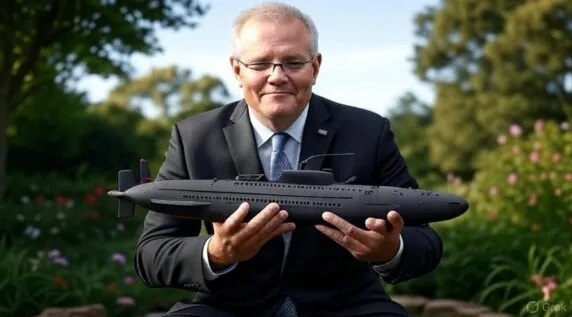
My own submission, ‘AUKUS is a boondoggle’, grappled with the problem of the afterlife of defence ministers. “Boondoggle” is an American word used to describe a government program that is expensive and wasteful yet continues to be funded because it is paid from the public purse, which fits AUKUS perfectly.
By John Jiggens | 5 October 2026, https://independentaustralia.net/politics/politics-display/aukus-inquiry-exposes-the-great-submarine-deception,21620
AUKUS critics warn the $500 billion submarine deal is sacrificing Australian sovereignty and social priorities to deeper integration with the U.S. war machine, writes Dr John Jiggens.
This article is the second part of a two-part story. Read part one HERE.
Members of the Queensland “peace not war” community, including myself, attended the Brisbane session of the AUKUS Public Inquiry on 25 August. Many academics, unionists and activists from other peace groups attended, too.
At the Brisbane session, only two of the five Commissioners were physically present: Peter Garrett and retired Admiral Chris Barrie, a former head of the Australian Defence Force. Two other Commissioners beamed in via the internet: Dr Carmen Lawrence, the first woman to become Premier of an Australian state and Karina Lester, a Yankunytjatjara woman whose people’s country had been poisoned by the UK Government in nuclear tests in the 1950s.
As lead Commissioner, Peter Garrett judicially ran the Public Inquiry, introducing the evidence-givers and reading the questions of the online Commissioners. His rockstar charisma enveloped him in a kind of awe, while his career as a powerful voice for change gave him enormous presence and credibility.
Sharing the bench with him was Chris Barrie. They seemed an odd couple: the peacenik and the former chief of Defence, but AUKUS had united them.
The Queenslanders who presented to the Public Inquiry at the Brisbane hearing included Marianne Hanson, an academic representing the International Campaign against Nuclear Weapons (ICAN); Margaret Pestorius from Wage Peace; Adrian Skerritt, a unionist, ALP member and housing activist; and Professor Warwick Powell from QUT, among others.
Pestorius argued that AUKUS wasn’t a Defence program: it was an economic program that aimed to enmesh Australia in the U.S. military-industrial complex to enable the flow of money to corporate warmongers who had an appalling record of destruction, genocide and ecocide.
Pestorius said former Defence Minister Christopher Pyne, now a military exports consultant and arms dealer, reshaped Australia’s involvement in the weapons industry. This pathway was prefigured by other defence ministers who joined the board of major weapon manufacturers, such as Kim Beazley, who joined Lockheed Martin, and Brendan Nelson, who became CEO of Boeing Australia.
At the end of Margaret Pestorius’s evidence, Admiral Barrie asked her about several Australians employed by U.S. think tanks to profit from AUKUS:
I wonder if you know about American Global Strategies.
It’s an organisation based in Washington, DC, and I wondered if you knew that Scott Morrison is the vice president of American Global Strategies, and he’s assisted by a former ambassador and Liberal Senator, Arthur Sinodinos, and a former head of the Office of National Intelligence, Nick Warner.
The Brisbane session
My own submission, ‘AUKUS is a boondoggle’, grappled with the problem of the afterlife of defence ministers. “Boondoggle” is an American word used to describe a government program that is expensive and wasteful yet continues to be funded because it is paid from the public purse, which fits AUKUS perfectly.
The Americans have another word, which explains why boondoggles go ahead, even though they are such incredibly expensive and wasteful uses of public money. That word is “grifter”.
In politics, the word “grifter” refers to people who use the political process to enrich themselves from the public purse and profit from the extraordinary waste of public money created by boondoggles, such as AUKUS.
Prime Minister turned grifter
When Morrison became Prime Minister in 2018, the Future Submarine Project was running well behind time, and American voices were whispering about ditching the French deal and accepting the worst deal ever.
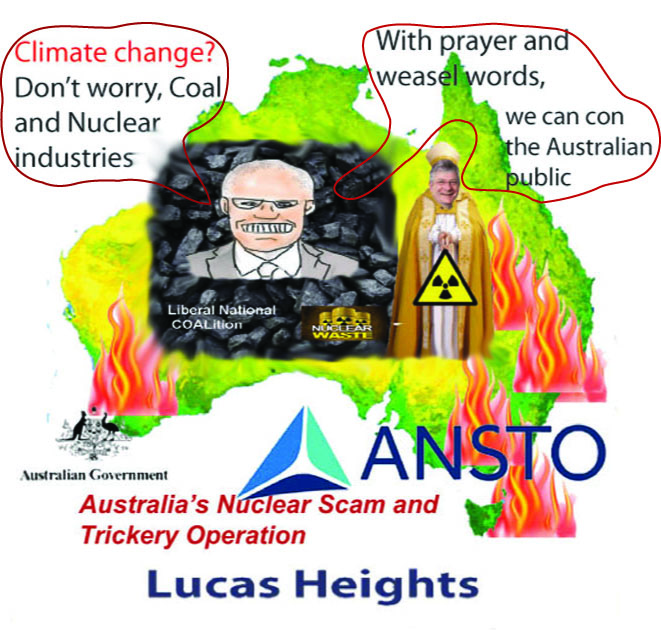
In his 2022 book, Morrison’s Mission, journalist Paul Kelly reveals that Mike Pompeo, the U.S. Secretary of State, was the U.S. voice who collaborated with Morrison in planning AUKUS. Evangelical Christians, the two men spoke every week about Jesus while plotting AUKUS. As they drew closer, Morrison, a geostrategic lightweight, became Pompeo’s pupil, who was co-opted by Pompeo into the U.S. strategic architecture.
In his role as Chair of the Strategic Advisory Board at the Hudson Institute, Mike Pompeo invited Morrison to join the Strategic Advisory Board at the Hudson Institute in November 2022.
The major originator of the AUKUS strategy was Mike Pompeo, who hijacked Australia’s Future Submarine Project and rebuilt it as AUKUS. His strategy was to lock Australia into a global war allied with the U.S. and UK against China, not an Australian-based strategy to deter invasion.
Adrian Pisarski, a veteran housing advocate and former CEO of National Shelter, championed purchasing the cheaper conventional submarines instead of AUKUS nuclear submarines, and using the hundreds of billions saved for addressing Australia’s major housing crisis and other social policies.
Pisarski said:
We could do free dental and Medicare for that sort of money quite easily.
We could have cheaper university education. Commonwealth rent assistance is something else that we could also lift very easily and start to assist people.
I caught the train down from the Sunshine Coast this morning and on the way, I observed no fewer than six homeless camps along parklands etc. We’ve just had a council to the north of Brisbane set up a permanent camp for homeless people. We haven’t seen these conditions in Australia since the 1940s. We are in a genuine housing crisis.
The sort of money that we are talking about for AUKUS would solve our housing crisis.
Admiral Chris Barrie followed this up. He had spoken to colleagues who suggested that for $78 billion Australia could get 12 conventional submarines, not the eight nuclear submarines for circa $500 billion from AUKUS.
Carmen Lawrence asked Mr Skerritt:
“As a fellow ALP member, why do you think the Labor Government has embraced AUKUS rather than prioritising social needs that you have identified?”
Mr Skerritt replied:
I don’t know. I find it particularly unfathomable that when there was a change of government, and this being signed up to by a previous government, that there was no proper inquiry or government-led initiative to question whether this was in Australia’s best interests in the long term.
In my view, it’s not in our best interest and I would have really appreciated the Australian Government performing a proper inquiry that looked at those questions.
Another witness was Professor Warwick Powell, who argued that Australian foreign policy has long been trapped between two deep psychological anxieties: a fear of our own Asian geography and a persistent fear of being abandoned by a distant transatlantic protector.
For over a century, these twin fears have led us to seek security from Asia, rather than security in Asia.
Powell said:
AUKUS tells us that Australia is small, vulnerable, frightened and incapable of surviving in its own region without huddling beneath an overseas nuclear umbrella…
We do not need to choose between being a vassal state or shutting ourselves off from the world and building a fortress. We need the courage to be a sovereign middle power.
The Morrison-Pompeo AUKUS deal changed the Future Submarine Project from providing for the defence of Australia to providing a base for U.S. and UK nuclear submarines in Australia for forward attack operations by the U.S. military against China.
The claim that AUKUS is about the defence of Australia is a lie disguised by Orwellian misuse of language. The Government’s pretence is that U.S. and UK nuclear submarines won’t be based in Australia. Instead, they say that the U.S. and UK nuclear submarines will be “rotated” through Australia.
To assist this “rotation”, the Australian Government is building accommodation for 2,000 US. military personnel at the Stirling Naval Base in Western Australia. This base is only 20 kilometres south of Fremantle and it will be a nuclear target if the coming war with China eventuates.
The extraordinary cost of the project, its clear strategic misdirection from a defence of Australia policy to participating as a vassal in a U.S. war on our main trading partner, China, and the high probability we will never see these submarines were just a few of the many faults of this far-fetched and highly implausible deal discussed at the Brisbane Hearing of the Public Inquiry into AUKUS.
AUKUS public inquiry asks what Parliament won’t
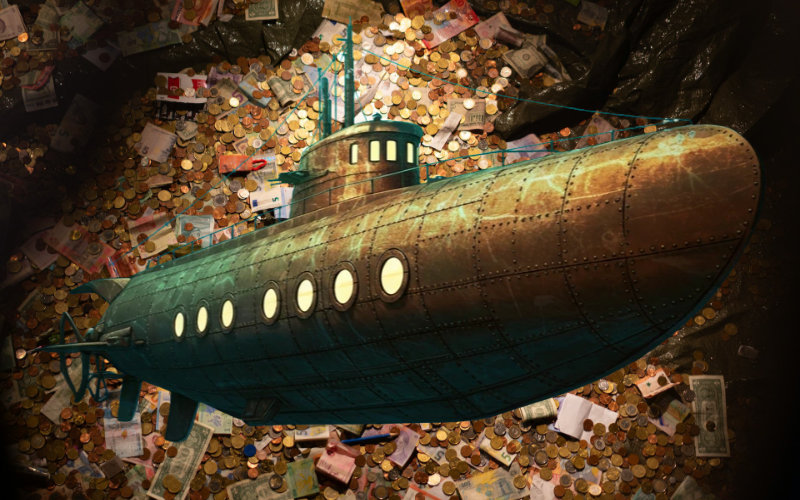
Scott Morrison devised AUKUS in 2021 in partnership with Mike Pompeo. While Morrison was an incompetent neophyte in terms of naval geostrategy, the more experienced Pompeo hijacked Australia’s Future Submarine Project, turning it from a strategy to defend Australia into a strategy for locking Australia into war with China.
Despite the astronomical debt AUKUS will saddle Australia with, deep public unease over nuclear submarines and the economic absurdity of using Australia as a base against its major trading partner, China, there has never been a parliamentary inquiry into AUKUS.
By John Jiggens | 29 September 2026, https://independentaustralia.net/politics/politics-display/aukus-public-inquiry-asks-what-parliament-wont,21597
With AUKUS costs soaring and scrutiny lacking, a public inquiry is asking the questions Parliament has failed to confront, writes Dr John Jiggens.
AUKUS IS A HIGHLY controversial and wildly expensive nuclear submarine arms deal between Australia, the UK and the USA, created largely in secret by former Prime Minister Scott Morrison in 2021, working with the man who would become his mentor in grift, U.S. Secretary of State Mike Pompeo.
The epic failure in defence policy that led to AUKUS flows from the mismanagement by successive coalition governments of the Future Submarine Project. Realising that our Collins-class submarines would become outdated by 2024, the Labor Government initiated the Future Submarine Project in 2012 to purchase replacement submarines that would begin arriving by 2024.
France, Japan and Germany were invited to tender for eight conventional submarines for $20 billion with delivery to start by 2024.
After Labor lost government in 2013, the Coalition governed Australia for the next nine years under three different Prime Ministers: Tony Abbott, Malcolm Turnbull and Scott Morrison. Every time the Coalition changed leaders, the leader changed the contract for which country would build the submarines.
The Abbott Government had planned to purchase 12 conventional submarines from Japan for $30 billion, but Abbott was ousted by Morrison and Turnbull in 2015, resulting in Malcolm Turnbull becoming PM.
Malcolm Turnbull rejected the Japanese deal, preferring the French tender and he changed the submarine deal. Turnbull was ousted by Scott Morrison in 2018 and Morrison, in turn, broke the contract Turnbull had signed with the French and sought a different builder for the submarines.
The deal Morrison signed off on in 2021 was for eight nuclear submarines from the U.S. at the mind-boggling cost of $368 billion. By then, eight years had been lost and under Morrison’s new AUKUS deal, the timeline for delivery of Australia’s submarines became sometime in the 2040s — two decades behind schedule.
The mainstream media never mention this disastrous mismanagement by Coalition governments of the Future Submarine Project and the cost blow-out from $20 billion to an astonishing $368 billion.
Rex Patrick, a submariner and former Senator, protested that this breathtakingly expensive AUKUS deal would bankrupt the Australian Defence Force. Former Prime Minister Paul Keating called AUKUS “the worst deal in all history”. They were just two of the numerous critics of this disastrous deal.
The worst deal ever
Besides wasting eight years changing contracts for building the submarines and putting the delivery date back two decades, as well as the extraordinary blowout in cost, there were many other outrageous provisions of the AUKUS agreement that justified Keating’s assessment of it as the worst deal ever.
Under Scott Morrison’s AUKUS deal, Australia will be responsible for disposing of the highly enriched uranium waste of all the partners of the AUKUS nuclear submarine fleets, the U.S., the UK nuclear submarines, as well as any nuclear submarines Australia obtains.
At the Brisbane session of the Public Inquiry into AUKUS, Commissioner Admiral Chris Barrie, a former head of the Australian Defence Force, disputed the claim that AUKUS would cost only $368 billion. Besides cost overruns, delays and material changes, which will add to that figure, there was one huge cost of the AUKUS agreement: the cost of disposing of nuclear waste that was never costed.
Admiral Barrie commented:
“But the other additional element which raises the question of whether costs can be contained and how that might affect the taxpayer in the long run is the requirement that Australia under the AUKUS pact is responsible for the disposal of highly enriched uranium waste.”
Admiral Barrie quoted an estimate of the expense of disposing of and securing the nuclear waste, which was derived from a South Australian royal commission that had costed a proposal that South Australia should become a repository for radioactive waste.
The South Australian Nuclear Fuel Cycle Royal Commission estimated construction, operation and decommissioning of a high-level nuclear waste repository at $145 billion over 120 years. The true cost of AUKUS will be over $500 billion.
A site for this radioactive waste facility has not been chosen, although possible locations on Defence land, including the Woomera Prohibited Area, have raised concerns among First Nations communities that traditional lands could again be targeted. No permission was sought from any First Nation’s people before Morrison signed off on this.
The coming war with China
Another reason why the AUKUS agreement is the worst deal ever is the replacement of conventional submarines with nuclear submarines. As Admiral Chris Barrie observed, nuclear submarines are designated as attack submarines.
The advantage of nuclear submarines over conventional submarines is that they are faster and can stay underwater longer. They are attack submarines and their naval purpose is to chase and attack enemy submarines. However, they are much bigger than conventional submarines, so they are more easily detected in the shallow waters of Australia’s continental shelf.
Conventional submarines are better suited for a policy of defending Australia, while nuclear submarines are designed to attack enemy submarines.
Scott Morrison devised AUKUS in 2021 in partnership with Mike Pompeo. While Morrison was an incompetent neophyte in terms of naval geostrategy, the more experienced Pompeo hijacked Australia’s Future Submarine Project, turning it from a strategy to defend Australia into a strategy for locking Australia into war with China.
The geostrategy embedded in AUKUS was an American strategy, designed to control the Indian and Pacific oceans and blockade China.
When the Pompeo-Morrison duo redesigned the Future Submarine Project in 2021, the USA had temporarily run out of wars, and U.S. geostrategy was turning into what was referred to by the U.S., their L-NP proxies and their media mates as “the coming war with China”.
China had emerged as a formidable economic and industrial power and was becoming a potential peer competitor with the U.S. Under the Wolfowitz Doctrine, the U.S. would not tolerate the rise of any power that can dispute its global dominance. The U.S. military was preparing for this coming war and was building up its nuclear submarine fleet for this purpose. This coming war with China was masked under the slogan of the Pivot to Asia.
AUKUS was announced shortly before the 2022 Australian Election, an election in which Morrison and his Defence Minister Peter Dutton ran on the China threat and “the coming war with China”. Repeatedly, Peter Dutton compared China to Nazi Germany, and declared China was backing Labor to win the election. Afraid of being wedged on foreign policy, the Albanese-led ALP pursued a “small target” strategy and went along with AUKUS.
However, in the following years, the U.S. military-industrial complex finds itself blessed with a surfeit of wars, led by a delusional and self-proclaimed “stable genius”, President Donald Trump: supporting Israel and its wars in Gaza, Lebanon, Syria and Iran, designed to build a Greater Israel; and supporting Ukraine in a proxy war against Russia in which the U.S. supplied the weapons, and Ukraine supplied the occupants of the body bags.
Ironically, this proxy war was designed to knock Russia out of the ranks of the great powers. Instead, these wars have weakened the U.S. severely.
Too many wars. And the Iran war has widened, creating a new war between Saudi Arabia and Yemen. The coming war with China, previously pencilled in for 2027, has been temporarily placed on hold.
The AUKUS Public Inquiry
Despite the astronomical debt AUKUS will saddle Australia with, deep public unease over nuclear submarines and the economic absurdity of using Australia as a base against its major trading partner, China, there has never been a parliamentary inquiry into AUKUS.
Our Parliament’s abject abdication of its responsibility for this ginormous boondoggle horrified a coalition of former MPs, retired military and naval officers, strategists, academics, union leaders and politicians. They noted the grifter-like silence of our political leaders and the failure of the mainstream media to question this looming disaster. They decided to organise an independent AUKUS Public Inquiry, under the auspices of the Australian Peace and Security Forum (APSF).
If the media and the Government refused to do their job, they would. They asked Australia two simple questions:
Will AUKUS keep us safe?
At what cost?
The Inquiry secretariat was headed by retired Major General Michael Smith and retired Labor politician Doug Cameron. They appointed five commissioners, led by Peter Garrett, former Midnight Oil vocalist and ALP Minister, as their lead commissioner and frontman. They invited Australians for submissions on AUKUS and received over 700 submissions.
Over the past three months, the five commissioners toured Australia, visiting all the state capitals, hearing from selected submission makers, including former Prime Ministers Malcolm Turnbull and Kevin Rudd, former Defence Ministers Bob Carr and Linda Reynolds, former Foreign Minister Gareth Evans and over 100 other concerned Australians.
Brisbane was the penultimate stop of the Public Inquiry on their tour of mainland states, before their concluding session in the Commonwealth capital, Canberra, after which they will write a report that they plan to release in November.
This is part one of a two-part story. Part two will be published soon.
Putting the boot into a new leader: the monstering of David Shoebridge

Identity politics is at its worst when it reduces the complex, dispersed and often contradictory workings of power to a cast-list of heroes and villains. It turns politics into the story of one man or one woman, oppressor or victim, with the facile implication that change is driven from the top down, by the capture or replacement of symbolic authority rather than by the patient reform of institutions, relationships and material conditions by a process of mutual agreement.
Urban Wronski Writes, 4 Oct, 2026
David Martin Shoebridge has been leader of the Greens for four days. In that time he has choked up on national television. He has been tagged an ecopopulist. He has been accused of prejudice. A Murdoch hack has charged him with being “snobby” to a police officer.
The Prime Minister, Anthony Albanese, tells him to go after One Nation instead. He found it “somewhat concerning” that, “at a time when we see a rise of a far right-wing party, Senator Shoebridge took the opportunity to actually criticise Labor.” Leave his government out of this.
Four days. That’s quick work. It’s also very old work.
Fleet Street called it monstering. In 1914, Kitchener’s propagandists did it with Belgian babies. Our corporate scribes have a four-day-old leader on the bayonet.
It would be easy to answer in kind. Find the villains, name them, shame them, go home. That’s the trap. Naming and shaming is their trade, not ours. The people doing this are seasoned operators and they are shameless. They aren’t confused and they aren’t stumbling. They are building something. The useful question isn’t who they are. It’s how the thing is built.
Start with Wednesday night. Sarah Ferguson had the new leader on 7.30 for eleven minutes. Her first question set the tone. “To get to know you, who is your key philosophical or political inspiration?”
Shoebridge named John Kaye, his mentor in the NSW Parliament, “a person of incredible principle, incredible courage,” dead since 2016. His voice caught.
“Oh, that still bothers you?”
“It still does. It’s a hard start to this interview, Sarah.”
“Why does it still move you in the way it does?”
He told her. She asked whether Kaye had expected him to become leader.
“You’d have to ask John.”
“Can’t.”
“Can’t,” he repeated.
A minute later the weeping man had become a bruiser. He and his deputy, Ferguson said, “came out aggressively” to “play hard ball.” Then: “Is that what voters want? An aggressive attitude towards Labor?”
Too soft to lead. Too hard to trust. Both charges inside three minutes.
The psychologists call it a double bind. The Tudors had a better name. Henry VII’s Lord Chancellor, Cardinal John Morton, had a rule for squeezing taxes out of the merchants of England. If a man lived well, he could plainly afford to pay. If he lived frugally, he must have money put away, so he could afford to pay.
Either way, he paid. Morton’s Fork. Shoebridge was skewered on it before he’d finished his first answer.
The ABC’s write-up knew exactly where the story was. “New Greens leader David Shoebridge gets emotional before launching attack on Labor“. First the tears, then the attack. The soft man, then the angry man. Then the “ecopopulist”. A character arc, pantomime villain included, ready for the promo.
This is the getting-to-know-you interview, and every new leader gets one. Who are you, really? What moves you? Who did you lose? It feels humane. It isn’t neutral. It turns the leader into the story, and once the leader is the story the argument is scenery.
Call it what it is: identity politics.
Identity politics is at its worst when it reduces the complex, dispersed and often contradictory workings of power to a cast-list of heroes and villains. It turns politics into the story of one man or one woman, oppressor or victim, with the facile implication that change is driven from the top down, by the capture or replacement of symbolic authority rather than by the patient reform of institutions, relationships and material conditions by a process of mutual agreement……………………………………………………………. https://urbanwronski.com/2026/10/04/monstering-of-david-shoebridge/
Submission to AUKUS Public Inquiry – absurd that the seller of submarines is immune from any liability – Monica Mesch.

179.Monica Mesch.
Subject: Agreement among the Government of Australia, the Government of the
United Kingdom of Great Britain and Northern Ireland, and the Government of
the United States of America for Cooperation Related to Naval Nuclear
Propulsion
I thank the Committee for allowing submissions relating to the above Agreement.
I particularly wish to submit my total disagreement with Part E of ARTICLE IV
Naval Nuclear Propulsion Plants, Related Equipment, and Material:-
E. Australia shall indemnify, subject to paragraph F of this Article, the United
States and the United Kingdom against any liability, loss, costs, damage or
injury (including third-party claims) arising out of, related to, or resulting from
Nuclear Risks connected with the design, manufacture, assembly, transfer, or
utilization of any Material or Equipment, including Naval Nuclear Propulsion
Plants and component parts and spare parts thereof, transferred or to
betransferred pursuant to this Article.
It is unconscionable that Australia, on behalf of its citizens, would sign off on
allowing this section in a treaty or otherwise with any dealings or purchases that
it makes with any country.
Ask anyone of your citizens if they’ve ever bought materials or equipment that
indemnify a supplier in the manner in which you propose?
It’s the dumbest thing I’ve heard of lately…. and ridiculous!
Submission to AUKUS Public Inquiry- AUKUS benefits foreign entities not Australians – Simon Murr.
168. Simon Murr
The most serious risks for Australians are:
Dependence on U.S. political and industrial reliability (which is not guaranteed).
Receiving older, less capable submarines at enormous cost.
A potential decade‐long submarine capability gap.
Strategic entanglement in U.S.–China rivalry.
Massive financial exposure with uncertain returns.
Submission to the AUKUS Public Inquiry- SEA LANES, SUBMARINES AND THE LIMITS OF AUSTRALIAN POWER- Peter Holding.

150. Peter Holding
Executive Summary
This submission argues that:
• The principal justification for AUKUS—the protection of Australia’s sea lanes—is unconvincing in the context of a major conflict between the United States and China.
• The ability of any allied naval force to guarantee normal commercial shipping during a major United States–China war is highly questionable. Australia’s proposed fleet of three nuclear-powered submarines would make only a limited contribution to that task.
• Australia’s submarine contribution is unlikely to materially alter China’s strategic calculations or significantly strengthen deterrence.
• Claims that AUKUS will provide Australia with substantially greater influence in Washington are overstated. Australia’s strategic value to the United States already derives principally from intelligence cooperation, particularly Pine Gap, and from Australia’s geographic position in the Indo-Pacific.
• Concerns about coercion in a China-dominated Asia deserve consideration, but discussions often overlook the reality that allies as well as rivals use economic and political pressure to advance their interests.
• Australia’s long-term security is more likely to depend upon economic resilience, diplomatic flexibility and political independence than upon a small fleet of nuclear-powered submarines.
The central question is not whether Australia faces strategic challenges. It clearly does. The question is whether AUKUS is the most effective and proportionate response to those challenges.
Protecting Australia’s Sea Lanes
One of the most frequently repeated justifications for AUKUS and Australia’s massive expenditure on nuclear-powered submarines is the need to protect “Australia’s sea lanes”.
But what exactly are these sea lanes, and can the proposed submarine fleet achieve that objective?
through the Indonesian archipelago, the South China Sea, the Strait of Malacca, the Indian Ocean and across the Pacific. Through them flow our exports of iron ore, gas, coal and agricultural products and many imports upon which Australia depends- manufactured products, pharmaceuticals, industrial components and much of our refined fuel.
As a trading nation, Australia clearly has an interest in keeping these routes open. The question is whether nuclear submarines can do so.
Can Nuclear Submarines Keep the Sea Lanes Open?
The central assumption behind current defence policy is that Australia can contribute to the protection of these sea lanes and, through deterrence, help prevent conflict from occurring in the first place.
Yet this argument becomes difficult to sustain when one asks what would happen in the very conflict for which these submarines are supposedly being acquired: a war between the United States and China.
If such a war occurred, commercial shipping throughout East Asia would immediately become hazardous. Insurance costs would soar. Shipping companies would avoid conflict zones. Missile strikes, submarines, drones, mines, cyberattacks and attacks on port infrastructure would threaten commercial traffic. The economic consequences would extend far beyond the immediate combat zone.
The argument is not that Australia’s submarines would operate alone. Supporters of AUKUS envisage them contributing to a broader allied effort, principally alongside the United States. Even so, it is difficult to see how allied naval forces could guarantee the safety of commercial shipping during a major war between the world’s two largest military powers.
Modern conflict would not resemble the relatively uncontested maritime operations of recent decades. Long-range missiles, submarines, drones, cyberattacks, mines and attacks on port infrastructure would create risks across vast areas of ocean. Commercial shipping companies and insurers would respond accordingly. Insurance premiums would rise sharply, many vessels would avoid conflict zones altogether, and some trade routes could become effectively unusable regardless of how many warships were deployed.
Australian submarines might contribute to military operations conducted by an allied coalition. That is not the same thing as ensuring that commercial sea lanes remain open for normal trade. The ability to sink enemy vessels is not necessarily
the same as the ability to guarantee the safe passage of civilian shipping.
Indeed, the widespread use of drones in Ukraine and the Middle East has highlighted how relatively inexpensive systems can threaten far more expensive military platforms. This raises further questions about whether a strategy centred on a small number of extremely costly submarines represents the most effective means of protecting Australia’s interests.
Would AUKUS Strengthen Deterrence?
Nor is it obvious that Australia’s submarine force would significantly increase deterrence.
China will make its strategic calculations primarily based on the military capabilities and political resolve of the United States. It is difficult to believe that Beijing’s decision-making would be materially altered by the addition or subtraction of a small Australian submarine force.
This does not mean the submarines would be militarily irrelevant. Rather, it means that their existence is unlikely to be decisive in the strategic calculations of a great power.
Does AUKUS Increase Australia’s Influence in Washington?
A second argument often advanced is that AUKUS increases Australia’s influence in Washington.
Australia already possesses assets of enormous value to the United States, particularly Pine Gap and other intelligence and defence facilities. If Australia has influence in Washington, it derives principally from these assets, from decades of intelligence cooperation, and from our geographic position in the Indo-Pacific.
Three submarines will not provide influence that Pine Gap does not already provide.
More fundamentally, history suggests that great powers pursue what they perceive to be their own interests. If a future crisis over Taiwan occurs, Washington will act according to its own assessment of American interests, not according to the wishes of Canberra.
What Would Chinese Regional Dominance Actually Mean?
Supporters of AUKUS often respond that the real issue is not sea lanes or submarines but what happens if China becomes the dominant power in Asia.
No serious analyst suggests that China intends to invade Australia. Australia is geographically distant, sparsely populated, militarily capable and occupies a continent that would be extraordinarily difficult to conquer and administer.
The more plausible concern is that China could seek to pressure Australia to align more closely with Chinese preferences on issues such as Taiwan, intelligence cooperation, human rights criticism or regional disputes.
That concern is not irrational. However, it raises an important question. Why do we assume that coercion is uniquely a Chinese problem? Economic Coercion by Allies: Recent Examples
The United States has repeatedly demonstrated a willingness to use economic pressure against allies when it believes its interests require it.
Recent examples are instructive.
In 2025 the Trump administration imposed significant tariffs on Canada despite Canada being one of America’s closest allies, a NATO member and a Five Eyes intelligence partner. The dispute became intertwined with broader political disagreements and repeated public comments questioning Canadian sovereignty and suggesting that Canada should become America’s “51st state”.
The administration also imposed and threatened tariffs against Brazil while openly criticising legal proceedings involving former Brazilian president Jair Bolsonaro, a political ally of President Trump. Trade measures were linked to concerns about Brazil’s domestic political decisions.
Similarly, the United States threatened retaliatory tariffs against several European allies in response to digital services taxes and regulatory measures affecting major American technology companies. The objective was not simply to secure market access but to influence the domestic regulatory choices of allied governments.
These examples demonstrate that great powers frequently use economic leverage against both allies and rivals.
Coercion, Influence and Australian Independence
China has certainly attempted to exert pressure on Australia. It has objected strongly to criticism of its human rights record, calls for a COVID inquiry and other policies it regarded as hostile. Its trade restrictions on Australian exports were clearly intended to influence Australian behaviour.
However, China’s pressure has generally been directed at what Australia says or does about China.
By contrast, the United States has often sought influence over Australia’s domestic economic arrangements themselves.
Successive American administrations and corporate interests have pushed Australia on pharmaceutical regulation, intellectual property rules, investment
provisions, agricultural market access and other matters. The Pharmaceutical Benefits Scheme has repeatedly been a target of American lobbying because it restrains drug prices and therefore pharmaceutical profits.
In other words, China has largely sought to influence Australia’s foreign policy towards China. The United States has often sought to influence how Australia’s domestic economy operates.
Indeed, one could argue that American influence already penetrates much more deeply into Australian institutions than Chinese influence does. Intelligence cooperation, defence procurement, technology standards, financial markets and trade arrangements all bind Australia closely to the United States.
The point is not that America and China are identical. They are not. The point is that the mere possibility of coercion cannot by itself justify one alliance and condemn another relationship. The relevant question is not whether coercion exists, but how much coercion exists, in what forms, and with what consequences.
Trade, Protectionism and Australia’s Economic Interests
Australia is a trading nation. Yet if our prosperity depends upon open markets and relatively free flows of goods and capital, it is worth noting that China remains deeply dependent upon and supportive of international trade while the United States has become increasingly protectionist.
Under both Republican and Democratic administrations, tariffs, industrial subsidies, export controls and economic nationalism have become mainstream features of American policy. Donald Trump accelerated trends that were already emerging, but those trends have continued under subsequent administrations.
This raises a difficult question. If open trade is an Australian value, why do we automatically assume that our economic interests align more closely with the United States than with China?
Historical Affinities and Strategic Assumptions
The usual answer invokes shared history, shared values and the alliance.
Australia has deep historical, cultural and institutional ties to the Anglosphere. We speak the same language as Britain and America. Our legal and political systems have common roots. Our intelligence services are closely integrated.
But perhaps these historical affinities also shape our perceptions in ways we rarely examine.
Australians tend to view the United States as familiar and therefore reassuring, even when Washington imposes tariffs on allies, seeks changes to our domestic policies, or pursues its own interests at our expense.
China, by contrast, is often portrayed as fundamentally alien, opaque and threatening.
The old phrase was “the inscrutable Oriental”. We no longer use such language openly, but it is worth asking whether remnants of that mindset still influence some of our strategic assumptions.
This does not mean China poses no challenges. It does. Nor is Australia about to abandon the alliance with the United States. Support for the alliance is deeply embedded in Australian political culture and remains strong across much of the electorate.
Conclusion
This submission argues that public discussion of AUKUS often proceeds from a series of assumptions that deserve closer scrutiny.
Even if one accepts concerns about China’s growing power, it does not automatically follow that spending hundreds of billions of dollars on a small fleet of nuclear-powered submarines is the most effective response.
The ability of even a large allied naval force to guarantee normal commercial shipping during a major United States–China war is highly questionable. Australia’s proposed submarine capability would make only a limited contribution to that task. Nor is it likely to alter China’s strategic calculations in a decisive way or provide Canberra with substantial additional influence in Washington beyond that which Australia already derives from intelligence cooperation and its strategic location.
Australia’s security ultimately depends not on the illusion of controlling events far beyond its power, but on maintaining economic resilience, diplomatic flexibility, political independence and a realistic understanding of the limits of Australian influence.
Submission to AUKUS Public Inquiry – Citizens Party – foreign interests used Australian Strategic Policy Institute to foment fear of China and drum up support for AUKUS.

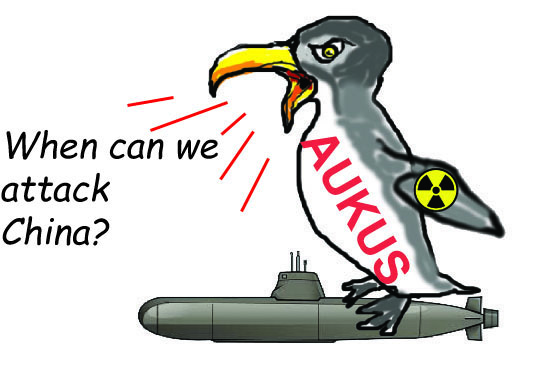
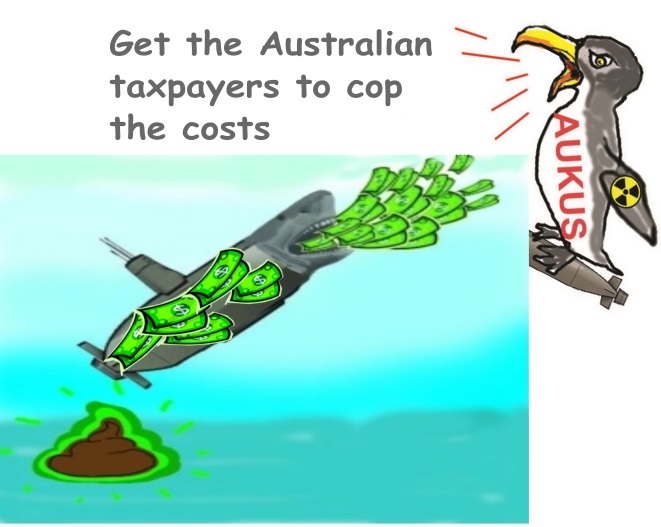
149. Robert Barwick On behalf of Citizens Party
AUKUS is the policy product of foreign interference
On 15 February 2024 Australian Strategic Policy Institute (ASPI) senior analyst Dr
Alex Bristow explicitly connected the willingness of the Australian public to bear
the growing cost of military spending that AUKUS represents, with our level of
alarm about one country—China.
“We will not generate or sustain public consent for necessary rises in defence
spending and the whole-of-nation effort required in the years ahead until our
national security establishment stops treating China as a taboo subject in public”,
Dr Bristow wrote in an article on the ASPI website (https://www.aspi.org.au/strateg
ist-posts/we-mustnt-be-afraid-to-mention-china-in-public-discussions-about-defenc
e/).
There you have it—focus on China to “generate” public consent for mega-spends
like AUKUS.
However, this was not mere advice from ASPI; the AUKUS Public Inquiry should
examine how ASPI has taken the lead on focussing Australians’ attention on China
for more than a decade, and how it has been funded by the US and UK
governments, as well as American and British weapons manufacturers, to do so.
Having paid ASPI in the low tens of millions of dollars over more than a decade to
make repeated, mostly unfounded and always exaggerated accusations against
China in Australia, the US and UK governments and their biggest weapons
companies have already received billions of Australian dollars through the AUKUS
program.
This is the universal business model of the military-industrial complex: sponsor
think tanks that relentlessly hype tensions and threats; cash in with defence
contracts.
Analysis by APAC News published 31 March 2021 (ASPI sponsors collect billions
from Defence) showed that ASPI received almost $7 million in sponsorship and
commercial revenue the previous year, the majority from foreign governments and
weapons companies.
APAC News reported that since 2001, weapons companies that sponsored ASPI
had collectively received more than $51 billion in contracts from the Australian
government.
Because of its funding, ASPI became a specialist in hyping a China “threat”
narrative.
The AUKUS agreement was announced later in 2021 following an intense period of
relentless anti-China commentary from ASPI.
The quality of ASPI’s analysis varies, from sometimes competent analysis, such as
its assessments of China’s technological capabilities, to ridiculous, baseless
fearmongering.
For example, this year is the 10th anniversary of a particularly embarrassing
instance of ASPI inciting baseless hysteria. In 2016, when Australia conducted its
first online census, the Australian Bureau of Statistics (ABS) census website portal
failed, overwhelmed by the public trying to access it on census night. ASPI
Executive Director Peter Jennings immediately jumped to shape the media
narrative by claiming China hacked the census. “I think we’ve had quite a
sophisticated attempt to take down the ABS and maybe also to steal information,”
he told the ABC. “They [China] have the capacity to do this and the interest to do
it.” The ABS later concluded that there was no hack—the IBM hardware hosting the
website was inadequate for the job.
The census claim was a harbinger of things to come, as 2016 coincided with a shift
in US policy towards confronting the rise of China, which ASPI faithfully
represented in Australia.
For a decade, ASPI has pumped out allegations of Chinese cyberattacks on
Australian institutions, foreign interference in Australian politics and the Australian
Chinese community, Chinese infiltration of Australian universities through
academic research collaboration, Chinese bots manipulating Australian social
media, and more.
Because the Citizens Party regularly fact-checked ASPI’s claims, and debunked
most of them, it also became ASPI’s target: an ASPI report in 2023 claimed that
Chinese bot accounts on Twitter were boosting two things: statements by former
prime minister Paul Keating, and the Citizens Party’s campaign to stop banks from
closing branches in regional Australia! (The bot accounts ASPI identified had no
followers and no engagement, and ASPI didn’t prove they were Chinese.)
In this period the Australian media has amplified ASPI’s claims, and ASPI personnel
became permanent, ubiquitous fixtures on media interviews and current affairs
shows when anything to do with China was in the news—without ever declaring
the conflict of interest from their funding.
The Citizens Party urges the AUKUS Public Inquiry to examine the way the foreign
interests which are profiting from AUKUS used ASPI to shape public opinion in
Australia to accept the bill for AUKUS.
In this period the Australian media has amplified ASPI’s claims, and ASPI personnel
became permanent, ubiquitous fixtures on media interviews and current affairs
shows when anything to do with China was in the news—without ever declaring
the conflict of interest from their funding.
The Citizens Party urges the AUKUS Public Inquiry to examine the way the foreign
interests which are profiting from AUKUS used ASPI to shape public opinion in
Australia to accept the bill for AUKUS.
1 This month
17 October, Free Public Talk on Nuclear Issues in South Australia
David Noonan will speak on public interest concerns over the new Roxby Downs Indenture Act 2026 on BHP copper-uranium mining and ore processing in SA, and on how AUKUS may face SA with a High-Level nuclear waste agenda.
Dr Jim Green will discuss international developments in the field of nuclear power including ‘small modular reactors’ and Generation 4 ‘advanced’ nuclear reactor concepts.


Help Aunty Sue Protect Her Land and Sacred Sites From Destructive Rocket Testing.
.

Australians deserve the truth
about
AUKUS – https://aukuspublicinquiry.com/

PETITION – To: Prime Minister Anthony Albanese and the Australian Labor Government

of the week – Australians for War Powers Reform (AWPR)
To see nuclear-related stories in greater depth and intensity

