Nuclear power a “no-go” in a water-short world
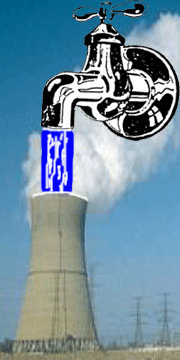
“The best alternatives from a water perspective are wind and photovoltaics, that require effectively no water”
Water Adds New Constraints to Power, NYTimes.com By ERICA GIES May 17, 2010 “……In the United States, thermoelectric power generation — mainly coal, nuclear and natural gas — accounted for 41 percent of U.S. freshwater withdrawals in 2005, U.S. Geological Society data show………..
But there is a growing awareness in California and throughout the United States that the use of water for energy generation may be reaching its limits.
California has extensive experience with water shortages, resulting in its adoption of a policy, included in the energy commission’s 2003 Integrated Energy Policy Report, that discourages freshwater use for power plant cooling…….“If you want to build a big central power plant, whether it’s oil, gas or nuclear, you can’t take the water for granted.” In the past decade, water availability has increasingly had an effect on the reliability of power supplies in many countries, with droughts leading to temporary closings of nuclear plants in Australia, France, Germany, Romania and Spain. Similar shutdowns have been threatened in the United States.
For a thermoelectric plant, the cooling technology used is the biggest factor in its water needs.
Once-through cooling, an inexpensive, energy-efficient and therefore widely used process, sucks up huge quantities of river, lake, or sea water. A typical 500-megawatt power plant takes in almost 19 million gallons, or 72 million liters, an hour, according to a 2005 report from the U.S. Department of Energy.
After running through the plant, almost all of this is returned to the river, lake or ocean. The used water, however, may be polluted, and the heat that it has absorbed can be lethal to fish, while the intake can kill wildlife and microorganisms. Research of the environmental consequences has led to tighter regulations in recent years, making it nearly impossible to get permits for new plants using once-through cooling anywhere in the United States…………..
Dr. Gleick, of the Pacific Institute, said: “The best alternatives from a water perspective are wind and photovoltaics, that require effectively no water. I.H.T. Special Report – Water and Energy – Water Adds New Constraints to Power – NYTimes.com
No comments yet.
1 This month

of the week – Australians for War Powers Reform (AWPR)
To see nuclear-related stories in greater depth and intensity
 Antinuclear
Leave a comment