Marketing nuclear technology to unstable Middle Eastern States

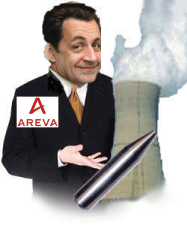 Suppliers such as France, Russia, South Korea, Japan, and the United States are eagerly competing to ink deals with, and provide nuclear aid to, more than a dozen Middle Eastern states, including Egypt, Jordan and Saudi Arabia — many of the same regimes now facing threats of internal upheaval.
Safeguarding Nuclear Security in the Shadow of Middle East Revolutions, THE HUFFINGTON POST, Jonathan Pearl, 4 Feb 2011, As revolutionary fervor sweeps across the Middle East and the Obama administration takes steps to recalibrate decades of U.S. foreign policy toward the region, it must not neglect the issue of nuclear nonproliferation. The region’s present instability, historic precedent, and inadequate safeguards make the rapidly increasing trend of nuclear deal-making with Arab autocrats a dangerous road to tread. Unlike democratic transitions, which Washington is morally obligated to support but which are largely beyond its control, regional nonproliferation is an issue on which the administration has leverage, and on which it must step up its efforts to exert influence

Over the past several years, the Middle East has become something of a nuclear bazaar. A.Q. Khan and his network may be out of business, but legal nuclear cooperation deals are on the upswing. Suppliers such as France, Russia, South Korea, Japan, and the United States are eagerly competing to ink deals with, and provide nuclear aid to, more than a dozen Middle Eastern states, including Egypt, Jordan and Saudi Arabia — many of the same regimes now facing threats of internal upheaval.
The primary concern here for Washington must be the proliferation risks associated with transferring nuclear technology to unstable regimes. Revolutions are notoriously unpredictable, and the short-term result is rarely stable democracy. What guarantees exist that nuclear installations, institutions, and knowledge remain secure during and after such tumult?…
Given the dramatic events unfolding in the Middle East, the Obama administration would be wise to consider taking immediate precautionary steps, including imposing a moratorium on U.S. nuclear deal-making with Middle Eastern states until the current instability subsides.
Jonathan Pearl: Safeguarding Nuclear Security in the Shadow of Middle East Revolutions
No comments yet.
1 This month

of the week – Australians for War Powers Reform (AWPR)
To see nuclear-related stories in greater depth and intensity
 Antinuclear
Leave a comment