Energy Resources of Australia facing grim financial report on uranium mining drop
 Reports gauge damaging La Nina summer rain’s cost | The Australian, Matt Chambers, April 11, 2011″…..ERA, which reports tomorrow, has the biggest potential to give the market a negative shock, as far as Rio’s results go. UBS is expecting a 55 per cent drop in uranium production from the previous quarter to 525 tonnes….”Reports gauge damaging La Nina summer rain’s cost | The Australian
Nuclear power, uranium mining, continue to be unpopular in Australia
 After Fukushima: Nuclear less popular than ever, Green Left Weekly, April 10, 2011,By Jim Green A poll by Roy Morgan Research several days into the Fukushima nuclear crisis found that 61% of Australians oppose the development of nuclear power in Australia, nearly double the 34% who support it. Continue reading
The nuclear establishment now moving into full spin mode
 As nuclear energy markets feel the squeeze, we can expect to see the industry going into PR overdrive to promote the safety of nuclear technology in the coming months, often air-brushing existential threat dimensions from the nuclear equation out of the public’s consciousness…..
Fukushima sets faithful to spin mode James Norman The Australian April 11, 2011 “…..history has shown that the industry is adept at rebranding, and as we approach the 25th anniversary of the Chernobyl accident later this month the Nuclear Power Oversight Committee will be busy drafting a new PR plan. Continue reading
Darwin hears Aboriginals, scientists, call to close Ranger uranium mine
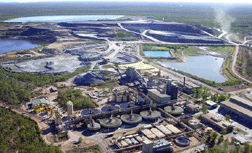 Monash University engineering academic Dr Gavin Mudd said that Ranger was one of the most heavily monitored uranium mines in the world, but this was still insufficient to deal with the problems.
The Ranger mine has been closed for several weeks because the extreme wet season has threatened to overflow a dam site used to hold radioactive tailings.
‘Call to close Ranger uranium mine’ | Green Left Weekly April 10, 2011 By Peter Robson, Darwin One hundred and thirty people packed out a room in the Crowne Plaza hotel to hear traditional owners and nuclear experts call for the closure of the Ranger uranium mine in the world heritage-listed Kakadu national park.
Ranger uranium mine is shut: keep it that way
 Traditional Land Owners Want Mining Stopped at Ranger Uranium Mine, Azo Mining, By Joel Scanlon, 11 April 11, The Ranger uranium mine has been mining on a lease inside the Kakadu National Park for 30 years. Now following the Japanese Fukushima nuclear fiasco the traditional land owners say that they do not want uranium mining to continue on their land. The Mirarr people want the Jabiluka uranium deposit to not be mined and included into the national park protection area……Production at the Ranger mine is currently suspended due to persistent water management problems. The heavy rains are posing
 greater environmental risk. On Thursday the Gundjeihmi Aboriginal Corporation said that more than 10 million liters of contaminated water was present on the Ranger site…..Traditional Land Owners Want Mining Stopped at Ranger Uranium Mine
Increasing global heatwaves mean increasing nuclear power shutdowns
 Heatwaves cause problems for nuclear power plants | Climate Central, By Alyson Kenward. 11 April 11, “…...Extreme Heat Limits Nuclear Energy Production “……nuclear power has a paradoxical relationship with climate change. Even though it might help mitigate long-term global warming, nuclear power is already being challenged by rising temperatures and the increasing number of heat waves around the world. Throughout the last decade, several plants have had to reduce electricity production during heat waves, just when when electricity demand typically reaches peak levels.
“It’s a dilemma between mitigation of climate change, and adaptation to it,” says Natalie Kopytko, an energy policy doctoral student at the University of York in England. Having recently studied the ways in which climate change could have a negative impact on nuclear power, she says nuclear power is caught in the middle because it could be used to help lower greenhouse gas emissions, but global warming is making the technology less effective at providing electricity…. Heatwaves cause problems for nuclear power plants | Climate Central
No real safeguards in Australia’s uranium to Russia
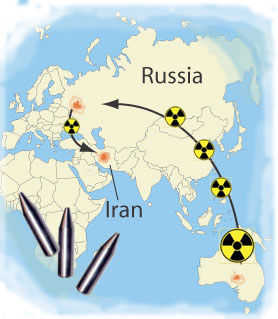 Fukushima sets faithful to spin mode James Norman The Australian April 11, 2011“………Given Julia Gillard ratified the nuclear co-operation agreement with Russia last November to supply Australian uranium, the apparent opportunism and the lack of transparency of the Russian nuclear industry is very much Australia’s business.The agreement struck with Russia contains no requirement for nuclear safeguards inspections, despite the rhetoric from the government and industry that “strict” safeguards will “ensure” peaceful use of Australian uranium in Russia.
Aside from the often stated reality that there is still no long-term safe way to dispose of nuclear waste, one of the most critical but frequently overlooked issues is the nuclear industry’s repeatedly proven connection to the proliferation of nuclear weapons. For those who remain sceptical of this connection, Iran, Pakistan and North Korea provide compelling examples….Fukushima sets faithful to spin mode | The Australian
Japanese citizens rally against nuclear power
‘‘We hope to halt the Hamaoka plant which is said to be the most dangerous, and the campaign to halt nuclear plants will spread elsewhere.’‘…..
17,500 gather for Tokyo rallies against nuclear plants , Japan Today, 11 April 2011 TOKYO —About 17,500 people gathered Sunday for two rallies held in Tokyo against nuclear power plants amid the prolonged crisis at the Fukushima Daiichi Nuclear Power Station some 220 kilometers to the northeast. Continue reading
Inadequacy of health study into Australian nuclear veterans
 Letter to Governor General from Major Alan Batchelor Paul Langley’s Nuclear History Blog, 11 April 11, Quote:
29 March 2011 “…….requests a review and cancellation of the currently accepted study of the health of Australian nuclear veterans contained in Australian Participants in British Nuclear Tests in Australia by Dr Gun et al. Both the hazardous environments and resulting detriments to the health of many nuclear veterans have been incorrectly assessed in this document, leading to many false exposure and compensation assumptions that also need revision and remedial action…….
The basis on which the Cancer and Mortality Study was constructed omits several important areas of consideration and makes no effort to explain the effect of these omissions.
• It confined the study to the carcinogenic effects of ionising radiation, ignoring:
o Non-carcinogenic effects following exposure to internal radioactive emitters with long biological half-lifes resulting in;
• Loss of immune competence,
• Short and long term sterility, miscarriages, stillbirths, etc,
• Heredity defects in subsequent generations,…….
The above background discussion provides a number of conditions that reduce the viability of the Cancer and Mortality Study and should have, as a minimum, been taken into account in the findings. In addition, Royal Commission Conclusion 201 (15.6.13) goes even further and questions the feasibility of attempting such a study:
“Because of the deficiencies in the available data, there is now little prospect of carrying out any worthwhile epidemiological study of those involved in the tests nor of others who might have been directly affected by them.” Letter to Governor General from Major Alan Batchelor « Paul Langley’s Nuclear History Blog
Huge expense and uncertainty about Britain’s growing pile of plutonium waste

A leaked cable from the US embassy in London said Sellafield’s Mox plant was a white elephant costing about £90m a year and considered, privately, by the UK Government as “[one of] the most embarrassing failures in British industrial history”…the French nuclear company Areva ….wants to build the second Mox plant based on its own Mox operation at Marcoule in the south of France.
Government’s doomed £6bn plan to dispose of nuclear waste, The Independent, 11 April 11, One month after the Japanese tsunami, the world’s biggest reserve of plutonium waste is reaching crisis point. It was meant to be reprocessed and sold – but now no nation will take it. So where is this vast stockpile? Not Fukushima, but Sellafield, Cumbria, By Steve Connor, Science Editor Continue reading
1 This month

of the week – Australians for War Powers Reform (AWPR)
To see nuclear-related stories in greater depth and intensity
 Antinuclear