Atomic bomb tests’ radiation kept secret from Australians
 British monitoring of water commenced in the 1950s. The records of this early monitoring are unavailable in Australia. As British nuclear weapons testing in Australia commenced in the early l950s, this data is of great importance.
Propaganda Paul Langley’s Nuclear History Blog 13 April 11, Introduction From 1957 to 1978 the Australian Government carried out dissections on the bodies of people who had died of illness or accident. These dissections were carried out to monitor the amount of Strontium 90, a radioactive element, absorbed by Australians. Strontium 90 was a component of the fallout deposited from nuclear tests conducted in Australia, the Pacific and China. Continue reading
The necessary steps in cleaning up Fukushima
count on cleanup costing $10 billion. Engineers can break the problem down to the basics, and they know how to do each individual step — but nobody’s ever tried a nuclear cleanup on this scale before.

 AUDIO Cleaning Up Fukushima: A Challenge To The Core : NPR NPR, 13 April 2011, “…….Nuclear engineers working at the Japanese plant are dealing with two problems at the same time: They are working to fully stabilize the plant’s reactors, and they are trying to control the release of radioactive material.
It could take weeks or months to stabilize the reactors. And containing and cleaning up the radioactive material could take at least 10 years, at a cost of more than $10 billion. Even though many of the details about what’s happening at the reactors are not known, experts can predict the tasks ahead for workers. Continue reading
Whittlesea (Victoria) may strengthen its nuclear free status
 free of a nuclear power plant, uranium enrichment or reprocessing plants;Is not used as a base for nuclear weapons or any facilities associated with their development, manufacture or transportation;
Nuclear fallout – Whittlesea Leader, 12 April 11, A TOXIC debate exploded at a Whittlesea Council meeting during a discussion about the municipality reaffirming its position as a nuclear-free zone. Continue reading
Nuclear establishment uneasy, as UK moving away from nuclear?
The bosses at EDF, Centrica, RWE npower, E.ON and all must be feeling distinctly queasy, after all the time and money they’ve spent on pushing for nuclear power in Britain. They’ve been pretty successful at gaining subsidies for it too – with UK billpayers expected to pay at least £17 more per year by the middle of the decade to encourage the construction programme. Could the years of lobbying fail to pay off?
 Is Chris Huhne preparing for his second U-turn on nuclear? – Telegraph, By Rowena Mason 12 April 11, The previously anti-nuclear Lib Dem, who famously became pro-nuclear on appointment to Energy Secretary, is yet to pronounce definitively on what the Japan atomic disaster may mean for UK plans for 10 new stations. But he has ordered an inquiry into safety concerns and several ministers seem to be smoothing the way for a new official line – that we don’t need nuclear power after all. Continue reading
Joint solar and wind energy venture – Australia and China

 China joins $6.2bn Australia wind and solar roll-out Recharge 13 April 11–Australia’s CBD Energy plans to invest A$6bn ($6.26bn) in wind and solar farms across the country in a joint venture with two of China’s biggest renewables companies.
China joins $6.2bn Australia wind and solar roll-out – Finance – Renewable energy news – Recharge – wind, solar, biomass, wave/tidal/hydro and geothermal
Germany to shift from nuclear to renewable energy
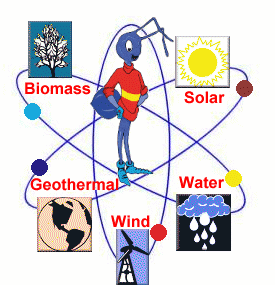 a draft plan from Germany’s environment and economy ministries proposes to speed up the shift from nuclear power to renewable energy and increased energy efficiency…..Germany has already shut down 7 of its own nuclear reactors and the remainder will be subject to a safety review by the independent Reactor Safety Commission.
 Germany To Accelerate Shift From Nuclear Power To Renewable Energy Renewable Energy News 13 April 11, The Fukushima nuclear power station crisis in Japan, now designated a level 7 incident – on par with Chernobyl, continues to make itself felt around the world, with many nations reconsidering their pursuit of nuclear power sourced electricity generation. Continue reading
Australian uranium shares down, but ERA worst hit
 Uranium miner’s shares slump on forecast loss ABC News (Australian Broadcasting Corporation) By finance reporter Alicia Barry 13 April 11, Shares in uranium miner Energy Resources of Australia have slumped more than 10 per cent after the company flagged a first-half loss.Speaking at ERA’s annual general meeting, its CEO Rob Atkinson said 2010 was an extremely difficult year after heavy rains suspended production at its Ranger mine in the Northern Territory…..
Uranium mining leads the plunge in Australian resources shares
Uranium miners were among the weakest in the S&P/ASX 200, with Paladin down 4.9 per cent to $3.53…..”There’s no reason to be buying risk assets when you’re told the third-biggest economy in the world has a nuclear crisis potentially as big as Chernobyl.
Nuclear danger poisons bourse: Japan crisis wipes month’s worth of share gains The Australian David Rogers * From: Dow Jones Newswires * April 13, 2011 AUSTRALIA’S sharemarket had its biggest one-day fall in a month yesterday, as Japan’s nuclear crisis worsened, commodity prices fell and BHP Billiton shares reversed after Monday’s buyback-led surge…… Continue reading
Fukushima hastens the existing decline of the nuclear industry
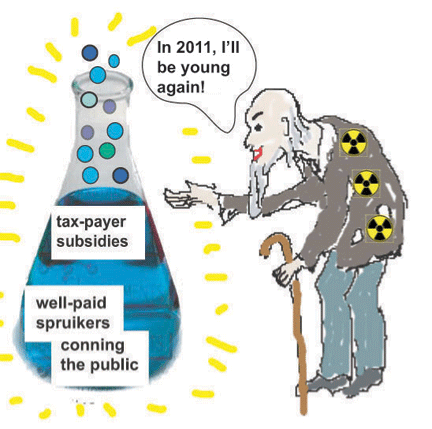 Before Fukushima, a “nuclear renaissance” — as it was termed in the press — seemed well underway, except for this point: Nuclear power, as a total of world energy supply, has been in steady decline for the past decade.
Japan: The ‘nuclear renaissance’ that wasn’t | Finance Business News, CNN) 11 April 11, — A month after a devastating earthquake sent a wall of water across the Japanese landscape, the global terrain of the atomic power industry has been forever altered. Continue reading
1 This month

of the week – Australians for War Powers Reform (AWPR)
To see nuclear-related stories in greater depth and intensity
 Antinuclear