BHP Billiton does some creative spinning about Olympic Damn Uranium Mine

 BHP and the new maths of nuclear reactors. by Bernard Keane, Crikey, 17 May 11, Olympic Damn: is BHP ignoring Fukushima and its effect around the world | Crikey Yesterday Robert Gottliebsen of Business Spectator spruiked the glories of BHP’s Olympic Dam uranium mine, Continue reading
No safe level of radiation, says Director of World Health Organisation
 Chan distanced herself from the recent statements made by the WHO on the consequences of Chernobyl.
W.H.O. Secretary General “Margaret Chan” admits for the first time: RADIATION IS ALWAYS DANGEROUS, Jan Hemmer Blog, May 12, 2011 by Mikkai “…..There is no safe low level of radiation, ” said WHO Director General Margaret Chan on Wednesday during a short meeting scheduled with members of the critical “initiative for an independent WHO “. By the former Ukrainian, Russian and Western European doctors and radiation biologists, and WHO staff based initiative has been demonstrating daily about four years before the WHO Office for cancellation of the agreement with the International Atomic Energy Agency (IAEA)……. Continue reading
Martin Ferguson’s Nuclear Waste Dump Bill Now in the Too Hard Basket?
Nuclear waste dump debate on back burner, ABC News (Australian Broadcasting Corporation), 17 May 11, By Alison Middleton The Federal Government says it hopes the Senate will debate its proposed legislation for a nuclear waste dump in the Northern Territory at the next sittings of the Upper House in June.

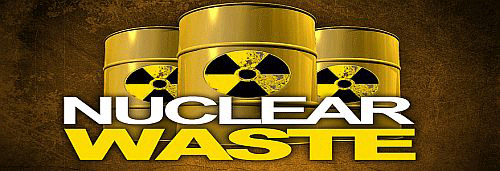
The bill paves the way for a dump to be built at Muckaty Station near Tennant Creek. It also also allows for alternative sites if that nomination does not go ahead.The bill was due to be debated last week but was not.A spokeswoman for Federal Resources Minister Martin Ferguson says the Government hopes the bill will be debated at the next opportunity.Nuclear waste dump debate on back burner – ABC News (Australian Broadcasting Corporation)
Unconvincing argument from Australian company on radioactive wastes
Where is the chosen site for the disposal of the waste? What would make this site suitable for waste disposal? How will the waste be managed? What would be the storage capacity for the radioactive waste? And how many years of waste would it have room for?
 To appease the voracious public outcry, it was announced that the International Atomic Energy Agency has appointed a nine-member team to help the Government probe whether the rare earth refinery carries any threat of radioactive contamination.
Less rhetoric, more clarity please (about Lynas dumping radioactive wastes in Malaysia) The Star online by ANITA GABRIEL, 14 May, A victim of a campaign of misinformation.” That’s how Australia’s Lynas Corp executive chairman Nick Curtis characterised his company’s controversial RM1.3bil rare earths refinery being built in Malaysia in a recent interview with an Australian news network.
He’s correct in part. Seriously wrong on all else. Continue reading
Wind Energy Set to Boom inWestern Australia
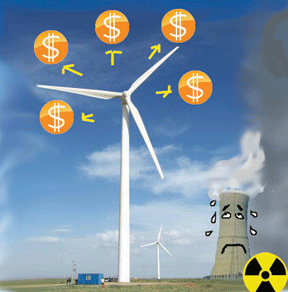 The proposals are the latest in a number of wind-energy projects on the ground or in the pipeline
New bid to harvest Wheatbelt wind – The West Australian, 17 May 11, .In dusty back paddocks and weathered coastal landscapes across WA, a transformation is taking place.A wind-farm investment drive is to become a multi-billion-dollar boom and nowhere is that boom likely to be bigger than in the small Wheatbelt town of Williams, about 150km south-east of Perth. Continue reading
Solar energy in Australia – whacked by the power of polluter lobbyists
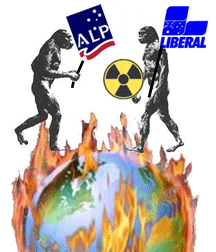 The situation in Australia is problematic because renewables, and climate policies in general, are clearly a political football.
A solar policy of ill repute | Climate Spectator, Giles Parkinson, 17 May 11, “…….The renewables industry has experienced multiple policy convulsions over the past decade that have stalled its development, but none may be so damaging as the decision last week by the NSW government to make retrospective changes to its feed-in tariffs. Continue reading
Good news on minimising medical radiation for Australian children
 The government’s decision to allow GPs to order MRI scans could prove lifesaving for children with cancers who would otherwise lose time waiting for a specialist appointment
GPs get the go-ahead to order less risky scans, Sydney Morning Herald, Amy Corderoy, May 17, 2011 THE federal government will allow GPs to order magnetic resonance imaging scans to stop patients being sent for riskier and less sensitive imaging such as computed tomography scans.
New research shows the number of children undergoing CT scans has grown by 5.1 per cent a year over the past 20 years. Continue reading
Medical radiation and the hazard for children


Children, he says, face a lifetime of radiation procedures, and many studies suggest that the adverse effects of radiation are cumulative. So limiting radiation exposure, particularly if it’s not absolutely necessary, is a good idea.
AUDIO Reporting On Hidden Dangers Of Medical Radiation, NPR 17 May 11, “…..On Monday’s Fresh Air, Bogdanich discusses his ongoing Times seriesabout the medical and regulatory issues that have arisen as radiation therapies have become more ubiquitous in both dental and doctors’ offices. Continue reading
Dr Paul Dorfman shoots down theory on “safety” of nuclear reactors near children
You really should read the entire article to get the full meaning of this –
Why UK nuclear power plants may cause childhood cancer and leukaemia – The Ecologist
 it’s all about who you trust. On the one hand, nuclear low-level radiation emissions are ‘safe’, and nuclear plant should carry on generating. On the other hand, it has taken decades to establish that there are real excesses of childhood cancer and leukaemia near some nuclear facilities. As for me, I value precaution when considering the potential effect of a micron sized plutonium particle on the tracheal bronchial lymph node of a child.
 Why UK nuclear power plants may cause childhood cancer and leukaemia, Dr Paul Dorfman, 16th May, 2011 You won’t hear the UK government admit it but after decades of research there is now evidence of real excesses of childhood cancer and leukaemia near some nuclear facilities, argues Dr Paul Dorfman…. Continue reading
1 This month

of the week – Australians for War Powers Reform (AWPR)
To see nuclear-related stories in greater depth and intensity
 Antinuclear