Unconvincing argument from Australian company on radioactive wastes
Where is the chosen site for the disposal of the waste? What would make this site suitable for waste disposal? How will the waste be managed? What would be the storage capacity for the radioactive waste? And how many years of waste would it have room for?
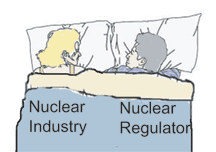 To appease the voracious public outcry, it was announced that the International Atomic Energy Agency has appointed a nine-member team to help the Government probe whether the rare earth refinery carries any threat of radioactive contamination.
Less rhetoric, more clarity please (about Lynas dumping radioactive wastes in Malaysia) The Star online by ANITA GABRIEL, 14 May, A victim of a campaign of misinformation.” That’s how Australia’s Lynas Corp executive chairman Nick Curtis characterised his company’s controversial RM1.3bil rare earths refinery being built in Malaysia in a recent interview with an Australian news network.
He’s correct in part. Seriously wrong on all else.
There is, as Lynas has pointed out, low level of thorium (a radiation source) in the raw material which it will ship over from the Mount Weld mine in Australia to the facility in Gebeng, Kuantan. In that sense, the drubbing against the setting up of the facility on that premise may be misdirected.
The company has also reiterated, again countless times, that the storage of these residues (this is where the concern lies as it is the residues which contain some level of radiation) will be safe and poses no risk.
Glaringly absent in the sudden outpouring of information from Lynas on the project which has thus far largely centred around how safe, rigorous and uncompromising its processes are and the effectiveness of Malaysia’s legal framework is one pivotal issue it has yet to answer satisfactorily.
Where is the chosen site for the disposal of the waste? What would make this site suitable for waste disposal? How will the waste be managed? What would be the storage capacity for the radioactive waste? And how many years of waste would it have room for?
That’s not “misinformation”, Mr Curtis. That’s glaringly a lack of information.
This is what we know so far.
● Lynas will place funds with the Government to ensure safe management of any remaining residues.
Question: Does that mean the management of the remaining residues would eventually be managed by the Government, and not Lynas?
● Lynas has “embarked on a research and development programme together with local universities, Nuclear Malaysia and Australian Nuclear Science and Technology Organisation” to use the residue containing low level of radiation in safe by-products and commercial applications.
What that really means is that while Lynas is merely four months away from operating its rare earths facility in Gebeng (if it gets the green light to go ahead as scheduled, that is), it has yet to clearly ascertain what it plans to do with these residues.
● Lynas says it has taken the additional safety step of placing these residues in safe, reliable engineered storage cells that are designed so that there is no possibility for any leakage of material into the environment.
If Japan’s nuclear emergency following the tragic tsunami in mid-March has taught us anything at all, it is this the unpredictability of certain events and its potential magnitude. And this the “unknown unknowns” (a memorable quote by former US Defense Secretary Donald Rumsfeld), essentially meaning the things we don’t know that we don’t know.
And so, when Nick Curtis says he thinks there are “local political purposes” who have “sought to join the dots of the drama in Japan … and fear in local community,” he may come across as underestimating the very reach of Japan’s nuclear fallout and perhaps, a tad dismissive of the public’s concerns over the potential environmental and social risks of having a rare earths facility in one’s backyard. If such facilities are safe and brings enormous economic benefits to a country, then why is it that China controls over 90% of the world’s supply of rare earth elements?
To appease the voracious public outcry, it was announced that the International Atomic Energy Agency has appointed a nine-member team to help the Government probe whether the rare earth refinery carries any threat of radioactive contamination. The panel will submit its report to the Government in end-June and the findings will be made public. Until then, Lynas will not receive government approval to operate or import any raw material into Malaysia.
Once the answers to these crucial questions are forthcoming and the review mandated by the Government is able to throw out of the window the potential hazards of having such a project in our backyard, perhaps the veterans of protest may be assuaged. But what if they’re not?
No comments yet.
1 This month

of the week – Australians for War Powers Reform (AWPR)
To see nuclear-related stories in greater depth and intensity
 Antinuclear
Leave a comment