Beware the uses and misuses of opinion polls, like Galaxy’s on carbon tax
 The problem lies with the following: “Does the PM have a mandate to introduce the tax or should she call an early election?” This gives respondents no outlet for the obvious third alternative: that while the Prime Minister does not have a mandate for a carbon tax (and given her position during the election campaign, it could hardly be argued otherwise), the government should nonetheless govern as it sees fit and face the music at the end of its term…
Considerably exacerbating the problem is that the poll was conducted for Australia’s most brazenly partisan metropolitan newspaper, the Daily Telegraph (UPDATE: The Herald-Sun is also selling it as its own work). And true to form, the Telegraph has today used the opportunity to run an editorial headlined “voters demand a carbon tax ballot”, in which it argues that “an election now is very necessary”.
Taxing credulity, June 6, 2011 – by William Bowe “….. today’s Galaxy poll, .. targeted a small sample of 500 respondents on behalf of the Daily Telegraph. For the most part, its results are of genuine concern for the government.
Will the Australian govt reneg on its promise to save Koongarra from uranium mining?
 The Gundjeihmi Aboriginal Corporation has called for mining to be banned at the Ranger uranium mine as it is a part of their tradional land.
Corporation executive officer Justin O’Brien told the ABC a climate change report on Kakadu released on Wednesday ignored the effects of increased storms and rising sea-levels on Ranger and the Government has reneged on its promise to incorporate the nearby Koongarra lease into the national park and apply for world heritage listing…..”Now is the time, in light of what we know at Kakadu, for the Ranger Mine expansion and the Koongarra Mine proposal to be taken off the table.
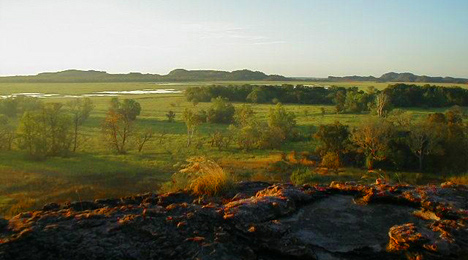
 ERA MISLEADING ABOUT RANGER URANIUM PLANS: ENVIRONMENTALISTS, Mining Australia, By Jessica Burke 6 June 2011 Environmentalists have accused Energy Resources Australia (ERA) of ulterior motives over plans to expand its uranium mine in the Kakadu National Park in the Northern Territory.
After winning the rights to mine at the site in the late 1990’s, the traditional owners of the land, the Mirrar people opposed the mining and the shaft was filled in. They believe the plans by ERA to expand its Ranger Mine operations is a sneaky way for the company to also access one of the world’s largest known undeveloped uranium deposits at Jabiluka.
The company has been under pressure to close the mine amid fears of contamination to nearby waterways and damage to traditional Aboriginal land. Continue reading
Northern Land Council did not consult Aboriginal landowners on Muckaty nuclear waste dump plan
COMMENT “Real Fella – Anthropologists can effecitvely make up whatever they like to suit their employer. It’s not an objective process. If they go to one Traditional Owner who says its his land, and ignore 20 other Traditional Owners s saying its not, then he can produce a report saying its the land of the 1 Traditional Owner despite all the conflicting evidence. This is exactly what the NLC did in this case, it didnt actually talk to most TOs, and worst it didn’t even show people the report once it was written so that they could confirm it or not.”.
 Nuclear dump in question, Northern Territory News, BONNY SYMONS-BROWN | June 7th, 2011 NORTHERN Land Council chief executive Kim Hill has not met with traditional owners of the area earmarked for Australia’s first nuclear waste dump. Continue reading
Time bombs – USA’s huge collection of nuclear radioactive wastes
After more than 50 years, the quest for permanent nuclear waste disposal remains illusory. One thing, however, is clear, whether we like it or not: the largest concentrations of radioactivity on the planet will remain in storage at U.S. reactor sites for the indefinite future.
America’s Nuclear Spent-Fuel Time Bombs HUFFINGTON POST, Robert Alvarez, : 06/ 6/11 Japan’s nuclear disaster should serve as a wake-up call for the United States. Now that many Americans have stopped paying attention to Japan’s nuclear catastrophe, shocking new details about its severity are finally coming to light.
The U.S. Nuclear Regulatory Commission recently revealed that the cores of three of the Fukushima Dai-Ichi nuclear station’s reactors started to melt within hours after the loss of offsite power, right after the March 11 earthquake and tsunami. Tokyo Electric Power, which owns the wrecked reactors, has announced that the accident probably released more radioactivity into the environment than the Chernobyl debacle. That would make it the worst nuclear accident on record. Meanwhile, a nuclear waste advisor to the Japanese government reported that about 373 square miles near the power station — an area roughly 17 times the size of Manhattan — may now be uninhabitable.
The Fukushima accident should be a wakeup call for the United States to address the hazards posed by our own dangerous spent fuel pools at nuclear reactors. They are a time bomb. America’s reactors have generated about 65,000 metric tons of spent fuel, of which 75 percent is stored in pools, according to Nuclear Energy Institute data. No other nation has generated this much radioactivity from either nuclear power or nuclear weapons production. Continue reading
Toro talks up uranium, as its shares slump
 UP AND ATOM Sydney Morning Herald, Colin Kruger June 7, 2011 Human catastrophe and financial markets are never a pretty mix. Just ask the uranium explorer Toro Energy, which dedicated yesterday’s shareholder update to clearing the air on some of the ”sensationalist” media coverage of the Fukushima nuclear plant accident.
Toro’s concern is understandable. Its share price nose-dived after the incident and the stock is retracing recent lows following Germany’s promise to close down all its nuclear facilities by 2022.
The company says ”a sequence of extraordinary forces unleashed by an unprecedented natural disaster” caused the accident at the reactors, ”not an operating failure, human error or design fault of the reactors themselves”.
Your columnist feels safer already.
”The lessons learnt from this incident will make nuclear power even safer than its already impressive record would attest,” the company says, while noting that the precautionary radiation checks provided ”plenty of sensationalist film footage” for the media and anti-nuclear groups.
It was not enough to cheer up its share price yesterday. The stock continued its slide, closing 0.3¢ lower at 8¢…http://www.smh.com.au/business/taking-on-water-and-headed-for-the-rocks-20110606-1fpa2.html
Surge in renewable energy predicted for Australia
Renewable energy set to surge, Adam Morton The Age 6 June 11 AUSTRALIA is expected to generate six times more renewable energy and up to three times more gas-fired power in 2050 under a carbon price than it does today, according to Treasury modelling for the multi-party climate policy committee.
Releasing a snapshot of the long-awaited modelling before a speech on climate policy at the National Press Club tomorrow, Treasurer Wayne Swan said it showed a carbon price would drive innovation and encourage investment in cleaner power. But the figures also suggest greenhouse-gas-intensive coal will remain a significant part of Australia’s power supply for decades……The snapshot said gas-fired power – which in baseload form has about two-thirds fewer emissions than coal – would generate 1½ to three times more output in 40 years than today.
Australian Conservation Foundation executive director Don Henry said the shift to a cleaner economy was expected to involve more gas-fired power but should only be developed if it included technology to capture and store emissions.He said the proportion of power from burning coal must be dramatically reduced unless carbon capture proved viable.
”It is a little hard to judge, based on what has been released, but we’d be looking for much stronger growth in renewables than appears to be indicated by Treasury figures,” Mr Henry said…….Read more: http://www.theage.com.au/national/renewable-energy-set-to-surge-20110605-1fnh7.html#ixzz1ORrH3G4s
Will Egypt continue nuclear power program, despite calls for renewable energy?
The costs of nuclear energy , By Manal Abdul Aziz – The Egyptian Gazette, June 6, 2011 CAIRO – The difference between humankind, homo sapiens, and other animals is that human beings have experience and learn from their mistakes, while other animals behave according to instinct. For this reason, human beings are the only creatures that have a civilisation. …., when we consider establishing a nuclear project for generating energy, we should review the nuclear programmes of other countries and clearly assess their positive and negative aspects. …..
1 This month

of the week – Australians for War Powers Reform (AWPR)
To see nuclear-related stories in greater depth and intensity
 Antinuclear