Future for decentralised solar power in Australia
”grid parity” – when unsubsidised solar energy becomes cost-competitive with power from the electricity grid – is getting devilishly close as the cost of photovoltaics (PV) falls…..
”If you can spend $500 and get $700 to $800 back, there won’t be a person in Australia that would ignore that,” Newman says. ”The PV [photovoltaic] retailers will be all over them, and the smart energy retailers will of course step into the game.” It might not be the cheapest form of abatement available to the economy but it’s money in the bank for the punter.
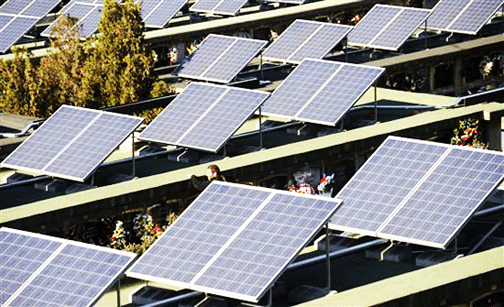
Future lies in power to (and from) the people, Sydney Morning Herald,Paddy Manning, July 30, 2011 It’s hard to tell whether the glass is half full or half empty for Australia’s solar industry right now……..
What the solar industry wants NSW and other jurisdictions to do is adopt a one-for-one feed-in tariff, so householders with solar panels get as much for every kilowatt hour they put into the grid as they pay for every kilowatt hour they use.
That policy is totally reasonable. In fact, the Council of Australian Governments agreed in 2008 that ”residential and small business consumers with small renewables should have the right to export energy to the electricity grid and require market participants to provide payment for that export which is at least equal to the value of that energy in the relevant electricity market and the relevant electricity network it feeds into, taking into account the time of day during which energy is exported”. Ah, COAG. Zzzzz.
On the bright side, ”grid parity” – when unsubsidised solar energy becomes cost-competitive with power from the electricity grid – is getting devilishly close as the cost of photovoltaics (PV) falls.
Reaching grid parity depends on your electricity use, how much sun you get and your tariff but, given the widespread public support for solar, demand could skyrocket, the Australian PV Association’s chief executive, Peter Newman, says.
Assume no subsidies at all for rooftop solar panels in three years’ time but that the total cost of a 1.5-kilowatt system has dropped to $6000 (today that same system costs between $7500 and $9000 – even cheaper if you shop around), and say the system lasts 12 years (the panels might last longer but the inverter might not) – savings of $500 a year on average are needed to justify the outlay.
A typical household might use 21 kilowatt hours a day, and a typical 1.5-kilowatt solar system might generate 7.5 kilowatts a day. Any saving is at the retail electricity price, so on a typical electricity tariff of 28¢ a kilowatt hour the annual saving is $715. You’re in the money, and electricity prices are only going one way – up.
”If you can spend $500 and get $700 to $800 back, there won’t be a person in Australia that would ignore that,” Newman says. ”The PV [photovoltaic] retailers will be all over them, and the smart energy retailers will of course step into the game.” It might not be the cheapest form of abatement available to the economy but it’s money in the bank for the punter. If the electricity industry hoped to make a margin on decarbonising the grid – if it thinks it can do renewables cheapest – it’s at least got stiff competition from good-old DIY. ”There’s not many things you do in your home that increase its value and reduces your energy bill,” Newman says.
A modest one-for-one tariff, steady for three to five years, could take us through until grid parity is achievable for the majority. Roughly 1000 megawatts of rooftop solar is installed Australia-wide and with grid parity that could really rise. Then, Newman says, the government has ”got the community to buy its own power station”.
Genuine utility-scale solar power stations are also on the way with the first two solar flagship projects to be built from next year: the BP Solar-led $923 million, 150-megawatt Moree solar farm (PV) in NSW, and the Areva-led $1.2 billion, 250-megawatt Solar Dawn solar-thermal and gas hybrid power plant near Chinchilla, Queensland……
The best thing happening? The multiparty climate change committee’s clean energy future package contained $5 billion in new money for renewables, including large-scale solar, to be loaned or invested by the proposed Clean Energy Finance Corporation (although it looks like more than half of that is earmarked for fiscal 2016 and beyond).
That’s a good model, emulating the US Department of Energy’s loan program, which has underpinned billions of dollars of private sector investment in renewables……Future lies in power to (and from) the people
No comments yet.
1 This month

of the week – Australians for War Powers Reform (AWPR)
To see nuclear-related stories in greater depth and intensity
 Antinuclear
Leave a comment