Common sense about ionising radiation and CT scans
breast tissue in women and ‘young’ cells in children are more sensitive to radiation…….Universally, MRIs and ultrasounds – which do not use radiation – are increasingly being used as an alternative to CTs where appropriate.
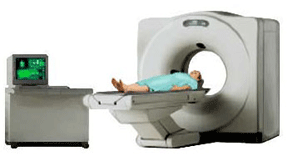 When you are faced with the prospect of undergoing a CT scan or another sort of imaging, here are some questions to ask and steps to take:
- Ask your referring doctor to outline the risks and benefits, and whether this test will change the way you are treated.
- Ask if there are alternative tests or methods that use less radiation but are as effective.
- Keep a record of the scans you have had and discuss this with your doctor. Avoid unnecessary duplicate tests.
- Tell your doctor if you are pregnant before having a scan.
- Educate yourself by accessing the many very good online resources for more information
- If you are still unsure, seek a second opinion.
CT scans and radiation, ABC by Pamela Wilson, 12 Aug 11, Every year, more CT scans are being ordered in Australia. They provide valuable information to guide medical care, but they come with a dose of radiation. Should we be worried?
Whereas a plain x-ray takes just one picture, during a CT scan many x-ray images can be taken of cross sections of our body. This allows doctors to visualise organs, bones and blood vessels and diagnose health conditions such as cancer, trauma, injuries and abnormalities in the head and abdomen….
But there is a trade-off – CT scans deliver radiation to our bodies, and at a much higher level than a traditional x-ray.
As we all know, high levels of exposure to radiation are linked to an increased risk of developing cancer. So with more and more of us having CT scans, should we be worried?…..
The radiation dose of a CT scan varies dramatically depending on which area of the body is being assessed and the techniques used.
As a rough guide, a CT of the chest can be equivalent to having at least 100 chest X-rays.
While this sounds like a lot for one CT scan, it translates to a very small increased risk of developing cancer over your lifetime – about a 0.04 per cent increase in risk in fact, the Royal Australian and New Zealand College of Radiologists estimates.
So if someone has a 30 per cent lifetime chance of developing cancer, this rises to 30.04 per cent after a single CT scan.
Age and sex also need to be factored into the equation. For example, breast tissue in women and ‘young’ cells in children are more sensitive to radiation…….
Universally, MRIs and ultrasounds – which do not use radiation – are increasingly being used as an alternative to CTs where appropriate.
The Federal Government recently changed its Medicare funding rules to make MRIs cheaper and more accessible for all patients.
Even the traditional referral system by doctors is changing, says Andrews – with radiologists providing feedback to GPs on when alternative tests with a lower radiation exposure might be used.
In addition to these initiatives, a major way we can minimise our exposure is to avoid unnecessary CT scans.
The Cancer Council has these examples of situations where CT scans are possibly unnecessary.
- Routinely investigating common symptoms like back pain
- Long-term follow-up in patients who have been successfully treated for cancer, who remain well and have no symptoms.
- As a precaution against a doctor being sued for missing a cancer diagnosis in patients who have no symptoms.
Although it is your doctor who ultimately makes the referral for a scan, be aware that pressure from patients can sometimes lead to doctors ordering inappropriate tests…..
When you are faced with the prospect of undergoing a CT scan or another sort of imaging, here are some questions to ask and steps to take:
- Ask your referring doctor to outline the risks and benefits, and whether this test will change the way you are treated.
- Ask if there are alternative tests or methods that use less radiation but are as effective.
- Keep a record of the scans you have had and discuss this with your doctor. Avoid unnecessary duplicate tests.
- Tell your doctor if you are pregnant before having a scan.
- Educate yourself by accessing the many very good online resources for more information .
- If you are still unsure, seek a second opinion.
No comments yet.
1 This month
7 April – WEBINAR – Australia and the Doomsday Clock – Preventing nuclear war through NoFirstUse and other policies
Online | Tuesday April 7, 4:00-5:30pm, Australian Eastern Time / 8:00-9:30am Central Europe Time
– Access the registration link
15 April – Zoom –Nuclear Power is Not the Solution
Apr 15, 2026 01:00 AM in Canberra, Melbourne, Sydney

Join the International Physicians for the Prevention of Nuclear War (IPPNW) on Tuesday, April 14th for a timely webinar exploring the risks associated with nuclear power and challenging the myth that it offers a simple, safe, carbon-free solution to the climate crisis

21 April Webinar: No Nuclear Weapons in Australia
Start: 2026-04-21 18:00:00 UTC Canberra, Melbourne, Sydney (GMT+10:00)
End: 2026-04-21 19:30:00 UTC Canberra, Melbourne, Sydney (GMT+10:00)
Event Type: Virtual
A virtual link will be communicated before the event.
Host Contact Info: australia@icanw.org

of the week – Australians for War Powers Reform (AWPR)
To see nuclear-related stories in greater depth and intensity
 Antinuclear
Leave a comment