How, from 1945, the media covered up the health effects of nuclear radiation
Laurence’s account of this visit … disclosed quite frankly why he and thirty other journalists had been invited: to “give lie to” Japanese propaganda “that radiations were responsible for deaths even after” the Hiroshima attack, as he wrote
 How a famous NYT Reporter Led the Media Cover-Up of Radiation Dangers, http://www.thenation.com/blog/163193/how-famous-nyt-reporter-led-media-cover-radiation-dangers, The Nation Greg Mitchell, September 7, 2011 William L. Laurence earned the nickname “Atomic Bill” several times over. As I’ve explored here in the past, he was Pulitizer-winning New York Times science reporter who became embedded with the Manhattan Project and followed its creation of the first atomic bombs at several sites around the United States. As the first use of the new weapon against Japan neared, he wrote several lengthy articles glorifying the Bomb and the men who made it, which were published, with overwheming impact, by his paper (and others) starting on August 7, 1945. Continue reading
Investor support ‘has evaporated’ from Australian uranium mining companies
 Investor support has evaporated and the share prices of most ASX-listed uranium plays have fallen more heavily than the wider market. The share price falls have eroded any chance of capital raisings to fund drilling programs or project development while continued production problems experienced by market leader Paladin Energy have added to the negative sentiment hanging over the sector.
The Merrill Lynch uranium equity index, which tracks global listed stocks, is down 19 per cent over the past month and 23 per cent in the past year.
More pain for uranium sector as price dips, PETER KLINGER, The West AustralianSeptember 7, 2011 Already battered by headwinds, including strong opposition from environmentalists, WA’s fledgling uranium sector is set for more grief amid expectation the nuclear fuel’s low price will fall another 6 per cent within the next few months. Continue reading
Head of China’s energy policy admires Australia’s carbon plan
 Beijing praises emissions plan, Sydney Morning Herald, Adam Morton, September 8, 2011, AUSTRALIA’S proposed emissions trading scheme has won praise from Beijing, where it will be the model for one of six Chinese pilot schemes to be introduced in 2013.
Jiang Kejun, head of the Chinese government’s energy and environmental policy agency, said pilot carbon trading schemes currently being researched would trial different designs based on schemes from Australia, Europe and California….
‘Some say what is happening in Australia is even better [scheme design] than in Europe, so in that sense Australia is leading.”
Dr Kejun spoke yesterday at a Victoria University climate change conference, having been brought to Australia by the government’s Climate Commission as the first of six international guests to report on steps overseas to reduce emissions….
The threat of uranium mining to Tanzania’s environment
 (relevant because Australian companies are trying to mine in Tanzania) Clear key concerns on uranium mining, The Citizen, 07 September 2011 Tanzania’s quest to allow investors to mine uranium in the Selous Game Reserve faces stiff opposition from some local and foreign wildlife conservationists.
Unesco’s World Heritage Committee maintains that the country should only allow in investors after an environmental impact assessment has been undertaken.And now, a Germany-based group calling itself Tanzania Network, has plunged into the fray. Its secretariat has reportedly written to President Jakaya Kikwete, through Tanzania’s ambassador in Berlin, Mr Ahmada Ngemera, pleading with him to halt plans of awarding uranium mining licences to any international company.
The organisation says it is concerned with the dangers that uranium poses to lives of living organisms as well as to the environment. …
Judging from the arguments by the government and conservationists, one notes that there is a sense of mistrust and some ignorance within the matter.It is evident that environmentalists don’t trust the government. Probably, they feel the country may blindly undertake a project that would have negative ramifications on the lives of its own people and the invaluable wildlife.
BHP, RIO, Xstrata try to control Australian govt on carbon tax
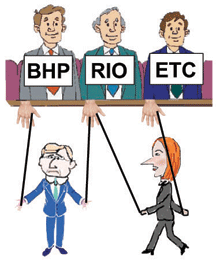 Rio Tinto warns Gillard over carbon tax, The Age, Peter Ker, September 8, 2011 MULTINATIONAL miner Rio Tinto has intensified its opposition to Australia’s carbon tax, urging Prime Minister Julia Gillard to go back to the drawing board and start again on carbon policy….Rio has previously claimed the tax would penalise trade-exposed industries and deter investment in resource projects, but yesterday Mr Peever stepped up the attack by urging the government not to proceed with the tax in its present form…….
Rio was one of three big mining companies – alongside BHP Billiton and Xstrata – invited by Ms Gillard to help shape Labor’s revised mining tax last year.
The government plans to introduce the carbon tax to Parliament next week, and Ms Gillard said its opponents would not stop the bill winning passage through the hung parliament. ”Everybody in the Parliament knows from the statements that have been made by parliamentarians that the legislation has sufficient support to get through and it will,” she said. ”I do expect, as we see constantly from the opposition, that we’ll see all sorts of wrecking tactics, but we will work our way through and ensure that the legislation does go through.”…..
Australia’s carbon tax stimulates foreign investment in renewable energy
 We think its a tremendous advantage. We’ve been long supporters of the carbon tax and we think the package the government has come up with will be pretty effective. It seems to be the most economically efficient way to reach any given target.
Foreign company interest in Australian renewable energy, Radio Australia September 7, 2011 , Some of the world’s biggest companies are getting involved in Australia’s renewable energy sector. Large investments are being made in solar technology at a time when the debate around climate change and carbon schemes is highly politicised. Continue reading
US Army goes for rooftop solar energy in a big way
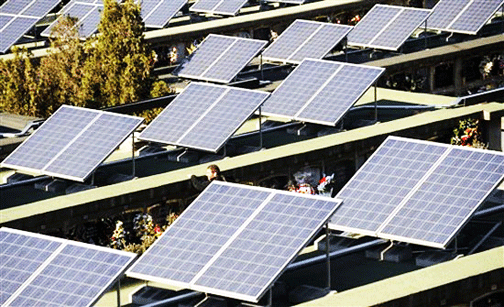
 U.S. military to be largest rooftop solar customer CNet News,By: Martin LaMonica, SEPTEMBER 7, 2011d more:The Department of Energy today backed a deal to connect solar electric panels at 160,000 locations on military bases, a move which could double the number of residential solar installations in the U.S.
The DOE said it has provided a conditional commitment to guarantee a $344 million loan for the SolarStrong Project, which will help the military meet its renewable energy targets and bring solar power to a many states which now have little. SolarCity, which specializes in residential solar installation and financing, has been tapped to install, own, and operate the panels in up to 124 military bases in as many as 33 states. The five-year project will add 371 megawatts of solar capacity, bringing rooftop solar to military families’ homes as well as warehouses and administrative offices on bases.
“This is the largest domestic residential rooftop solar project in history,” Energy secretary Steven Chu said in a statement. “This groundbreaking project is expected to create hundreds of jobs for Americans and provide clean, renewable power to our military families.” SolarCity said it hopes to fill as many jobs as possible with U.S. veterans and military family members.
This deal brings a clever residential financing model to a scale never been done before. Rather than pay for rooftop solar panels, customers pay a monthly fee–either to purchase the energy produced by panels or a solar lease. The arrangement allows consumers to avoid the big upfront cost of panels and lower their monthly spending on electricity.
For the SolarStrong deal, investor U.S. Renewables Group will serve as the lead lender for the project in partnership with Bank of America Merrill Lynch. The DOE will guarantee loans provided for the residential solar installations……http://news.cnet.com/8301-11128_3-20102845-54/u.s-military-
1 This month

of the week – Australians for War Powers Reform (AWPR)
To see nuclear-related stories in greater depth and intensity
 Antinuclear