Court case over nuclear waste dump, as Australian govt rushes Waste Bill through Senate
The federal government is likely to pass a bill in the Senate which would could allow a nuclear waste dump to be built on Aboriginal land near Muckaty Station
Resources Minister Martin Ferguson told SBS that regardless of what happens in the Senate, he will respect the findings of the court as regards ownership.
 Nuclear waste dump opposition heats up, By Bill Code -SBS World News Australia ,12 September 2011 A nuclear expert says the claims that a nuclear waste dump in the Northern Territory is needed to house low level radioactive waste from hospitals is ‘nonsense.’ Continue reading
Local anger at Australian govt plan for nuclear waste dump in Northern Territory
But on the ground, in communities near the site, many people are angry at the NLC. They say they haven’t been consulted, and can’t understand why.
What’s interesting is that Tennant Creek itself, where much opposition is focused, is just inside the jurisdiction of the  Central Land Council, not the NLC: Muckaty, bang in the middle of Australia, lies just on the NLC side. So people in Tennant Creek can complain about the site all they like, but the NLC is not compelled to listen to them.
LAND COUNCIL COPS DUMP FALLOUT, SBS World News, Living Black,08 September 2011 Video journalist Bill Code on the controversial proposal to store nuclear waste on Aboriginal land in the Northern Territory. Continue reading
Australian govt joins France in promoting nuclear energy as ‘safe and peaceful’ !
Greens spokesperson for nuclear affairs Senator Scott Ludlam said the Australia-France Joint Statement on Civil Nuclear Safety, issued on September 11th – the day before an explosion rocked the French nuclear plant of Marcoule – was a “declaration of delusion”.
 “The joint statement is bizarre even without the context of the deadly blast at Marcoule. The statement claims Australia and France ‘promote the responsible development of peaceful uses of nuclear energy’, with no mention of the fact France has the third largest nuclear weapons arsenal in the world, with an estimated 300 operational nuclear warheads, and as recently as 1996 was detonating nuclear weapons in Polynesia,” said Senator Ludlam.
“Then there was the claim ‘Australia and France possess world leading research reactor facilities’. If Lucas Heights is a world leading research reactor facility, it is likely the only ‘world leading research reactor’ currently the subject of four separate investigations sparked by serious health and safety concerns made public by whistle-blowers. Lucas Heights has been plagued by a series of major technical problems. The OPAL Reactor has been closed a number of times, sometimes for months at a stretch, due to leaks and other flaws.”
“The Government claims it ‘consider(s) it important that serious nuclear or radiological events are subject to review by independent fact-finding missions… with results made available publicly’, but has refused to disclose what its agencies knew about the Fukushima disaster and when they first knew it, and voted against motions in Parliament calling for disclosure of this information. The hypocrisy is mind-blowing.”
“This fudged and evasive joint statement stands in stark contrast to the comprehensive and meticulous report ‘Costs, risks, and myths of nuclear power’, a world-wide study by expert NGOs on the implications of thecatastrophe at the Fukushima Dai-ichi nuclear plant.” http://www.reachingcriticalwill.org/resources/publications/costs-risks-myths.html
“This Government needs to get serious about nuclear safety. There is only one sure way to make nuclear power safe – shut it down permanently.”
Accident at French nuclear site – a political and economic embarrassment
 France on edge after accident at nuclear site, The Independent By John Lichfield in Paris, 13 September 2011 France was yesterday quick to play down the significance of an explosion in a nuclear waste recycling plant in the south of the country which killed one man and injured four others. Ministers said the blast, close to the Marcoule nuclear power station, near Avignon, was an “industrial accident” and not an explosion in, or near, a nuclear reactor. There had been no radioactive leak and no need to evacuate workers or local people.
The explosion at the sprawling Marcoule site on the banks of the Rhône – one of the oldest and largest nuclear facilities in France – is nonetheless a political and economic embarrassment to the French government. France is more dependent on nuclear-generated electricity – 79 per cent – than any other country in the world. It also has a powerful nuclear export industry.
Since the calamity at the Fukushima plant in Japan in March, France has been at pains to reassure its citizens, and potential foreign buyers, of the safety of its own nuclear technology. Environmental groups called yesterday on the French government, traditionally secretive on nuclear questions, to allow “total transparency” and an independent investigation of the Marcoule blast
The pressure-group France Nature Environnement (FNE), which has 3,000 member associations, said the accident “underlines the problems with control of nuclear risks in France”. The significance of nuclear accidents has sometimes been obscured by French authorities in the past, FNE pointed out.
Famously, the French government announced in 1986 that the radioactive nuclear cloud from the Chernobyl explosion in the Ukraine had “stopped at the French frontier”…. http://www.independent.co.uk/news/world/europe/france-on-edge-after-accident-at-nuclear-site-2353692.html
Strong opposition to Toro Energy’s application to mine uranium in Western Australia
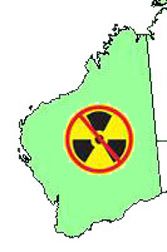 The Battle To Keep WA Uranium Free, An application has been lodged to build WA’s first uranium mine in Wiluna. It’s a shonky proposal and lacks community support. New Matilda.com By Jim Green and Mia Pepper, 13 Sept 11, Toro Energy has submitted an application to build Western Australia’s first uranium mine, at Wiluna, the beginning of WA’s iconic Canning Stock Route.
The debate over the proposed uranium mine has far-reaching ramifications. The construction of WA’s first uranium mine is likely to be the thin edge of the wedge whereas a strong show of public opposition can significantly increase the likelihood of keeping WAuranium-free. That, in turn, is important in the context of the national debate over uranium mining.
The WA Labor Opposition reaffirmed its opposition to uranium mining at its state conference in June. Recent legal advice states that an incoming Labor Government may not need to pay compensation to uranium miners if it wins the 2013 election and reinstates the uranium mining ban lifted by the Barnett Government in 2008.
 The position of anti-uranium Labor Party members has been bolstered by a strong community campaign led by groups such as the WA Conservation Council and the Anti-Nuclear Alliance of WA. The August to October Walk Away From Uranium walk from Wiluna to Perth, organised by Footprints for Peace, is drumming up further support for the anti-uranium cause.
Public opinion also supports a ban on uranium mining in WA and nationally. A poll of 400 voters in four marginal Liberal-held WA seats in April found that 46 per cent opposed uranium mining, with 34 per cent in favour and 20 per cent undecided. The poll also found that among swinging voters, support for uranium mining was only 28 per cent. Voters strongly opposed to uranium mining (32 per cent) exceeded those strongly in support (8 per cent) by a factor of four.
At least two WA uranium projects have been delayed this year. In June, Mega Uraniumdelayed a feasibility study for uranium mining at Lake Maitland, and BHP Billiton put on hold the environmental approvals process for its Yeelirrie uranium project because it did not meet internal standards. The West Australian reported in June that Toro’s Wiluna project “will have to overcome weak investor sentiment in the face of a depressed uranium price and opposition to uranium mining”……
But the greatest problem with uranium mined from Wiluna — or anywhere else — is that in the best-case scenario it will end up as high-level nuclear waste. At worst it will end up as fissile material in nuclear weapons or spewing from a nuclear disaster such as that unfolding in Fukushima, Japan. http://newmatilda.com/2011/09/13/battle-keep-wa-uranium-free
France awaits clarity on explosion at Marcoule nuclear site
the priority was to get the job done – to meet the military imperative of fuel production, to irradiate whatever needed irradiating, without much of a thought about how the facilities would eventually be rendered safe. Marcoule is now dealing with the legacy of radioactive waste that created….

 The French nuclear programme does not have a stellar record of transparency…..What the incident implies for the future of the French nuclear programme is not entirely clear….
Marcoule’s long nuclear history, By Richard Black, BBC News 12 September 2011 The Marcoule site is one of the oldest in France, and played a significant role in the development of the French nuclear and thermonuclear deterrents. It opened in 1956 – well after the US began the era of nuclear armaments, at a time when France was among the nations looking to gain their own seat at the nuclear table. Continue reading
Autralian govt has chosen safer airport scanners, amid claims that all scanners are ineffective
 The local Office of Transport Security has sought to calm health fears by selecting a “millimetre wave” machine (see left) that uses radio waves with an energy level claimed to be comparable to a mobile phone handset held some metres away.
Body scanners can not reliably detect home-made explosives, The Australian, Karen Dearne ,September 13, 2011 TRANSPORT Minister Anthony Albanese was warned by US security advisers that body scanners could not reliably detect home-made explosives before committing to a $28.5 million plan to X-ray international travellers.
With trials of new X-ray imaging technology just concluded at Sydney airport and currently being held in Melbourne, Continue reading
Toro Energy uranium company notorious for peddling lies
 The Battle to Keep WA Uranium Free, New Matilda.com By Jim Green and Mia Pepper, 13 Sept 11, “…..Toro is notorious for peddling junk science. As nuclear radiologist Peter Karamoskoswrote in The Age earlier this year:
“There seems to be a never-ending cabal of paid industry scientific ‘consultants’ who are more than willing to state the fringe view that low doses of ionising radiation do not cause cancer and, indeed, that low doses are actually good for you and lessen the incidence of cancer. Canadian Dr Doug Boreham has been on numerous sponsored tours of Australia by Toro Energy, a junior uranium explorer, expounding the view that ‘low-dose radiation is like getting a suntan’. Toro must have liked what it heard because it made him a safety consultant for the company in 2009.”
As Karamoskos goes on to note, Toro’s claims do not stand up to scrutiny: Continue reading
Solar energy lacks national plan, Australian govt slow to help
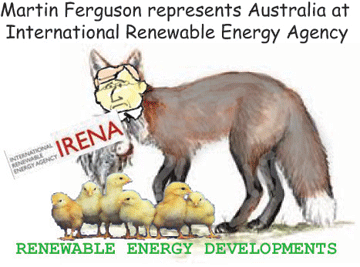 The Australian solar industry is battling to ensure that government support for large-scale development holds up, following a string of setbacks for a rooftop solar sector that has seen subsidies withdrawn or reduced across the nation…..
Australia needs national plan for large solar, says industry, Recharge 13 Sept 11, Australia risks missing its potential in large-scale solar without a stable policy and planning regime to underpin a steady pipeline of projects, the country’s renewables industry association has warned.
Launching its Large-scale Solar Policy Roadmap, Australia’s Clean Energy Council (CEC) calls on the country’s policy-makers to capitalise on the interest the federal government’s A$1.5bn ($1.6bn) Solar Flagships programme has generated among international investors. Continue reading
1 This month

of the week – Australians for War Powers Reform (AWPR)
To see nuclear-related stories in greater depth and intensity
 Antinuclear